Saints and Witnesses
St. Clare of Assisi and the Quiet Power of a Life Given to God
How a 13th century abbess still speaks to Catholics who long for simplicity, courage, and faithful joy
Site Admin | May 12, 2025 | 82 views
A saint whose silence still speaks
St. Clare of Assisi does not attract attention in the way some saints do. She was not a preacher roaming the roads, nor a scholar writing long treatises, nor a missionary crossing seas. Yet her witness endures because it is so unmistakably ordered toward Christ. The St. Clare of Assisi Catholic inspiration that continues to reach the Church is found in her radical trust, her reverence for the Eucharist, and her refusal to measure a life by worldly standards.
Clare lived in the 13th century, in a world shaped by wealth, family honor, and social obligation. Born in Assisi around 1193 or 1194, she came from a noble family, but her heart was drawn elsewhere. After hearing the preaching and example of St. Francis, she chose a path that would astonish her contemporaries. She left behind comfort and status for a life of consecrated poverty, eventually becoming abbess of the Poor Clares, the community she helped establish. Her life was not dramatic in the worldly sense. It was disciplined, hidden, and steady. That is part of why it still matters.
The courage to say yes to Christ
Clare's vocation did not begin with a vague spiritual interest. It began with a concrete response to grace. She recognized that Christ was asking more of her than a respectable religious devotion. He was calling her to belong wholly to Him. In the Gospels, Jesus speaks with the same clarity when He invites the rich young man to sell what he has, give to the poor, and come follow Him go sell what you possess. Clare heard that invitation not as a theory, but as a summons.
For a young woman in her social position, this was a costly decision. She turned from marriage expectations and the security of family standing. Tradition holds that she fled her home to join Francis and his companions, who received her at the Porziuncola. Her family opposed the decision, but Clare would not be persuaded to return to a life she no longer believed was hers to choose. The Church has always honored such courage when it is joined to obedience and discernment. Clare did not reject authority in the name of personal freedom. She submitted herself to Christ, and in that submission she discovered a freedom deeper than social approval.
Poverty as a way of belonging to Christ
One of the most striking features of Clare's life is her attachment to holy poverty. This was not poverty as romantic simplicity or as a lifestyle trend. It was a spiritual choice to depend on God rather than possessions. Clare believed that Christ, who came among us poor and meek, should be followed with undivided heart. Her community sought to live without property, trusting in divine providence. That choice was not easy, and it required repeated defense.
Clare's struggle for the privilege of poverty was not an abstract debate. It was a practical concern about whether her monastery would be shaped by the Gospel or by the comfort of security. The Church eventually recognized the value of her way of life. In Clare's case, poverty was not emptiness for its own sake. It was a form of freedom that made room for prayer, mutual dependence, and joyful detachment. She lived what Jesus taught when He blessed the poor in spirit blessed are the poor in spirit, because she understood that a heart filled with God has less need to cling to everything else.
Catholics today may not be called to the same external poverty, but Clare still exposes the habits that quietly crowd God out. We can become attached to comfort, image, efficiency, or control. Her witness asks whether our homes, schedules, and spending habits leave room for trust. The St. Clare of Assisi Catholic inspiration found here is very direct: holiness often begins when we stop insisting on being self-sufficient.
Her love for the Eucharist
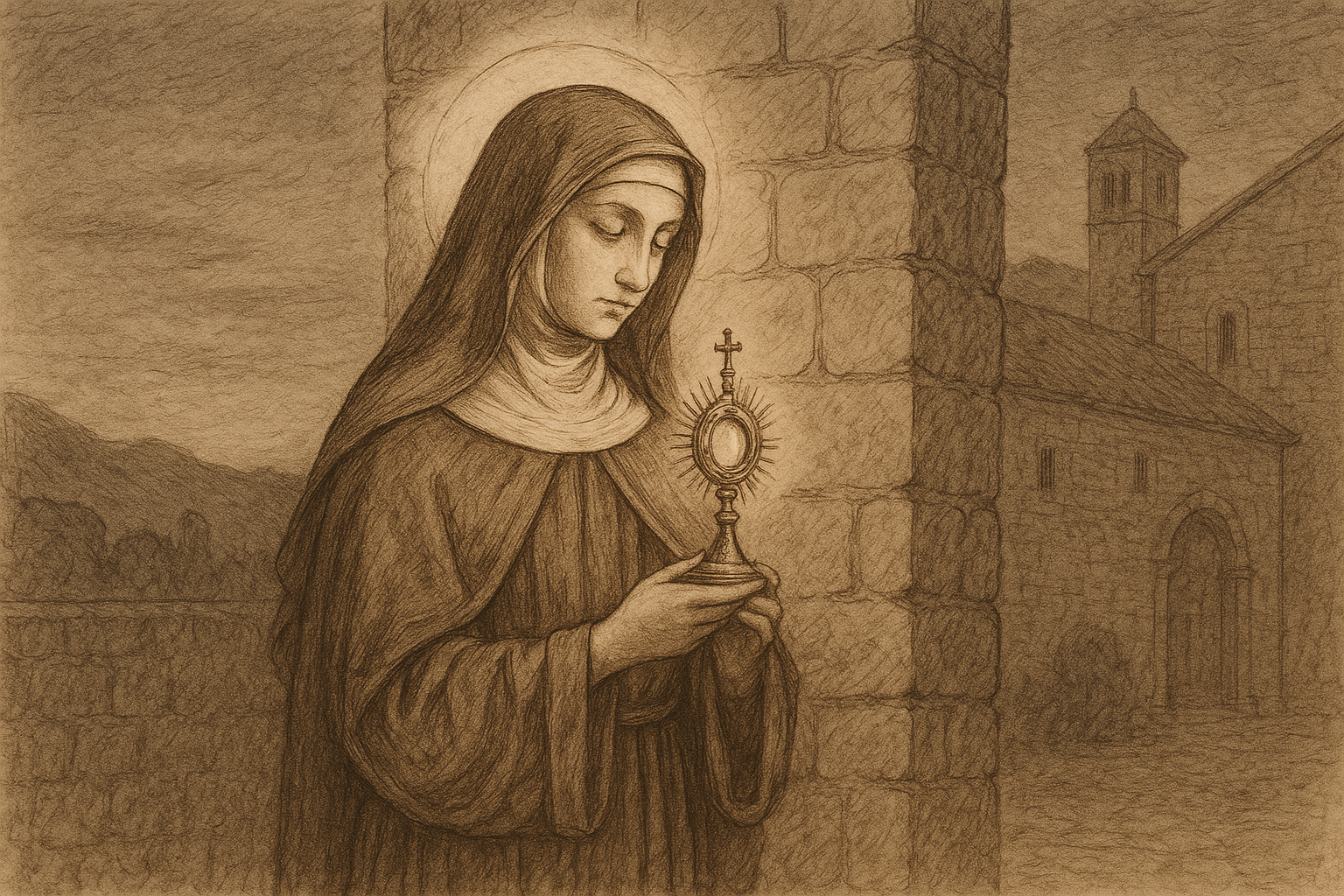
Perhaps the most famous episode in Clare's life is the one remembered for her defense of the Blessed Sacrament. According to the tradition of her life, when armed forces threatened Assisi and her monastery, Clare had herself brought to the wall with the Eucharist and prayed for God's protection. The story has long been treasured because it reveals the center of her faith. Clare trusted not in force, but in the presence of Christ. She placed the Eucharist before danger and asked God to act.
This is not pious decoration around her biography. It is the heart of it. Clare's strength flowed from adoration, from hidden communion with the Lord, from the certainty that Christ was near in the sacrament of His Body and Blood. The Psalmist's cry becomes her own: One thing have I asked of the Lord, that will I seek after one thing have I asked of the Lord. For Clare, that one thing was Christ Himself.
Her devotion remains especially instructive for Catholics who are tempted to treat the Eucharist as routine. Clare reminds the Church that the Blessed Sacrament is not a symbol among symbols. It is the living Lord, worthy of reverence, confidence, and love. A woman who spent much of her life within cloister walls still speaks loudly to a distracted age because she knew where true power is found. Her faith was Eucharistic before that word became a common theme in modern Catholic speech.
A woman of hidden strength
Clare spent decades in a cloister, and some may wonder how such a hidden life could still inspire the Church so widely. Yet the saints often reveal that hiddenness is not the same as insignificance. Clare's strength was not public performance. It was the strength of fidelity. She remained steadfast through illness, poverty, and the daily demands of monastic life. She was abbess for many years, giving her sisters a pattern of prayer, discipline, and charity.
Her hiddenness mirrors the Lord she served. Jesus Himself often withdrew to pray, and He taught that what is done in secret is known to the Father pray to your Father who is in secret. Clare's life was a school of that hiddenness. She shows that holiness does not depend on visibility. It depends on communion with God and the willingness to let that communion shape every other choice.
This is especially relevant in a culture that rewards display. Many people now feel pressure to be noticed, measured, and affirmed. Clare offers a different horizon. She suggests that a life can be fruitful even when it is not widely seen. The Church remembers her not because she sought influence, but because she sought Christ. That is why her witness remains fresh.
What her holiness asks of ordinary Catholics
Clare's life was extraordinary, but its lessons are surprisingly concrete. Catholics do not need to enter cloistered life to learn from her. Her example touches daily realities: how we use money, how we respond to fear, how we pray, and how we order our desires. She reminds us that sanctity is not reserved for the naturally heroic. It is a response to grace lived one faithful step at a time.
Here are a few ways her witness can speak to everyday Catholic life:
- Practice detachment. Clare encourages us to examine what we cling to most tightly and whether it helps or hinders prayer.
- Honor the Eucharist. Frequent Mass, reverent reception, and adoration become more meaningful when we remember Clare's love for Christ present in the sacrament.
- Choose simplicity. Simplicity is not about deprivation alone. It can create space for prayer, generosity, and peace.
- Trust God's providence. Clare's life shows that fear lessens when the heart is rooted in Christ.
- Value hidden faithfulness. Small acts of fidelity, repeated over time, are not wasted in the eyes of God.
These lessons do not feel outdated because they are not tied to a single era. They arise from the Gospel itself. Clare lived them with uncommon clarity. For that reason, she is still more than a historical figure. She is a companion in the pursuit of holiness.
The beauty of a life that points beyond itself
Clare died in 1253, after years of illness and prayer. Her final days were marked by the same hope that shaped her whole life. The Church soon recognized her sanctity, and she was canonized only two years later, in 1255. That swift recognition reflects how clear her witness already was to those who knew her story. She had become a sign of what happens when a human life is entirely reordered around Christ.
There is a particular beauty in saints like Clare. They do not dominate the Church's imagination by force of personality. Instead, they direct attention away from themselves. They become luminous by participation in the Lord's own light. Clare's life teaches that the Church does not need Christians who merely admire holiness from a distance. It needs men and women who allow grace to reshape their desires, habits, and fears.
The St. Clare of Assisi Catholic inspiration remains strong because so many people still hunger for exactly what she found: peace without pretense, joy without superficiality, and strength without self-assertion. In a restless age, her witness is a quiet summons to begin again with Christ.
Her life invites every Catholic to ask a simple but searching question: what would change if I trusted Jesus as completely as Clare did? That question does not have to be answered all at once. It can begin in prayer, in repentance, in one act of generosity, in one act of Eucharistic reverence, in one refusal to let fear rule the day. Clare's holiness began that way too, and it still shines because it was never her own. It was always a reflection of Christ.
Keep Reading on Lets Read The Bible
Frequently Asked Questions
Why is St. Clare of Assisi important to Catholics today?
St. Clare remains important because she shows how radical trust in Christ can reshape an entire life. Her witness speaks to Catholics who want simplicity, courage, and deeper devotion to the Eucharist.
What is St. Clare best known for?
St. Clare is best known for founding the Poor Clares with St. Francis of Assisi, for her commitment to holy poverty, and for her deep love of the Blessed Sacrament.
How can Catholics follow St. Clare's example in daily life?
Catholics can follow her by practicing detachment, honoring the Eucharist, simplifying their lives, and trusting God's providence in ordinary decisions.