Saints and Witnesses
St. Francis of Assisi and the Beauty of a Life Made Small
How the poverello of Assisi still teaches Catholics to trust Christ, love the poor, and live with freedom of heart.
Site Admin | May 10, 2025 | 75 views
A saint who still feels close
Few saints are as widely known, and yet as easily misunderstood, as St. Francis of Assisi. Many people remember him for birds, peace, and simplicity. Catholics remember those things too, but we also remember something deeper: a man so taken up by Christ that everything else in his life was gradually put in its proper place.
That is part of why St. Francis of Assisi Catholic inspiration continues to endure. He was not trying to create a spiritual brand or a pleasant mood. He was responding to a living encounter with the Lord. His life shows what happens when a person allows the Gospel to become concrete, costly, and joyful all at once.
Francis was born in Assisi in the late 12th century and died in 1226. He came from a prosperous family, knew the ambitions of a young man shaped by commerce and social standing, and then underwent a conversion that changed the direction of his life. The Church would later recognize in him not only a saint of personal holiness, but also a witness to the beauty of evangelical poverty, peace, and fraternity.
What changed in Francis
Francis did not begin as an austere hermit. He enjoyed status, clothing, and the promise of success. Yet during a period of illness, imprisonment, and spiritual unrest, he began to hear the Lord calling him to a different path. Over time, he abandoned the security of wealth and embraced a life marked by simplicity and trust.
One of the most famous moments in his story came when he publicly renounced his inheritance before the bishop of Assisi. The gesture was dramatic, but it was not performed for drama. It marked his refusal to let money, family expectation, or social prestige define his identity. He wanted to belong wholly to Christ.
That kind of conversion can sound extreme until we remember that the Gospel itself is extreme in the most beautiful sense. Jesus says,
If any man would come after me, let him deny himself, and take up his cross daily, and follow me.Francis took those words seriously. He did not merely admire them. He tried to live them.
Poverty that was never just poverty
When Catholics speak about Francis, poverty is often the first theme that comes to mind. But his poverty was never about misery for its own sake. It was a chosen freedom. It was an act of trust in divine providence and a protest against the false security that wealth can offer.
Francis believed that the Lord had become poor for our sake, and he wanted to follow that same path of self-emptying love. In this, he reflected the apostolic witness that Christ,
Though he was rich, yet for your sake he became poor, so that by his poverty you might become rich.
That line from St. Paul helps explain why Francis still matters. He did not treat poverty as a political slogan or an economic theory. He treated it as a spiritual condition of the heart. The poor in spirit are those who know they depend on God. Francis wanted that dependence to shape every part of his life, from the clothes he wore to the way he related to other people.
His witness asks Catholics a difficult but necessary question: What do we cling to when we feel unsafe? Francis answers not with an argument, but with a life. He teaches that detachment is not a loss when it makes room for greater love.
Joy, repentance, and the freedom to begin again
Francis is often associated with gentleness, and rightly so. But his gentleness came from repentance. He knew he was a sinner in need of mercy, and he never lost sight of that fact. His spiritual life was not about self-improvement in a modern sense. It was about conversion.
That is important for Catholics because holiness can be mistakenly imagined as polished and effortless. Francis was not polished. He was a penitent. And yet his penance did not make him dour. It made him free. He discovered that the more fully a person belongs to God, the more deeply that person can rejoice.
There is a line from the Psalms that captures something of his spirit:
O taste and see that the Lord is good!Francis had tasted that goodness. His joy was not denial of suffering. It was the fruit of communion with Christ.
For Catholics today, this is one of the strongest reasons his witness remains persuasive. We often think we must choose between seriousness and joy, sacrifice and happiness, truth and tenderness. Francis shows that in Christ these realities belong together. The saint who stripped himself of wealth was not impoverished in soul. He became spacious enough to receive God's gifts with gratitude.
His love for creation came from love of the Creator
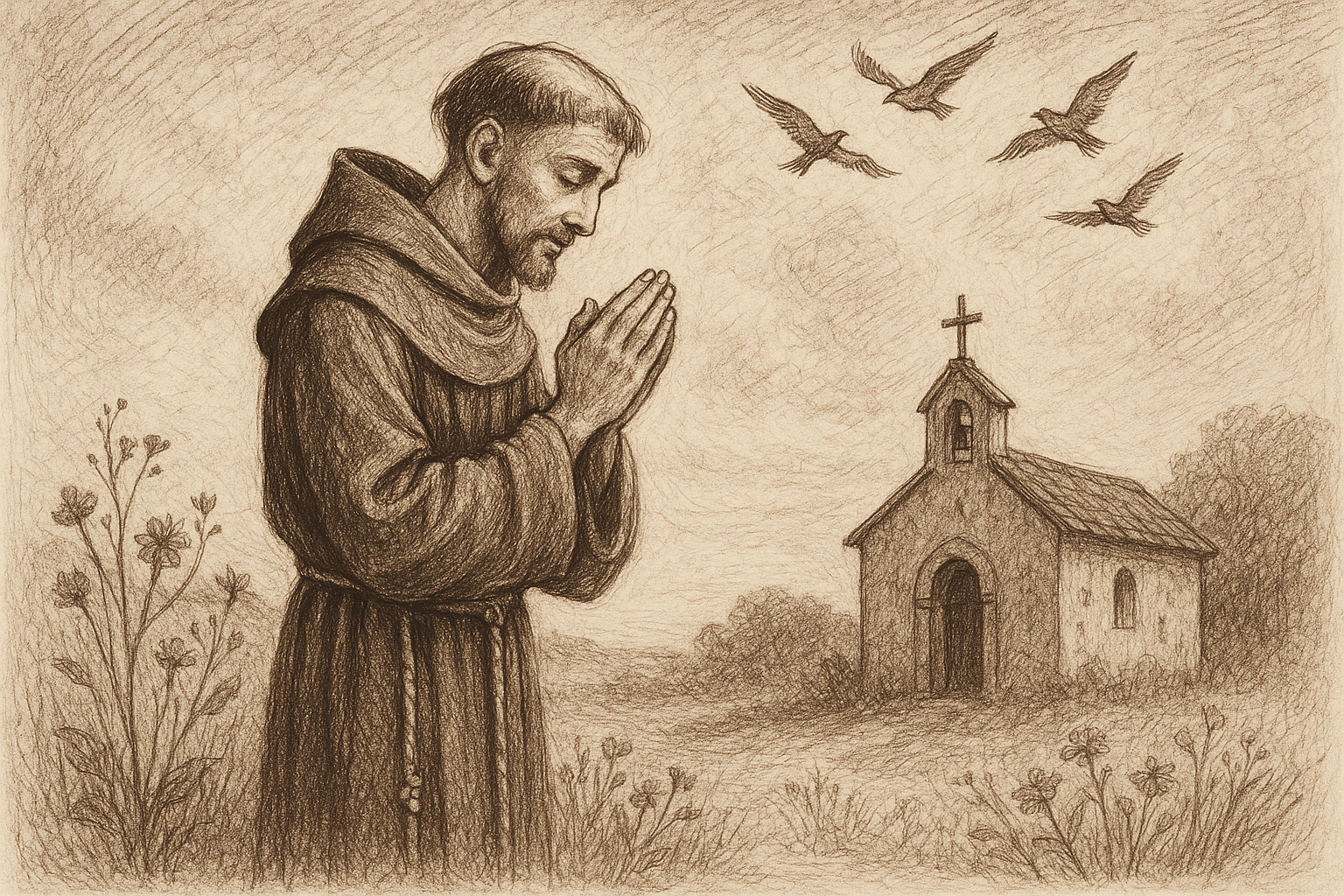
Francis is beloved as a saint of creation, and that devotion is well grounded. He saw the world not as a possession to exploit, but as a gift to receive with praise. His famous Canticle of the Creatures expresses that outlook by treating sun, moon, wind, water, and even bodily death as signs pointing back to God.
Still, it is important not to flatten Francis into a modern environmental symbol. His love of creation was never separated from worship. He praised the works of God because he adored the God who made them. Creation mattered because it was not God, and therefore could only be appreciated rightly when received in thanksgiving.
This is a profoundly Catholic instinct. The world is sacramental in the broad sense. Material things can point beyond themselves to divine beauty. Francis saw that clearly. He recognized that the same Lord who feeds the birds also feeds the soul, and the same Father who clothes the lilies is the Father who cares for His children.
In a culture tempted either to exploit nature or sentimentalize it, Francis offers a third way: reverence. He teaches Catholics to look at the world with gratitude, restraint, and wonder.
The saint of peace, but not cheap peace
Francis is also remembered as a peacemaker. That memory is fitting, but it should be understood in a Christian way. Peace for Francis was not merely the absence of conflict. It was reconciliation rooted in truth, humility, and conversion.
The peace of Christ is deeper than politeness. It requires surrender to God and charity toward neighbor, especially when it is difficult. Francis spoke to the violent, served lepers, and crossed social boundaries that others would have avoided. His peace had a cost.
That makes his witness especially relevant today. Many people want peace without repentance, harmony without sacrifice, and unity without conversion. Francis reminds us that authentic peace begins when pride is broken and the heart is turned toward Christ.
His example also helps Catholics remember that evangelization is not just about winning arguments. It is about becoming a person in whom the Gospel can be seen. Francis preached, but he also embodied. His life itself was a message.
Why Catholics keep returning to Francis
There are many reasons St. Francis still inspires Catholics, but three stand out.
- He makes holiness look possible. Francis was radical, but he was also human. His conversion was real, gradual, and costly. He reminds us that saints are not made from a different substance. They are made by grace.
- He exposes false security. Francis shows how easily comfort, reputation, and possession can become spiritual obstacles. He invites Catholics to ask what kind of freedom we actually want.
- He unites love of God and love of neighbor. His care for the poor, the sick, and creation all flowed from adoration. He did not separate devotion from action.
Francis also remains attractive because his witness is both simple and demanding. He did not write an abstract theory of discipleship. He lived a visible answer to Christ's call. That is why people across generations continue to return to him, even when they cannot imitate every detail of his vocation.
What his witness asks of Catholics now
It is easy to admire Francis from a distance. It is harder to let him disturb us in productive ways. Yet that may be exactly what a saint is meant to do.
His life asks whether we are willing to trust God without first securing every outcome. It asks whether we can live more simply in a world built on excess. It asks whether we see the poor as interruptions or as brothers and sisters. It asks whether our reverence for creation is matched by reverence for the Creator. And it asks whether our love of Christ is visible enough to reshape our habits.
None of this means every Catholic should copy Francis's exact manner of life. Most people are called to marriage, work, family responsibility, and ordinary stability. But Francis is not important because he offers a model to imitate mechanically. He is important because he reveals a direction: toward Christ, with less of self and more of God.
That is the heart of his enduring appeal. He did not become great by seeking greatness. He became small enough to be filled with God's love. In that sense, his life remains one of the clearest witnesses to the Gospel the Church has ever known.
When Catholics ask why St. Francis still matters, the answer is not complicated. He shows that a life surrendered to Jesus can become free, radiant, and fruitful. That is a message the Church never outgrows.
Keep Reading on Lets Read The Bible
Frequently Asked Questions
What is St. Francis of Assisi best known for in the Catholic Church?
He is best known for his radical poverty, love of Christ, care for the poor, reverence for creation, and witness to joyful repentance. He is also the founder of the Franciscan family of religious communities.
Did St. Francis hate wealth?
No. Francis did not hate material things in themselves. He rejected attachment to wealth and status when they threatened his freedom to follow Christ. His poverty was a spiritual choice, not a condemnation of created goods.
Why do Catholics still look to St. Francis for inspiration today?
Catholics return to Francis because his life shows that holiness can be simple, joyful, and deeply rooted in the Gospel. He still challenges believers to trust God more fully, love the poor, and live with greater reverence for creation.