Saints and Witnesses
St. Thomas Aquinas and the Quiet Strength of a Mind Given to Christ
A faithful look at the life, prayer, and lasting witness of the Angelic Doctor
Site Admin | May 15, 2025 | 71 views
A saint whose mind served his faith
St. Thomas Aquinas remains one of the most important figures in Catholic history because he joined two things that are often separated in modern life: serious thought and deep devotion. The St. Thomas Aquinas life is not the story of a detached scholar who happened to be religious. It is the story of a man who wanted every part of his mind to belong to Christ. His theology was not an escape from prayer. It grew from prayer.
Born around 1225 at Roccasecca in Italy, Thomas came from a noble family and was sent as a child to study first at Monte Cassino and later at the University of Naples. Even in his youth, he showed a strong attraction to learning. At Naples he encountered the Dominican Order, whose combination of preaching, study, and poverty deeply impressed him. Thomas chose the Dominicans, a decision that disturbed his family, who hoped for a more prestigious ecclesiastical path. His choice would shape the rest of his life.
That early conflict already reveals something important about sanctity. A saint is not always a person who receives universal approval. Sometimes holiness begins by following a call that others do not understand. Thomas did not become great by chasing status. He became great by surrendering his future to God.
Formation, resistance, and the making of a Dominican
After entering the Dominican Order, Thomas was sent to study in Paris and Cologne, where he came under the influence of St. Albert the Great. Albert recognized his student's gifts, even though Thomas was quiet and, by some accounts, physically imposing yet reserved. Fellow students are said to have called him the dumb ox because of his silence. Albert reportedly replied that the ox would one day fill the world with his bellowing, a remark that later seemed more prophetic than witty.
Thomas was ordained a priest and began teaching theology. He lived in an age when the works of Aristotle were becoming more widely available in the Latin West, and many Christians were unsure how to receive them. Thomas did not reject reason. He brought reason into service of revelation. He believed that truth is one, because God is the source of all truth. Therefore, what is truly discovered by human reason cannot ultimately contradict what God has revealed.
That conviction made his work both daring and practical. He showed that faith is not fragile. It does not fear honest inquiry. Instead, faith can purify and elevate reason, while reason can help explain what faith already holds. This is one reason Thomas continues to matter in Catholic life. He offers a way of thinking that refuses both credulity and skepticism.
The Summa and the disciplined search for truth
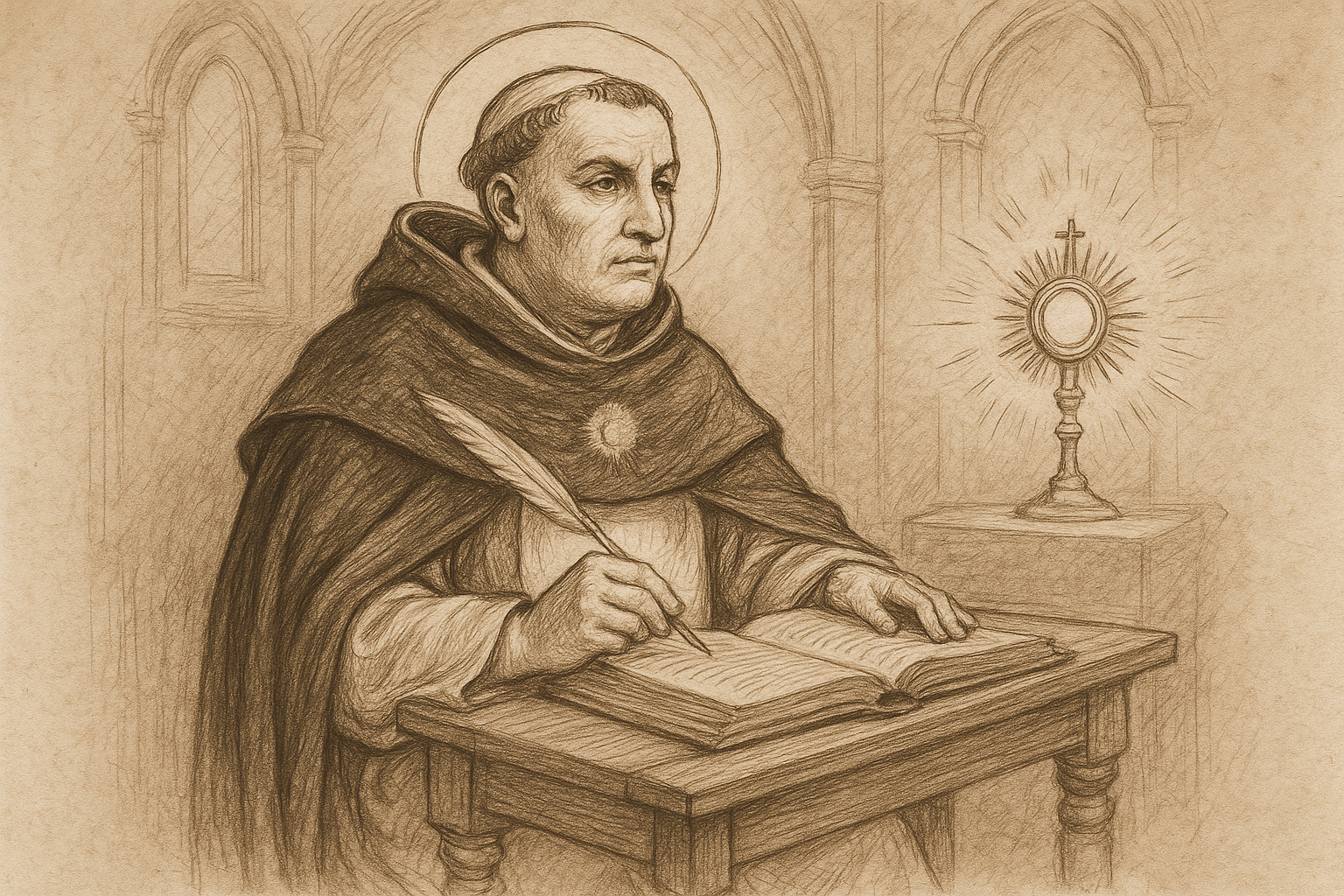
Thomas wrote with extraordinary clarity and order. His most famous work, the Summa Theologiae, was never completed, yet it became one of the most influential theological works in the history of the Church. Its structure itself teaches something spiritual. Thomas begins with God, then moves through creation, the human person, virtue, grace, Christ, the sacraments, and the life to come. In other words, he did not see theology as a collection of isolated ideas. He saw it as a whole vision ordered toward God.
The Summa is known for its careful method. Thomas states objections, gives a reasoned response, and then answers the objections. This style can seem almost austere, but it reflects a deep moral seriousness. He did not want to win arguments for their own sake. He wanted to clarify what is true. In that sense, his work is a form of service.
One of Thomas's great gifts is his insistence that grace perfects nature rather than destroying it. Human abilities, when purified and healed by God, are not discarded. They are fulfilled. This is deeply Catholic. It means that intellect, memory, discipline, friendship, vocation, and even ordinary daily habits can all become places where God works. Nothing genuinely human is wasted when offered to Him.
His teaching also helped the Church articulate the harmony between Scripture, philosophy, and sacred doctrine. He leaned on Scripture constantly, and his theological insight remained rooted in the Church's living tradition. He was not inventing a private religion. He was serving the Church's understanding of the faith once delivered to the saints, within the living body of Catholic teaching.
Prayer before study, and study before God
Thomas is often remembered for his intellect, but his intellectual life cannot be separated from prayer. Catholic tradition preserves hymns and prayers attributed to him, especially for the feast of Corpus Christi, among them the sequence Pange Lingua and the eucharistic hymn Adoro Te Devote. Whether one knows every line or not, the tone is unmistakable: worship, wonder, humility, and love for the Eucharist.
This matters because Thomas never treated the Eucharist as an idea to explain only. It was a mystery to adore. In his theology, Christ is present truly and really in the Blessed Sacrament. He approached that truth with reverence. His intellect bowed before the Lord he served.
That balance between thought and adoration offers an enduring lesson. Catholics can be tempted to separate prayer from study, as if only one of them were spiritually serious. Thomas lived otherwise. He studied because he loved God, and he prayed so that his study would remain faithful. His example encourages anyone who serves in catechesis, preaching, teaching, writing, or even ordinary family religious life. Knowledge in the Church should lead to greater love, and love should deepen understanding.
Before the Lord, Thomas did not appear as a conqueror of mysteries, but as a servant who knew how to kneel before them.
A life marked by obedience and travel
Thomas spent much of his mature life moving between major centers of learning and service. He taught in Paris, worked in Italy, and was often called upon to settle disputes or guide students. Even after he had become widely respected, he remained bound by the demands of Dominican obedience. He was not an independent religious celebrity. He was a friar under vows.
That obedience is easy to overlook when reading his works. Yet it shaped his holiness. Thomas accepted assignments, returned to study, taught publicly, and kept working with remarkable steadiness. His life did not seem dramatic in the worldly sense, but it was fruitful. He wrote, preached, and taught in ways that would continue to influence the Church for centuries.
He also labored in a period of intense intellectual ferment. Questions about Aristotle, the nature of knowledge, the relationship between faith and reason, and the interpretation of Christian doctrine were not abstract puzzles. They affected the Church's life and witness. Thomas approached these questions with patience. He trusted that truth need not fear time.
His patience is itself instructive. Many Catholics today live in an age of instant reaction, short attention spans, and public argument. Thomas offers another path. He teaches that a disciplined mind can be calm, and that calmness is not indifference. It is confidence in the Lord who is truth.
The mystical end of a great teacher
In the final year of his life, Thomas experienced something that changed his writing. After a profound mystical experience, he reportedly stopped work on the Summa Theologiae, saying that all he had written seemed like straw in comparison to what had been revealed to him. Whatever precise form that experience took, the Church has long remembered it as a sign of his humility before the mystery of God.
This does not mean his previous work became useless. Rather, it shows that even the greatest theological achievement remains partial in the face of divine glory. Thomas was not abandoning truth. He was confessing that every human attempt to speak of God remains limited. The more faithfully a theologian speaks, the more clearly he knows that God surpasses all speech.
Thomas died in 1274 while traveling to the Second Council of Lyons. He was later canonized and eventually declared a Doctor of the Church. His thought came to influence generations of seminarians, priests, religious, and lay Catholics. Yet the title that suits him best is perhaps still the one he received from tradition: the Angelic Doctor. It suggests both the clarity of his teaching and the purity of his aim.
What Catholics can carry from his example
The life of St. Thomas Aquinas offers more than admiration. It offers a pattern for Catholic discipleship today.
- Let truth shape your habits. Thomas did not separate belief from disciplined study. Catholics can ask whether their reading, listening, and thinking are leading them closer to Christ.
- Trust that faith and reason belong together. A Catholic does not need to choose between loving God and asking hard questions. Thomas shows that careful thought can be an act of reverence.
- Keep prayer at the center. His theological brilliance was rooted in adoration. Without prayer, knowledge can become pride. With prayer, it becomes service.
- Accept hidden obedience. Much of Thomas's life was spent in assignments that were not glamorous. Holiness often grows through ordinary fidelity rather than public recognition.
- Hold learning with humility. Even after decades of writing, Thomas recognized the limits of human language before God. That humility remains essential for every Catholic who teaches, studies, or speaks about the faith.
For Catholics today, St. Thomas Aquinas is not only a patron of schools and seminaries. He is a reminder that the Christian life asks the whole person. The heart must love, the will must choose, and the mind must be converted as well. When intellect is offered to God, it does not become less human. It becomes more fully alive.
His witness endures because it is balanced, quiet, and serious. Thomas did not build a spiritual reputation on emotion or novelty. He built it on fidelity, prayer, and truth. That is why the Church still listens to him, and why his life continues to point beyond itself to Christ, in whom all wisdom finds its peace.
Keep Reading on Lets Read The Bible
Frequently Asked Questions
Why is St. Thomas Aquinas called the Angelic Doctor?
He is called the Angelic Doctor because of the clarity and depth of his theology, as well as the tradition's sense that his teaching reflects a special purity of mind and purpose in service to God.
What is St. Thomas Aquinas best known for?
He is best known for the Summa Theologiae, his major theological work, and for his lasting influence on Catholic thought about faith, reason, grace, virtue, and the sacraments.
Did St. Thomas Aquinas have a mystical experience near the end of his life?
Catholic tradition says that after a profound mystical experience, he stopped writing and said his work seemed like straw compared with what had been revealed to him. This is understood as a sign of humility before the mystery of God.