Saints and Witnesses
A Saint Who Teaches the Church How to Pray
St. Teresa of Avila shows that prayer is not escape from the world but a path into deeper communion with Christ.
Site Admin | May 20, 2025 | 88 views
A Doctor of the Church with the heart of a pilgrim
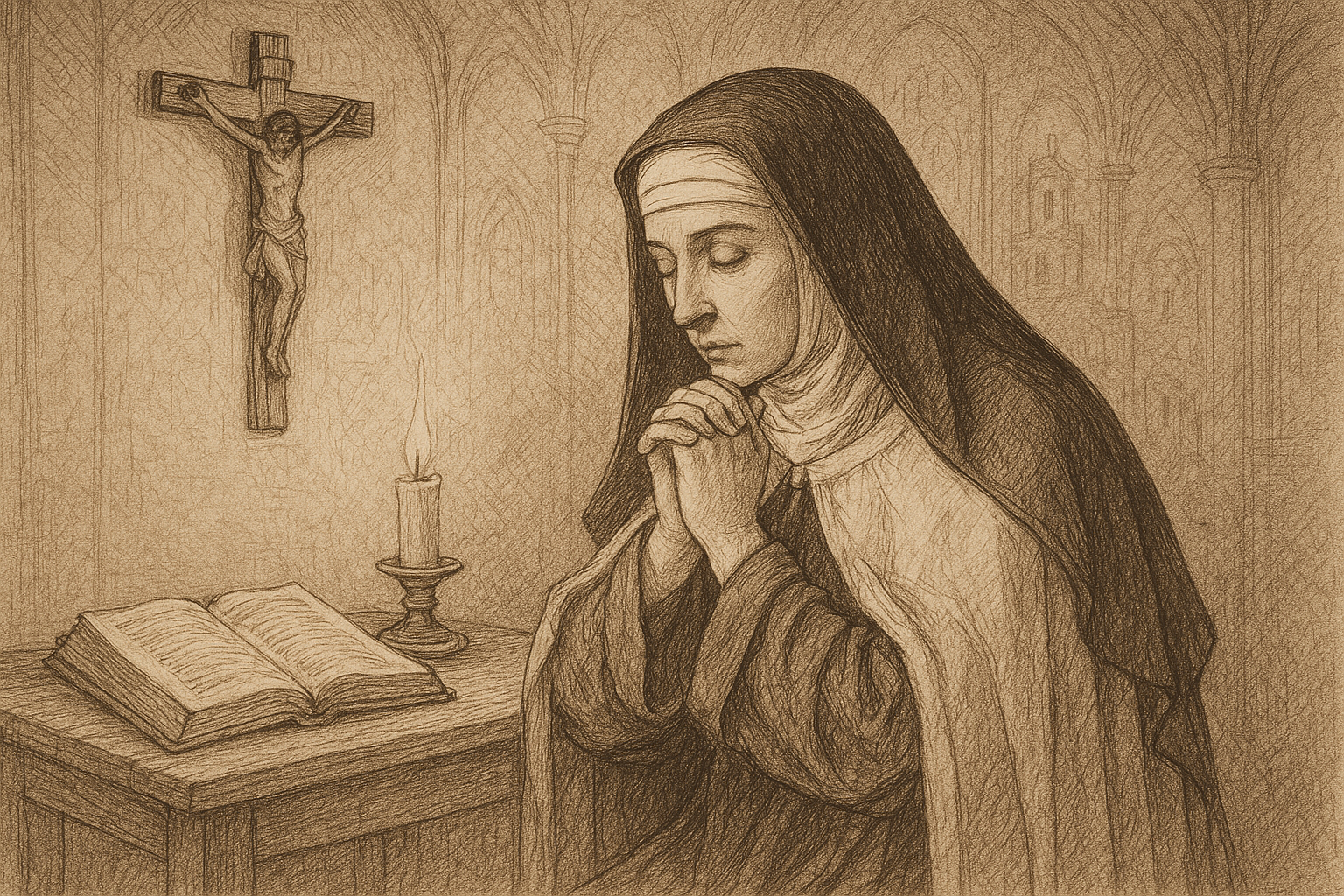
St. Teresa of Avila continues to speak to Catholics because she was neither abstract nor sentimental about prayer. She knew the long road of the interior life, the distractions of daily duties, the burdens of weak health, and the cost of pursuing reform in a resistant age. Born in 1515 in Avila, Spain, Teresa entered the Carmelite Order and eventually became one of the great saints of the Counter-Reformation. Yet what still draws people to her is not only her place in history. It is the clarity with which she describes the journey of the soul toward God.
Teresa did not begin as a finished saint. She struggled for years with divided attention, illness, and a restless desire for God that had not yet found its full shape. Her witness matters because many Catholics recognize something of themselves in that condition. We want to pray, but we are distracted. We want to be faithful, but we are slow. We want to love Christ more deeply, but our habits and fears keep pulling us elsewhere. Teresa speaks to that very human landscape with realism and confidence.
Her legacy is especially rich for anyone seeking St. Teresa of Avila Catholic inspiration today. She reminds the Church that holiness is not reserved for the effortlessly devout. It is formed through grace, perseverance, and a steady return to God.
Prayer as friendship, not performance
Teresa is famous for describing prayer as an intimate sharing between friends, but that insight is not a decorative line. It is a theology of the spiritual life. Prayer is not first of all about impressing God, collecting religious feelings, or producing spiritual accomplishments. It is a living relationship with Christ, grounded in trust and sustained by love.
This matters because many people approach prayer as if it were a test to pass. Teresa quietly corrects that mistake. To pray is to make time for the One who already knows us, loves us, and invites us deeper. In that sense, prayer is both simple and demanding. It is simple because God is near. It is demanding because friendship requires honesty, attention, and fidelity.
Teresa also helps Catholics understand that dryness in prayer does not automatically mean failure. Spiritual growth is often hidden. The soul may feel silent while God is at work. Teresa knew this by experience, and her writing gives comfort to those who have wondered whether prayer matters when it feels empty. For her, the answer was yes. Prayer matters because God is faithful, even when our senses are not.
The interior castle and the path inward
Teresa's best known spiritual image is the Interior Castle, her great work on the soul. She presents the soul as a castle with many rooms, with the center dwelling place belonging to God. The image is elegant, but it is also practical. The Christian life is not just about external behavior. It is about the gradual purification of the heart so that God may dwell more fully within us.
That vision feels especially important in a distracted age. Catholics today live amid noise, constant images, and endless claims on attention. Teresa's spirituality does not ask us to despise the world. It asks us to order the self before God. The more interiorly attentive a person becomes, the more freely that person can love, serve, and discern.
Her metaphor also suggests a hopeful truth: the soul is not a wasteland but a place of divine presence. Even when a person feels fragmented, grace can gather the heart. Even when prayer is weak, God can work within it. Teresa's confidence in the soul's hidden depth remains one of her greatest gifts to the Church.
Reform that began in prayer
Teresa is remembered not only for prayer but for reform. She helped renew the Carmelite Order by returning it to greater simplicity, poverty, silence, and contemplative discipline. She founded monasteries and faced misunderstanding, resistance, and practical hardship. Her reforms were not driven by ambition. They were born from a conviction that communities devoted to God must make room for recollection, humility, and fidelity.
This is where her witness becomes particularly Catholic. Reform in the Church is healthiest when it begins on the knees, not in the ego. Teresa did not treat prayer as an escape from ecclesial responsibility. She saw prayer as the source of reform. A life centered on Christ becomes capable of renewal because it is no longer ruled by fear or vanity.
Her example is a needed correction for any age that prefers quick fixes. Deep renewal takes time. It requires patient obedience, sound judgment, and the courage to continue when results are not immediate. Teresa knew that the Church is renewed not only by grand public gestures but by hidden fidelity in monasteries, parishes, homes, and ordinary lives.
Human weakness does not cancel holiness
One reason Teresa remains so beloved is that she did not write as though holiness were easy. She was frank about her weaknesses and about the complexities of spiritual progress. Her honesty makes her credible. She did not pretend to be untouched by struggle. Instead, she let grace illuminate the struggle.
That is an encouraging pattern for Catholics who feel unworthy or inconsistent. The saints are not proof that strong people become holy by their own power. They are proof that God can sanctify real human beings, including those who begin slowly. Teresa's life shows that perseverance is often more important than spiritual drama. A soul may move forward through small acts of trust repeated over time.
This is one of the deepest reasons her witness still inspires. She did not present the spiritual life as a pageant of flawless intensity. She presented it as friendship with Christ lived amid weakness, service, and reform. That is a much more realistic and therefore more hopeful vision.
What Catholics can learn from Teresa's courage
Teresa lived in a Church and a culture marked by real pressure, and she did not avoid difficulty. She traveled, founded communities, wrote, governed, and endured criticism. Her courage was not a personality trait alone. It was rooted in trust in God. She believed that the Lord asks more of the soul than comfort, and that grace gives the strength to answer.
That courage speaks powerfully to Catholics who are trying to live their faith with integrity in a complicated world. Sometimes courage means speaking the truth. Sometimes it means remaining faithful in hidden duties. Sometimes it means continuing prayer when one feels spiritually dry. Teresa's life suggests that courage and contemplation are not opposites. The person who spends time with God is often the one best able to act with peace.
Her witness also highlights the importance of spiritual guidance and discernment. Teresa valued obedience, tested experiences carefully, and sought to remain within the Church. For Catholics today, that balance matters. Authentic spirituality is not self-invention. It is growth in communion with Christ and His Church.
A saint for those who are learning to begin again
Many believers find St. Teresa of Avila Catholic inspiration precisely because she teaches the grace of beginning again. Not every day is spiritually bright. Not every prayer is easy. Not every resolution lasts. Teresa understands that reality, and she does not despair over it. Instead, she shows that a soul can return to God again and again, each time with renewed humility.
Her life invites Catholics to see prayer as something that can slowly re-form the whole person. When the heart turns inward toward Christ, it becomes less scattered. When a community turns toward prayer, it becomes more faithful. When a Church remembers that reform must be rooted in holiness, it becomes more alive to the Spirit.
For that reason, Teresa is more than a figure of historical devotion. She is a living witness to the fact that God still calls ordinary people to extraordinary intimacy. Her words and her life continue to tell the Church that prayer is not a retreat from reality. It is the place where reality becomes clearer in the light of Christ.
If Catholics today return to Teresa with patience, they will find not a distant spiritual monument but a companion for the road. She teaches that the soul belongs to God, that prayer can transform weakness into offering, and that the quiet work of holiness is still the surest renewal the Church can know.
Scripture passages that harmonize with Teresa's witness
Teresa's teaching on prayer and interior renewal resonates with the biblical call to seek God with a whole heart. Jesus invites His disciples to remain in Him, just as He remains in them: Remain in me. The psalmist prays, My soul thirsts for God, the living God: My soul thirsts for God. And St. Paul reminds believers that God can strengthen the inner person: Strengthened in the inner man.
Taken together, these verses echo Teresa's conviction that the deepest Christian life is hidden in communion with God. The saints do not replace Scripture. They help the Church hear Scripture with renewed seriousness and love.
Teresa's voice remains clear because it is simple at its core: pray, trust, remain, and let God lead the soul inward toward Himself. That counsel has not aged, and it still meets Catholics exactly where they are.
Keep Reading on Lets Read The Bible
Frequently Asked Questions
Who was St. Teresa of Avila in Catholic history?
St. Teresa of Avila was a 16th century Carmelite nun, mystic, reformer, and Doctor of the Church. She is remembered for her writings on prayer, her reform of Carmelite life, and her lasting influence on Catholic spirituality.
Why is St. Teresa of Avila important for Catholic prayer today?
She teaches that prayer is a friendship with Christ and that interior silence, honesty, and perseverance matter more than religious performance. Her teaching helps Catholics who struggle with distraction, dryness, or discouragement in prayer.
What is the Interior Castle in St. Teresa of Avila's teaching?
The Interior Castle is Teresa's image of the soul as a castle with many rooms, with God dwelling at the center. It describes the journey inward through prayer, purification, and growing union with God.