Sacraments and Liturgy
Bring a Listening Heart: Lectio Divina Before and After Mass
Lectio divina explained through its monastic roots, four traditional movements, and place in a Catholic life shaped by the liturgy.
Site Admin | September 14, 2026 | 23 views
Sometimes a sentence from Sunday's Gospel stays with us long after Mass. We remember it while washing dishes, driving home, or facing a conversation we would rather avoid. Instead of passing quickly to the next thought, we can return to that sentence, read its setting, and bring it before the Lord. That simple act opens onto the practice Catholics call lectio divina.
The Latin expression means divine reading or sacred reading. It describes a prayerful encounter with God through Scripture: reading attentively, reflecting on what we have heard, answering God in prayer, and remaining quietly in his presence. It belongs naturally within a Catholic life nourished by the sacraments, although it is not itself a sacrament or a substitute for the liturgy.
A practice rooted in the Church's listening
Lectio divina did not begin as a modern program for personal improvement. Its roots lie in the Church's earliest habits of receiving Scripture as God's word, pondering it, and allowing it to shape daily life. Early Christian teachers and the desert fathers and mothers cultivated close attention to the biblical text. Monastic communities gave this reading a stable place within lives ordered around prayer and work.
The Rule of Saint Benedict, written in the sixth century, assigns substantial time to sacred reading. Centuries later, the twelfth-century Carthusian monk Guigo II described four connected movements in his work commonly known as The Ladder of Monks: reading, meditation, prayer, and contemplation. He did not invent prayerful reading, but his account gave enduring expression to its pattern.
This inheritance is not reserved for monasteries. The Second Vatican Council's Dei Verbum, especially section 25, encourages the faithful to read Scripture and teaches that prayer should accompany that reading. The Catechism likewise presents meditation on Scripture as a path toward making the mysteries of faith our own and responding to God in love.
The essential conviction is straightforward: God's word is given not only to inform us, but to draw us into communion with him. We read to receive what God has revealed, not to manufacture a private message detached from the Church's faith.
Listening with the whole Church
At Mass, Scripture is proclaimed within the worship of the Church. We do not gather merely to hear religious literature. Christ speaks to his people through the Scriptures, and the proclaimed word prepares us to participate more deeply in the Eucharistic sacrifice and receive its fruits.
Personal lectio divina can prepare us for that public, communal listening. Reading the coming Sunday's Gospel slowly may help us arrive at Mass more attentive to its proclamation. Returning to the reading afterward gives us time to consider what we heard and how we might respond during the week.
There is an important distinction here. Private prayer allows us to pause over one phrase for several minutes. During Mass, we attend to the unfolding liturgical action rather than retreating into a separate exercise. Lectio supports participation in the liturgy; it should not distract us from the readings, responses, homily, or Eucharistic Prayer.
The disciples on the road to Emmaus offer a scriptural picture of this unity. The risen Jesus opens the Scriptures to them, and they recognize him in the breaking of the bread. The account joins the understanding of Scripture with an encounter with the living Lord: Luke 24:27 and Luke 24:35.
The four traditional movements
The usual pattern of lectio divina is helpful, but it is not a rigid staircase. Reading may lead immediately to prayer. A moment of silence may send us back to the passage. Beginners can follow the four movements without worrying about whether each receives an equal amount of time.
1. Lectio: Read what is actually there
Choose a short passage from a Catholic Bible, preferably a complete scene or a small unit of teaching. The Gospel for the coming Sunday is often a good place to begin. Ask the Holy Spirit to help you listen, then read slowly, perhaps twice.
Notice who is speaking, what happens, and how the passage fits together. Resist the temptation to seize a striking word while ignoring the rest. A phrase becomes clearer when heard within its sentence, its biblical book, and the whole witness of Scripture.
If something is confusing, a reliable Catholic commentary or the notes in an approved Bible can help. Study and prayer are not rivals. Accurate understanding protects prayer from becoming a conversation only with our own assumptions.
2. Meditatio: Ponder the word you have received
Meditation considers the truth of the passage and its claim upon our lives. What does it reveal about God? What does it show about human weakness, mercy, discipleship, or hope? Where does it call for trust or conversion?
Mary provides a model of receptive pondering. Luke describes her keeping and reflecting upon the events surrounding Jesus' birth in her heart: Luke 2:19. Her example suggests patient attention rather than a hurried search for a useful takeaway.
Personal application matters, but it follows the text's meaning. Ask how this word addresses your circumstances without assuming that every detail is a coded instruction about your next decision. Scripture is not a tool for fortune-telling.
3. Oratio: Answer God in prayer
Let reflection become a direct response to the Lord. You might offer thanks, confess a sin, ask for courage, intercede for someone, or praise God's goodness. The passage gives your prayer its direction.
There is no need for polished language. A person praying with Christ's command to love may simply say, "Lord, I am resisting this. Teach me to love the person I find difficult." Honest prayer can be brief and still be profound.
Nor must every response center on a problem. Scripture also teaches us to adore. We can thank God for his faithfulness without immediately turning the passage into a list of tasks.
4. Contemplatio: Remain before the Lord
After reading, pondering, and responding, allow some quiet. You do not need to keep generating thoughts. Rest your attention in God's presence as simply as you can, returning gently when distracted.
In the traditional pattern, contemplation names this receptive movement toward communion with God. Yet contemplative prayer is ultimately a gift of grace, not an experience we can produce by completing a method. Silence may feel peaceful, dry, distracted, or entirely ordinary.
The absence of a strong feeling does not mean the prayer has failed. Our part is faithful availability. God remains free in the way he draws us to himself.
A first session with the Sunday Gospel
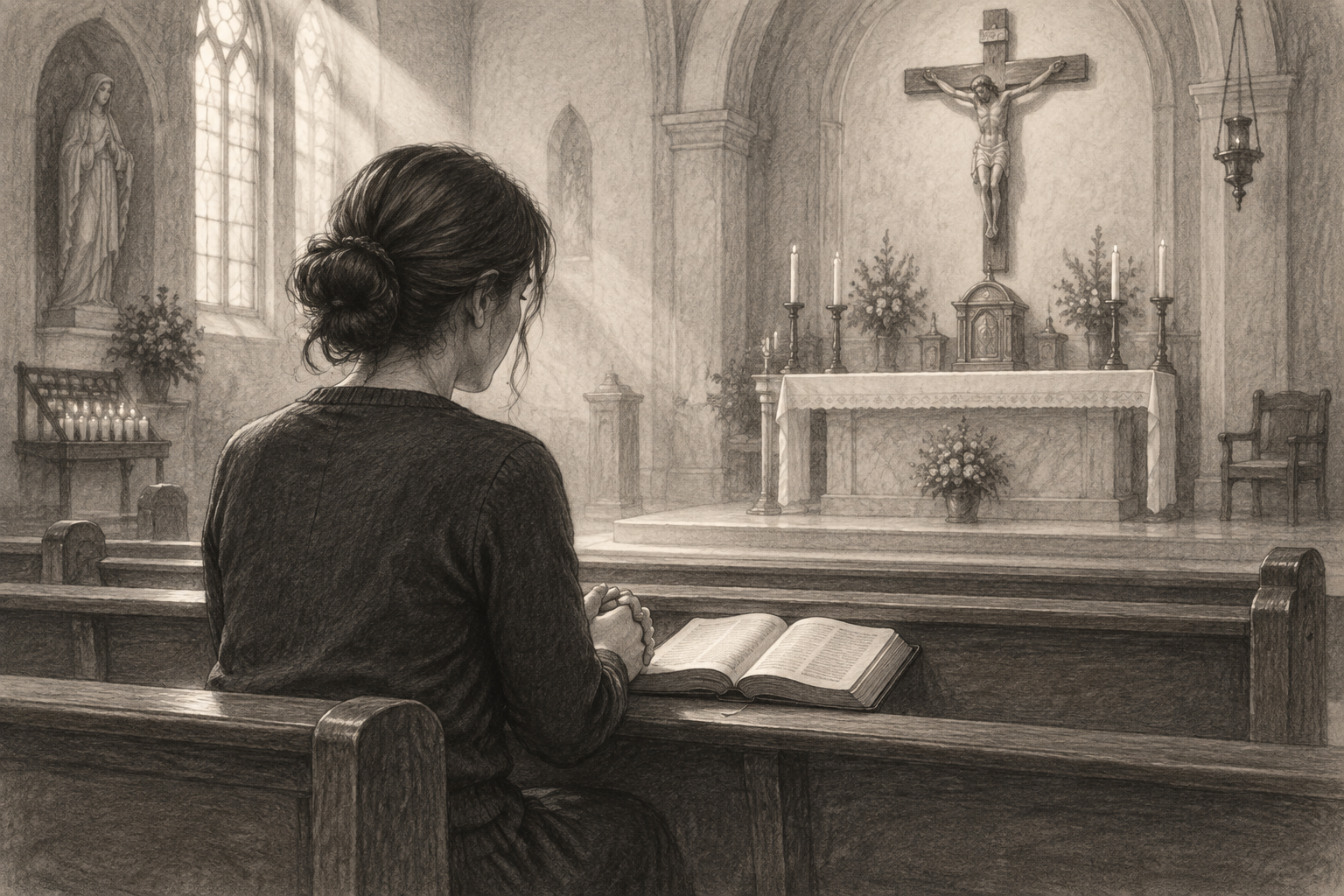
Begin with ten or fifteen minutes at a realistic time. You need a Bible and enough quiet to attend. A crucifix or simple sacred image may help, but an elaborate setting is unnecessary. A parent praying before the household wakes is not doing a lesser form of lectio than someone in a monastery.
- Place yourself before God. Make the Sign of the Cross and ask the Holy Spirit for an attentive, teachable heart.
- Read a short passage. Stay with the text rather than rushing to complete a chapter.
- Ponder one truth. Consider what the passage reveals and where it invites a response.
- Speak to the Lord. Offer the prayer that arises, including any resistance or confusion.
- Keep a little silence. Remain with God without demanding a particular experience.
- Carry the word into your day. Choose one modest, concrete response when appropriate.
For example, you might pray with Jesus' teaching about the vine and branches in John 15:5. First notice that the image concerns dependence on Christ and fruitfulness through union with him. Then consider where you have been relying only on your own strength. Ask for the grace to remain in him. Finally, sit quietly, allowing that dependence to become an act of trust.
The practical response might be to return to prayer before a difficult meeting or to undertake a neglected work of charity. It need not be dramatic. The aim is not to extract an impressive resolution from every session, but to become more receptive and faithful.
When prayer feels difficult or unclear
Distraction is common. When you notice it, return to the passage without scolding yourself. If your attention is especially scattered, read a sentence aloud or shorten the session. A sustainable practice is usually more fruitful than an ambitious routine abandoned after several days.
Dryness also belongs to ordinary Christian prayer. Do not keep changing passages simply to find one that produces a consoling feeling. Sometimes a familiar text received patiently does more to form us than a succession of striking insights.
Other difficulties require help rather than persistence alone. A troubling passage may call for historical context or guidance from a priest, catechist, or sound Catholic resource. An impression received in prayer should never be treated as permission to contradict Catholic teaching or neglect clear responsibilities. Personal spiritual impressions remain subject to discernment.
Lectio divina can also be practiced in a parish group. Shared silence and restrained reflection can help people listen, provided no one is pressured to disclose intimate experiences or present a personal interpretation as God's authoritative message to another participant.
Let the word accompany you to the altar
The fruit of lectio divina becomes visible over time in faith, hope, charity, repentance, and greater readiness to serve. Saint James warns against hearing the word without putting it into practice: James 1:22. Prayerful reading should gradually make us more truthful, more merciful, and more willing to obey God.
This is also how it supports sacramental life. Scripture can awaken gratitude for the Eucharist, expose sins we need to confess, and deepen our understanding of the grace God gives. It does not replace sacramental confession or Eucharistic worship. It helps dispose our hearts to receive and live the gifts entrusted to the Church.
Before next Sunday, take a few quiet minutes with the Gospel that will be proclaimed. Read it without rushing. Bring one honest prayer to the Lord, and leave room for silence. Then come to Mass ready to hear that word again, this time among the people with whom you will worship, pray, and be sent to serve.
Keep Reading on Lets Read The Bible
Frequently Asked Questions
How is lectio divina different from Bible study?
Bible study primarily seeks to understand the biblical text, including its context and meaning. Lectio divina includes attentive reading but moves deliberately into meditation, personal prayer, and quiet receptivity to God. The two support each other: sound study helps keep prayer rooted in what Scripture actually teaches.
Can I practice lectio divina with the readings for Mass?
Yes. The coming Sunday's Gospel or another Mass reading is an excellent choice. Pray with it before Mass to prepare for its proclamation, or afterward to deepen your response. During Mass itself, remain attentive to the communal celebration rather than conducting a separate private prayer exercise.
Do I need to feel God's presence for lectio divina to be fruitful?
No. Consolation can be a gift, but it is not the measure of faithful prayer. Distraction and dryness do not automatically make a session fruitless. Return gently to the text and look over time for growth in trust, repentance, charity, and fidelity to your responsibilities.