Saints and Witnesses
The Little Cure9 of Ars and the Great Work of Hidden Holiness
St. John Vianney shows that the Church is renewed not by noise, but by holiness, prayer, and a priest who stays close to God and his people.
Site Admin | June 11, 2025 | 66 views
St. John Vianney does not present himself to the imagination as a grand public figure. He was small in stature, modest in learning by ordinary standards, and outwardly unremarkable. Yet the Church remembers him as the Cure9 of Ars, a priest whose hidden fidelity became a light for countless souls. That contrast is part of his enduring appeal. In an age that often prizes visibility, influence, and polish, Vianney shows another path: steady prayer, tireless penance, and a heart wholly given to God.
For Catholics seeking St. John Vianney Catholic inspiration, his life is not only a story about one remarkable saint. It is also a witness to what grace can do in a human life that consents, day after day, to be shaped by Christ. His example touches priests in a particular way, but it also speaks to parents, workers, catechists, and anyone who wonders whether an ordinary life can become holy.
From a peasant village to the altar
John Vianney was born in 1786 in Dardilly, near Lyon, in France. He grew up in a time of upheaval. The French Revolution had wounded the Church deeply, and many Catholics lived amid confusion, fear, and the loss of steady religious practice. Vianney's family was poor, and he worked in the fields as a child. His early education was limited, and he struggled greatly with academic studies, especially Latin, which was essential for priestly formation at the time.
Yet the young John had a hunger for God and a reverence for the priesthood. He was drawn to the sacraments and to the life of prayer. His path toward ordination was slow and full of obstacles. He was older than many seminarians by the time he entered serious preparation, and he passed through real discouragement. Still, he persevered, helped by wise priests who recognized that intellectual difficulty does not cancel divine call.
He was ordained a priest in 1815. At first glance, nothing about him suggested future fame. But holiness seldom begins with spectacle. It begins with fidelity. Vianney's greatness would emerge through years of prayer, sacrifice, and patient labor in a small parish that many would have considered insignificant.
Ars and the dignity of the ordinary parish
In 1818, Vianney was sent to Ars, a tiny village in France. The parish was spiritually cold in many ways, and the people had grown accustomed to a low level of religious practice. He arrived not as a celebrity but as a parish priest who meant to stay. He would spend the rest of his life there.
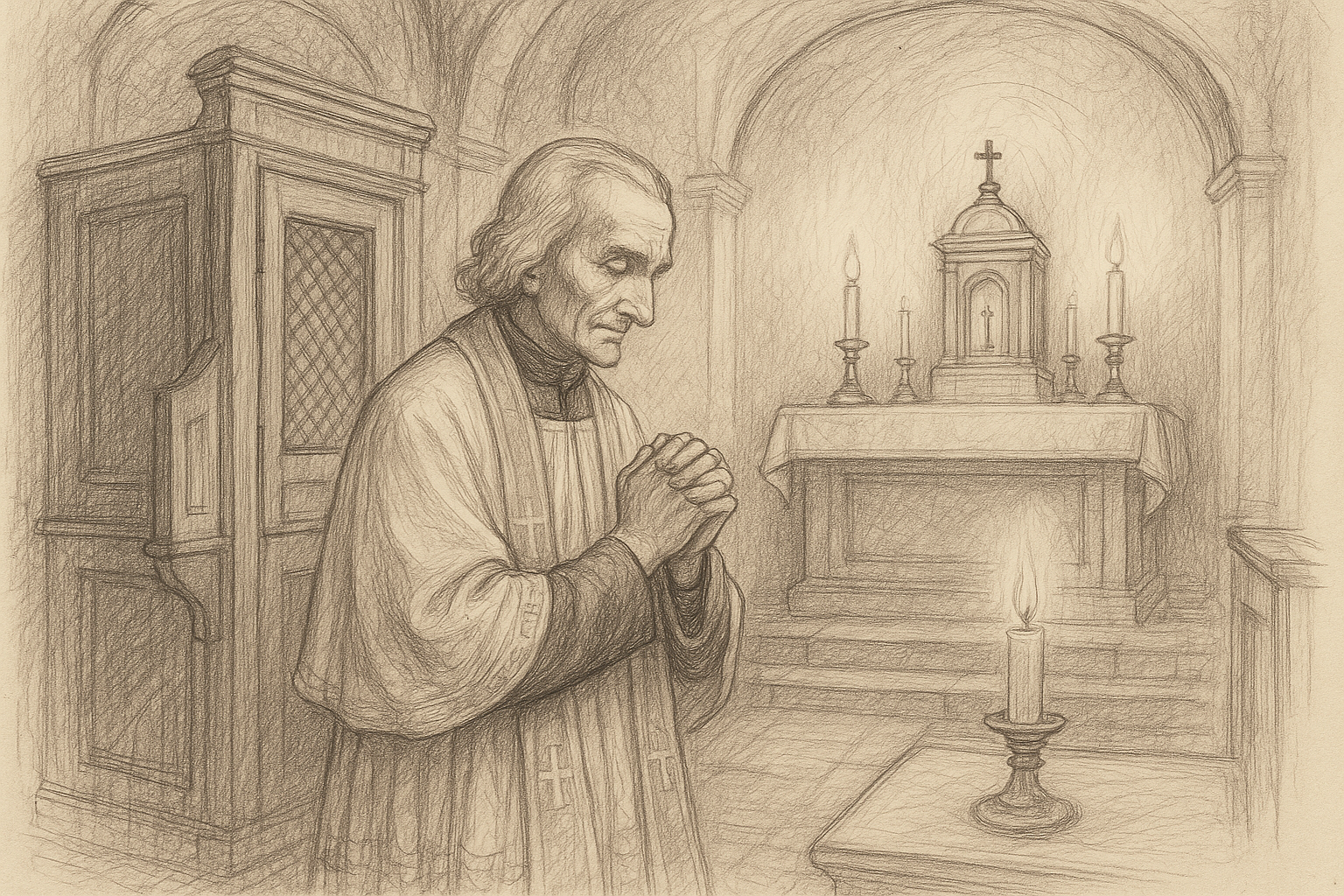
His ministry at Ars became a visible sign that God does not measure places the way we do. A little village became a center of spiritual renewal because one priest believed that every soul matters. Vianney preached simply and directly. He spent long hours in the confessional. He prayed before the tabernacle. He fasted severely. He bore misunderstandings and temptations without retreating from the work set before him.
The ordinary parish, in his hands, became a place where grace could be encountered in concrete ways. This is one reason his witness remains so powerful. Catholics do not need to imagine holiness only in cathedrals, monasteries, or moments of public triumph. The sanctification of a parish, a family, or a single conscience can unfold quietly, one repentant heart at a time.
The confessional as a place of mercy
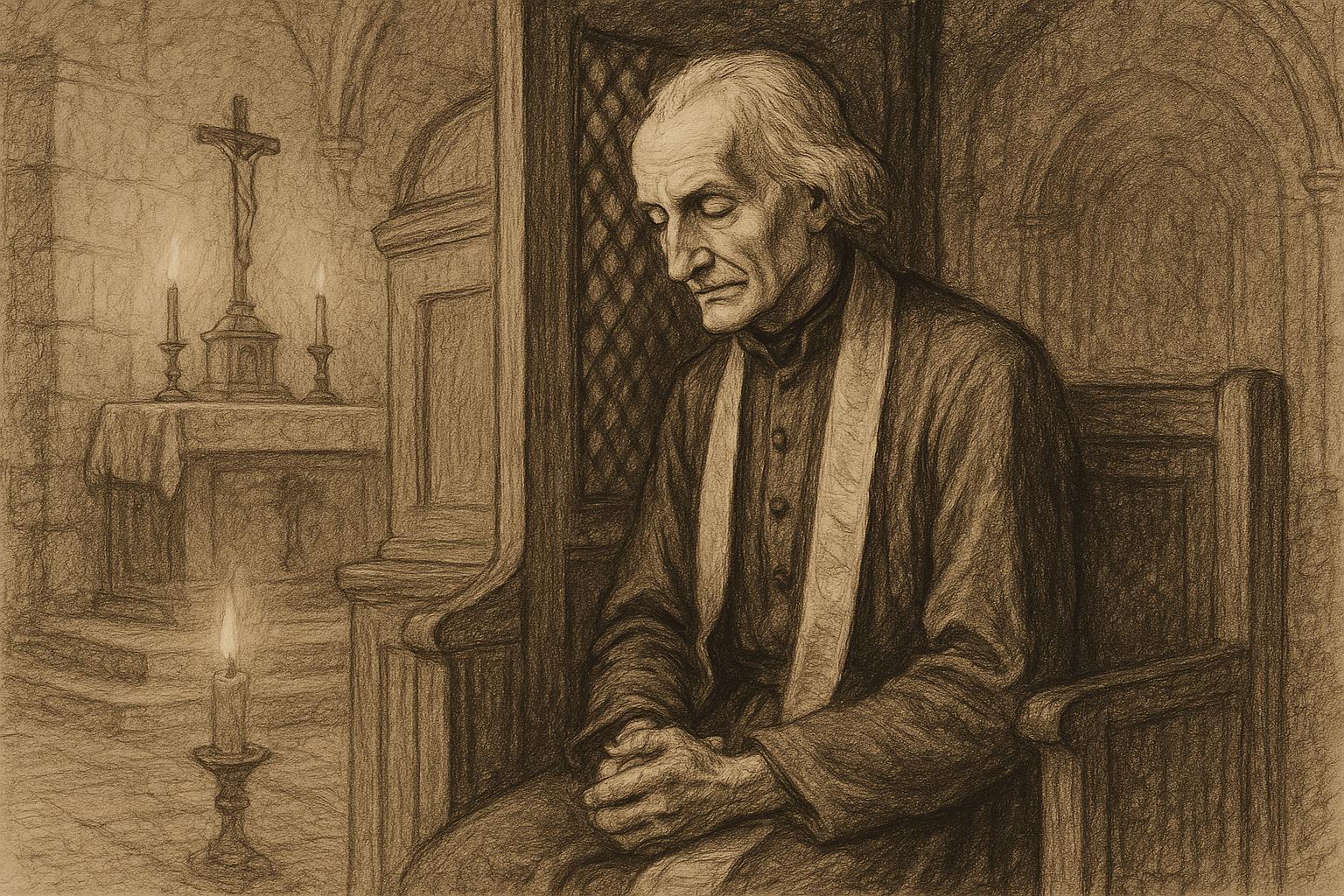
Vianney is often remembered above all as a confessor. People traveled from far away to seek his counsel and absolution. He is said to have spent many hours each day hearing confessions, and the stream of penitents became so great that Ars was transformed into a place of pilgrimage. His ministry in the confessional was not dramatic in the worldly sense. It was repetitive, demanding, and hidden. But there he witnessed to something essential: the mercy of God meets sinners not as an abstraction, but through sacramental grace.
His seriousness about sin was matched by a tender concern for repentance. He did not minimize moral responsibility. He called people to conversion plainly and without flattery. Yet he did so as a father who desired their salvation. That combination of truth and mercy is deeply Catholic. It reflects the Lord who says, Go, and do not sin again and also the Savior who seeks the lost sheep.
For many Catholics today, the confessional can feel intimidating. Vianney reminds us that the sacrament of reconciliation is not meant to humiliate the sinner, but to restore communion with God. A holy confessor does not stand at the door of mercy to keep people away. He stands there to help them enter.
Prayer, penance, and the unseen battle for souls
John Vianney's holiness was not built on activity alone. It was built on sacrifice. He prayed early and late. He kept vigil before the Blessed Sacrament. He practiced severe fasting and self-denial. These practices may seem remote to modern sensibilities, but they belong to a truth Catholics have always known: love is not cheap. The priest who gives himself to God in service of others often does so through hidden offerings that only heaven fully sees.
Vianney also understood that spiritual work involves struggle. He endured temptations and interior trials. He did not imagine that a priest could remain fruitful without prayerful resistance to evil. His life can be read as a steady response to the word of Scripture: For our struggle is not with flesh and blood. He knew that souls are not changed merely by advice or management. They are converted by grace, prayer, and the patient action of God.
This is one reason his witness is still relevant. Catholics often feel the pressure to solve spiritual problems by technique alone. Vianney points us back to the deeper sources of renewal: confession, Eucharistic devotion, fasting, and a life ordered toward God. These are not relics of a bygone age. They are the bedrock of Catholic life.
What his priesthood reveals about vocation
St. John Vianney is often invoked as a patron of parish priests, and rightly so. His life reveals that priesthood is not primarily a career or a platform. It is a sacrificial participation in Christ's shepherding of His people. A priest is called to preach the Gospel, celebrate the sacraments, and give himself for the salvation of souls. Vianney embodied that call with remarkable clarity.
He also reveals something encouraging for anyone discerning a vocation. God does not call only the most polished or naturally gifted. He can use weakness, difficulty, and limitation as part of His design. Vianney struggled in study, but he was faithful in formation. He was not fluent by worldly standards, but he was eloquent in charity. He was not impressive in appearance, but he was radiant in love.
For seminarians and priests, his witness is both a comfort and a challenge. It comforts because it shows that fruitfulness depends first on union with Christ. It challenges because it rejects mediocrity. A priest cannot serve souls well if he does not first surrender himself to prayer and holiness. Vianney's life insists that the priesthood becomes luminous when the priest remains close to Jesus.
Why his witness still speaks to lay Catholics
Although Vianney's life is especially important for clergy, lay Catholics can draw much from him. His simplicity is a rebuke to spiritual vanity. His perseverance is a remedy for discouragement. His love of the sacraments is an invitation to deeper participation in the life of the Church. His patient endurance of hidden labor is a sign that ordinary faithfulness matters more than self-importance.
Many Catholics today live with the feeling that their lives are small. They work, care for children, serve in parish ministries, struggle with anxiety, and try to remain faithful in a noisy culture. Vianney does not tell them to become famous or to manufacture spiritual intensity. He tells them to be faithful where they are. A kitchen, a classroom, a shop floor, a desk, or a sickroom can become a place of sanctification when offered to God.
He also reminds the laity to pray for their priests. A priest's holiness affects a parish in ways that are not always visible but are deeply real. Vianney became holy not by isolation from the needs of others, but by carrying those needs before God. Catholics can support their priests best by prayer, patience, and gratitude.
Concrete lessons from St. John Vianney
- Go to confession regularly, not only when guilt becomes unbearable.
- Make time for silence before the Blessed Sacrament, even if briefly.
- Accept that holiness grows through small acts repeated faithfully.
- Pray for priests, especially those who seem burdened or discouraged.
- Take sin seriously, but never despair of God's mercy.
- Offer sacrifices with intention, joining them to Christ's saving work.
These practices are not dramatic, but they are sturdy. They form the soul over time. Vianney's life suggests that grace often works by slow accumulation, like water shaping stone.
A saint for a church that needs steady hands and repentant hearts
St. John Vianney was canonized in 1925. He is remembered not because he solved every problem of his age, but because he answered God's call with unusual fidelity. He remained where he was sent. He loved the sacraments. He gave himself to sinners. He trusted that the Lord could work through a simple priest in a small place.
That is why St. John Vianney Catholic inspiration continues to endure. His life cuts through modern assumptions about success and influence. It asks whether we are willing to let God make us useful in the quiet ways that matter most. It reminds priests that hidden fidelity can bear extraordinary fruit. It reminds the faithful that sanctity is not reserved for the dramatic or the brilliant. It belongs to those who keep saying yes to Christ, even when no one is applauding.
In the end, the Cure9 of Ars points us toward the heart of the Gospel: God saves through humility, mercy, and love offered without reserve. That is a truth worth remembering whenever the Church needs fresh courage and repentant hearts.
Keep Reading on Lets Read The Bible
Frequently Asked Questions
Why is St. John Vianney important in Catholic life?
He is important because he shows how a priest can renew souls through prayer, confession, sacrifice, and fidelity to a small parish. His life is a lasting witness to the power of hidden holiness.
What is St. John Vianney especially known for?
He is especially known as the Cure9 of Ars and as a great confessor. Pilgrims came to Ars to seek his counsel and absolution because he spent so many hours serving people in the sacrament of reconciliation.
What can lay Catholics learn from St. John Vianney?
Lay Catholics can learn to value ordinary faithfulness, regular confession, prayer before the Blessed Sacrament, and patient endurance. His life shows that holiness grows in simple daily acts offered to God.