Saints and Witnesses
St. John of the Cross and the Hard Road to Light
A Carmelite doctor of the Church shows how purification, prayer, and fidelity can lead the soul closer to God.
Site Admin | May 22, 2025 | 78 views
A saint who speaks to hidden places in the soul
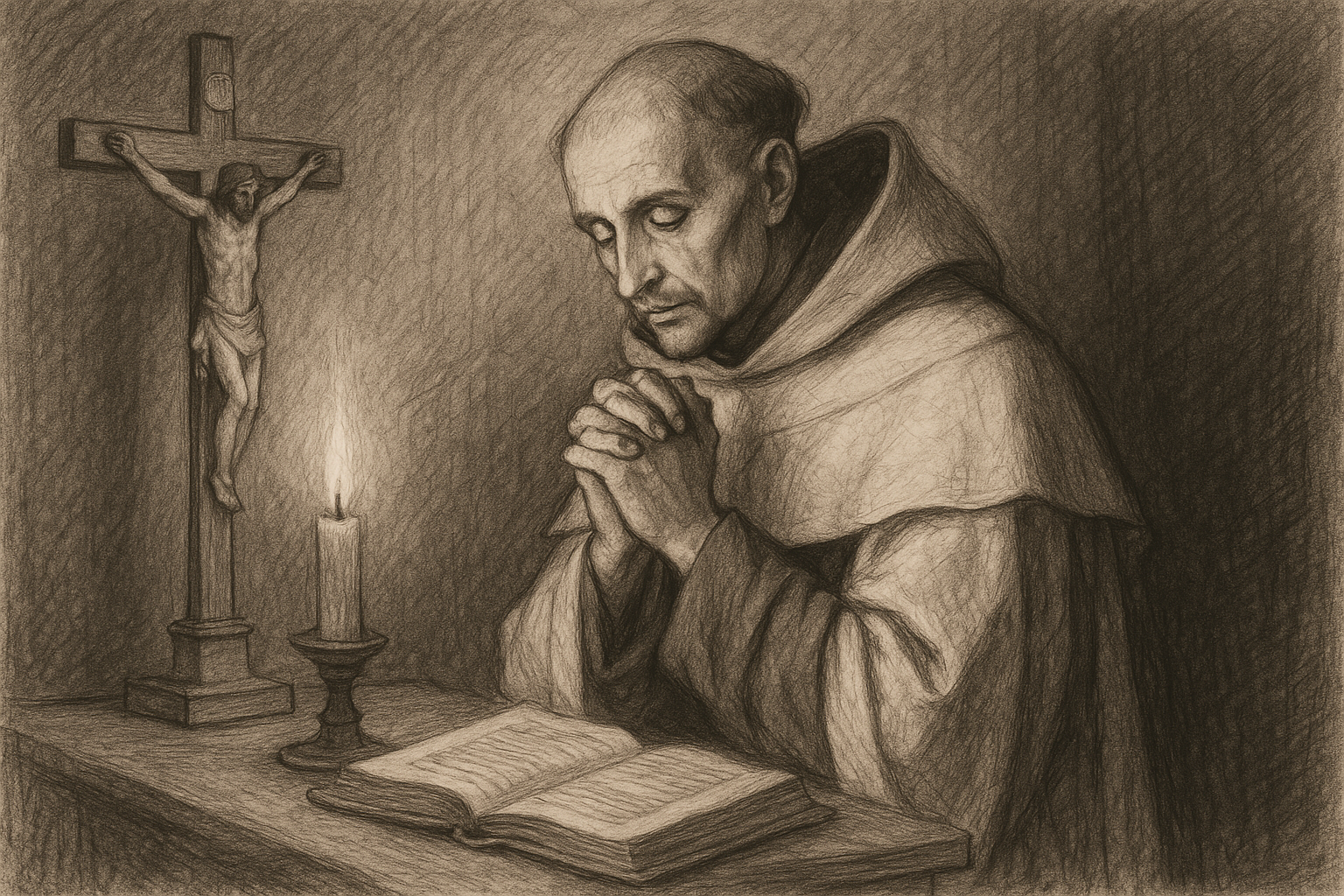
St. John of the Cross is one of the most searching voices in the Catholic tradition. He is remembered not only as a Carmelite friar, priest, and doctor of the Church, but also as a spiritual master who wrote with unusual clarity about prayer, purification, and the soul's journey toward union with God. His witness remains powerful because he never pretended that holiness is simple or sentimental. He understood that love often passes through darkness before it reaches peace.
Born in 1542 in Fontiveros, Spain, John de Yepes came from a poor family and knew hardship early. He later joined the Carmelites and became closely associated with St. Teresa of Avila in the reform of the Carmelite Order. Their shared desire was not novelty for its own sake, but fidelity to the original spirit of prayer, silence, and detachment that could make room for God. In this sense, St. John of the Cross Catholic inspiration begins not in abstract ideas, but in a life marked by discipline, reform, and trust.
His writings were shaped by personal suffering, including imprisonment and conflict within his own religious community. Yet he did not let suffering have the final word. Instead, he offered the Church a language for the soul's purification that remains both demanding and consoling. He shows Catholics that God may work most deeply when His action is least visible.
Why his life still feels so close to ours
Modern Catholics often live amid noise, distraction, and a constant pressure to feel in control. St. John of the Cross cuts through all of that. He reminds us that the spiritual life is not mainly about religious activity, but about being transformed by grace. That transformation may require the stripping away of attachments that quietly rule the heart.
His famous image of the dark night is often misunderstood as mere sadness or psychological distress. In his spiritual teaching, it points to a purifying work of God that loosens the soul from dependence on created things so that it can love Him more freely. This is not a rejection of creation, but a healing of our disordered love for it. God does not remove what is good in order to leave us empty. He removes what competes with Him so that we can receive Him more fully.
This is one reason his witness remains so compelling. Many Catholics know what it is to pray without consolation, to persevere without immediate results, or to carry a cross that does not seem to yield easy answers. St. John of the Cross does not rush past that experience. He gives it meaning without reducing mystery. His confidence rests on the conviction that the Lord is active even when the soul feels abandoned.
Psalm 63:1 captures something of his spiritual instinct: the soul thirsts for God in a dry and weary land.
The dark night as purification, not despair
It is important to read St. John of the Cross carefully. He was not glorifying suffering for its own sake, and he was certainly not proposing that every spiritual struggle has the same meaning. Rather, he described a path by which God purifies the intellect, memory, will, and desires so that the soul can cling to Him with greater simplicity.
In Catholic life, this helps correct two opposite errors. One error assumes that if prayer is difficult, something must be wrong. The other assumes that dryness proves the absence of God. St. John teaches that neither conclusion is reliable. At times, God allows prayer to lose its sweetness so that faith can deepen beyond the level of feeling. The soul learns to love God for His own sake, not for the comfort He gives.
That lesson is especially important today because many people are tempted to measure spiritual health by immediate experience. But Catholic tradition has never reduced holiness to emotional intensity. The saints often testify that the deepest acts of faith are quiet acts, hidden from view, repeated in fidelity. St. John of the Cross gives this hidden fidelity a strong theological backbone.
Three lessons from his teaching
- Detachment is freedom. The soul becomes more available to God when it is not ruled by passing desires.
- Dryness is not always failure. Prayer can be fruitful even when it feels barren.
- Love must be purified. God wants not partial devotion, but the whole heart.
A life marked by reform and suffering
St. John of the Cross did not teach from a distance. His life included conflict, misunderstanding, and imprisonment. Because he supported reform within the Carmelite family, he was taken and confined for months in harsh conditions. During that time he suffered isolation and severe treatment. Yet even there, the seed of his spiritual insight was not destroyed. His faith became more focused, his vision more refined.
This matters for Catholics because it shows that saints are not people who avoid trial. They are people whom God forms through trial. St. John of the Cross did not become holy by escaping the cross. He became holy by remaining with Christ in it. His example helps believers see that suffering, when united to the Lord, can become a place of purification rather than bitterness.
At the same time, the Church does not praise suffering as an end in itself. Catholic faith insists that suffering is joined to the mystery of redemption only through Christ. St. John of the Cross lived this truth. He did not deny pain, but he trusted that divine love could transfigure it. That trust gives his life a quiet strength that still speaks across the centuries.
Romans 8:18 offers a fitting horizon for his thought, since present sufferings are not the measure of the glory to come.
His writings remain a guide for serious prayer
St. John of the Cross is not easy reading, but he is worth the effort. Works such as The Ascent of Mount Carmel, The Dark Night, The Spiritual Canticle, and The Living Flame of Love continue to shape Catholic prayer because they are both contemplative and realistic. He does not flatter the reader. He asks for honesty, humility, and patience.
His teaching on contemplative prayer is especially valuable for Catholics who struggle to understand silence before God. He shows that prayer is not mainly a matter of producing thoughts or religious emotions. It is an act of loving attention. As the soul matures, words may become fewer, but love becomes deeper. The goal is not spiritual emptiness, but a fuller surrender to God who draws near in secret.
For many believers, this is liberating. It means prayer does not fail simply because it is simple. A quiet act of trust, a repeated surrender, or a faithful return after distraction can be deeply pleasing to God. St. John of the Cross helps Catholics resist the illusion that spiritual progress must always be dramatic. More often, it is hidden, gradual, and purified by grace.
How his teaching can shape ordinary Catholic life
- Make room for silence. Even a few minutes of quiet can help the heart become more attentive to God.
- Hold earthly goods lightly. Enjoy what is given, but do not let it become ultimate.
- Stay faithful in dryness. Perseverance in prayer matters even when consolation is absent.
- Receive the cross with trust. Difficulties can become occasions for deeper dependence on Christ.
His witness in the communion of saints
The Church calls St. John of the Cross a doctor of the Church because his teaching serves the whole people of God. But his influence is not only academic. He remains a saint whose life can be imitated in ordinary ways. He teaches that the path to God is not a search for spiritual spectacle, but a steady movement toward purified love.
That is why St. John of the Cross Catholic inspiration endures. He gives words to experiences many Catholics know but struggle to explain. He confirms that emptiness before God need not be meaningless, that hiddenness can be fruitful, and that love often grows most where self-reliance dies. His witness is sober, but it is never hopeless.
In a culture that prizes speed, visibility, and control, St. John of the Cross proposes another way. He invites believers to trust the Lord who works in darkness, not against the soul, but for its freedom. He reminds the Church that the saints are not those who escape the night, but those who let God lead them through it.
And for Catholics who are praying, waiting, suffering, or simply trying to remain faithful, that message still lands with quiet force. The road may be hard, but it is not empty. God is at work on it, and His light is often nearer than it first appears.
Keep Reading on Lets Read The Bible
Frequently Asked Questions
Who was St. John of the Cross in Catholic history?
St. John of the Cross was a 16th century Spanish Carmelite priest, reformer, and doctor of the Church. He worked closely with St. Teresa of Avila and wrote influential works on prayer and union with God.
What does the dark night mean in St. John of the Cross?
In his teaching, the dark night is a period of purification in which God frees the soul from attachments and deepens its love. It is not the same as despair, and it does not mean God has abandoned the person.
Why do Catholics still read St. John of the Cross today?
Catholics still read him because he speaks clearly about prayer, suffering, silence, and detachment. His writing helps believers understand that holiness often grows through hidden fidelity and trust in God.