Saints and Witnesses
The Parish Priest Who Would Not Let Go of Souls: St. John Vianney
A close look at the humble French priest whose hidden holiness changed an entire village and still speaks to Catholics today.
Site Admin | June 10, 2025 | 75 views
St. John Vianney is often remembered as the Cur of Ars, the parish priest who spent long hours in the confessional and drew pilgrims from far beyond his small French village. But the strength of his witness does not lie only in what people saw. It lies in the hidden structure of his life: a conversion of heart, a steady love for God, and a refusal to let discouragement have the last word. The St. John Vianney life is not a story of worldly success. It is a story of a man made fruitful by grace.
Born in 1786 in Dardilly, near Lyon, Jean-Baptiste-Marie Vianney grew up in a devout Catholic family during a time of upheaval in France. The French Revolution had shaken the Church, and many priests ministered under dangerous conditions. His early years were marked by simple country labor, prayer, and a faith that was real but not polished. He was not a natural scholar, and later studies for the priesthood were difficult for him. Yet even this weakness became part of his witness. He would spend years in seminary and face repeated academic struggles, but he persevered because he believed God had called him.
That perseverance matters because it reminds Catholics that holiness does not begin with talent. It begins with surrender. Scripture often shows God choosing what the world overlooks. As Saint Paul writes, God chose what is foolish in the world to shame the wise. Vianney's life gives flesh to that truth. He was not impressive by worldly standards, but he was available to God.
From country boy to priest
Vianney entered the priesthood after years of formation that were interrupted by the instability of the French Revolution and his own limitations in Latin and theology. Some superiors doubted whether he was fit for ordination. He needed a great deal of help with his studies, especially in the intellectual demands of seminary life. Yet he was known for sincerity, piety, and a deep desire to serve God. In the end, he was ordained in 1815 and assigned to the small village of Ars in eastern France.
Ars was not a celebrated parish. It was a quiet rural community, and Vianney arrived there without prestige. But his greatness would not come from a famous appointment. It would come from faithfulness in a hidden place. That is one of the clearest patterns in the St. John Vianney life: God often begins his work where the world is least interested.
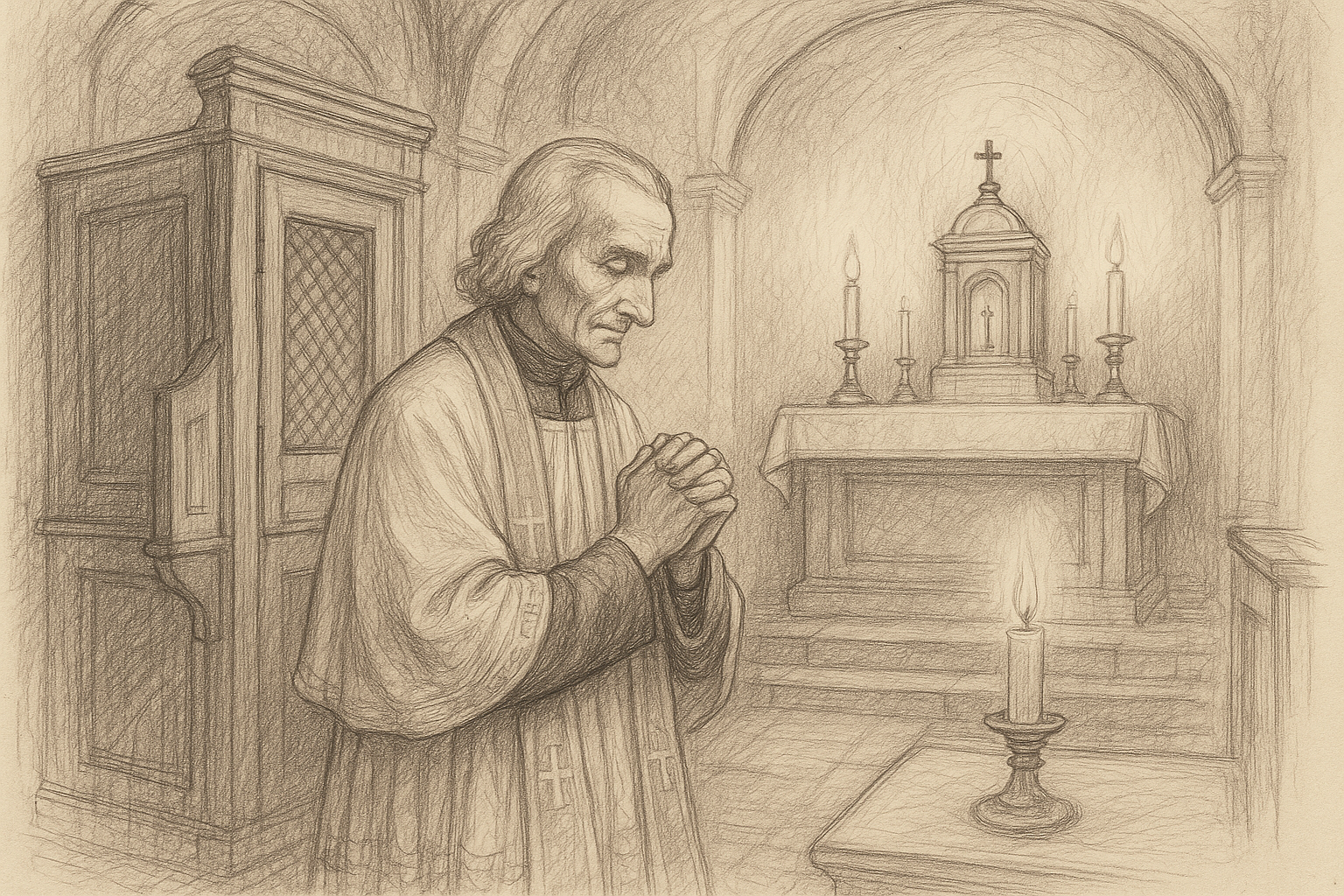
At first, Vianney faced a parish that was spiritually indifferent. Church attendance was weak, and many had drifted from the sacraments. He did not answer this with irritation or theatrical measures. He answered with prayer, fasting, penance, and patient pastoral care. He spent long hours before the tabernacle, believing that a priest must first belong to God before he can fruitfully belong to the people. This is not a romantic detail. It is the center of his method. He preached with simplicity, examined consciences with seriousness, and invited people back to confession and conversion.
The confessional and the cure of souls
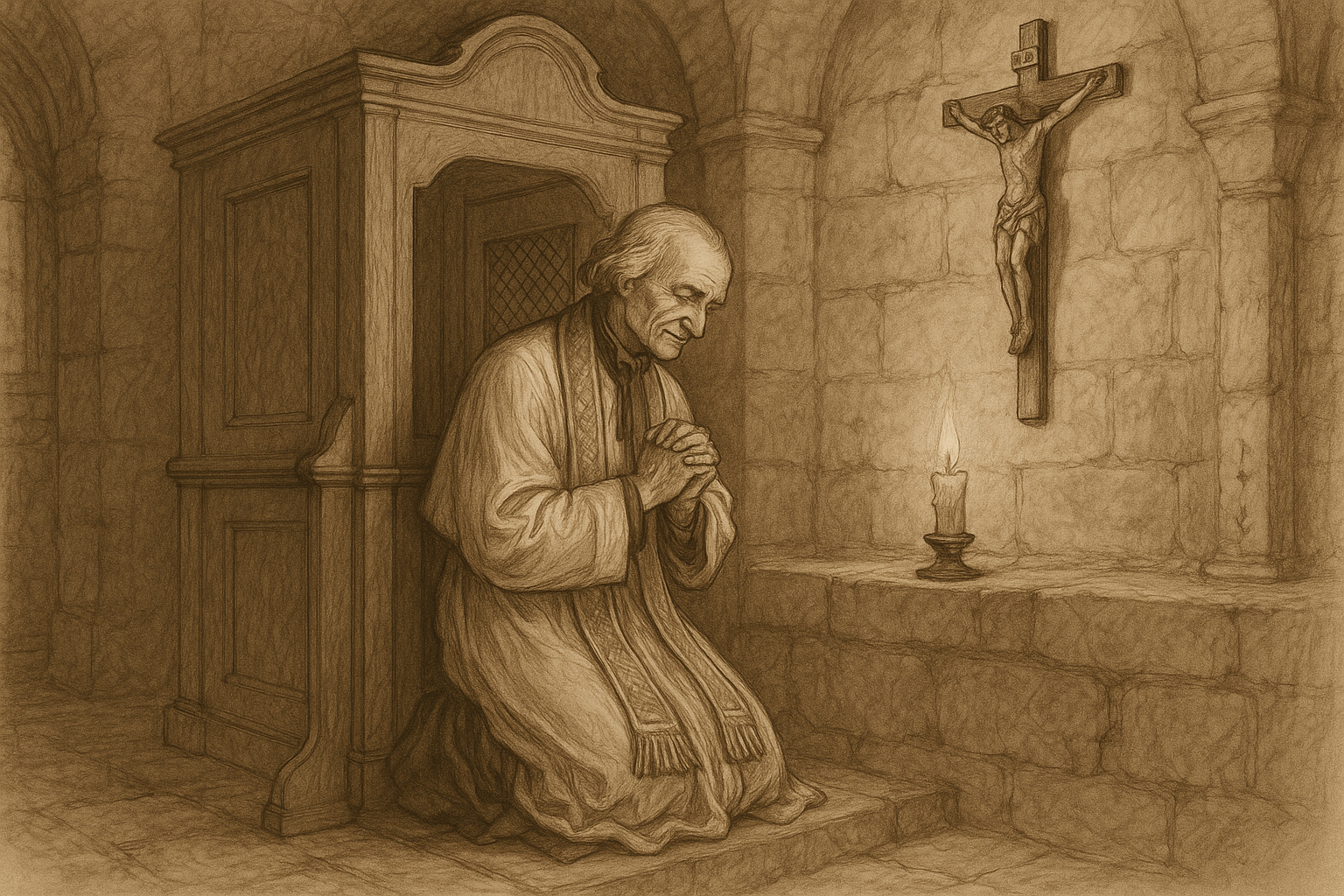
Vianney's reputation spread because people found in him a confessor who took sin seriously and mercy seriously at the same time. He spent astonishing hours hearing confessions, often from early morning until late at night, especially in the later years of his life. Pilgrims came from all over France, and the little village of Ars became a place of spiritual renewal.
What drew people was not charisma in the modern sense. It was moral clarity joined to compassion. Vianney could be direct, even severe, when he needed to be. But he was not harsh for its own sake. He wanted souls to be free. He believed the Sacrament of Penance was a real meeting with the mercy of Christ, not a religious formality. That conviction echoes the Gospel, where Jesus says, Receive the Holy Spirit and gives his apostles authority connected to forgiveness of sins. For Vianney, confession was not an accessory to Catholic life. It was a source of life.
His ministry also reveals something important about priestly identity. A priest is not a religious administrator who performs occasional sacred tasks. He is a shepherd ordered toward the salvation of souls. Vianney lived that conviction so completely that he came to be known as a model parish priest. In time, the Church recognized him as the patron saint of parish priests, a fitting honor for a man who spent himself for the people entrusted to him.
It would be a mistake, however, to imagine that his ministry was easy. Vianney endured spiritual trials, physical exhaustion, and opposition from the evil one. He also faced the heavy burden of his own sense of unworthiness. Yet his response was not self-assertion. He remained at his post. That steady fidelity is part of what makes his witness so powerful. Many people long to do great things for God, but Vianney teaches that staying put, praying faithfully, and serving patiently can be just as heroic.
His prayer, penance, and Eucharistic love
Vianney's life in Ars was built around the sacraments, especially the Eucharist. He loved the Mass with deep reverence and often spoke of the beauty and seriousness of the priest's vocation at the altar. He understood the Mass as the heart of parish life. This is why his own prayer was so intense. He knew that a priest cannot give what he does not first receive.
He also embraced penance. Contemporary accounts describe his austere way of life, his fasting, and his willingness to endure discomfort for the sake of the Gospel. Yet this should not be confused with grimness. His sacrifice was not self-punishment for its own sake. It was the expression of a heart ordered toward God and others. He wanted to make room for grace. In this, he lived the logic of Christ's words: If anyone would come after me, let him deny himself and take up his cross.
One of the most striking features of his sanctity is that it was ordinary in form and extraordinary in depth. He did not found a religious order or write a great theological treatise. He did not become famous through public debate. He changed lives by being a priest who prayed, listened, preached repentance, and remained faithful. The Church does not only need brilliant minds and public figures. It also needs holy pastors whose lives make room for God.
His devotion to the Blessed Virgin Mary also shaped his spirituality. Like many saints, he saw Marian devotion not as an addition to Christian life but as a way of coming more closely to Christ. In the Church's tradition, Mary always leads believers to her Son. Vianney's piety was simple and filial, fitting a man who trusted God's grace more than his own strength.
What the saint of Ars teaches Catholics now
For Catholics today, St. John Vianney offers more than an inspiring biography. He offers a pattern of discipleship that still speaks clearly. First, he reminds us that holiness is possible in ordinary circumstances. Many Catholics live hidden lives, with little recognition and few visible opportunities. Vianney's example says that a life offered to God, however small it may seem, can bear great fruit.
Second, he reminds us that confession is a gift, not a burden. In an age that often resists moral seriousness, Vianney's ministry re-centers the Sacrament of Penance as a place of mercy and truth. Catholics who return to confession regularly often discover something he knew well: grace does not merely pardon us, it reshapes us. The confessional is not where God humiliates the sinner. It is where Christ restores him.
Third, Vianney teaches the importance of Eucharistic devotion. A parish becomes spiritually strong when the Mass is treated as the center of life, not one devotion among many. His own reverence before the altar flowed into his care for souls. For lay Catholics, this can mean deepening participation in Mass, preparing better for the Eucharist, and allowing Sunday worship to shape the whole week.
Fourth, his life encourages perseverance when our gifts seem limited. Vianney was not a naturally gifted student, and he did not begin with obvious advantages. Yet he became fruitful because he stayed close to God. Many Catholics fear that their weaknesses disqualify them from useful service. The opposite is often true. God works through weakness so that his power is more clearly seen. The saint of Ars is proof that grace can make up for what nature lacks.
Holiness is not the absence of struggle. It is fidelity in the midst of it.
That sentence could serve as a summary of his life, but it is more than a summary. It is a challenge. If we want to grow in holiness, we must be willing to let God use the daily places where we already live: our homes, parishes, workplaces, and hidden responsibilities. Vianney did not wait for ideal conditions. He became a saint by receiving the life God gave him and spending it well.
A priest for the Church, and a reminder to all the faithful
St. John Vianney died in 1859, after years of tireless ministry. By then, Ars was no longer an unnoticed village in the same way as before. It had become a place where people encountered the mercy of God through the ministry of a priest who believed that every soul mattered. His canonization confirmed what the faithful already knew: here was a man whose life had become a sign of divine compassion.
For priests, his example remains especially urgent. He shows that parish ministry is not about efficiency alone, but about sanctity. For laypeople, his witness is just as important. He reminds the whole Church that conversion is never outdated, that prayer is never wasted, and that the mercy of Christ reaches people most deeply when someone is willing to stay, listen, and serve.
The life of St. John Vianney is not complicated, but it is demanding. It asks whether we believe that God can do great things through small beginnings. It asks whether we trust the confessional, the Mass, and daily prayer enough to let them shape us. And it asks whether we are willing to become, in our own places, faithful witnesses to the mercy we have received.
In a world that prizes visibility, John Vianney points to the quiet fruitfulness of a life hidden in God. That is why his life still matters: not because he was remarkable in the ways the world prefers, but because he belonged so completely to Christ.
Keep Reading on Lets Read The Bible
Frequently Asked Questions
Who was St. John Vianney?
St. John Vianney was a French priest born in 1786 who became the Cur of Ars and is remembered for his holiness, his long hours in the confessional, and his care for parish life. He is the patron saint of parish priests.
Why is St. John Vianney so closely associated with confession?
He spent many hours hearing confessions and helped countless people return to the sacraments through patient, direct, and merciful spiritual guidance. His ministry made the Sacrament of Penance central to the renewal of his parish.
What can Catholics learn from the life of St. John Vianney today?
His life teaches perseverance in weakness, devotion to the Eucharist, reverence for confession, and the importance of faithful service in ordinary places. He shows that holiness grows through prayer, sacrifice, and steady love for souls.