Saints and Witnesses
A Martyr's Mercy and the Quiet Strength of St. Maximilian Kolbe
How one Franciscan priest lived a fearless love that still shapes Catholic discipleship today
Site Admin | May 28, 2025 | 83 views
A saint whose witness reaches across time
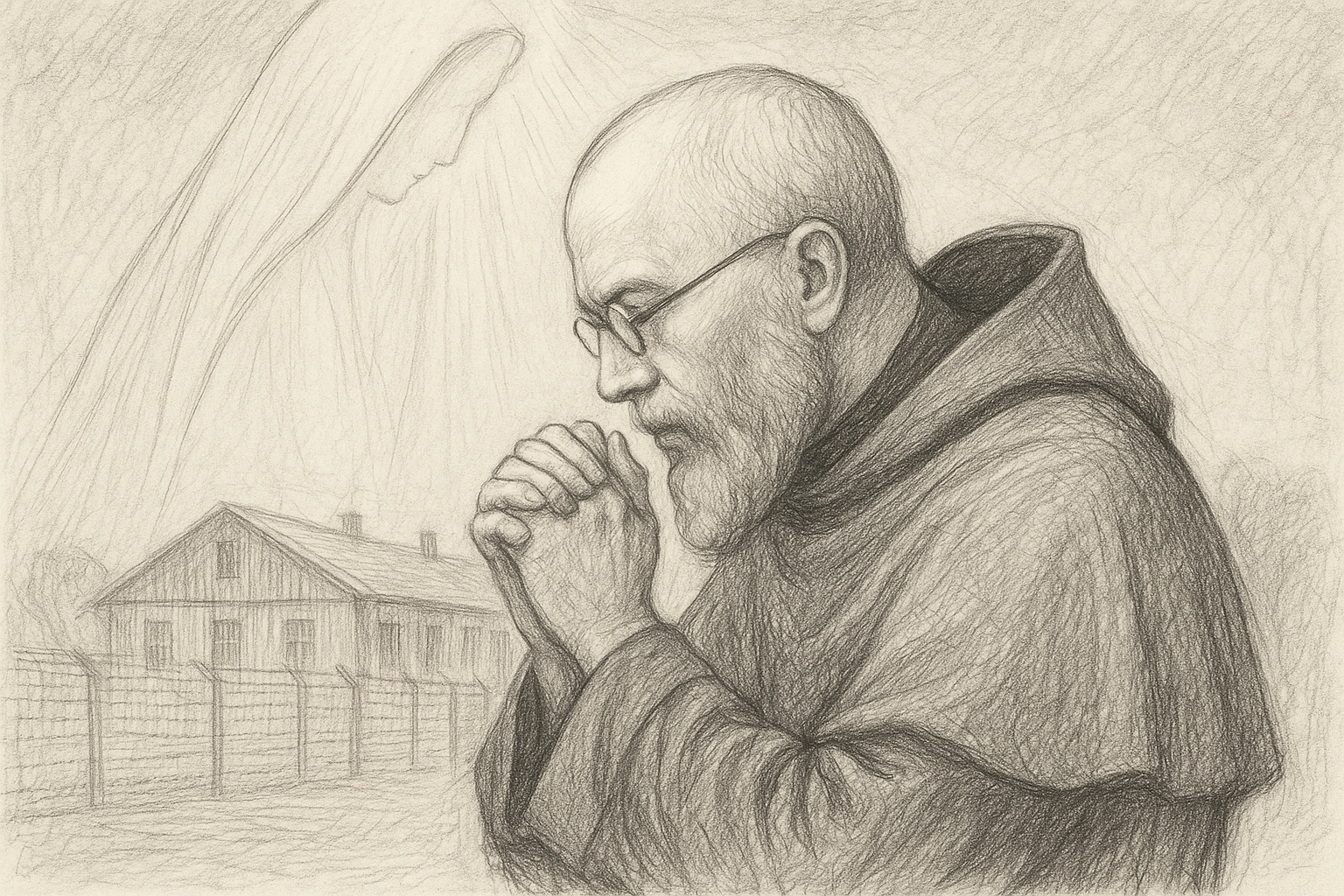
Among the saints of the modern age, St. Maximilian Kolbe stands out for the clarity of his witness. He was not a martyr by accident, nor simply a victim of history. He was a Franciscan priest formed by prayer, discipline, and a deep love for the Blessed Virgin Mary. When his life came to its final test in the German death camp at Auschwitz, that formation became visible in the most demanding way possible.
For Catholics, the St. Maximilian Kolbe Catholic inspiration is not only about a dramatic act at the end of his life. It is about a whole way of living that made such an act possible. His story brings together devotion to Mary, missionary zeal, courage in suffering, and a belief that charity is stronger than fear. He reminds the Church that sainthood is not reserved for peaceful circumstances. It can shine with extraordinary force in places of darkness.
His life before Auschwitz
Raymond Kolbe was born in 1894 in Poland, then under partition. As a young boy, he entered the world of faith with unusual intensity, and as a teenager he joined the Franciscan Order, taking the name Maximilian. In Rome, he studied philosophy and theology, and there he also developed a lifelong devotion to the Immaculate Virgin Mary. That devotion was not sentimental. It was practical, missionary, and total. He wanted to belong to Christ through Mary and to help others do the same.
Ordained a priest in 1918, he soon became known for bold apostolic energy. He founded the Militia Immaculatae, or Army of the Immaculate, a movement centered on conversion, holiness, and trust in Mary's intercession. He also built up publishing work in Poland, including Rycerz Niepokalanej and the large friary at Niepokalanow, which became a center of evangelization, prayer, and media apostolate. Later he also worked in Japan, where his missionary spirit took new forms in a different culture and language.
These facts matter because they show that Kolbe's martyrdom was not a sudden flash detached from the rest of his life. He had spent years training his heart to say yes to God. He believed that the Christian life is not only about avoiding sin but about giving oneself entirely to divine love. That conviction shaped his public work and his private discipline alike.
The pressures that formed his witness
To appreciate Kolbe's final sacrifice, it helps to understand the world he lived in. Poland was crushed first by war and then by occupation. The Nazi regime was hostile to the Church, to Polish identity, and to any form of human dignity that did not serve its ideology. Kolbe was arrested in 1941 and eventually sent to Auschwitz. There, he entered a world designed to strip men of name, purpose, and hope.
In a place like Auschwitz, ordinary acts took on moral weight. Sharing bread, speaking a word of encouragement, or praying silently became ways of resisting cruelty. Kolbe was not a political leader with an army behind him. He was a priest in a camp of terror. Yet even there he remained a pastor. Witnesses remembered his calm, his prayer, and his concern for others. In that sense, his sanctity was already visible before the famous event that led to his death.
The offering that made history
In July 1941, a prisoner escaped from Kolbe's barracks. In retaliation, camp authorities selected ten men to die by starvation. One of those chosen, Franciszek Gajowniczek, cried out for his wife and children. According to the well-known account preserved by witnesses, Kolbe stepped forward and offered to take his place. The guards accepted. He was sent with the others to the punishment bunker.
What happened next has become one of the most striking testimonies of Christian charity in the modern era. In the starvation cell, Kolbe is reported to have led prayers and hymns, sustaining the others with faith and peace. After two weeks, he was the last survivor and was killed by lethal injection on August 14, 1941, the vigil of the Assumption of the Blessed Virgin Mary. The timing has long struck Catholics as fitting, though the real significance lies deeper: he died as he had lived, in an act of love freely chosen.
His death is often described as martyrdom, and rightly so in the broad Catholic sense of giving one's life for Christ and for another in union with Him. It is also important to say that his witness is not meant to romanticize suffering. Auschwitz was evil, and starvation was evil. Kolbe does not make evil good. Rather, he shows that evil does not get the final word when a human person, by grace, chooses self-giving love instead of hatred or despair.
Greater love has no one than this, that one lay down his life for his friends. John 15:13
The Marian heart of his spirituality
Many Catholics know Kolbe first through his Marian devotion, and that devotion is central to understanding him. He did not treat Mary as a distraction from Christ. He saw her as the surest path to a deeper union with Christ. His consecration to the Immaculate was rooted in the conviction that grace can transform the human person when the soul is yielded to God without reserve.
This is one reason he remains so compelling. Modern life often prizes autonomy, self-definition, and control. Kolbe's life points in a different direction. He chose surrender, but not passivity. He chose consecration, but not retreat. He gave himself to Mary in order to belong more fully to Jesus and to serve the world more fruitfully. For Catholics seeking a model of Marian devotion that is active rather than inward-looking, he offers a compelling example.
His language about the Immaculata can sound intense to modern ears, but it emerged from a sincere desire for holiness and evangelization. He believed that holiness spreads, that souls can be won by prayer and sacrifice, and that Marian devotion should lead to apostolic action. That balance is one of the most enduring features of his legacy.
Why his witness still speaks
St. Maximilian Kolbe continues to inspire Catholics because his life addresses questions that are still painfully present. What does courage look like when life is threatened? How does a Christian act when institutions become cruel? Can love remain real when the world seems ruled by force? Kolbe answers these questions not with theory, but with a human life.
First, he shows that holiness is formed long before crisis arrives. His final act was extraordinary, but it was prepared by years of confession, prayer, work, discipline, and surrender. The saints often appear sudden to us, but grace usually works in hidden repetition. They become who they are through daily fidelity. Kolbe is a reminder that ordinary Catholic habits matter because they prepare the soul for whatever God may ask.
Second, he teaches that charity is not merely kindness. Christian charity can be costly, and sometimes it means bearing another's burden in a literal way. Kolbe did not speak vague words of support to the condemned man. He stepped forward and took his place. That kind of love confronts the temptation to preserve oneself at all costs. It reflects the logic of the Cross, where Christ Himself gives His life for sinners. Romans 5:8
Third, his witness gives courage to people facing fear, suffering, or injustice. Most Catholics will not face Auschwitz, but many face moments when fear narrows the heart. A diagnosis, persecution, family crisis, or the moral pressure to remain silent can tempt a person to shrink back. Kolbe shows that grace can enlarge the soul even under oppression. He is a patron of prisoners, families, the persecuted, and all who need steadfastness.
Fourth, he reveals the power of hope. In the starvation bunker, Kolbe did not become absorbed in despair. He prayed. He sang. He encouraged others. Christian hope is not denial of suffering. It is confidence that suffering does not have ultimate authority. That is why his witness still matters in a culture that often treats despair as realism and sacrifice as foolishness.
We know that in everything God works for good with those who love him. Romans 8:28
What Catholics can learn from his example
Kolbe's legacy can become concrete in ordinary Catholic life. His witness invites believers to consider a few habits of discipleship that are easy to admire and harder to practice:
- Consecutive prayer: a life of prayer that is steady rather than occasional, especially Marian prayer and Eucharistic devotion.
- Spiritual discipline: choosing habits that train the will toward self-gift rather than self-indulgence.
- Missionary imagination: looking for ways to share the faith through speech, writing, hospitality, and works of mercy.
- Merciful courage: standing with the vulnerable even when it costs reputation, comfort, or security.
- Trust in grace: believing that holiness is not self-made but received from God and answered with cooperation.
These are not dramatic virtues in themselves, but they are the soil from which dramatic love can grow. Kolbe did not become a saint by one noble choice alone. He became a saint by a long obedience that made room for grace.
A saint for our anxious age
The modern world often celebrates efficiency, image, and self-protection. Kolbe offers something better. He presents a life centered on Christ, given through Mary, and poured out in love for others. That is why his witness remains so fresh. It cuts through cynicism. It challenges comfortable religion. It invites Catholics to ask not only whether they believe, but whether they are willing to belong to God with their whole lives.
When we remember St. Maximilian Kolbe, we are not admiring a distant hero. We are meeting a priest who trusted the Gospel enough to live it in the darkest place imaginable. His life says that the Christian answer to evil is not despair, and not hatred, but love made visible. For anyone looking for a saint who speaks plainly to the conscience and gently to the heart, he remains an enduring guide.
And perhaps that is why his memory continues to draw Catholics back again and again: because in him we see not only a martyr of the past, but a man who still points the Church toward the only victory that lasts, the victory of charity offered in union with Christ.
Keep Reading on Lets Read The Bible
Frequently Asked Questions
Was St. Maximilian Kolbe a martyr in the strict Catholic sense?
The Church honors him as a martyr of charity because he freely offered his life for another prisoner and died in union with Christ's self-giving love. His witness is deeply connected to martyrdom, even though his death came through an act of sacrificial substitution rather than a conventional execution for refusing the faith.
Why is St. Maximilian Kolbe so closely associated with Mary?
Kolbe believed that devotion to the Immaculate Virgin Mary leads people more fully to Jesus. His Marian consecration shaped his prayer, his missionary work, and his understanding of holiness as total surrender to God's will.
What is one practical way Catholics can imitate St. Maximilian Kolbe today?
A practical beginning is to unite daily prayer with a deliberate work of mercy, especially for someone who is suffering, lonely, or overlooked. Kolbe's life shows that love becomes credible when it is both prayed and practiced.