Marian Devotion
Marys Visit That Changed the House of Zechariah
In the Visitation, charity becomes visible, joy begins to speak, and Christ is already at work before His birth.
Site Admin | March 22, 2026 | 122 views
Marys journey and the first fruits of Christ's presence
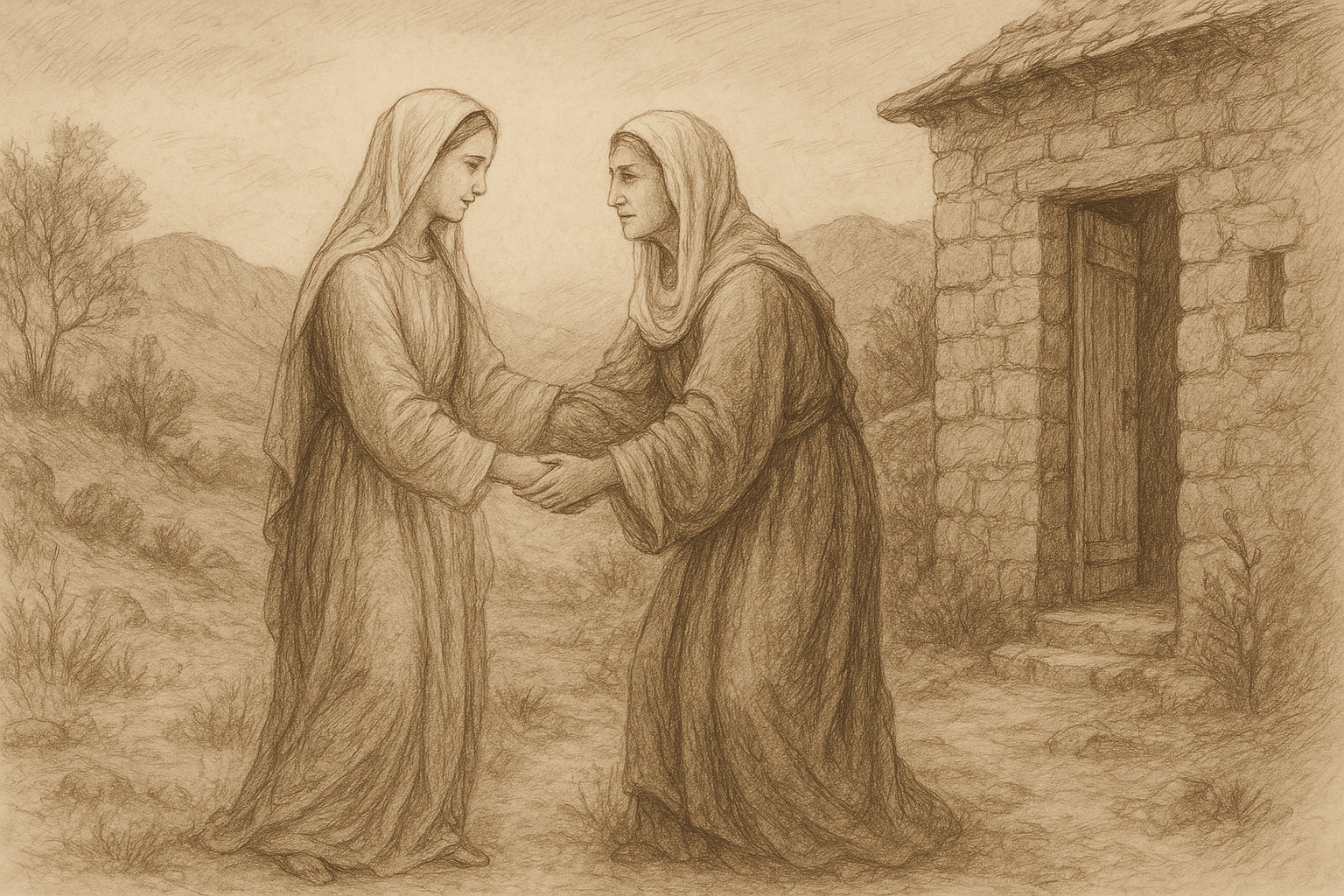
Luke tells the story with great simplicity: Mary went in haste to the hill country, entered the house of Zechariah, and greeted Elizabeth Luke 1:39-40. The scene is brief, but the mystery is rich. In the Visitation, the Mother of the Lord does not remain centered on herself. She carries Christ to another household, and the meeting becomes a revelation of God's saving work. This is one reason the Visitation explained by Catholic faith is never only about Mary. It is about what happens when the Lord draws near through her. Grace overflows into encounter, charity, and praise.
Mary's visit is not sentimental travel writing. It is the first visible movement of the Incarnation outward into the world. The Word has taken flesh in her womb, and that hidden presence immediately bears fruit. Elizabeth is filled with the Holy Spirit, the child in her womb leaps, and the older woman blesses both Mary and the fruit of her womb [[VERSE|luke|1|41-42|Luke 1:41-42]]. Before Jesus speaks a word, His presence already speaks. Before He is born in Bethlehem, He is recognized in the home of a relative who welcomes Him with faith.
Catholics have long seen here a deep pattern of discipleship. Mary receives Christ and then brings Him to others. Her faith is never turned inward. It is active, generous, and quietly radiant. That is why the Visitation remains one of the clearest biblical images of Christian charity. Love received from God becomes love given to neighbor. The Lord is not hoarded. He is carried.
Elizabeth's greeting and Mary's hidden greatness
Elizabeth's words are among the most treasured prayers in the Church: Blessed are you among women, and blessed is the fruit of your womb Luke 1:42. She also speaks of Mary's faith, praising her as one who believed that the Lord's promise would be fulfilled Luke 1:45. These verses matter because they show that Mary's greatness is inseparable from her obedience. She is blessed not by self-assertion but by trust.
The Catholic tradition sees in Elizabeth's greeting a pattern of reverence. She does not place herself at the center. She recognizes what God has done in Mary and through Mary. This is not competition. It is adoration shaped by humility. To honor Mary rightly is never to distract from Christ. Rather, it is to accept the way God Himself chose to bring His Son into the world. If the Lord gave His Son a mother, then the mother's dignity belongs to the saving plan of God.
Elizabeth's unborn child also takes part in the scene. John the Baptist leaps in his mother's womb Luke 1:41, and the Church has often contemplated this as an early sign of the Forerunner's mission. Even before birth, John points to the Messiah. Even in the womb, he responds to Christ. The Visitation therefore reveals that God's grace reaches where human sight cannot. The unborn are not outside the concern of the Lord, and the hidden life of the child is already precious before Him.
Mary's Magnificat and the shape of true praise
After Elizabeth's blessing comes Mary's great canticle, the Magnificat Luke 1:46. This prayer is one of the Church's daily treasures because it joins humility, prophecy, and worship in a single song. Mary magnifies the Lord, not herself. She rejoices in God her Savior, acknowledging both His greatness and her own lowliness [[VERSE|luke|1|46-48|Luke 1:46-48]]. Here is one of the deepest lessons of the Visitation: authentic joy does not come from self-exaltation, but from being looked upon by God with mercy.
The Magnificat also reveals the style of divine action. God scatters the proud, lifts up the lowly, fills the hungry with good things, and sends the rich away empty [[VERSE|luke|1|51-53|Luke 1:51-53]]. This is not social theory dressed as prayer. It is a spiritual vision in which God's mercy overturns the false ordering of the world. In Mary, the poor of the Lord receive the greatest gift: Christ Himself. Her song belongs to the whole Church because the Church, like Mary, lives from mercy and waits for fulfillment from God alone.
For prayer, the Magnificat teaches a sober and beautiful habit. It gives words to gratitude, but it also disciplines the soul. When we pray it, we learn to measure our lives by God's action rather than by our own achievements. We ask to be made lowly enough to receive Him. That is a deeply Marian disposition. It is also a deeply Christian one.
Charity made visible in a house on the hill
One of the most moving details in the Visitation is Mary's practical presence. Luke says she remained with Elizabeth about three months before returning home Luke 1:56. This small line matters. Mary does not merely arrive with good intentions. She stays, serves, and accompanies. Charity is not abstract. It enters a house, shares time, and bears another person's burden.
This is where the Visitation speaks so directly to Catholic devotion. Marian devotion is never meant to replace works of mercy. It inspires them. Mary does not pull the believer away from neighbor love. She shows how to live it. Her hidden service in the house of Zechariah becomes a model for every Christian home, parish, and friendship. To visit in Christ's name is to bring peace, attentiveness, and practical care to another person's need.
The Church's sacramental life echoes this same logic. Christ comes to us, and then He sends us out. We receive grace and become instruments of grace. The Visitation is a mystery of presence: Mary's presence to Elizabeth, Christ's presence in Mary, and the Holy Spirit's presence over the whole event. When Catholics pray the Visitation, they are invited to ask whether their own lives carry the peace of Christ into the places they enter. A family, a sickroom, a workplace, even a simple conversation can become a small house in the hill country when charity is lived sincerely.
What the Visitation teaches about Marian devotion
Catholic devotion to Mary is sometimes misunderstood as admiration detached from discipleship. The Visitation corrects that error. Mary's role is always relational and Christ-centered. She is the Mother of the Lord, the first to bear Him, the first to carry Him in mission, and the first to teach by example what it means to believe. In her, devotion becomes obedience.
The Visitation explained in Catholic terms also guards against two opposite mistakes. One mistake is to speak of Mary only in historical terms and miss the spiritual meaning of the event. The other is to speak of her in a way that forgets her real humanity. The Gospel gives us neither a distant symbol nor a mere bystander. It gives us a woman of faith who responds to God's word and cooperates with His grace. She is blessed, but she is also active. She rejoices, but she also serves. She is humble, but she is not passive.
Her visit to Elizabeth shows why the Church asks the faithful to love Mary as mother and model. She does not keep the gifts of God for herself. She brings them to others. In that way, Marian devotion becomes a school of charity. It teaches believers to welcome Christ inwardly and then let His life shape outward conduct. The one who prays the Rosary, meditates on the mysteries, and honors the Mother of God should also become more ready to forgive, to assist, to listen, and to go in haste where love is needed.
Praying the Visitation with a Catholic heart
To pray with this mystery, begin with its plainness. Mary traveled. Elizabeth welcomed. Two mothers met. Two children were already at work in hidden ways. God acted in silence and speech alike. That quiet realism is important for devotion because not every grace comes with dramatic feeling. Often God works through ordinary fidelity. The Visitation reminds us that holiness is frequently expressed in simple acts done with faith.
A fruitful way to pray the Visitation is to ask three questions:
- Where is Christ asking me to bring His presence today?
- Who around me needs patient, concrete charity rather than words alone?
- Do I rejoice when God blesses others, or do I compare myself with them?
These questions keep prayer grounded in life. They also lead naturally to repentance and gratitude. Like Mary, we can ask for a heart that magnifies the Lord. Like Elizabeth, we can ask for the grace to recognize God's work in others. Like John, we can ask for an interior sensitivity to the presence of Christ.
It is also fitting to pray the Visitation when carrying hidden burdens. Elizabeth knew the vulnerability of late pregnancy. Mary knew the mystery of a promise too large to explain. Many Christians know what it means to carry concerns privately while still answering others with kindness. This mystery says that such hidden burdens can be places of grace. God is not absent there. He is already near, and sometimes He arrives through the visit of a friend, the patience of a family member, or the quiet endurance of someone who simply stays.
A simple prayer intention
When meditating on the Visitation, many Catholics find it helpful to offer a brief intention such as this: Lord Jesus, teach me to carry You to others with humility, joy, and practical love. Let my home, my speech, and my choices make room for Your presence. Make me ready to visit, to serve, and to bless.
That prayer captures the heart of the mystery. The Visitation is not only something Mary once did. It is a pattern the Church continues to live. Wherever Christ is received in faith and then brought in charity to another person, the Visitation is echoed again. And wherever praise rises from a lowly heart, the Magnificat is not far behind.
Keep Reading on Lets Read The Bible
Frequently Asked Questions
Why is the Visitation important in Catholic devotion?
The Visitation shows Mary carrying Christ to Elizabeth, and it reveals how grace becomes charity. Catholics see in it a model of humility, missionary joy, and service to others.
What Scripture passages are central to the Visitation?
The main passages are [[VERSE|luke|1|39|Luke 1:39]] to [[VERSE|luke|1|56|Luke 1:56]], especially Elizabeth's blessing of Mary and Mary's Magnificat.
How can I pray with the Visitation in daily life?
You can meditate on Mary's journey, ask where Christ is calling you to bring peace, and pray for a heart that serves others with practical love and gratitude.