Marian Devotion
When Heaven Waited for a Reply: The Annunciation and Mary's Yes
The Annunciation is more than a scene in sacred art. It is the moment when the Word became flesh and Mary's free assent opened the door to the Incarnation.
Site Admin | March 19, 2026 | 97 views
The Annunciation stands at the quiet center of the Christian faith. Before the shepherds, before the stable, before the public signs of Jesus' ministry, there is a simple exchange in Nazareth between the angel Gabriel and a young Jewish woman named Mary. In that moment, heaven does not overwhelm the earth with spectacle. It asks for a response.
That is one reason the Annunciation Catholic meaning is so rich. The scene is not only about Mary. It is about God entering human history by way of promise, freedom, and trust. It is about the eternal Son taking flesh in the womb of the Virgin, and about the Church learning to adore Christ more deeply by honoring the one who said, Let it be to me according to your word.
The biblical scene in Luke's Gospel
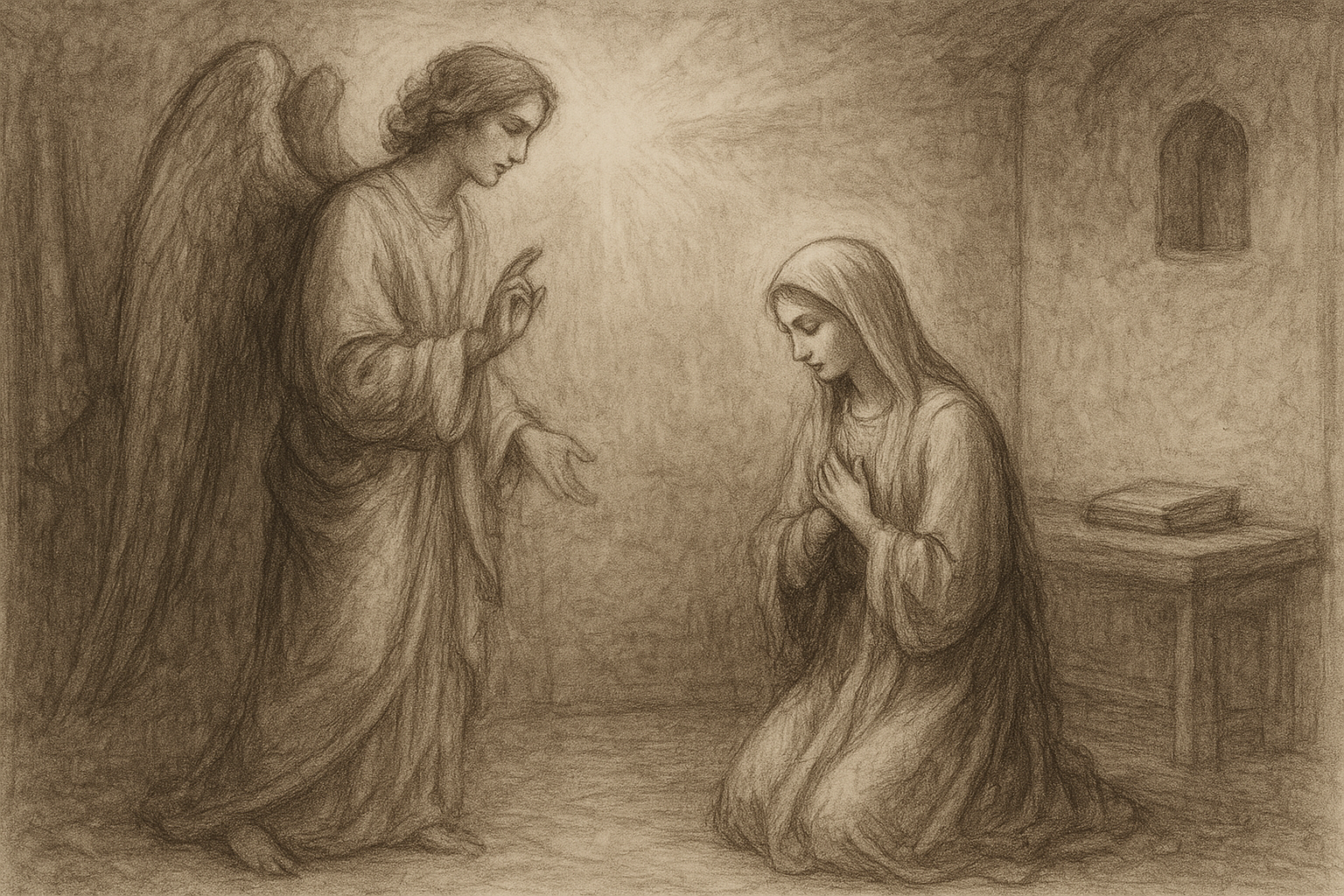
The chief account of the Annunciation is found in Luke 1:26 to 38. Gabriel is sent by God to Nazareth, a small and unremarkable place in the eyes of the world, to speak to Mary. He greets her as one favored by God and tells her that she will conceive and bear a son, and that the child will be called Jesus.
Mary is troubled, and rightly so. The message is unlike anything she has heard before. Yet her questions are not rebellion. They are the questions of a believing heart trying to understand the word of God. Gabriel answers her by revealing that the conception will be the work of the Holy Spirit. The child will be holy, the Son of the Most High, and Mary will bear him while remaining a virgin. The sign given to her is that her relative Elizabeth has also conceived in old age, because nothing is impossible with God.
The passage ends with Mary's consent: Behold, I am the handmaid of the Lord; let it be to me according to your word Luke 1:38. Catholic tradition has always heard in this response not a passive resignation, but a free and loving faith. Mary does not seize God's plan. She receives it.
Why the Church sees this as the beginning of the Incarnation
For Catholics, the Annunciation is not a preface to Christmas in a merely decorative sense. It is part of the mystery of the Incarnation itself. The eternal Son, who is one with the Father, truly becomes man. He does not merely appear human. He takes a real human nature from Mary, remaining fully God while becoming fully man.
Saint John states the mystery in majestic language: The Word became flesh and dwelt among us John 1:14. The Church reads the Annunciation as the first audible human answer to that divine decision to come near. The Son's taking flesh is entirely God's initiative, yet God chooses to work through Mary's free cooperation. That does not lessen grace. It reveals how grace restores and elevates human freedom.
This is why Catholics speak with such care about Mary's role. She is never a rival to Christ. She is the one chosen by Christ's grace to serve the coming of Christ. Her yes is beautiful precisely because it is directed wholly toward him.
Mary's faith and the shape of true discipleship
Mary's greatness in the Annunciation is not found in self-display. It is found in receptivity. She listens, asks, believes, and consents. The Church recognizes in her a model of discipleship that every Christian is called to imitate in a different way.
There is a pattern here that remains spiritually demanding. God speaks. A person is unsettled. Understanding comes only in part. Faith chooses trust. Then obedience follows. Mary does not require that every difficulty vanish before she believes. She entrusts herself to the one who has spoken.
Her response also teaches that holiness is not produced by human control. The Lord's work begins where self-sufficiency ends. Mary's humility is not weakness. It is spiritual freedom. She belongs to God before she belongs to any plan of her own.
My soul magnifies the Lord, and my spirit rejoices in God my Savior. Luke 1:46
The Magnificat, spoken soon after the Annunciation, shows what Mary's yes begins to shape within her: praise, wonder, and gratitude. She becomes a living witness that God's promises are trustworthy and that his mercy reaches the lowly.
The Annunciation in Catholic doctrine and devotion
Catholic teaching has long honored the mystery of the Annunciation because it safeguards two truths at once: the true divinity of Christ and the real humanity he receives from Mary. If Christ is truly born of a woman, then he is truly one of us. If he is conceived by the Holy Spirit, then his saving work is clearly God's work from the beginning.
The Church also honors Mary under the title of Theotokos, or Mother of God, because the child she bears is one divine Person, the Son. This title does not mean Mary is the source of Christ's divinity. It means that the one she gives birth to is truly God in the flesh. The Annunciation prepares the way for that confession.
In prayer and liturgy, the Annunciation invites believers to contemplate both mystery and mercy. The Angelus prayer, prayed traditionally at morning, noon, and evening, recalls the angel's message and Mary's consent. It is a simple devotion, but a profound one. It trains the heart to pause, remember, and adore the Word made flesh.
The feast itself is celebrated on March 25 when possible, nine months before Christmas, unless it is displaced by Holy Week or Easter week. This placement is fitting because the Church wants the faithful to see the intimate link between the moment of conception and the birth of Jesus. The saving story begins not with public acclaim but with hidden obedience.
How the Annunciation deepens devotion to Jesus
Some people worry that Marian devotion distracts from Christ. Properly understood, the opposite is true. Mary's place in the Annunciation directs attention to Jesus by making his coming more concrete, more personal, and more astonishing.
First, the scene reveals how near the Son of God has come. He enters the world not as an idea but as a child conceived in Mary's womb. Catholic devotion to the Annunciation protects the tenderness of the Incarnation. Jesus is not distant from our human life. He begins his earthly life hidden, dependent, and small.
Second, Mary's yes teaches the believer how to receive Christ. Devotion to Mary is always meant to lead to imitation. If she says yes to God's word, the Christian is called to say yes as well. That may happen in prayer, in repentance, in family life, in hidden sacrifice, or in the patient endurance of ordinary duty.
Third, the Annunciation deepens awe before divine humility. God does not force his way into the world. He asks, and Mary answers. The Lord who created all things chooses to begin the New Covenant in silence, in a home, through a young woman whose faith is greater than her visibility.
In that sense, the Annunciation Catholic meaning is not sentimental. It is theological. It tells us something essential about the way God saves. He saves by entering our nature, redeeming our freedom, and asking for our cooperation. The miracle is not only that Christ comes. It is that he comes in a way that honors the dignity he himself has given to human beings.
What Catholics can pray before this mystery
The Annunciation is especially fruitful for meditation because it gathers together humility, trust, and reverence. A Catholic praying this mystery may ask for the grace to listen before speaking, to trust before understanding, and to obey before control becomes an idol.
It also invites a deeper sense of reverence for life. From the first moment of the Incarnation, the Son of God takes to himself our human condition. The womb of Mary becomes the holy place where God begins his saving work among us. Catholics have always seen in this mystery a reason for gratitude before the wonder of human life.
For anyone who feels uncertain before God's call, the Annunciation offers comfort. Mary is not praised because she had no fear. She is praised because, in fear and faith together, she trusted God's word more than her own comprehension. That is not an easy lesson. It is a lifelong one.
When the Church looks to Mary at the Annunciation, she is not looking away from Christ. She is looking more directly at him. The first chapters of the Gospel show that the Savior comes through a human yes, and that this yes was already wrapped in grace. That is why the Annunciation remains one of the most luminous mysteries in Catholic life, always drawing the heart toward the child who will be called holy, the Son of the Most High, and the Lord who came to dwell among us.
Keep Reading on Lets Read The Bible
Frequently Asked Questions
What is the Annunciation in Catholic teaching?
The Annunciation is the moment when the angel Gabriel announced to Mary that she would conceive Jesus by the power of the Holy Spirit. Catholics see it as the beginning of the Incarnation, when the eternal Son of God truly took flesh.
Why is Mary's yes so important?
Mary's consent shows that God respects human freedom and invites cooperation with grace. Her yes is an act of faith and humility that helps reveal the beauty of God's saving plan.
How does the Annunciation lead Catholics closer to Jesus?
The Annunciation shows Jesus as truly entering human life through Mary, which deepens reverence for his Incarnation. It also teaches Catholics to receive Christ with Mary's trust, humility, and obedience.