Marian Devotion
Standing with Mary at the Foot of the Cross
The Seven Sorrows lead Catholics into a deeper contemplation of Christ's Passion through the heart of His Mother.
Site Admin | April 19, 2026 | 98 views
The sorrows of Mary are never separated from the life of Christ
The Seven Sorrows of Mary are among the most beloved Marian devotions in the Church because they keep our eyes fixed where the Gospel itself keeps them: on Jesus Christ, received and accompanied by His Mother. To speak of Mary's sorrows is not to place her above her Son, but to look more closely at the mystery of redemption as it unfolded in a real family, in a real human life, with real suffering and faithful love.
The Church has always treated Marian devotion as ordered to Christ. Mary does not replace the Lord, and she is never adored as God. Rather, she is honored as the Mother of the Redeemer, the woman whose obedience and compassion were uniquely joined to the saving work of her Son. In that light, the Seven Sorrows of Mary explained plainly become a school of meditation. They teach Catholics how to stay near Christ when faith is tested, when innocence is misunderstood, when grief is sharp, and when love must endure without easy answers.
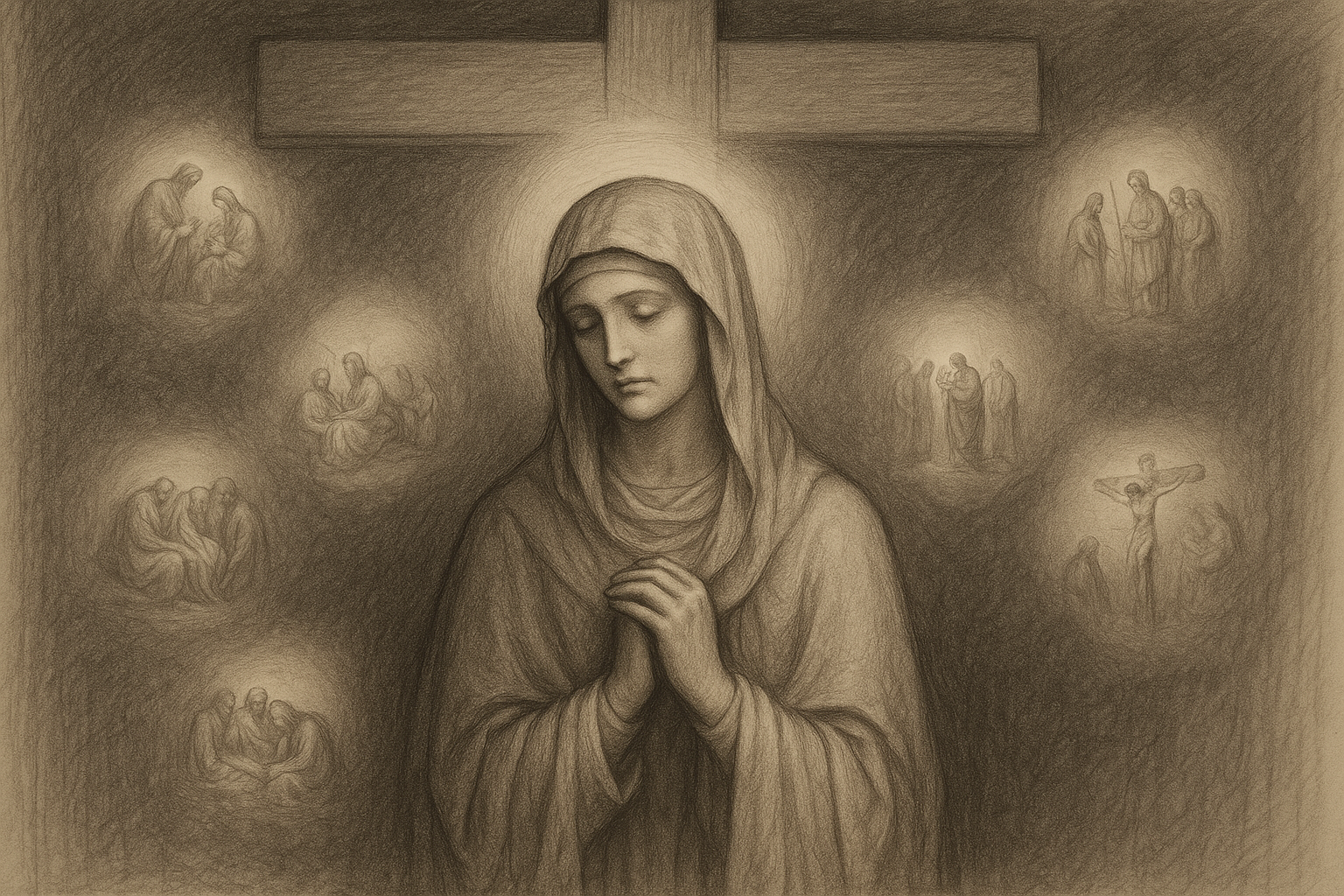
At the heart of the devotion are seven events from Scripture and sacred memory: Simeon's prophecy, the flight into Egypt, the loss of the Child Jesus in the temple, Mary's meeting with Jesus on the way to Calvary, the Crucifixion, the taking down of His body, and His burial. These are not sentimental scenes. They are moments of profound sorrow, but also of steadfast faith. Mary does not flee from the mystery. She bears it.
What the Church sees in Mary's suffering
Catholic teaching speaks carefully about Mary's role in salvation history. Jesus alone is the Redeemer. Yet Mary is inseparably joined to Him by grace, by motherhood, and by her complete yes to God's will. At the Annunciation, she offered that yes freely. At Bethlehem, at Nazareth, and at Calvary, she continued in that same obedience, even when it led her into suffering she could not avoid or explain away.
The Church does not mean that Mary suffered as though she were equal to Christ in His redemptive Passion. His sacrifice is unique. But she did suffer truly, as a mother, and her suffering was united to His in a way that reveals the cost of love. Her sorrow is a human sorrow illumined by faith. It is the sorrow of one who believes God's promise even while the sword foretold by Simeon pierces her heart and a sword will pierce your own soul too.
This is why the Seven Sorrows remain so fruitful for Catholic prayer. They do not encourage us to admire pain for its own sake. They teach us how suffering can be borne in faith, and how compassion is born when love refuses to turn away from another's agony. Mary stands close to her Son, and in doing so she becomes a tender companion to all who suffer at the foot of their own crosses.
The seven moments that shape the devotion
Each sorrow opens a doorway into Scripture and into prayer. Taken together, they trace the path from prophecy to burial, from the first shadow of suffering to the silence of the tomb.
1. Simeon prophesies a sword of sorrow
When Mary and Joseph bring the Child Jesus to the temple, Simeon blesses them and speaks words that are both luminous and painful. He recognizes the Messiah, but he also foretells that Mary will know a piercing sorrow Simeon, sword will pierce your own soul too. Even at the beginning of the Gospel, the shadow of the Cross is already present.
2. The flight into Egypt
Joseph rises in the night and takes the Child and His Mother into Egypt to escape Herod's violence Rise, take the child and his mother, They rose and took the child and his mother. This sorrow reminds Catholics that the Holy Family knew danger, displacement, and fear. Mary becomes the mother of the exiled and the threatened, the one who knows what it means to protect life in a time of peril.
3. The loss of the Child Jesus in the temple
After three days of searching, Mary and Joseph find Jesus in the temple among the teachers sitting among the teachers, Your father and I have been searching for you in great anxiety. The sorrow here is not merely parental alarm. It is the painful experience of not understanding where the Lord has gone, even while remaining faithful to seek Him. Many Catholics recognize their own prayer life in this moment. God is not always immediately felt, but He is still to be sought with patience.
4. Mary meets Jesus on the way to Calvary
Though not described in detail in the canonical Gospels, this sorrow has long held a place in Catholic devotion because it is consistent with the Passion accounts and with Mary's presence near the Cross. The Mother sees her Son burdened under the Cross, and He sees her. The meeting is brief, but it speaks volumes. Love does not prevent suffering, yet it can make suffering more bearable by presence alone.
5. The Crucifixion of Jesus
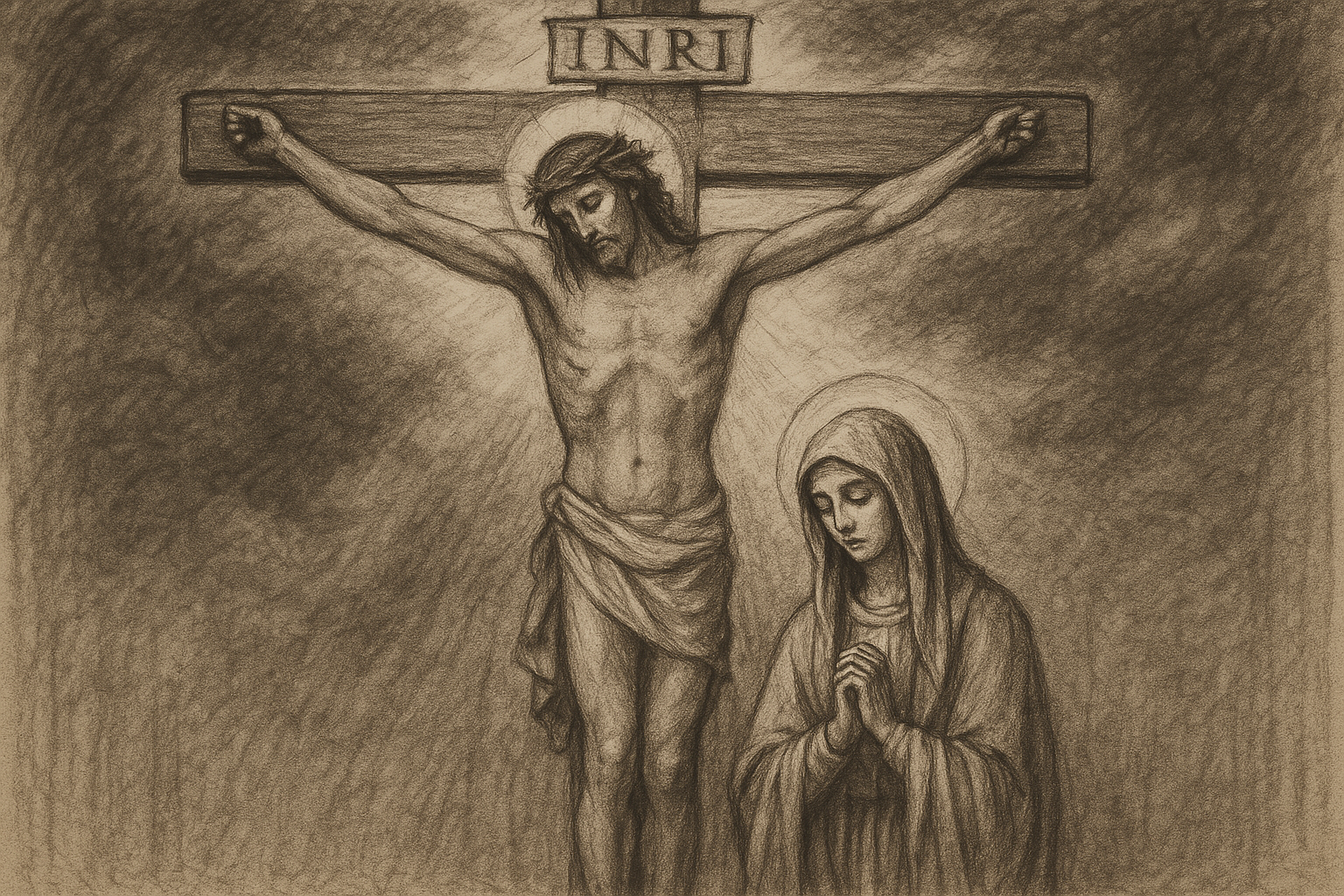
Here the devotion reaches its center. Mary stands near the Cross while Jesus gives His life for the world standing by the cross of Jesus were his mother, Woman, behold, your son, It is finished. This is not distant observation. It is maternal suffering joined to the hour of redemption. In John, the beloved disciple receives Mary, and in that gesture the Church sees a sign that all the faithful are invited into the shelter of her maternal care.
6. Jesus is taken down from the Cross and placed in Mary's arms
The Pieta is not narrated in a single Gospel verse, yet it belongs naturally to the Passion and to Christian memory. Mary receives the body of her Son after the sword has done its work. There is a terrible intimacy in this sorrow: the one who once carried Him into the world now holds Him in death. It is a scene of silence, reverence, and immeasurable grief.
7. Jesus is laid in the tomb
The final sorrow is the burial of Christ Joseph took the body, laid it in his own new tomb. The stone is rolled into place, and the disciples are left with grief and confusion. Mary, who had trusted God's word from the beginning, now waits in the darkness of Holy Saturday. The devotion ends not in despair, but in faithful waiting.
Why this devotion speaks so powerfully to Catholics
The Seven Sorrows of Mary explained in Catholic life are not a call to dwell morbidly on suffering. They are a call to look at suffering with Christian realism. Pain is not denied. Death is not minimized. Yet neither is God absent. The Cross reveals that divine love does not remain at a distance from human anguish. It enters it.
Mary's sorrows also teach a quiet and difficult virtue: compassionate endurance. She does not dominate the scene. She does not speak many words. She is present. That presence matters. In families, in hospitals, in moments of fear, and in seasons of unanswered prayer, faithful presence can become an act of love stronger than explanation. Mary models that kind of love.
For Catholics, the devotion can also purify our understanding of discipleship. To follow Christ is not to avoid suffering at all costs. It is to remain with Him through sorrow, trusting that the Father is still at work. Mary's life shows that holiness is not built only in joy. It is also formed in fidelity under the weight of tears.
Mary's sorrow does not compete with the Passion of Christ. It points us more deeply into it, and into the mercy that flows from it.
How to pray the Seven Sorrows with simplicity
There is no need for complicated language or elaborate preparation. What matters most is reverence, attention, and a desire to accompany Mary as she accompanies Christ. A simple way to begin is to choose one sorrow at a time and pray with the corresponding Scripture passage. Read slowly. Pause. Imagine the scene without forcing sentiment. Ask for the grace to see Christ more clearly and to remain faithful in your own trials.
Some Catholics pray the Seven Sorrows Rosary, which is traditionally structured around seven groups of seven Hail Marys, each with a meditation on one sorrow. Others simply reflect on the seven events during the week, perhaps one sorrow each day, or one sorrow at a time during Lent, Fridays, or the month of September, which is especially associated with Our Lady of Sorrows.
A few practical suggestions can help the devotion bear fruit:
- Read the Gospel passage before each decade or meditation.
- Keep the prayers unhurried, even if they are brief.
- Offer one sorrow for a specific intention, such as the suffering of a friend, the conversion of a family member, or peace for the departed.
- Let silence remain after prayer so the heart can respond.
Above all, do not be afraid of the tenderness this devotion awakens. Catholic prayer is not meant to harden the heart. It is meant to enlarge it. Mary's sorrows soften us toward Christ, toward one another, and toward those who suffer without anyone to accompany them.
Mary's sorrows and the life of the Church
The Seven Sorrows also have a communal meaning. The Church is not a collection of isolated believers who each carry their crosses alone. She is a body, and when one member suffers, all are called to respond in charity. Mary stands at the center of that mystery in a uniquely maternal way. She gathers the grieving, the uncertain, the wounded, and the persevering into the atmosphere of her own faith.
Her example is especially important in an age that often hides pain or rushes past it. The Gospel does neither. It tells the truth about human loss, and it reveals that redemption comes through love that remains. Mary helps Catholics learn that lesson not by argument alone, but by her presence in the sacred story.
To meditate on the Seven Sorrows is to learn that compassion is more than feeling sorry for someone. It is the willingness to stand near another's suffering without abandoning hope. Mary does this at Bethlehem, in Egypt, in Jerusalem, on the road to Calvary, beneath the Cross, at the tomb, and in the waiting that follows. She does it because she believes the word of God, even when that word must pass through death before it flowers in resurrection.
For prayerful readers, this devotion can become a gentle discipline of the heart. It teaches us to remember, to accompany, and to trust. And when we ask Mary to pray for us, we are asking to be formed by the same steadfast love that kept her close to Jesus from the first prophecy to the final burial, and beyond the silence of the tomb into the hope that God never fails His promises.
Keep Reading on Lets Read The Bible
Frequently Asked Questions
What are the Seven Sorrows of Mary?
They are seven events from Scripture and Catholic tradition that highlight the suffering of the Blessed Virgin Mary in union with the life and Passion of Jesus Christ: Simeon's prophecy, the flight into Egypt, the loss of the Child Jesus in the temple, Mary's meeting with Jesus on the way to Calvary, the Crucifixion, the taking down of Jesus from the Cross, and His burial.
Is the Seven Sorrows devotion the same as worship of Mary?
No. Catholics worship God alone. The devotion honors Mary as the Mother of Jesus and asks her intercession, while keeping Christ at the center of the meditation.
When is a good time to pray the Seven Sorrows?
Many Catholics pray it on Fridays, during Lent, on the Memorial of Our Lady of Sorrows in September, or whenever they want to pray through grief, suffering, or compassion for others.