Marian Devotion
How the Rosary Becomes a Prayer of the Whole Heart
The Rosary is not a mechanical repetition, but a steady path into the mysteries of Christ with Mary at our side.
Site Admin | April 15, 2026 | 94 views
The Rosary has long been one of the most loved prayers in Catholic life, and for good reason. It is simple enough for a child to learn, yet deep enough to sustain a lifetime of prayer. When people ask for the Rosary explained in a Catholic way, they often expect a list of vocal prayers or a method for counting decades. Those things matter, but they are only the surface. At its heart, the Rosary is a school of contemplation. It invites the faithful to look at Christ with the eyes of His Mother and to walk through the mysteries of salvation with a steady, prayerful rhythm.
That rhythm is part of the Rosary's beauty. The repeated prayers do not exist to fill space, but to quiet the heart. They create a kind of sacred stillness in which the mind can return again and again to the saving events of the Gospel. In this way, the Rosary is both spoken and silent. It is vocal prayer, but it also becomes meditation. It belongs to the lips, the hands, and the heart.
What the Rosary is, and what it is not
The Rosary is a devotional prayer centered on Christ, prayed with Mary. Catholics do not treat it as a substitute for the liturgy or the sacraments. It does not replace the Mass, and it does not stand apart from the Church's life of grace. Rather, it supports that life. The Rosary prepares the heart for worship, follows the mysteries of the Lord's life, and keeps the believer close to the Gospel in moments of peace, suffering, and daily labor.
Sometimes outsiders imagine that Catholics pray the Rosary as if repetition itself were the goal. But the Church has always understood prayer more deeply than that. Jesus warns against empty babbling in prayer, yet He also teaches persistence and trust before the Father Matthew 6:7 Luke 18:1. The Rosary is not empty speech when it is prayed with faith. Its repeated words are like the steady breathing of the soul, giving room for attention, love, repentance, and praise.
The Rosary is also not a Marian devotion that competes with Christ. In Catholic belief, all true devotion to Mary leads to her Son. Mary never points attention to herself as an end. At Cana she says, Do whatever He tells you John 2:5. That simple instruction describes her role in the Christian life. She gathers the believer toward Christ rather than away from Him.
Why Scripture belongs at the center
The Rosary is often called biblical, and that is no exaggeration. Its opening prayers echo the Gospels. The Hail Mary begins with Gabriel's greeting: Hail, full of grace, the Lord is with you Luke 1:28. It then joins Elizabeth's blessing: Blessed are you among women, and blessed is the fruit of your womb Luke 1:42. In one prayer, the Church places on our lips the very words of Scripture spoken at the dawn of the Incarnation.
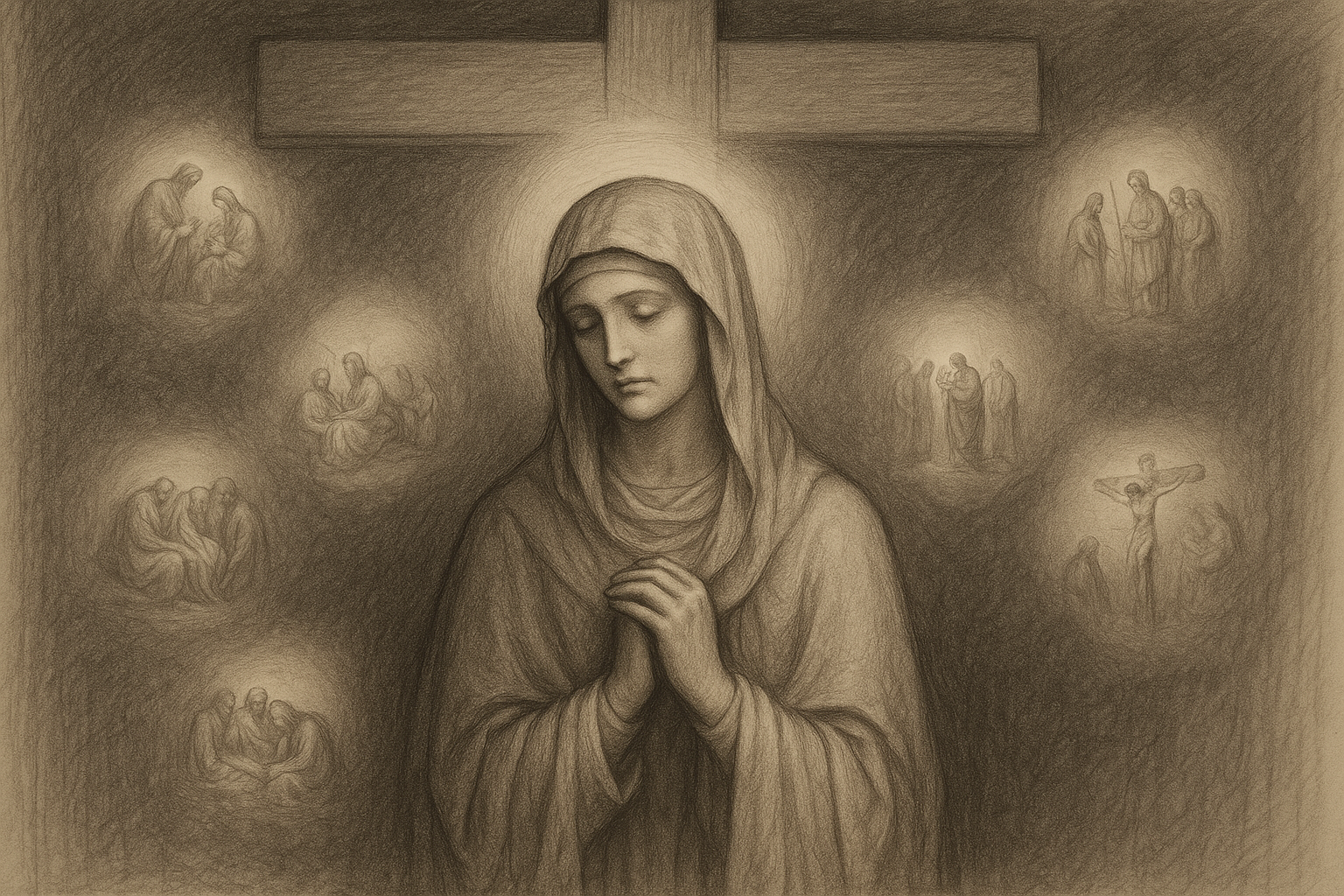
Even the mysteries themselves are drawn from the Gospel narrative. The Joyful Mysteries contemplate the Annunciation, Visitation, Nativity, Presentation, Finding in the Temple. The Luminous Mysteries reflect Christ's public ministry, especially His Baptism, the Wedding at Cana, the proclamation of the Kingdom, the Transfiguration, and the institution of the Eucharist. The Sorrowful Mysteries lead into the Passion. The Glorious Mysteries open toward Resurrection, Ascension, Pentecost, and Mary's sharing in the victory of her Son. In every set of mysteries, the Rosary returns to what God has done in Christ.
This is one reason the Rosary remains so fruitful. It does not ask the believer to invent spiritual content out of thin air. It gives the Gospel back to the praying Church, slowly and lovingly. It helps us remember that salvation is not an idea but an event. The Word became flesh John 1:14. He lived, suffered, died, rose, and poured out the Spirit. The Rosary keeps those mysteries near to the heart.
Mary's place in Catholic prayer
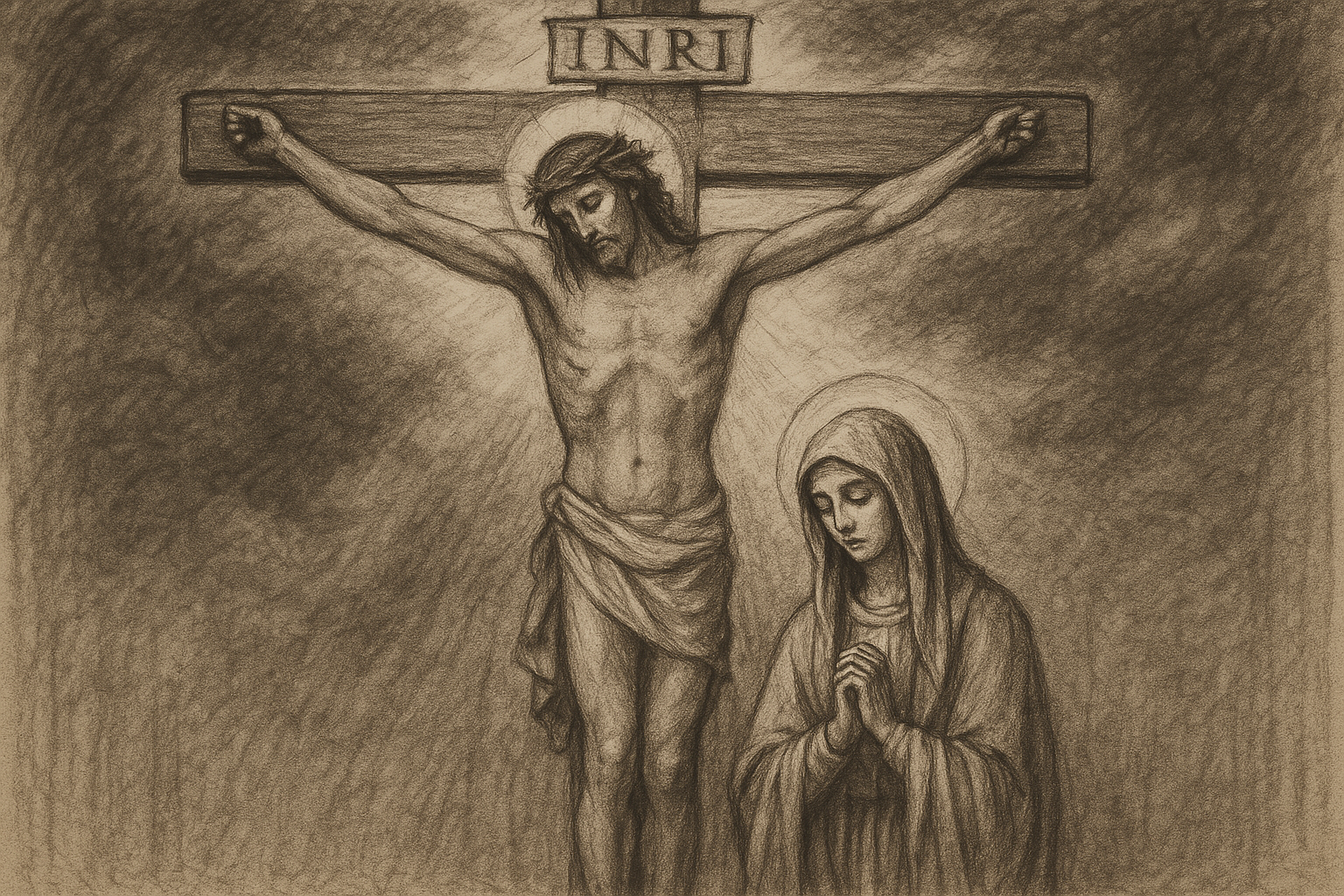
Catholic devotion to Mary has always been rooted in her relation to Christ. She is honored because God has done great things for her Luke 1:49. She is the Mother of the Lord, the first disciple, and a model of faith. At the Annunciation she answers with obedience: Let it be to me according to your word Luke 1:38. At the Cross she stands near her Son John 19:25. In the Upper Room, she is found praying with the disciples as the Church waits for the Spirit Acts 1:14.
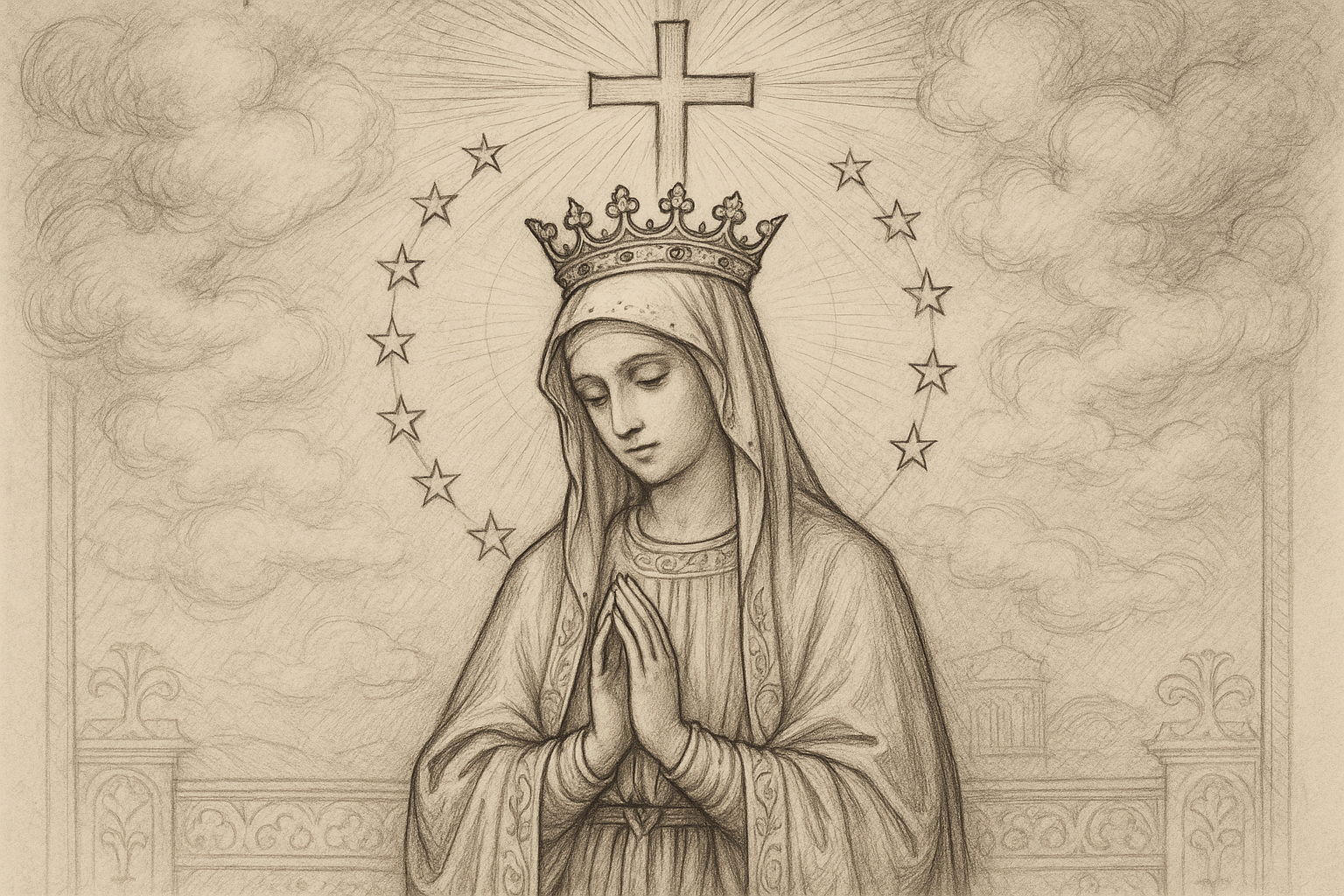
The Rosary is Marian because Mary is close to the mysteries of Christ. She is not adored as God alone is adored. Catholics worship the Blessed Trinity, and they honor Mary as the most blessed of creatures, chosen by grace to bear the Savior into the world. Her place in the Rosary is maternal and contemplative. She helps the faithful remain with Jesus, to ponder His life as she once pondered it in her heart.
Mary's greatness in the Rosary lies in this: she never obscures Christ. She teaches the Church how to receive Him, treasure Him, and follow Him.
That is why the Rosary so often feels both intimate and universal. It belongs to the simplest believer and to the seasoned contemplative alike. A grandmother praying at her kitchen table, a student on the bus, a sick person in bed, a priest in a quiet chapel, a family gathered after dinner, all can enter the same mysteries. The prayer does not depend on sophistication. It depends on faith.
The shape of the prayer
To pray the Rosary is to move through a sequence that is at once fixed and spacious. The usual form begins with the Sign of the Cross, the Apostles' Creed, an Our Father, three Hail Marys, and a Glory Be. Then comes each decade: an Our Father, ten Hail Marys, and a Glory Be, while meditating on one mystery at a time. Many Catholics also add the Fatima prayer after each decade, though the essential structure remains simple.
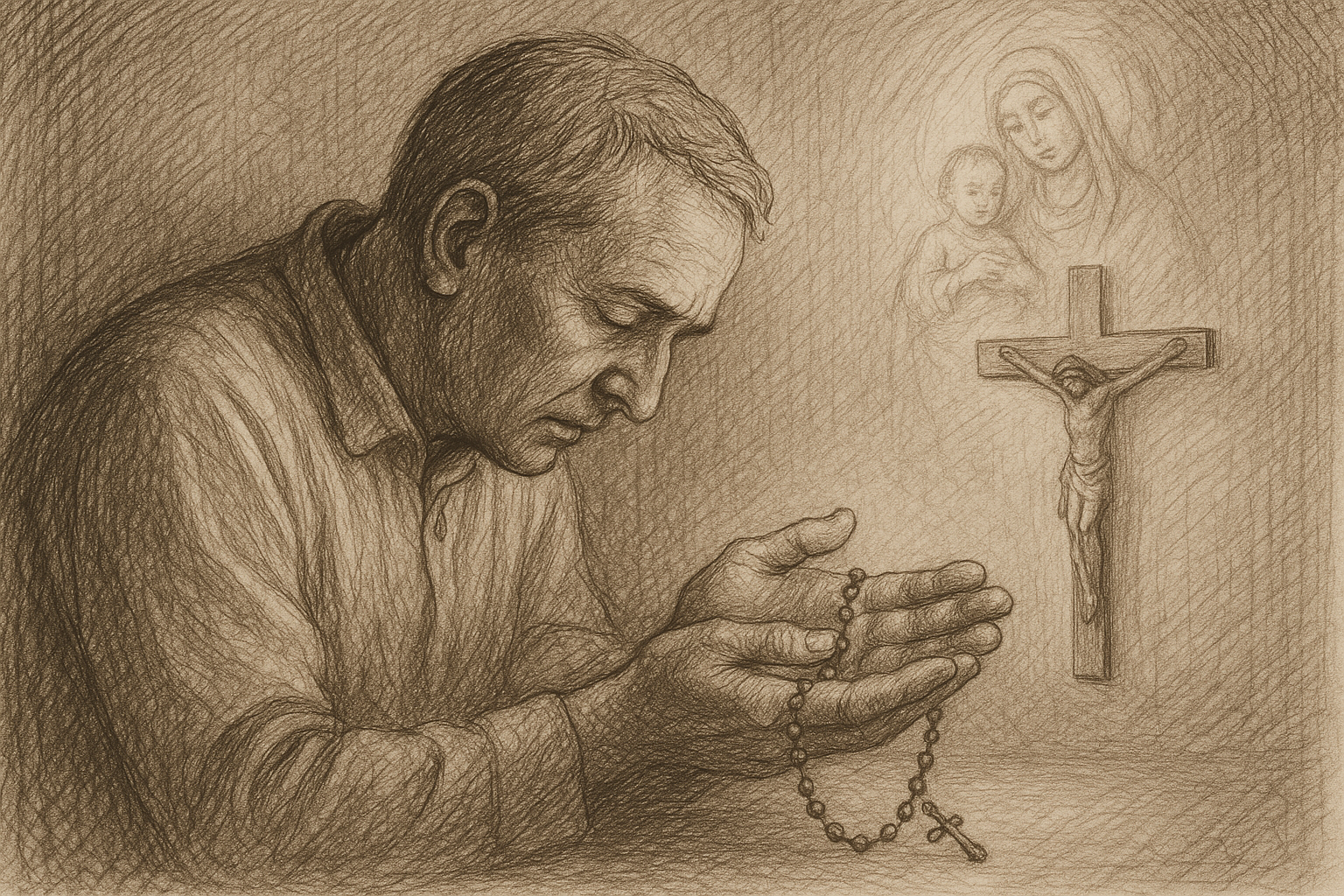
That structure matters because it makes prayer accessible. The hands count the beads while the mind contemplates the mystery. The body participates, which is fitting for Catholic prayer, since we are not disembodied souls. The faith comes through the senses, through words, gestures, memory, and time. The Rosary engages all of that without becoming complicated.
For those new to it, a wise approach is to start small. One decade prayed attentively is better than many decades rushed without recollection. The point is not to complete a task but to enter prayer. Some people pray the full Rosary each day. Others pray one set of mysteries. Families may choose a portion that fits the day. What matters is fidelity and love.
How the Rosary forms the Christian heart
The Rosary does more than provide a prayer routine. It shapes the heart over time. Repeated meditation on the mysteries trains the soul to see life through Christ. The Joyful Mysteries teach humility, trust, and hidden obedience. The Luminous Mysteries teach wonder, mission, and sacramental awareness. The Sorrowful Mysteries teach endurance, repentance, and union with the Cross. The Glorious Mysteries teach hope, perseverance, and confidence in God's final victory.
In this way, the Rosary is a prayer for ordinary life. It steadies the mind when the world is noisy. It consoles those who suffer. It recollects the distracted. It keeps before us the truth that the path to glory passes through the Cross. Saint Paul says that we are to pray without ceasing 1 Thessalonians 5:17. The Rosary helps many Catholics answer that call in a practical, embodied way.
It also teaches spiritual memory. Human beings forget what they most need to remember. We forget mercy after we have received it. We forget hope when fear arrives. We forget Christ's promises when burdened by the present moment. The Rosary patiently returns the mind to what is true. Again and again it places before us the mysteries by which God has saved the world.
Praying the Rosary well
Many Catholics discover that the Rosary becomes richer when prayed slowly. The words should be clear, but not hurried. The mysteries should be named, then contemplated. A short pause before each decade can help. Some people read a verse from the Gospel before beginning a mystery. Others simply hold the scene in memory. There is no single private method required by the Church. The essential thing is reverence.
If distractions come, they do not mean the prayer has failed. Every prayerful person knows distraction. The Rosary can actually help us respond to distraction by gently bringing the mind back. When attention wanders, we begin again. That repeated return is itself an act of humility. It acknowledges that prayer is gift, not achievement.
It is also helpful to pray the Rosary with intention, but not with the illusion that prayer is a technique for control. Catholics pray for many needs: peace in the family, repentance, healing, the dead, the conversion of sinners, and strength to carry the daily cross. These intentions are real and important. Yet the Rosary is not magic. It is a prayer of trust. We bring our need before God, and we ask to be formed by His will.
A simple way to begin today
- Choose one mystery set that fits your day.
- Read the first Gospel scene slowly.
- Pray one decade without rushing.
- Pause for a moment of silence after the decade.
- Offer the next decade with the same care, if time allows.
A simple beginning can open into a lasting habit. Many Catholics have found that the Rosary becomes more beautiful, not less, the longer it is prayed. Familiar words do not wear out when they are filled with faith. They deepen. They become companions in joy and sorrow.
In the end, the Rosary is a way of staying near Christ with Mary. It gathers the Gospel into prayer and lets the heart dwell there. For anyone seeking the Rosary explained in a way that is faithful and practical, this is the center of it: a humble, biblical, Catholic prayer that teaches us to remember Jesus, to love Him more deeply, and to follow Him with the steadfast trust of His Mother.
Keep Reading on Lets Read The Bible
Frequently Asked Questions
Is the Rosary mainly a prayer to Mary?
No. The Rosary is a Christ-centered prayer prayed with Mary. Catholics honor Mary, but the mysteries and the prayers lead the believer to Jesus Christ.
Do I have to pray the whole Rosary every day?
No. While many Catholics pray all four sets of mysteries each day, the Church does not require every person to pray the full Rosary daily. A decade prayed faithfully is a good place to begin.
What if I get distracted while praying the Rosary?
Distraction is common and does not mean the prayer has failed. Simply return to the words and the mystery with patience. That gentle returning is part of prayer itself.