Marian Devotion
The Angelus and the Rhythm of Holy Memory
A brief prayer that gathers the Annunciation, the Incarnation, and daily Catholic life into one steady act of praise.
Site Admin | April 17, 2026 | 99 views
The Angelus has long held a quiet place in Catholic life. It is not long, elaborate, or difficult to learn, and yet it opens a wide horizon of faith. In three short verses, a response, and a concluding prayer, the Church places before us the mystery of the Incarnation and the humble faith of the Blessed Virgin Mary. For many Catholics, the Angelus becomes a daily pause in the middle of ordinary life, a way of letting eternity touch the clock.
When people ask about the Angelus explained, they are often asking more than how to say the prayer. They want to know why the Church would gather so much meaning into a devotion prayed at sunrise, noon, and evening. The answer is simple and beautiful: the Angelus trains the heart to remember that the Word became flesh, that Mary consented in faith, and that every Christian life is meant to make room for Christ.
The prayer begins with Scripture
The Angelus is not a private meditation loosely attached to Catholic tradition. It is built from the Gospel itself. The opening verse recalls the angelic message to Mary: The Angel of the Lord declared unto Mary. The response, And she conceived of the Holy Spirit, points directly to the mystery revealed in the Gospel of Luke: 26 through 38.
This matters because Catholic devotion is healthiest when it stays close to Scripture. The Angelus does not ask us to imagine a pious scene of our own making. It asks us to enter the biblical event with the Church. We remember the Angel Gabriel's greeting, Mary's fear and openness, and the astonishing truth that the eternal Son of God took flesh in her womb by the power of the Holy Spirit.
The pattern continues with the words, And the Word was made flesh. Here the prayer echoes the Prologue of John's Gospel: 1 through 14. In that passage, the Church contemplates not only the coming of Christ, but the mystery of divine humility. The One through whom all things were made entered creation as one of us. The Angelus gives this truth a place in the daily rhythm of prayer, so that believers do not leave the Incarnation behind after Christmas or Advent.
Mary's fiat stands at the center
At the heart of the Angelus is Mary's yes. She does not merely receive a message; she responds with faith. Her words, Be it done unto me according to thy word, are among the most important lines in Scripture for understanding discipleship: 38. The Church has always seen in Mary's fiat a model of obedience rooted in trust.
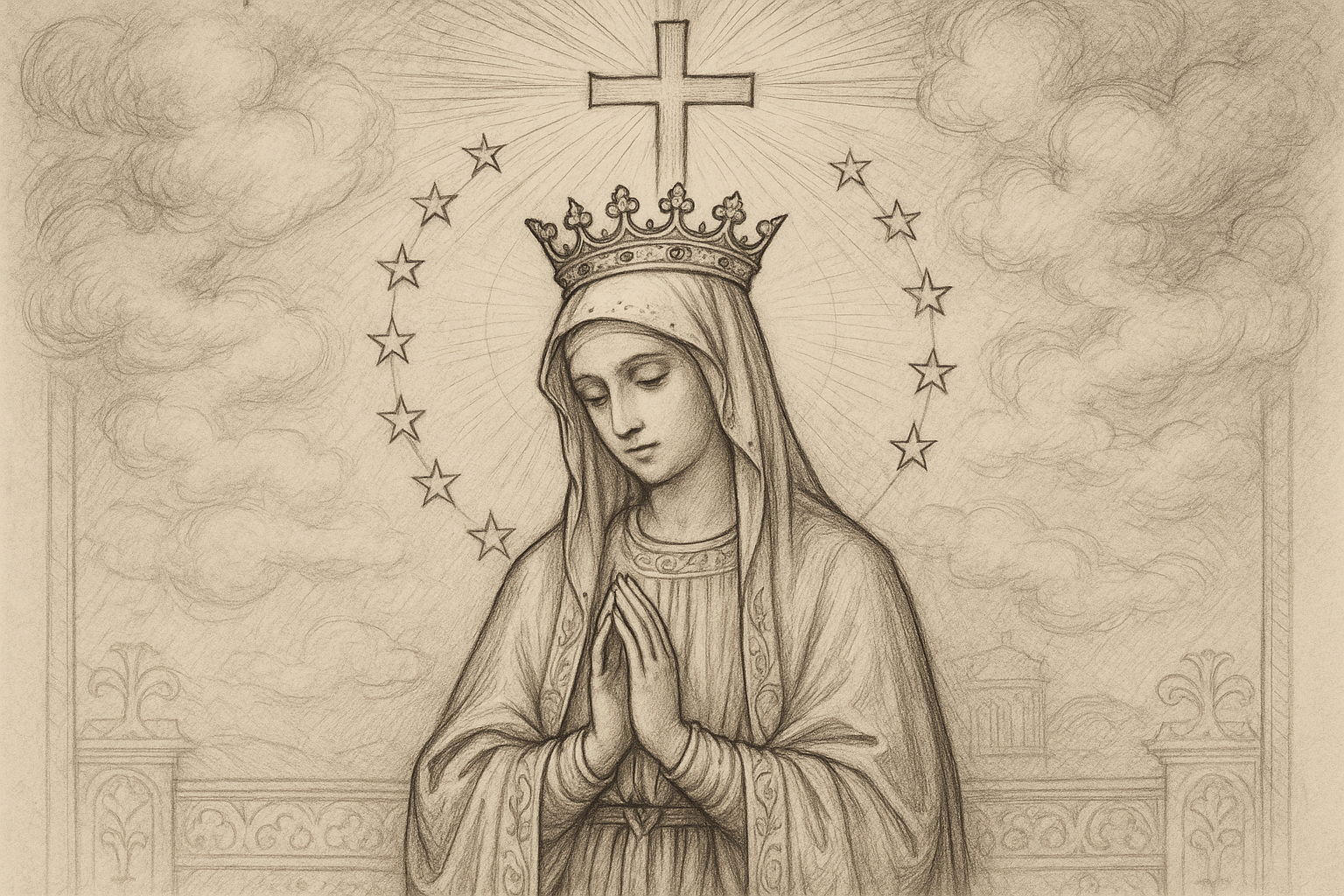
This does not mean that Mary becomes the center instead of Christ. Rather, she leads us to Christ because she is the first to receive Him in faith. The Angelus honors her unique role in salvation history precisely because her life is transparent to the Lord she bears. When Catholics pray the Angelus, they are not admiring Mary as though she were the final destination. They are asking for the grace to imitate her readiness to receive God's will.
In this sense, the prayer teaches a distinctly Catholic lesson: holiness is receptive before it is active. Mary does not save herself, and she does not save the world by her own power. She consents to God's saving action. The Angelus places that consent before us three times a day, quietly shaping the believer into a person capable of saying yes to grace.
A devotion of the Incarnation, not a distraction from it
Some devotions drift away from the central mysteries of the faith. The Angelus does the opposite. It returns us to the Incarnation, which is one of the foundational truths of Christianity. The Son of God did not merely appear among us or send a message from afar. He became man. He entered human history through the virgin's womb, in fulfillment of God's plan and for the salvation of the world.
This is why the prayer is so deeply liturgical in spirit, even when said outside the liturgy. It has the cadence of the Church's memory. The moment the bell rings, the day itself is interrupted by praise. Work pauses. Travel pauses. Conversation pauses. The body, which is often hurried and distracted, remembers that the flesh matters because God has honored flesh by taking it upon Himself.
That pause is not an escape from life. It is a way of returning life to its proper center. The Angelus sanctifies the ordinary by reminding the faithful that Christ entered the ordinary. Nazareth was not a palace. Mary's home was not an altar in the visible sense. Yet that hidden place became the site of the world's redemption. Every kitchen, office, classroom, and road can be touched by the same mystery when a believer pauses to pray.
The traditional form and its movements
The familiar structure of the Angelus helps explain its power. It usually includes three versicles and responses, each followed by a Hail Mary, then a closing prayer. The repetition gives the prayer a measured pace. It is easy to memorize, but not hurried. It is simple, but not thin.
That rhythm has pedagogical value. Repeated prayer teaches by gentle insistence. The mind may begin with words, but the heart slowly follows. The Angelus is especially suited to people who struggle to sustain long periods of contemplative prayer. It offers a compact, disciplined pause that can be prayed in a chapel, at a desk, in a field, or in the family home.
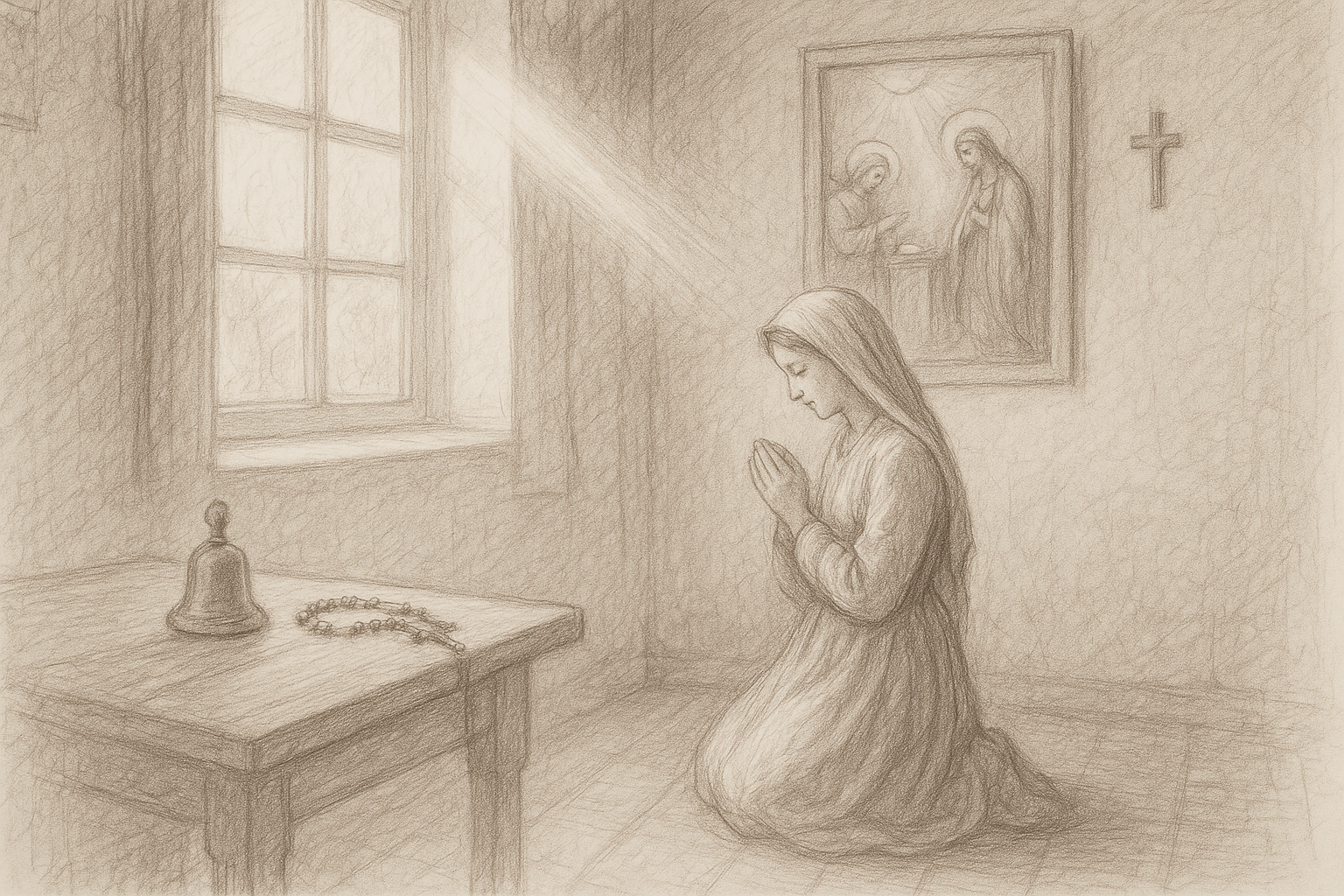
Many Catholics also pray the Angelus at the ringing of bells, a custom that has served Christian communities for centuries. The bell is a summons, not to anxiety, but to remembrance. Its sound gathers scattered thoughts and calls them back to the Lord. In this way, the prayer and the bell work together: one speaks, the other interrupts. Both invite recollection.
How the prayer forms the imagination
The Angelus does more than transmit doctrine. It forms spiritual habits. Because the prayer returns day after day, it places the mysteries of the Annunciation and the Incarnation into the imagination of the faithful. A Catholic who prays it regularly learns to see time differently. The day is no longer only a sequence of tasks. It becomes a field where grace can be received, remembered, and answered.
It also teaches that prayer need not be far removed from responsibility. Some people fear that devotion will make them less practical. The Angelus suggests the opposite. By stopping to remember the Incarnation, a Christian becomes more able to carry on with charity, work, and endurance. The prayer does not replace labor; it reorders labor under the Lordship of Christ.
There is something profoundly human in this. We often forget what matters most because we are absorbed by what is closest. The Angelus restores perspective. It says, in effect, that the greatest event in history happened quietly, and that the greatest God entered the world humbly. That memory can soften pride, steady anxiety, and deepen gratitude.
Praying the Angelus in ordinary life
For those who want to begin, the best advice is to keep it simple. Learn the form, choose a regular time, and pray it faithfully. Many Catholics use morning, midday, and evening as natural markers. Others begin with just one time of day. The important thing is to create a habit that can endure.
It can be helpful to pray the Angelus slowly at first, paying attention to each phrase. When the words mention Mary, pause with her. When they name the Word made flesh, pause before the mystery of Christ's coming. When the prayer asks that we be made worthy of His promises, let that petition sink in as a real plea, not a formula.
Here are a few practical ways to weave it into daily life:
- Pray it when a phone alarm, church bell, or natural break in the day reminds you.
- Teach it to children as a short family prayer rooted in the Gospel.
- Keep a printed copy nearby until the words become familiar.
- Offer one brief intention before or after the prayer for the needs of the Church and the world.
These small practices matter because devotion grows through consistency. The Angelus is not meant to impress; it is meant to sanctify. Its beauty lies partly in how gently it enters the day.
A prayer for seasons of waiting and fulfillment
The Angelus speaks especially well to seasons of waiting. Advent gives it a natural home, but the prayer is not limited to that liturgical season. It speaks to every human experience of longing, uncertainty, and hope. Mary waited in faith. Israel waited for redemption. The Church still waits for the Lord's final coming. The Angelus keeps all of that expectation alive.
At the same time, the prayer reminds us that fulfillment has already begun. Christ has come. The Savior has entered the world. Grace is not a distant promise but a present reality. The same Lord whom Mary bore in humility now feeds His people in the sacraments and sustains them by His Spirit. The Angelus holds waiting and fulfillment together without confusion.
That balance is one reason the devotion remains so fruitful. It is neither sentimental nor abstract. It is grounded in the Gospel, but it is also profoundly pastoral. A tired parent can pray it. A worker on a break can pray it. A student preparing for class can pray it. The prayer does not ask for ideal conditions. It asks only for attention, reverence, and faith.
In a world that prizes speed, the Angelus makes room for holy memory. In a culture that often forgets silence, it creates one. In a spiritual life that can easily become detached from the Incarnation, it returns us to the beginning of Christian hope: the Word became flesh and dwelt among us, and Mary said yes.
For Catholics who pray it well, the Angelus becomes more than a devotion. It becomes a daily school of recollection, a gentle discipline of love, and a way of standing with the Church at the mystery where heaven touched earth.
Keep Reading on Lets Read The Bible
Frequently Asked Questions
What is the Angelus in Catholic prayer life?
The Angelus is a traditional Catholic Marian devotion that recalls the Annunciation and the Incarnation. It combines short Scripture-based verses with three Hail Marys and a closing prayer, usually prayed morning, noon, and evening.
Why do Catholics pray the Angelus three times a day?
The three times of prayer help sanctify the day and keep the mystery of the Incarnation before the mind. The pattern also mirrors the Church's desire to pause regularly for remembrance, gratitude, and prayer.
Is the Angelus a Marian prayer or a Christ-centered prayer?
It is both, but it is firmly Christ-centered. The prayer honors Mary because of her role in the Annunciation, yet its heart is the mystery that the Word became flesh. Mary is always ordered to Christ in Catholic devotion.