Marian Devotion
Mary at the Nativity: Silence, Wonder, and the First Christmas Prayer
How the Church reads Mary's place at Bethlehem as a quiet witness to the Incarnation and a path into deeper devotion to Christ.
Site Admin | March 25, 2026 | 84 views
The Gospels do not give us a long scene at the manger. They give us enough to contemplate, and that is often how God teaches the heart. Mary is there at the Nativity, close to the Child whom she has borne by the power of the Holy Spirit, and the Church has never treated that detail as incidental. Her presence points to the mystery of the Incarnation itself: the Son of God has truly come among us, and he comes into human life through the free, believing yes of a woman of Israel.
The Mary at the Nativity Catholic meaning is not found in sentiment alone. It is found in Scripture, in the Church's reverence for the Mother of the Lord, and in the way her hidden faith helps us adore Jesus more deeply. At Bethlehem, Mary does not replace Christ. She leads us to him by her silence, her faith, and her maternal care.
Mary in the Nativity accounts
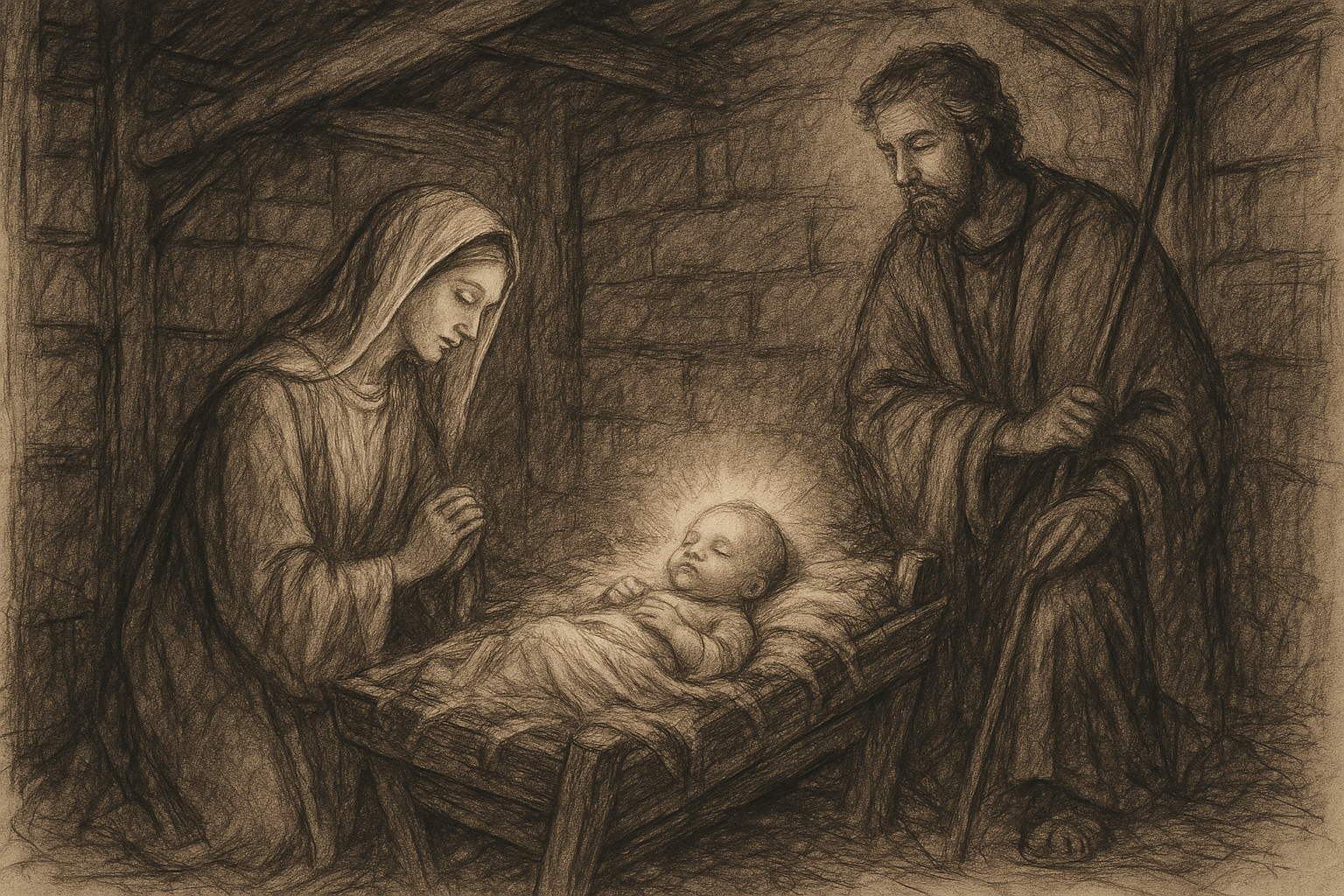
The Nativity narratives in Matthew and Luke do not read like later devotional art, though sacred art has long helped Christians imagine the scene. Luke tells us that Mary gave birth to her firstborn son, wrapped him in swaddling clothes, and laid him in a manger, because there was no room in the inn Luke 2:7. The angelic announcement to the shepherds comes after this, and they find Mary and Joseph, and the baby lying in the manger Luke 2:16. Matthew, for his part, speaks of the child Jesus with Mary his mother, especially when the Magi come to worship him Matthew 2:11.
These passages matter because they place Mary exactly where the Church has always received her: beside the Son, not in rivalry with him. She is mother, disciple, and first among believers. The child is not merely connected to her; he is entrusted to her care in real human infancy. That is one reason the Nativity is so precious to Catholic devotion. In Mary we see that the Word became flesh, not as an idea, but as a child who needed to be held, fed, wrapped, and protected.
Luke also preserves Mary's interior life. Before the Nativity, after the shepherds' visit, we are told that Mary kept all these things, pondering them in her heart Luke 2:19. This is one of the most important lines in the Christmas Gospel. It shows that Mary's faith is not noisy or self-asserting. It is receptive, contemplative, and steady. She receives the mystery and turns it over in prayer.
What the Church sees in Mary's presence at Bethlehem
Catholic doctrine reads the Nativity within the larger mystery of the Incarnation. The eternal Son of God truly became man, and Mary is the Mother of that incarnate Son. The Church honors her as Theotokos, Mother of God, not to magnify Mary apart from Christ, but to protect the truth about Christ. The one whom she bears is one divine Person, the Son, who has taken a human nature from her. At Bethlehem, that truth is visible in humble form.
Mary's presence also reveals something about how God saves. He does not enter history as a passing force or a distant teacher. He enters through family, promise, poverty, and trust. He comes in the ordinary texture of human life. Mary stands at the center of that mystery because she said yes to God at the Annunciation and remained faithful through the hiddenness of the child's early days. Her faith is not dramatic display. It is fidelity.
That is why Catholic devotion to Mary at Christmas is never meant to compete with adoration of Jesus. Rather, it helps us see Jesus more clearly. If Christ is truly man, then the maternity of Mary is not secondary information. It belongs to the truth of the Gospel. The one born in Bethlehem is the same one conceived by the Holy Spirit in Mary's womb. To love Mary rightly is to confess that Jesus truly came through her, and that his coming was real, bodily, and saving.
Mary's humility and the shape of Christian prayer
Mary at the Nativity teaches a kind of prayer that many Christians need to recover, especially during Advent and Christmas. Her prayer is not a performance. It is receptivity before mystery. She does not explain the Incarnation. She adores it. She does not control the event. She receives it.
There is wisdom in that posture. In a season that can become crowded with noise, schedules, shopping, and sentimental expectations, Mary's stillness is corrective. She shows that the deepest things are often received in silence. The Child in the manger is not grasped by argument alone. He is welcomed by faith.
Mary's humility also reminds us that Christian greatness is not self-display. She is blessed, but her blessedness is shaped by obedience. At Bethlehem, she appears small in the eyes of the world, yet she is nearest to the heart of salvation history. Her hidden service is part of the revelation of God's mercy. The Lord lifts up the lowly, and Mary is the first to embody that song.
The Nativity teaches that God does not save us from afar. He enters the world in the vulnerability of a child, and Mary stands near that mystery with trusting faith.
From Bethlehem to the altar
Catholics do not stop at historical remembrance when they contemplate Mary and the Nativity. The Church reads Bethlehem in light of the liturgy. The same Lord whom Mary bore in her arms is present to his Church in the sacraments, especially in the Eucharist. That does not mean the Nativity and the Eucharist are identical events, but they are related by the one saving identity of Christ. The Child of Bethlehem is the risen Lord who gives himself to us as food and life.
This connection gives Christmas devotion a sacramental depth. Mary carried the Body of Christ before anyone else did. She was the first tabernacle in a very real sense, because the Son of God dwelt within her. Catholic tradition has long cherished this insight, not as a poetic exaggeration, but as a meditation on the truth that God chose to dwell among us in flesh and blood. Mary's body became the place of divine visitation, and that fact continues to shape the Church's reverence for the human body, for motherhood, and for the dignity of ordinary life.
When believers kneel before the manger scene, or before the Eucharist, they are not turning toward different Christs. They are adorning one and the same mystery from different angles. Mary helps us move from the scene at Bethlehem to the living presence of Christ in the Church. Her maternal closeness does not end in nostalgia. It leads to worship.
The witness of the saints and the tradition of devotion
Across the centuries, the saints have returned to Mary in the Nativity because they understood that her quiet witness protects Christian faith from abstraction. Saints and theologians have praised her consent, her purity of heart, and her steadfast love. Christian art has shown her bending over the manger, gazing at the Child, or standing in adoration with Joseph nearby. These images endure because they help ordinary believers pray with the Gospel.
The Church's liturgical life also places Mary at the center of Christmas in a restrained and fitting way. The Octave of Christmas includes the Solemnity of Mary, Mother of God, which falls at the beginning of the new year. That is not accidental. The Church wants us to begin the year by confessing the one who bore the Savior. Mary's title safeguards the identity of Jesus and invites the faithful to begin again in wonder.
At the same time, Marian devotion remains ordered to Christ. The rosary, for example, leads believers into the mysteries of his life, including the joyful mysteries that begin with the Annunciation and continue through the Nativity. In that way, Mary is not an endpoint. She is a sure guide. Her words at Cana remain a concise pattern for all Christian devotion: Do whatever he tells you John 2:5. At Bethlehem, as throughout her life, she points beyond herself to her Son.
How to pray with Mary at Christmas
For Catholics, a fruitful way to approach Mary at the Nativity is not to look for a dramatic feeling, but to ask for a steadier faith. The Christmas mystery can be prayed simply and honestly. One might visit the manger scene in a church or at home and remain there in silence. One might read Luke 2 slowly and let the details settle in the mind. One might ask Mary to teach the heart how to receive Christ with reverence.
It can also help to place one's own life before the Child she holds. Mary knows what it is to love without fully seeing the future. She knows what it is to trust God in obscurity. She knows what it is to guard a precious gift in a world that does not always make room for him. In that sense, she speaks to every Christian family trying to keep Christ at the center of a busy season.
Her example is not complicated. She receives, she ponders, she adores, and she gives him to the world. That is the heart of Marian devotion at Christmas. It is not an escape from Jesus. It is one of the Church's oldest ways of staying close to him. And when believers stand with Mary at Bethlehem, they learn again that the Savior comes in gentleness, in poverty, and in flesh, asking only that we receive him with faith.
Keep Reading on Lets Read The Bible
Frequently Asked Questions
Why is Mary important in the Nativity story?
Mary is important because she is the Mother of Jesus and the one through whom the Son of God entered human history in the flesh. Her presence at Bethlehem shows the reality of the Incarnation and the humility of God's saving plan.
Does honoring Mary at Christmas take attention away from Jesus?
No. In Catholic faith, honoring Mary always points to Jesus. She is honored because of who her Son is. Her role helps believers recognize the truth of the Incarnation and adore Christ more deeply.
What does Mary teach Catholics during the Christmas season?
Mary teaches receptivity, humility, contemplation, and trust. She shows how to welcome Christ with faith, to ponder God's work in silence, and to keep Jesus at the center of family and prayer life.