Marian Devotion
Marys Song, and the Shape of Christian Praise
A Catholic reading of the Magnificat as Scripture, prayer, and a school of humble joy
Site Admin | March 24, 2026 | 94 views
The Church has always received the Magnificat with reverence because it is not only one of the most beautiful prayers in Scripture, but also one of the clearest windows into the heart of the Blessed Virgin Mary. In the Gospel of Luke, Mary speaks after Elizabeth has blessed her, and her words rise almost like a hymn already carried by the Holy Spirit. The prayer begins with joy, but it does not remain private. It widens into praise of Gods mercy, His justice, and His fidelity to Israel. That is part of what makes the Magnificat explained so compelling for Catholic readers: it is Marian, biblical, and unmistakably centered on God.
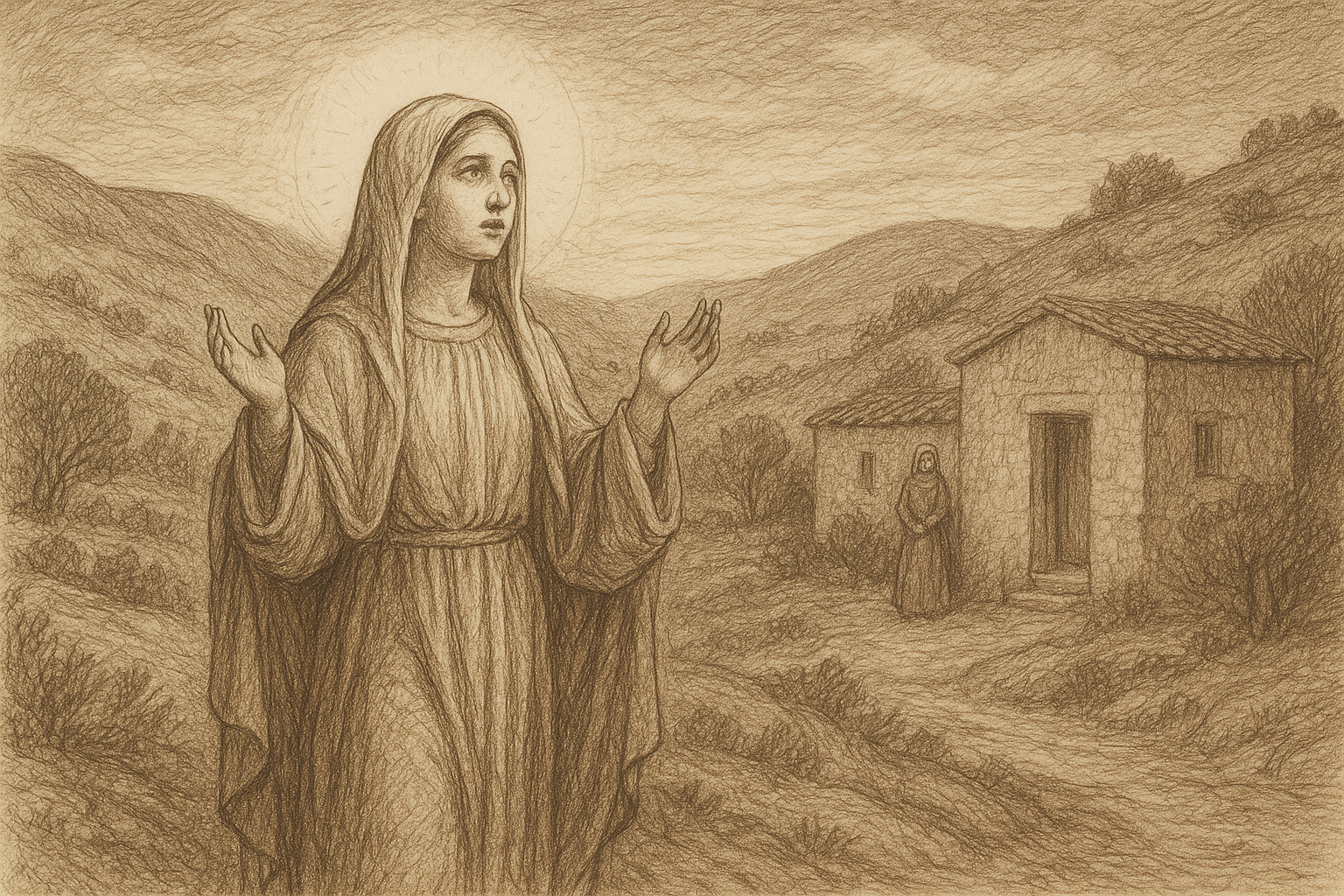
Luke places the canticle in the Visitation scene, when Mary goes to Elizabeth and the unborn John the Baptist leaps for joy in his mothers womb. The whole passage is charged with grace. Elizabeth cries out, And why is this granted me, that the mother of my Lord should come to me? Luke 1:43 and Mary answers with the prayer the Church now calls the Magnificat: My soul magnifies the Lord, and my spirit rejoices in God my Savior Luke 1:46. Mary does not draw attention to herself for her own sake. She points beyond herself to the God who has looked upon her lowliness and done great things for her Luke 1:48-49.
The scriptural roots of Marys song
The Magnificat is not a private poem detached from the Old Testament. It is soaked in Israel's prayers, especially the song of Hannah in 1 Samuel 2. Hannah, once barren, praises the Lord who lifts the lowly and humbles the proud. Mary does something similar, but even more profoundly, because she speaks as the Mother of the Messiah. Catholic readers should notice that the Magnificat is not isolated sentimentality. It belongs to the long history of Gods covenant mercy.
Mary says that God has scattered the proud in the thoughts of their hearts, put down the mighty from their thrones, and exalted those of low degree Luke 1:51-52. These lines are not a call to worldly rebellion or bitterness. They are a proclamation that God sees human pride truthfully and that His kingdom overturns the false standards by which power often operates. The hungry are filled with good things, and the rich are sent away empty Luke 1:53. In biblical language, hunger and fullness are not only about food. They reveal the condition of the soul. Those who know their need are prepared to receive grace.
Why Catholics honor the Magnificat so deeply
Catholic devotion to Mary always remains ordered to Christ. That is one reason the Magnificat matters so much. Mary never competes with the Lord she bears. She glorifies Him. Her soul magnifies the Lord because all true Marian devotion leads to adoration of God, not away from it. She is the first and most perfect disciple, and her prayer shows the proper posture of discipleship: grateful, obedient, and receptive.
The Catechism teaches that Marys fiat, her yes at the Annunciation, opened her whole life to the saving work of God. The Magnificat is what that yes sounds like when it becomes praise. The same woman who said, Let it be to me according to your word Luke 1:38 now sings of a God who has remembered His promise to Abraham and his descendants forever Luke 1:55. There is continuity here. Marys faith is not a passing emotion. It is covenant faith. She trusts that Gods mercy is ancient, personal, and active.
For Catholics, the Magnificat is also a school of humility. Mary does not deny what God has done in her. She names it plainly: for he who is mighty has done great things for me Luke 1:49. Humility is not pretending that grace is small. It is receiving grace without stealing credit from the Giver. Marys greatness lies precisely in her openness to Gods greatness. This is why the Church honors her. She is the woman in whom Gods favor shines without distortion.
Praise that remembers mercy
One of the most striking features of the Magnificat is that praise and memory belong together. Mary praises God not only for what He is doing in the present, but for what He has always been. She calls Him holy, merciful, mighty, and faithful to His promise. Christian praise is healthiest when it remembers. We forget so quickly. We forget answered prayers, forgiven sins, undeserved consolations, and the quiet ways God has sustained us. Marys song resists forgetfulness.
This is especially important in prayer. Many Catholics know how to ask God for help, but less often do they pause to bless Him for who He is. The Magnificat teaches a more complete prayer. It begins in worship before it turns to need. It acknowledges that God has already acted and will continue to act according to His mercy. If a Catholic prays the Magnificat slowly, line by line, the heart can be trained to see life differently. The soul learns to look for God not only in dramatic interventions, but in faithful providence.
My soul magnifies the Lord, and my spirit rejoices in God my Savior Luke 1:46.
That sentence alone can become a daily prayer. It is simple enough to memorize and deep enough to return to for a lifetime. The soul magnifies the Lord not by making Him larger, but by letting His greatness become more visible in the believer's life. Praise does that. It clears the haze of self-importance and places all things in right relation to God.
The Magnificat and the reversals of the kingdom
Marys words about the proud, the mighty, the rich, and the hungry can sound unsettling, but they should not be read as envy. They are a moral and spiritual diagnosis. God opposes pride because pride shuts the heart against grace. God lifts up the lowly because humility creates room for mercy. The kingdom of God is marked by reversals that reveal the truth. Human status is not final. Exaltation and humiliation are not decided by appearance, wealth, or power.
This is deeply Catholic. The Gospel constantly presents God as One who exalts the humble. Jesus will later teach that the first shall be last, and the last first. The Magnificat already prepares us for that truth. It tells us that salvation is not earned by social advantage. It is received by faith. That matters for prayer, for repentance, and for the way Catholics view the poor. If God looks with favor upon the lowly, then the Church must do so as well.
The Magnificat also protects us from a shallow view of holiness. Holiness is not self-display. Mary is the holiest creature, and yet her song is not about her own significance apart from God. Her holiness is transparent. She becomes clearer as Christ approaches. That should challenge any Christian tempted to turn devotion into self-promotion. True Marian devotion never ends in itself. It becomes more fully Christian because it becomes more fully centered on the Lord.
Praying the Magnificat in ordinary life
Many Catholics pray the Magnificat at Evening Prayer in the Liturgy of the Hours, where it stands as the Church's daily song of praise. That liturgical setting is not accidental. Evening is a natural time to remember what God has done throughout the day and to offer it back to Him. But the Magnificat can also become a personal prayer outside the Office, especially in moments of gratitude, uncertainty, or repentance.
One practical way to pray it is to move through the canticle in three steps:
- Begin with adoration. Name God as mighty, holy, and merciful.
- Remember His works. Recall concrete graces, even small ones.
- Offer your needs. Ask for the humility and faith to receive what He gives.
Another fruitful practice is to pray the Magnificat after receiving Communion or after reading the Gospel of the day. Since the prayer is so deeply rooted in Scripture, it harmonizes well with lectio divina. A reader can pause after each phrase and ask: Where in my life is God showing His mercy? Where am I tempted to pride? Where do I need to trust that He fills the hungry with good things?
Marian devotion becomes very practical here. To pray with Mary is to let her school the heart in attentiveness. She notices. She remembers. She believes. She gives praise before she explains herself. Those habits are useful for every Catholic household. Parents, children, the young, and the elderly can all learn to make thanksgiving more immediate and grumbling less familiar.
Marys song and the life of the Church
The Magnificat is not merely about Mary as an individual. It is also the song of the Church. The Church is meant to be a people who magnify the Lord, rejoice in God our Savior, and stand with the lowly. When the Church sings Marys words, she is learning how to speak as the Bride of Christ. She is being formed in humility, memory, and hope.
This is why the Magnificat remains so important in Catholic spirituality. It is not devotional decoration. It is a pattern for the soul. The prayer teaches that God does not forget the promises made to His people. It teaches that holiness and humility belong together. It teaches that praise should rise from gratitude, not self-confidence. And it teaches that every true Marian prayer ends where Mary herself always points us: to the mercy of God in Christ.
When Catholics pray the Magnificat with attention, they are not simply reciting ancient words. They are joining Mary in her joy and allowing her faith to shape their own. The result is a calmer heart, a clearer conscience, and a more grateful way of seeing the world. Marys song still belongs to the Church because the God who raised up the lowly has not changed, and His mercy still reaches from age to age Luke 1:50.
Keep Reading on Lets Read The Bible
Frequently Asked Questions
What is the Magnificat in the Catholic faith?
The Magnificat is Mary's hymn of praise in Luke 1:46-55. Catholics honor it as Scripture, as a prayer of thanksgiving, and as a beautiful witness to Mary's humility and faith in God's mercy.
Why does the Church pray the Magnificat every evening?
The Church includes the Magnificat in Evening Prayer because it is a fitting daily song of praise. It helps believers thank God for His work, remember His mercy, and end the day with worship rather than self-focus.
Does praying the Magnificat take attention away from Jesus?
No. In Catholic teaching, authentic devotion to Mary always leads to Christ. The Magnificat itself is entirely Christ-centered, since Mary magnifies the Lord and rejoices in God her Savior.