Marian Devotion
When Mary Set Out in Haste: The Grace Hidden in the Visitation
The Visitation reveals how charity, humility, and joy in Christ move together in Marys meeting with Elizabeth.
Site Admin | March 21, 2026 | 92 views
Marys journey that changed two households
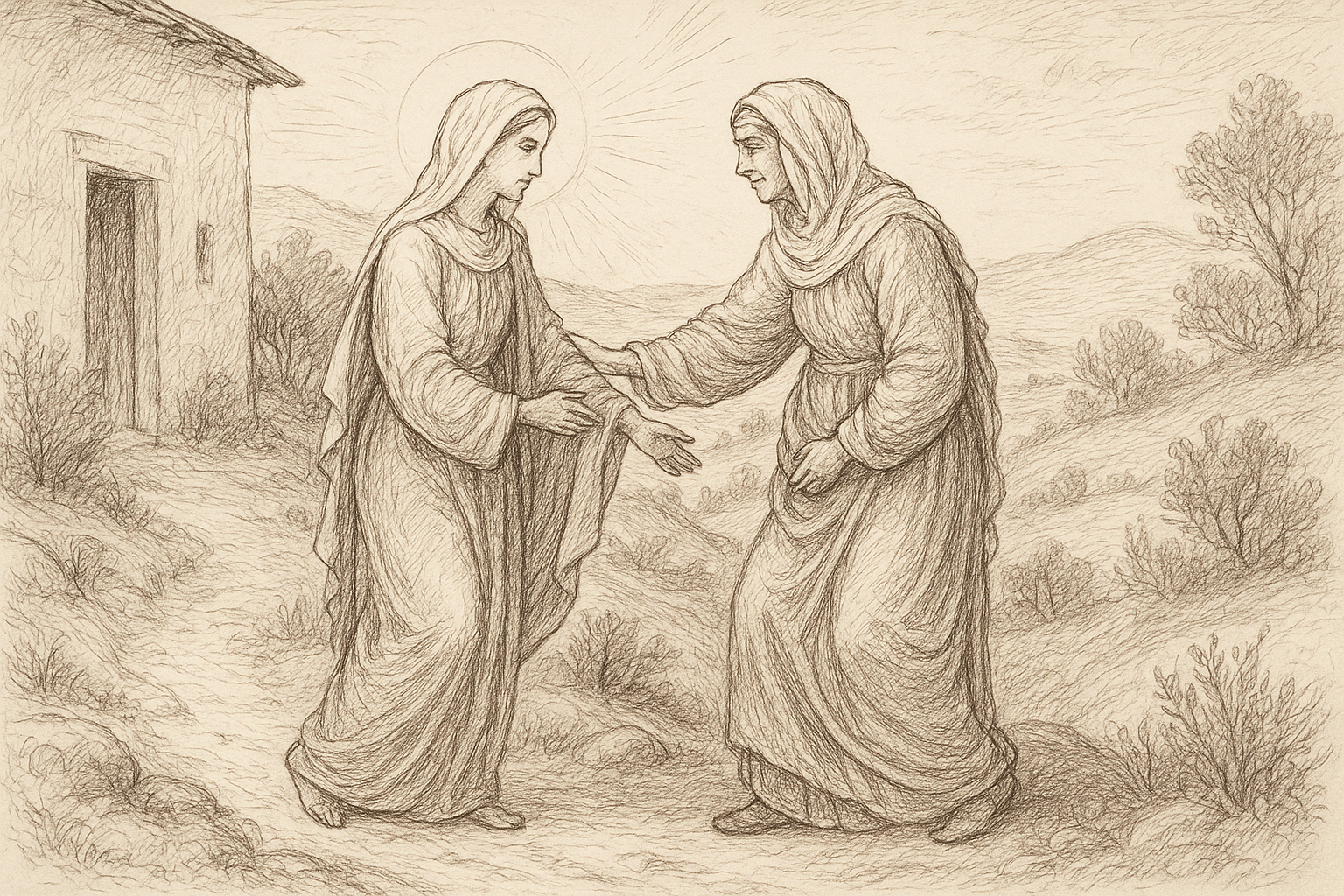
The Visitation is one of the most beautiful scenes in the Gospels, and one of the most revealing. After the Annunciation, Mary does not remain inwardly focused on the mystery she has received. She rises and goes to the hill country to visit her cousin Elizabeth. The Gospel tells us that she went with haste. That phrase is simple, but it carries the energy of a heart that has heard God and now moves in love.
In the Visitation, the Church sees more than a family meeting. She sees the meeting of two pregnancies, two women of faith, and two children who are already being woven into salvation history. John the Baptist leaps in Elizabeths womb, and Elizabeth, filled with the Holy Spirit, blesses Mary with words every Catholic knows by heart: blessed are you among women, and blessed is the fruit of your womb. The child in Mary is already at the center of the moment. The event is Marian, but it is never merely about Mary. It is always about Jesus.
This is part of the Visitation Catholic meaning. Mary bears Christ, and Christ brings blessing, joy, and sanctification wherever He comes. The Mother of the Lord becomes the bearer of His presence to another home. The Gospel quietly teaches that the Christian life is not meant to stop at private devotion. Grace received is grace carried outward.
A Gospel scene shaped by Scripture and promise
The Visitation is found in Luke 1:39 to 56. Luke alone preserves this passage, and he presents it with the care of a theologian and the tenderness of a witness. Mary enters Elizabeths house, and the first response belongs to the unborn John. He leaps because he recognizes, in mystery and in joy, the One whom his whole mission will proclaim. Elizabeth then speaks not from mere human insight, but from the Holy Spirit.
Her greeting echoes Scripture. The words call to mind the honor given to Jael and Judith in the Old Testament, women through whom God delivered His people. Mary is not being placed beside those figures as a rival, but as their fulfillment. The Church reads the Visitation in continuity with Gods saving pattern: the Lord does great things through humble servants.
Elizabeth also asks, And why is this granted me, that the mother of my Lord should come to me? That title, mother of my Lord, is deeply important. It points to the truth that the child Mary carries is no ordinary child. He is the Lord, the promised Messiah, truly present even before His birth. The Visitation therefore becomes a witness to the Incarnation. Jesus is not a symbol or an idea. He is already among His people, hidden but real.
Marys visit is not simply an act of kindness. It is the arrival of Christ in the house of charity.
Charity in motion
Marys haste matters. She does not delay in self-absorption, even though she has just received the most astonishing revelation ever given to a human heart. She goes to serve. This is one reason the Visitation Catholic meaning speaks so strongly to daily Christian life. Love received from God becomes love directed toward neighbor. Contemplation and service are not enemies.
Mary likely went to help Elizabeth in practical ways during her pregnancy. Yet the Gospel gives the scene a spiritual depth far beyond ordinary assistance. Mary brings Jesus, and with Him comes consolation. The first effect of Christian charity is often not noise or display, but nearness. A faithful presence can be a form of grace. In Mary, charity is not abstract. It has feet, urgency, and tenderness.
For Catholics, this makes the Visitation a model of discipleship. Mary does not cling possessively to the gift she has been given. She becomes a bridge by which Christ reaches others. In that sense, every act of true charity does something similar. It makes room for Christ to be known, welcomed, and praised.
There is also humility here. Mary does not announce herself. She comes quietly. Yet her presence changes everything because she carries the Lord. Catholic devotion to Mary is never meant to obscure Christ. It is meant to reveal how perfectly a human life can receive Him and give Him to the world.
Elizabeths prophecy and Marys praise
Elizabeths blessing leads naturally to Marys Magnificat, one of the great prayers of Scripture. Mary responds not by turning attention back to herself, but by magnifying the Lord. My soul magnifies the Lord is her first answer to being honored. This is no small detail. Mary receives praise and immediately returns glory to God.
The Magnificat shows the inner meaning of the Visitation. Mary sees that Gods mercy is not theoretical. He exalts the lowly, fills the hungry, and keeps His promises to Israel. The child within her is the fulfillment of those promises. Her song is both personal and prophetic. She speaks as daughter of Israel and as mother of the Messiah.
In Catholic devotion, the Visitation and the Magnificat belong together. The visit shows charity in action. The song reveals the theology of that action. Mary serves because God has done great things for her. She is humble because He has looked upon her lowliness. She is joyful because His mercy reaches from age to age.
This is why the Visitation draws believers into deeper devotion to Jesus. Marys greatness is entirely relational. She is great because the Lord is near. She is honored because she gives Him to the world. A true Marian devotion always ends in worship of Christ, not in distraction from Him.
The Churchs memory of the Visitation
The Church has long treasured the Visitation as both a feast and a mystery of faith. In the liturgy, it is not treated as a sentimental family moment, but as a revelation of Gods saving work. The feast is celebrated on May 31 in the Roman Rite, and it invites believers to contemplate the meeting of the Old and New Covenants. John, the last prophet, rejoices before the one he will announce. Mary, daughter of Zion, carries the Messiah to the home of Elizabeth. The hidden Christ is already gathering His people.
This also helps explain why the Visitation has such a place in Marian devotion. Catholics do not honor Mary because she competes with Christ. We honor her because God Himself has done so, and because her faith makes visible the response God desires from all disciples. She is the first believer to bear the Savior bodily, but she is also an image of the Church, which is called to bear Christ into the world.
When the Church contemplates Mary visiting Elizabeth, she sees her own vocation. The Christian community is meant to become a place where Christ is carried, recognized, and welcomed. That happens in preaching, in sacraments, in works of mercy, and in simple acts of Christian friendship. The Visitation teaches that grace is meant to move.
Three quiet lessons for Catholic life
- Let grace send you outward. Prayer should make us more available to love, not less.
- Recognize Christ in hidden places. The Lord is present in ordinary homes, in the poor, in the sick, and in those who serve quietly.
- Let every honor return to God. Marys response to blessing is praise, not self-display.
The Visitation also offers a gentle correction to modern impatience. Marys charity is not frantic in the worldly sense. Her haste is ordered by love. She knows whom she carries, and she moves accordingly. Catholics can learn from that rhythm. The Lord deserves both reverence and action, both silence before Him and generous service after Him.
It is worth pausing over the way Elizabeth is blessed through Marys presence. This does not mean Mary replaces God as the source of grace. Rather, it shows how God chooses to work through human cooperation. He sends His Son into the world through the assent of a young woman, and He brings joy to Elizabeths house through that same willing heart. The pattern is consistent throughout Scripture: God exalts the humble and uses them to bless others.
For anyone who prays the Rosary, the Visitation is a mystery that rewards slow meditation. It is easy to imagine the journey, the greeting, the sudden joy, the movement of the child, the Spirit-filled words, and the song that follows. Yet beneath the tenderness is a profound theology. Christ enters human history. John is sanctified in the presence of the Lord. Mary serves as the first tabernacle of the Incarnation. Charity and revelation meet in one household.
That is why the Visitation Catholic meaning remains so enduring. It shows that holiness is not passive, that joy can be active, and that the presence of Jesus transforms even the most ordinary encounter. Mary still teaches the Church how to go forth with Christ, how to serve without self-importance, and how to let every blessing become praise.
When believers look to the Visitation, they are invited to do what Mary did: carry Jesus into the world with reverence, mercy, and readiness. And when He is carried, hearts still recognize Him.
Keep Reading on Lets Read The Bible
Frequently Asked Questions
What is the Visitation in Catholic teaching?
The Visitation is the event in Luke 1:39 to 56 when Mary, حاملing Jesus, visits her cousin Elizabeth. The Church sees it as a revelation of Christ's presence, Elizabeth's Spirit-filled recognition of Mary, and Mary's humble charity in service.
Why is the Visitation important for Marian devotion?
The Visitation shows Mary's role as the one who bears Christ to others. Catholic devotion to Mary focuses on how perfectly she points to Jesus, serves with humility, and magnifies God rather than herself.
What does the Visitation teach about charity?
It teaches that true charity begins with God's grace and moves outward. Mary receives God's gift and then goes quickly to help Elizabeth, showing that Christian love is active, attentive, and centered on Christ.