Saints and Witnesses
Padre Pio and the Quiet Strength of a Wounded Saint
A faithful look at the life of St. Padre Pio, his love for confession, and the hard-won holiness that still speaks to Catholics today.
Site Admin | May 25, 2025 | 80 views
St. Padre Pio life is often remembered through the striking signs associated with him, especially the stigmata and the crowds that sought his prayers. Yet the heart of his witness was not spectacle. It was a hidden fidelity that unfolded in prayer, confession, obedience, and suffering. He was a Capuchin friar who spent long hours before the Blessed Sacrament, heard confessions tirelessly, and carried physical and spiritual burdens that shaped his entire priestly life.
For Catholics, Padre Pio remains compelling because he did not offer an easy faith. He pointed again and again to repentance, the mercy of God, and the call to take holiness seriously. His life reminds us that sanctity is not a polished image. It is a daily yes to Christ, often in weakness, often under misunderstanding, and always by grace.
From Pietrelcina to the Friary
Padre Pio was born Francesco Forgione in Pietrelcina, Italy, in 1887. From childhood he showed a deep attraction to prayer and a serious religious sensibility. His family was poor, and ordinary life in southern Italy was demanding, but those early years formed the quiet background of a vocation that would one day draw the attention of the whole Church.
As a young man, he entered the Capuchin Franciscans and received the name Pio. He was ordained a priest in 1910. Like many saints, he did not become holy by escaping human weakness. He entered a life of discipline, study, and hidden sacrifice. Illness was a recurring part of his story, and it frequently interrupted his ministry. Even so, he remained rooted in the priestly work that defined him: celebrating Mass, praying, and guiding souls.
The First World War and the turbulence of the early twentieth century formed the wider setting of his priesthood. Padre Pio eventually lived most of his life at San Giovanni Rotondo, where he served for decades. That place became associated with his ministry, but the significance was never the geography alone. It was the steady presence of a priest who believed that souls are changed most deeply when they are brought close to Christ.
The Stigmata and the Burden of Attention
In 1918, Padre Pio received the visible wounds of Christ, known as the stigmata. These wounds remained with him for many years. They drew pilgrims, admirers, investigators, and critics. The phenomenon was extraordinary, but Padre Pio himself did not treat it as a spiritual trophy. In the Catholic life, such signs are never the goal. They are, at most, reminders that the Passion of Christ reaches into human suffering and can be borne in union with Him.
His wounds also meant scrutiny. He was examined, questioned, and for periods restricted in his ministry. That part of his life is important because it shows a saint who was not insulated from difficulty. He lived under obedience, and obedience was not always comfortable or publicly understood. Yet this, too, became part of his witness. He did not build his identity on being admired. He remained a friar and priest who accepted the cross placed before him.
Padre Pio's holiness was not built on being extraordinary in the world's eyes, but on being faithful when life was costly and misunderstood.
For Catholics, that is a bracing lesson. A saint is not a spiritual celebrity. A saint is a person conformed to Christ. The signs surrounding Padre Pio drew attention, but the deeper reality was his union with the Crucified Lord.
Confession as a Place of Mercy and Truth
Few parts of Padre Pio's ministry are as well known as his work in the confessional. He heard confessions for long hours, often with a seriousness that startled penitents. Some found him gentle, others found him severe, but many came away with a renewed desire to convert. He did not treat confession as a routine social exchange. He treated it as sacred ground, where a soul stands before the mercy of God and the truth of its own life.
That approach fits the Catholic understanding of the sacrament. Christ gave the Church the ministry of reconciliation so that sinners could be absolved, healed, and restored. Padre Pio never separated mercy from conversion. He knew that God's mercy is not sentimental. It is transforming. A person who confesses truly is not merely discharged from guilt. He is invited into a new life.
His life also exposes a common temptation: to think holiness can be pursued without repentance. Padre Pio's devotion to confession says otherwise. The road to sanctity runs through humility, honesty, contrition, and the willingness to begin again. That is one reason he still speaks to Catholics who feel spiritually dry or stuck. He points them back to the sacrament that Christ entrusted to His Church.
What his confessional ministry teaches
- Confession is not humiliation for its own sake, but an encounter with mercy.
- Spiritual growth requires truth, not self-protection.
- A priest can become an instrument of conversion when he is faithful to his office.
- Regular confession helps Catholics resist spiritual complacency.
Prayer, Suffering, and the Hidden Life
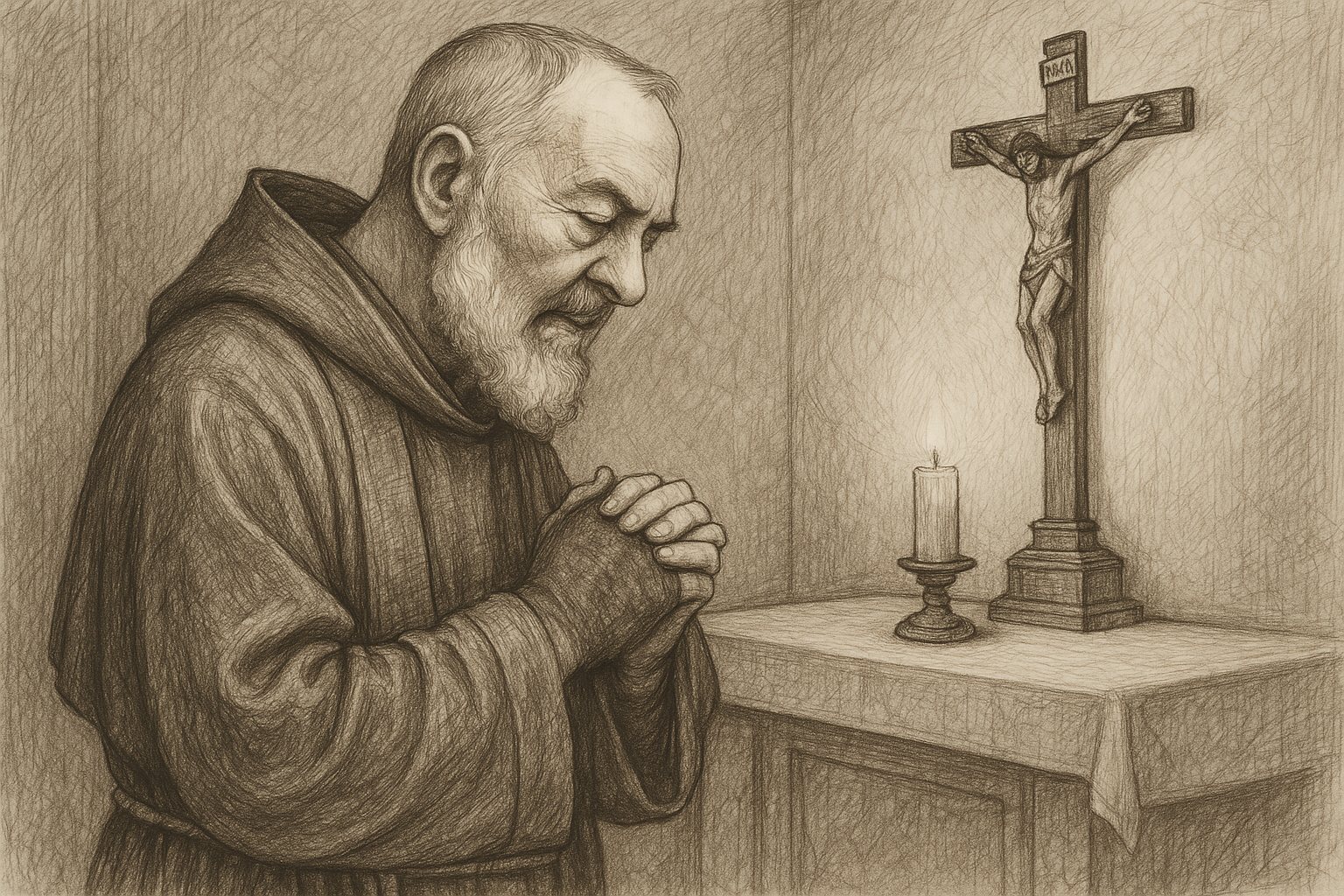
Padre Pio was known for intense prayer. He celebrated Mass with deep reverence and spent long hours in the presence of God. He also endured physical pain, fatigue, and interior trials. Much of his sanctity was hidden from public view. That hiddenness matters. In the Catholic tradition, the interior life is not a private hobby. It is the furnace in which grace purifies the soul.
There is a temptation to imagine that holiness must be visible to be real. Padre Pio's life corrects that idea. Some of the most important things a Christian does will never be applauded. Waiting patiently, forgiving quietly, confessing honestly, praying when no one sees, and offering suffering to God can matter more than public religious display.
His devotion to the Eucharist also stands at the center of his witness. He understood the Mass as the summit of Christian life, not merely a duty to be completed. For him, the sacrifice of Christ was not an abstraction. It was lived, received, and entered into with awe. That Eucharistic seriousness should challenge Catholics who can become casual about Sunday Mass or inattentive in prayer.
Misunderstanding and Obedience
Padre Pio was not universally appreciated during his lifetime. Questions were raised about him, and he experienced restrictions that affected his ministry. Whatever one makes of the historical details, the larger pattern is clear: he remained a son of the Church. He did not make himself the center of a movement or respond to difficulties with rebellion. He accepted the discipline placed upon him and continued to live the basic demands of his vocation.
That obedience is important because many people admire saints from a distance but overlook the cost. True holiness is usually expensive. It asks for humility, patience, and trust when circumstances seem unfair. Padre Pio's willingness to remain faithful under pressure gives his life a realism that Catholics can use. He was not preserved from suffering; he was taught by it.
His story also warns against reducing spiritual life to private experience. Extraordinary graces, if they are genuine, are always ordered to charity, repentance, and the Church's life. Padre Pio did not exist to satisfy curiosity. He existed to call souls back to God.
Lessons for Catholics Today
St. Padre Pio life still matters because the temptations he confronted have not disappeared. Catholics still struggle with distraction, laxity, fear of repentance, and the desire to appear religious without surrendering to Christ. Padre Pio answers those temptations with concrete habits of grace.
First, he calls Catholics back to confession. Many people delay the sacrament out of embarrassment or routine negligence. Padre Pio shows that confession is not an accessory to the faith. It is a place where the mercy of Christ is made personally effective. A serious return to confession can reshape an entire spiritual life.
Second, he teaches reverence in prayer. When prayer becomes hurried or thin, the soul weakens. Padre Pio's disciplined life suggests that prayer is not measured by feelings. It is measured by fidelity.
Third, he reminds us that suffering can be united to Christ. Not every burden is removed immediately, and not every trial is explained. But suffering offered in love can become fruitful. This does not make pain good in itself. It means God is able to redeem what wounds us.
Fourth, he models trust in the Church's sacramental life. Holiness is not a self-made project. It grows through grace received in the sacraments, especially the Eucharist and Reconciliation.
Simple practices inspired by Padre Pio
- Go to confession regularly, not only when a serious sin has occurred.
- Set aside quiet time before the Blessed Sacrament, even briefly.
- Examine your conscience with honesty and without excuses.
- Offer a difficulty to God instead of only trying to escape it.
- Pray for priests, especially those who hear confessions and guide souls.
Padre Pio died in 1968, leaving behind a legacy of devotion that continues to draw pilgrims and ordinary believers alike. But the most enduring part of his legacy is not the fame attached to his name. It is the invitation to conversion. His life says that God can work powerfully through a frail human life when that life is surrendered in prayer, obedience, and mercy. For Catholics today, that is not a distant story. It is a summons to return to the altar, to the confessional, and to the quiet place where Christ still heals souls.
Keep Reading on Lets Read The Bible
Frequently Asked Questions
Why is St. Padre Pio especially associated with confession?
Padre Pio spent many years hearing confessions and was known for treating the sacrament with great seriousness. He called people to honest repentance and trusted the mercy Christ gives through reconciliation.
What are the stigmata in Padre Pio's life?
The stigmata are the wounds of Christ that appeared on Padre Pio and remained for many years. Catholics view such signs cautiously, as extraordinary phenomena that are never more important than holiness, obedience, and union with Christ.
What can ordinary Catholics learn from St. Padre Pio life?
His life encourages regular confession, reverent prayer, patient endurance in suffering, and trust in the sacraments. He shows that holiness grows through fidelity, not spiritual performance.