Church History
Pope St. John XXIII and the Courage to Open the Windows
In a century marked by war, anxiety, and change, John XXIII led the Church with calm faith, pastoral wisdom, and a surprising confidence in the Holy Spirit.
Site Admin | January 8, 2026 | 94 views
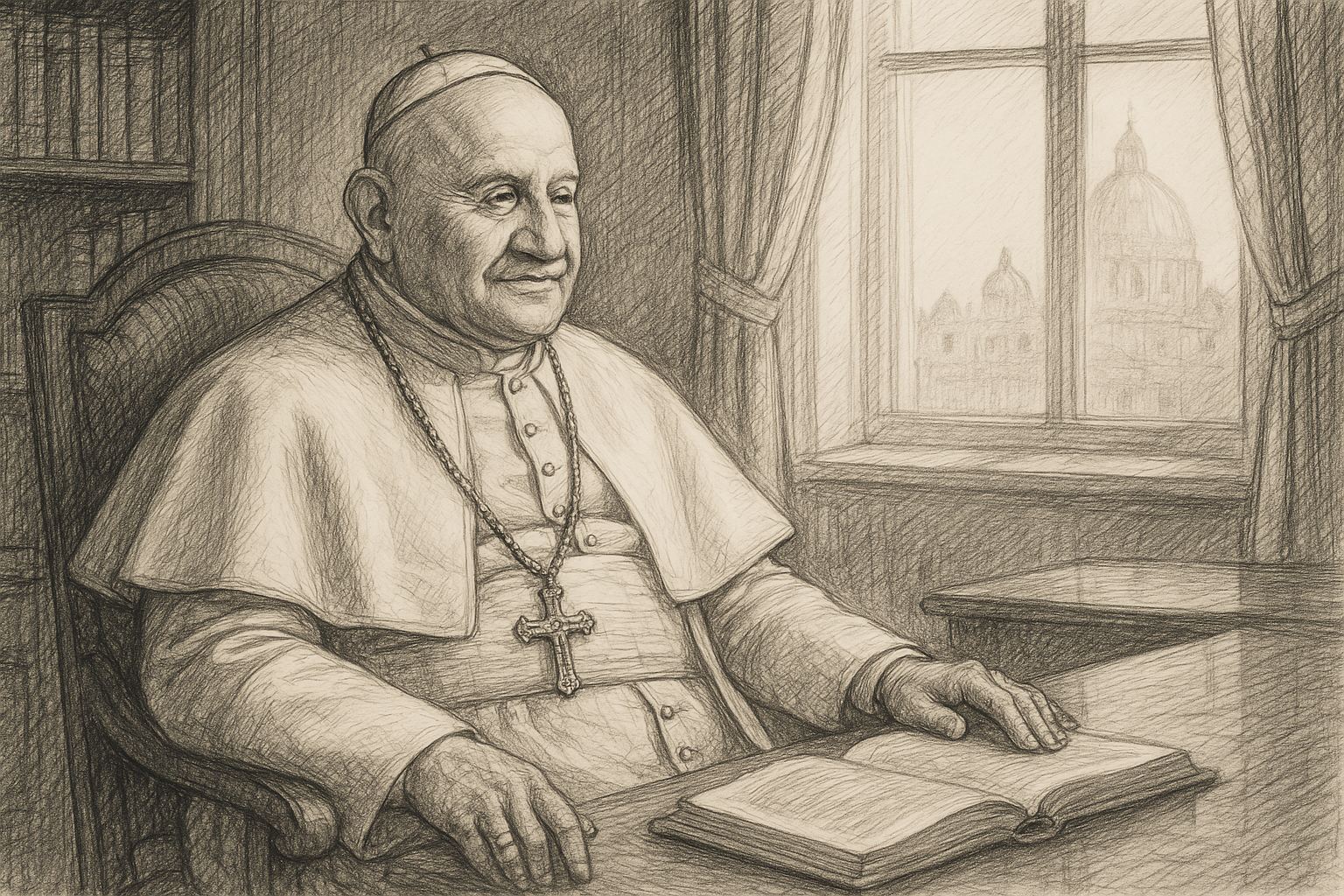
Pope St. John XXIII holds a special place in modern Catholic memory. For many people, his name is linked above all with the Second Vatican Council, the great assembly that opened a new chapter in the Church's recent life. Yet the man behind the council was not simply a figure of renewal in the abstract. He was a shepherd formed by long years of service, diplomatic hardship, wartime danger, parish life, and the slow work of Christian patience. The story of Pope St. John XXIII history is really the story of a priest who learned to serve the Church in seasons both ordinary and extraordinary, and who became pope at a moment when the world seemed to be changing faster than many Christians could absorb.
Angelo Giuseppe Roncalli was born in 1881 in the rural town of Sotto il Monte, in northern Italy. He came from a large farming family, and the simple piety of his childhood left a deep mark on him. His background mattered. He was not shaped first by courtly life or academic prestige, but by village faith, family discipline, and the rhythms of prayer and labor. That kind of formation often produces a pastor who can speak to ordinary people without embarrassment or condescension. It also helps explain the warmth that later made John XXIII so beloved. Even when he carried heavy responsibilities, he retained the manners of a man at peace with the basics of Christian life: confession, the Mass, the Rosary, and confidence in Divine Providence.
After seminary formation and ordination, Roncalli served in a variety of roles that broadened his understanding of the Church. He worked in diocesan ministry, taught, served in military chaplaincy, and later entered diplomatic service. His assignments took him to Bulgaria, Turkey, Greece, France, and other places where the Church often lived under pressure or in delicate relationships with civil authorities. These were not years of spectacle. They were years of listening, negotiation, and patient fidelity. They also exposed him to the wounds of a divided Europe, especially in the first half of the 20th century, when nationalism, total war, and ideological conflict left deep scars across the continent.
Those scars form the backdrop to his pontificate. John XXIII became pope in 1958, after the long reign of Pope Pius XII. The Church at that moment faced a difficult balance. On the one hand, Catholics had strong reasons for gratitude. The Church had survived the upheavals of modern secularism, two world wars, and the brutal totalitarian systems of the century. On the other hand, many signs suggested that the old confidence of Christendom no longer described the world around it. In the prosperous postwar West, faith was increasingly treated as private sentiment rather than public truth. In communist nations, believers endured open hostility. Scientific progress, mass media, urbanization, and rapid social change altered the habits of daily life. The Church had to speak to a world that was still Christian in memory, but not necessarily in practice.
John XXIII was not blind to these pressures. But he was known less for alarm than for serenity. He believed that the Church should not meet the modern age by shrinking inward. Instead, she should preach Christ clearly, trust the Holy Spirit, and seek fresh ways to present the same apostolic faith. That instinct did not mean changing doctrine to suit the age. It meant discerning how the perennial truth of the Gospel could be proclaimed more fruitfully. In that sense, his pontificate was deeply pastoral. He wanted the Church to be a mother who speaks in a language her children can hear.
The most famous decision of his papacy came on January 25, 1959, when he announced his intention to convoke an ecumenical council. This was unexpected. Many in the Roman world had not anticipated such a step, and the news spread quickly through the Church. John XXIII later identified several aims for the council: the renewal of Catholic life, a more effective presentation of doctrine, and a stronger call to Christian unity. He did not call the council because he thought the Church had lost the faith. He called it because he wanted the faith to be handed on with renewed clarity, joy, and missionary energy.
The opening of the Second Vatican Council in 1962 became one of the defining events of the 20th-century Church. The council would continue after John XXIII's death and conclude under Paul VI, but it remains inseparable from John XXIII's vision. It gathered bishops from across the world in unprecedented numbers and reflected the growing global character of Catholic life. The council was not a break from the Church's past. It was an act of the Church reflecting on herself in the light of Scripture, Tradition, and the needs of the present age. Whatever debates followed in later years, the council itself cannot be reduced to slogans. It was a genuine act of episcopal discernment, prayer, and teaching.
One of the most beloved images associated with John XXIII is his willingness to speak simply and directly. He had a gift for pastoral language. He was capable of seriousness without harshness, and of humor without triviality. That combination made him approachable. His famous address on the eve of the council, often remembered for its call to let the fresh air of the Spirit enter, captured something essential about his temperament: confidence that God was already at work, even in a restless time. The point was not novelty for its own sake. The point was openness to grace.
At the same time, it would be a mistake to imagine John XXIII as a pope who dismissed discipline or ignored doctrine. He was a traditional priest and bishop in the deepest sense. He valued the sacramental life of the Church, revered the liturgy, and had a strong sense of ecclesial order. He also wrote important encyclicals, including Mater et Magistra and Pacem in Terris, which addressed social justice, human dignity, international peace, and the moral duties of public life. These were not abstract manifestos. They were pastoral teaching meant to help Catholics think faithfully about modern problems. In an age of political tension, nuclear fear, and social unrest, John XXIII insisted that peace must rest on truth, justice, charity, and freedom.
His concern for peace was not sentimental. He had lived through war and had seen how ideology can dehumanize entire peoples. In Pacem in Terris, he spoke to all people of good will about the foundations of a just social order. The encyclical remains striking because it joins moral clarity to an expansive pastoral concern for humanity. John XXIII did not treat the Church as one voice among many in a marketplace of opinions. He treated her as a teacher with a responsibility to witness to the moral law written by God in the human heart.
The saint's holiness also showed itself in his personal style of governance. He was not a rigid administrator in the narrow sense, but he was not careless. He carried the burdens of office with a notable gentleness. Those who encountered him often remembered his humanity, humility, and fatherly attention. This matters because the papacy is never only about ideas. It is also about witness. A pope teaches not only by documents and decrees, but by the way he carries authority. John XXIII's manner suggested that firmness and kindness need not be enemies.
For modern Catholics, his witness offers several lessons. First, the Church must never confuse fear with fidelity. A frightened Church can become defensive, shrill, or inward-looking. John XXIII shows another path: a steady confidence that Christ governs His Church. Second, renewal is not the same as rupture. Authentic renewal comes from returning to the sources of faith with greater intention, not from abandoning what the Church has always believed. Third, pastoral charity matters. People are more likely to hear truth when it is spoken by someone who clearly loves them.
There is also a lesson here about history itself. Catholics sometimes approach the 20th century as a battlefield of competing interpretations, especially when speaking about Vatican II. John XXIII reminds us that history is not merely a contest of winners and losers. It is also a place where grace works through frail human instruments. The council was convened by a man who prayed, laughed, suffered, and trusted. His life resists the temptation to flatten the Church's story into ideology. He invites believers instead to look for holiness in the actual circumstances of the age.
John XXIII died in 1963, only a few years after opening the council, and his death was mourned with unusual affection across the world. In 2000, he was beatified, and in 2014 he was canonized by Pope Francis. The Church honors him not because he solved every problem of his era, but because he lived his office with evangelical simplicity and courage. He helped the Church face the modern world without panic. He trusted that the Lord who called the council would also guide its fruits.
That is why Pope St. John XXIII remains more than a historical name. He is a reminder that the Church advances best when her leaders are rooted in prayer, attentive to the signs of the times, and ready to speak the truth with a father's heart. His life suggests that sometimes the most important reform begins not with noise, but with a quiet act of trust in God.
Keep Reading on Lets Read The Bible
Frequently Asked Questions
Was Pope St. John XXIII trying to change Church doctrine?
No. John XXIII did not call Vatican II to replace Catholic doctrine. He wanted the same apostolic faith to be taught more clearly and fruitfully in a changing world. The council was meant to renew the Church's presentation of the truth, not to invent new teaching.
Why is John XXIII called the pope who opened the windows?
The image comes from his desire for the Church to speak more openly and persuasively to the modern world. It symbolizes freshness, clarity, and trust in the Holy Spirit. It does not mean abandoning tradition, but allowing the Church to breathe more freely in her mission.
What is the most important event associated with John XXIII?
The most important event connected to his name is the convocation and opening of the Second Vatican Council. That decision shaped the modern Catholic Church and remains central to any account of his pontificate.