Church History
Pope St. Pius X and the Battle for a Faith That Could Be Handed On
How a parish priest from Veneto became a decisive pope in an age of political pressure, theological confusion, and urgent reform.
Site Admin | January 4, 2026 | 79 views
The name of Pope St. Pius X history belongs to one of the most important turning points in modern Catholic life. He is often remembered for his opposition to Modernism, but that single theme does not fully explain the man or the age in which he governed the Church. Giuseppe Sarto, later Pope St. Pius X, became pope in 1903 after serving as a pastor, parish priest, bishop, and patriarch of Venice. He arrived at the Chair of Peter as Europe was changing rapidly, governments were pressuring the Church from outside, and many Catholics were trying to understand how to remain faithful in a world shaped by new political ideas and new ways of thinking.
To understand his pontificate, it helps to begin with the atmosphere of the early twentieth century. The old political order in Europe was under strain. Nationalism was rising, secular governments were claiming more authority over education and public life, and in several places the Church was being pushed to the margins. At the same time, scholars were asking difficult questions about Scripture, history, and doctrine. Not every question was unhealthy, but some thinkers began to treat Catholic teaching as if it were only a human product that could be reshaped by changing tastes. Pius X saw that this was not simply an academic matter. If doctrine can be reduced to opinion, then the Church loses the clear voice by which she teaches, sanctifies, and governs.
A pope formed by ordinary pastoral life
Pius X was not a career diplomat or court prelate. He came from humble origins and was formed in parish work, diocesan administration, and close contact with the faithful. That background shaped his style as pope. He was not interested in cleverness for its own sake. He preferred clarity, directness, and practical reform. As a parish priest, he had learned that the faith must be preached so that ordinary people can live it. As a bishop, he had learned that the Church must be governed with both firmness and charity. That combination would define his pontificate.
When he became pope, he chose the name Pius X in continuity with the line of papal predecessors who had defended the Church in difficult times. His motto, Instaurare omnia in Christo, meaning to restore all things in Christ, expressed the center of his vision. He did not see reform as a matter of novelty. He saw it as a return to order, reverence, and fidelity in Christ. That is a crucial detail in Pope St. Pius X history, because his reforms were never meant to make the Church fashionable. They were meant to make her more faithful.
The crisis he named Modernism
The issue most associated with Pius X is Modernism, which he called the synthesis of all heresies. That phrase can sound severe, but his concern was theological rather than rhetorical. Modernist thought often treated doctrine as something that evolves from religious experience rather than something received from Christ through the Apostles. In that view, dogma changes because human consciousness changes. Revelation becomes less a gift from God and more a record of inner feeling. Pius X recognized that such ideas, once accepted, would eventually empty the faith of its supernatural character.
His response was not to reject scholarship itself. He did not fear honest study. What he rejected was the attempt to separate scholarship from submission to the Church and from belief in divine revelation. In 1907 he issued Pascendi Dominici Gregis, the encyclical that most clearly identified and analyzed the Modernist crisis. That document remains one of the defining texts of his pontificate. It examines the ways Modernism works in theology, philosophy, biblical interpretation, and religious psychology. Pius X was trying to protect the faithful from a pattern of thought that could sound pious while quietly dissolving the truth.
He also required an Anti-Modernist Oath for clergy and certain Church personnel. Whatever one thinks of the details of later historical debates, the purpose was straightforward: to ask those who taught in the Church to profess the faith honestly and to reject principles that undermined it. In a time of confusion, he believed that clarity was an act of charity.
Reform in liturgy, discipline, and the sacramental life
Pius X was not only a defender against error. He was also a reformer of Catholic life. He encouraged more frequent reception of Holy Communion, especially for children and for the laity generally. He believed that the Eucharist should not be treated as a reward for the spiritually elite, but as the ordinary food of the Christian life. He also lowered the age for First Communion, making it possible for children to receive the sacrament earlier when they had sufficient understanding. These reforms expressed his conviction that grace, not spiritual pride, is the true source of Christian growth.
He also promoted liturgical renewal. Pius X restored dignity to sacred music by giving strong support to Gregorian chant and by encouraging music that served prayer rather than spectacle. In his view, liturgy should help the faithful pray with the Church, not distract them from God. He cared deeply about the internal life of worship because worship forms belief. A reverent liturgy teaches the soul to recognize that God is God and that man is not.
Another important reform was his work on the Roman Breviary and the organization of the liturgy. He sought a greater balance in the Church's prayer life and a more stable arrangement of the Psalms and office. These changes may seem technical, but they were part of a broader pastoral goal: to renew the prayer of the Church so that clergy and faithful alike could be drawn more fully into the life of Christ.
His approach to Church governance
Pius X understood that doctrine and discipline belong together. He reorganized the Roman Curia and worked to make Church administration more coherent. He did not treat governance as a side issue. The Church is not only a community of private devotion. She is a visible society with bishops, offices, law, and responsibility. Good governance protects the faithful and helps the Church act with unity.
He was also concerned with canon law. Under his pontificate, the long process of codifying canon law advanced significantly, and the Church eventually received the 1917 Code of Canon Law after his death. The work of codification was important because it brought order to a body of law that had grown over many centuries. Again, Pius X's instinct was not novelty but clarity. He wanted the Church's legal structure to serve her mission more effectively.
His governance was marked by pastoral seriousness. He was attentive to diocesan life, seminary formation, and the spiritual quality of clergy. He did not see reform as something imposed from a distance. It had to begin with holiness, discipline, and obedience.
Conflict with the political world
Pius X also ruled during a time when the Church had to contend with modern states that wanted more control over religion. In Italy, the loss of the Papal States still cast a long shadow over papal life. In France, the relationship between Church and state became increasingly hostile, culminating in severe restrictions on religious life and property. Pius X defended the rights of the Church without confusing those rights with worldly power. His position was not nostalgic politics. It was the conviction that the Church must be free to preach Christ, form consciences, and administer the sacraments without being subordinated to secular ideology.
His firmness could be misunderstood as mere resistance to change. In fact, he was willing to reform many things, but not the truth of the faith or the freedom of the Church to proclaim it. That distinction matters. Catholic history is full of reforming saints who changed disciplines, renewed institutions, and corrected abuses while refusing to compromise doctrine. Pius X belongs in that line.
The holiness behind the office
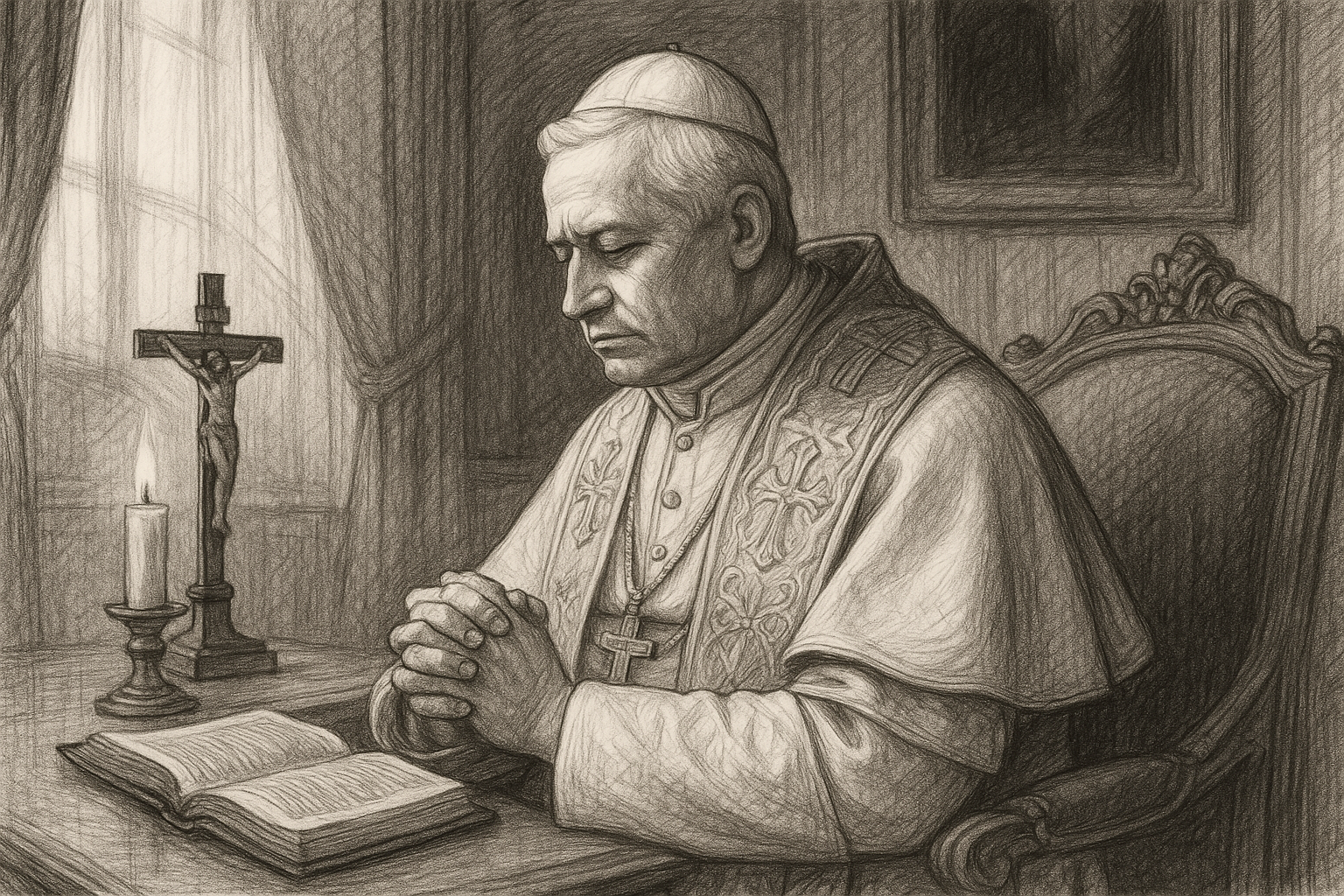
What makes Pius X compelling is that his firmness was joined to personal holiness. He was known for simplicity, humility, and directness. He lived without pretense and was not interested in cultivating an image. He was a pope of prayer and duty. That combination helped him avoid one of the temptations that can come with leadership: the temptation to let strategy replace sanctity. For Pius X, the health of the Church was ultimately a matter of souls.
His death in 1914 came just as Europe was entering the First World War, a catastrophe that would reshape the century. In hindsight, his pontificate can look like a last firm warning before a long age of conflict and change. The Church would soon enter an era in which many of the pressures he identified only intensified. That does not mean every later debate can be traced back to him, but it does mean his concerns were not exaggerated. He saw that theological confusion and cultural secularization could work together to weaken faith from within and without.
What Catholics can learn from his witness
Pope St. Pius X history offers several lessons for Catholics today. First, truth and charity are not opposites. To guard doctrine is not to be harsh by nature. It can be a form of love, especially when confusion threatens the faithful. Second, reform in the Church is healthiest when it begins with the sacraments, prayer, and reverence. Pius X did not think renewal came mainly from slogans or institutions. It came from Christ.
Third, his life reminds Catholics that holiness and governance belong together. The Church needs learned people, careful administrators, and courageous pastors, but all of that must be rooted in prayer. Pius X's greatest strength was that he believed the faith with his whole life. He did not treat Catholicism as a set of ideas to be managed. He treated it as the living truth of Christ entrusted to the Church.
For modern Catholics, that witness is still timely. We live in a world that often prizes adaptability more than fidelity and ambiguity more than clarity. Pius X answers with a different measure. The faith is not made new by being diluted. It is renewed when it is received humbly, taught clearly, and lived faithfully. That is why his name still carries weight in the Church. He defended the treasure he had received, and he urged the Church to return again and again to Christ, where every true reform begins.
Selected biblical resonances
The spirit of Pius X's pontificate echoes the biblical concern for guarding the deposit of faith, as in Guard the good deposit and the call to remain rooted in the truth that sanctifies the Church, as in Sanctify them in the truth. His insistence on receiving Christ with simplicity also fits the Gospel spirit of Become like little children.
Keep Reading on Lets Read The Bible
Frequently Asked Questions
Why is Pope St. Pius X so closely associated with Modernism?
Because he identified Modernism as a major theological threat to the Church in the early twentieth century and responded decisively in <em>Pascendi Dominici Gregis</em> and related measures. He believed it undermined divine revelation, doctrine, and the supernatural life of faith.
What reforms is Pope St. Pius X best known for?
He promoted frequent Holy Communion, lowered the age for First Communion, encouraged Gregorian chant and liturgical reverence, and worked to improve Church governance and canon law.
What is the main lesson Catholics can take from Pope St. Pius X history?
His witness shows that real reform begins with fidelity to Christ, reverence for the sacraments, and clear teaching. He is remembered for defending truth while calling the Church back to holiness.