Church History
Pope St. Pius V and the Courage to Reform the Church
In a century of fracture and pressure, Pius V answered with discipline, prayer, and a clear defense of Catholic life.
Site Admin | December 31, 2025 | 85 views
A pope formed by reform before he ever wore white
When Catholics remember Pope St. Pius V, they often think first of the Council of Trent, the Rosary, or the Battle of Lepanto. Those associations are fitting, but they can hide something important. His pontificate was not the work of a man who arrived on the scene with a prepared slogan. It was the fruit of a long life of Dominican discipline, pastoral seriousness, and personal asceticism shaped by a Church under strain.
Born Antonio Ghislieri in 1504, he entered the Dominican Order and spent much of his early life in the work of teaching, study, and administration. Before becoming pope, he served in the Roman Inquisition and later as bishop and cardinal. He was known for doctrinal clarity and for insisting on reform not as a fashionable program, but as a moral duty. That matters for any honest reading of Pope St. Pius V history: he was not merely a reaction to crisis. He was a reforming Catholic formed by the Church's own tradition of repentance and renewal.
His election in 1566 came at a tense moment. The Protestant Reformation had already fractured Western Christendom, and the Catholic Church was still applying the decrees of the Council of Trent. Political rivalries among European powers remained intense. The papacy needed a man who would not soften the Church's teaching in order to calm the age, but who would strengthen the Church by making her life more holy and ordered.
The world he inherited was Catholic, but unsettled
The mid-16th century was a time of deep upheaval. The unity of Latin Christendom had been broken, and the Holy See had to confront both doctrinal dissent and internal weakness. Many bishops were absent from their dioceses. Clerical discipline was uneven. Liturgical practice varied from place to place. Monastic life, parish life, and ecclesial governance all needed renewal.
The Council of Trent had already clarified Catholic teaching on Scripture, the sacraments, justification, and the Mass. Yet councils do not reform lives by their existence alone. Their decrees must be implemented with patience and authority. Pius V understood this well. His task was not to invent a new Church, but to help the old one live more faithfully according to its own truth.
At the same time, Catholic rulers and Protestant princes were locked in political conflict that often reached far beyond theology. The pope could not control all of Europe, but he could shape the Church's internal discipline and help Catholic identity become more coherent. Pius V did both. He pressed for the reform of clergy, strengthened the catechetical life of the faithful, and encouraged a more uniform and reverent liturgical practice.
His reforming energy was practical, not theatrical
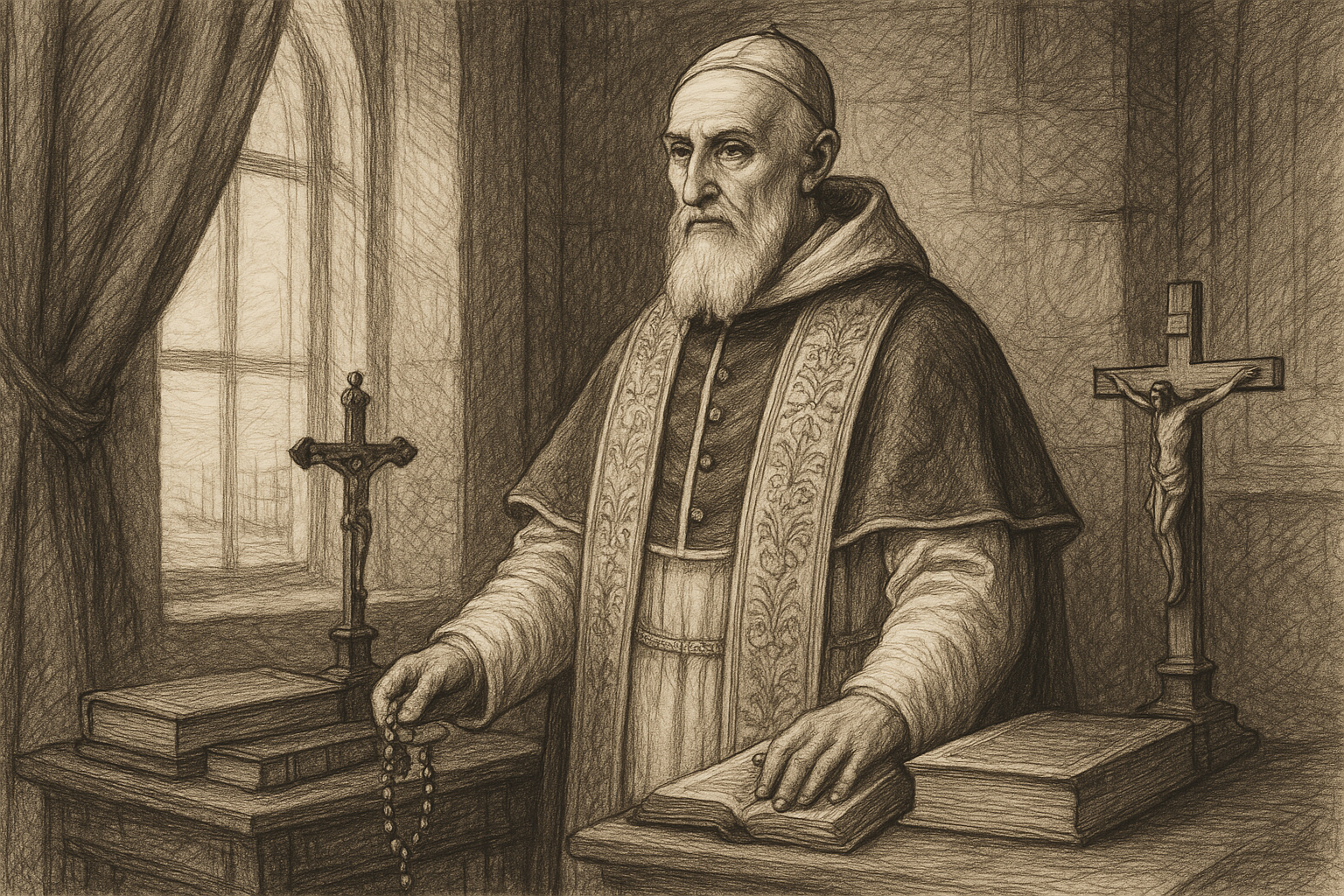
Pius V's holiness was not ornamental. He lived simply, fasted rigorously, and took seriously the moral responsibility of office. He did not treat reform as a way to look severe. He treated it as a form of pastoral charity.
Among his most important acts was the implementation of the Tridentine reforms. He worked to ensure that bishops were resident in their dioceses, seminarians received proper formation, and priests were better prepared for their sacred duties. The Church had long known that doctrine and discipline belong together. Pius V gave that principle force at a moment when confusion could easily have won the day.
He also helped standardize the Roman Rite through the Missal of 1570 and the Breviary, making it easier for the Church to pray with greater unity after an era of liturgical divergence. Catholics sometimes speak of this period as if uniformity were the main point. It was not. The deeper aim was fidelity. In an age of doctrinal conflict, shared worship became a visible sign that the Church remained one body under one faith.
That kind of reform was demanding, and it did not satisfy every political interest. Yet the pope did not measure success by popularity. He measured it by whether the Church would be more obedient to Christ and more truthful in her witness.
His name is forever linked to Lepanto
One of the most famous events of Pius V's pontificate was the Battle of Lepanto in 1571. The Ottoman Empire had become a major military threat to Christian Europe, especially in the Mediterranean. Pius V worked to unite Catholic powers into a Holy League to resist further expansion. On October 7, 1571, the Christian fleet won a decisive naval victory.
Catholics remember this event not only as a military success, but as a moment of prayerful confidence. Pius V had urged the faithful to pray the Rosary for victory. The tradition of attributing the outcome to the intercession of the Blessed Virgin Mary became inseparable from the event itself, and the feast of Our Lady of the Rosary eventually developed from that victory.
The Church does not glorify war as such. Catholic tradition recognizes that rulers have obligations to protect the innocent, but it also knows that conflict brings suffering and moral peril. Lepanto stands in Catholic memory because it was seen as a defense of Christian peoples in a dangerous time, and because the pope interpreted the moment through prayer, not triumphalism. The event is best understood not as a medieval relic, but as part of a pope's effort to protect the faithful in a violent age.
Scripture offers a fitting lens here: Unless the Lord build the house, they labor in vain who build it and By the grace of God I am what I am. Pius V's life reflected both truths: human labor matters, but grace gives it its meaning.
He governed with firmness because he believed the truth had weight
Pius V is sometimes remembered as austere, and it is true that he was not a courtly figure. Yet his severity was not the same thing as cruelty. He believed that the Church's mission required moral seriousness. That belief guided his dealings with clergy, religious communities, and political leaders.
He was known for resisting nepotism and for using papal resources with restraint. In a period when secular power often leaned on family alliances and patronage, his unwillingness to turn the papacy into a private estate was itself a sign of reform. He also supported the enforcement of Tridentine standards for preaching, sacramental practice, and episcopal oversight.
His pontificate was not free of controversy. Like many rulers of his time, he acted firmly against what he saw as threats to the unity of the faith. Modern readers should acknowledge the full historical setting rather than flatten it. Still, it is fair to say that Pius V believed the Church's unity depended on more than goodwill. It depended on truth, discipline, and public fidelity to the faith once handed down.
That conviction gave his papacy a hard edge, but also a lasting coherence. He was not trying to keep everyone comfortable. He was trying to keep the Church Catholic.
His legacy reached beyond his own lifetime
Pius V died in 1572, only a year after Lepanto, but his influence endured. The liturgical reforms associated with his name shaped Catholic prayer for centuries. His support for the decrees of Trent helped set the course for the post-Tridentine Church. His witness also helped define a pattern of papal leadership marked by personal holiness, doctrinal clarity, and reform of ecclesial life.
In 1712, he was canonized by Pope Clement XI, a reminder that holiness can coexist with severity when severity is ordered to charity and truth. His canonization also signals that the Church did not see him merely as an administrator of a difficult age. She recognized him as a saint whose life was disciplined by prayer and service.
His legacy is especially relevant for Catholics who feel the pressure of confusion in the present day. The answer to disorder is not nostalgia alone, and it is not panic. It is fidelity. Pius V shows that reform begins with conversion, that public leadership requires interior sacrifice, and that the Church serves the world best when she refuses to dilute the Gospel.
What modern Catholics can take from his witness
Pius V did not live in a gentle time, and neither did he try to be a gentle pope in the modern sense. He lived as a Dominican who believed that prayer, penance, and truth belong together. For modern Catholics, that is not a museum lesson. It is a call to seriousness.
His life suggests several enduring lessons:
- Holiness is never separate from governance. Church leadership is always spiritual before it is managerial.
- Reform begins inside the Church. Renewal of doctrine, worship, and discipline must be rooted in fidelity to Christ.
- Prayer and action belong together. The Rosary, the liturgy, and public responsibility were not competing goods for Pius V.
- Truth has a cost. Catholic unity cannot be preserved by silence about the faith.
There is something bracing about that witness. Pius V reminds Catholics that the Church is not preserved by charm, but by grace working through men and women who are willing to obey, repent, and act. In a time when compromise can seem easier than conviction, his life still speaks with uncommon clarity.
That is why Pope St. Pius V history remains more than a chapter in Church history. It is a portrait of what it looks like when a pope tries to serve the Church with discipline, prayer, and courage in a world that needs all three.
Keep Reading on Lets Read The Bible
Frequently Asked Questions
Who was Pope St. Pius V before he became pope?
He was Antonio Ghislieri, a Dominican friar, theologian, and Church administrator who later served as bishop, cardinal, and reformer before his election as pope in 1566.
Why is Pope St. Pius V closely associated with the Council of Trent?
He did not preside over the council, but he strongly implemented its decrees after becoming pope, helping to shape the post-Tridentine Church through reform of clergy, liturgy, and discipline.
What is Pope St. Pius V best known for?
He is best known for carrying out Catholic reform after Trent, standardizing the Roman liturgy, and for his role in the Catholic response to the Battle of Lepanto.