Church History
Benedict XVI and the Patient Work of Keeping the Faith Clear
A look at the German pope who taught the Church to think, pray, and remember what endures.
Site Admin | January 17, 2026 | 105 views
Why Benedict XVI still belongs in the conversation
Pope Benedict XVI remains one of the most important Catholic figures of the modern era because he helped the Church speak clearly at a time when clarity often seemed suspect. He was not a pope of spectacle. He was a theologian, a liturgist, a pastor, and a man formed by the wounds of the twentieth century. His life stretched from the turbulence of Nazi Germany through the collapse of old certainties in Europe and into an age of spiritual confusion that many Catholics still feel today.
When people ask why Pope Benedict XVI Catholic history still matters, the answer is not merely that he held the papal office from 2005 to 2013. It is that his witness continues to illuminate what the Church is for. He reminded Catholics that the Church does not exist to flatter the spirit of the age, but to hand on the faith once delivered to the saints. He insisted that truth is not an enemy of love, and that worship is not a side issue. It is central.
Benedict understood something deeply Catholic: the Church lives from memory. If the memory of Christ grows thin, everything else starts to weaken. His teaching, his homilies, his books, and even his quiet style all pointed back to that basic conviction.
Formed by history, not detached from it
Joseph Ratzinger was born in 1927 in Bavaria. His childhood and youth were marked by the rise of National Socialism, the Second World War, and the moral damage done by totalitarian ideology. That background mattered. Benedict did not approach theology as an abstract system floating above human suffering. He knew what happens when political power tries to become a substitute religion, and he knew how fragile the human person can be under pressure.
That experience helped shape his later work. As a priest, scholar, archbishop, cardinal, and then pope, he returned again and again to the question of truth. Not truth as a slogan, but truth as something received from God and lived within the Church. He saw that modern people often want freedom without the discipline that makes freedom fruitful. His answer was not harshness. It was a call to rediscover the beauty of reality as God made it.
In this sense, Benedict stood in continuity with the great Catholic tradition. Like the Fathers of the Church and the doctors before him, he believed that faith and reason are not rivals. He repeatedly taught that reason is enlarged, not diminished, when it opens itself to God. That is one reason he continues to speak to believers and nonbelievers alike.
A theologian who became pope
Before he became pope, Benedict was already well known as one of the Church's major theologians. He participated in the work of the Second Vatican Council as a young adviser and later served as prefect of the Congregation for the Doctrine of the Faith. Some people misread that role as merely policing doctrine, but in Catholic terms doctrine is not a cage. It is a gift that protects the faithful from confusion.
His years in that office reinforced what would become a hallmark of his pontificate: patient teaching. Benedict did not pretend that the truth of the Gospel is self-explanatory in a world shaped by media noise and cultural fragmentation. He wanted to lead people back to the sources. He wrote on Jesus, the liturgy, the apostles, the saints, and the relation between faith and public life. He wanted Catholics to know not only what the Church teaches, but why it is beautiful and trustworthy.
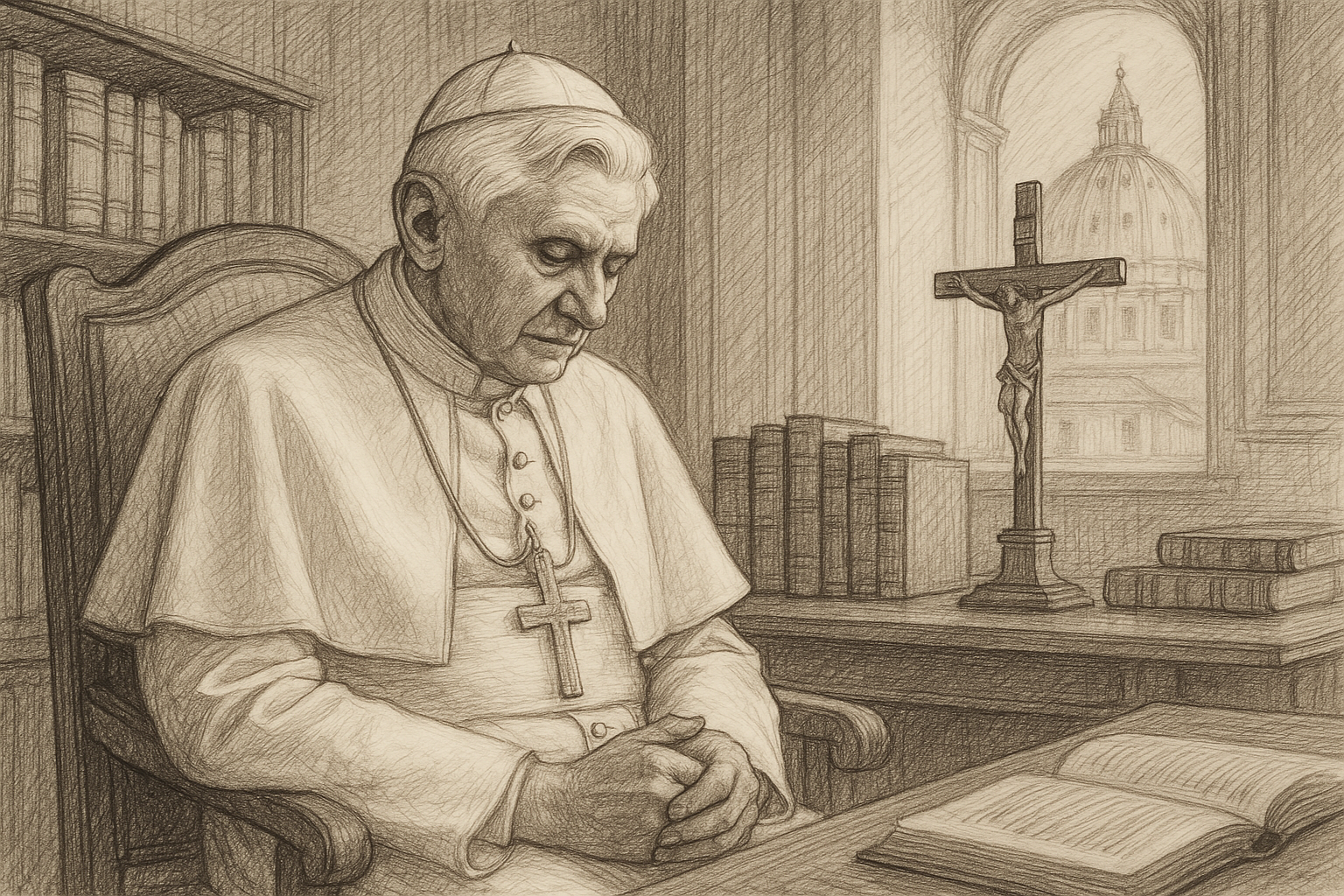
One of his greatest strengths was his ability to connect doctrine to prayer. For Benedict, theology was never meant to remain trapped in academic language. It had to lead to adoration, conversion, and a deeper love of Christ. That is a lesson the Church still needs.
His papacy and the gift of clarity
When Benedict was elected in 2005, many expected a transitional figure. Instead, they received a pope with a distinct and coherent vision. He entered office at a time when the Church faced scandals, confusion, and intense pressure from secular culture. He responded not by lowering the standard, but by urging Catholics to recover the center.
His encyclicals reflected that approach. Deus Caritas Est taught that Christian love begins in God and shapes the Church's life of charity. Spe Salvi reminded believers that Christian hope is not naive optimism, but trust rooted in Christ. Caritas in Veritate linked charity and truth in the social order, showing that Catholic social teaching cannot be reduced to sentiment or policy alone.
These were not abstract documents meant only for specialists. They offered a way to think about the whole Christian life. Benedict was reminding the Church that doctrine is not separate from service. The more clearly we see God, the better we can serve the poor, the suffering, and the confused. Truth and mercy belong together.
He also spoke often about the danger of relativism, by which he meant not that people have no opinions, but that they increasingly doubt whether truth exists at all. In one of his most frequently cited observations, he warned that a world without truth becomes unstable and vulnerable to manipulation. Catholics today can still recognize that dynamic around them. When truth becomes flexible, human dignity becomes vulnerable.
Worship as the place where belief is renewed
Among Benedict's most lasting contributions was his insistence that liturgy matters because God matters. He believed that worship is not a performance for an audience, but the action of Christ and his Church. That conviction guided his writings and his decisions as pope, especially his desire to encourage reverence, continuity, and a deeper sense of sacredness.
This emphasis may seem narrow to some, but Benedict knew that what a community believes eventually appears in how it prays. If worship is casual, belief soon becomes casual too. If worship is oriented toward God, the soul learns humility. Benedict's famous liturgical sensitivity was never just about style. It was about guarding the Church's ability to adore.
He often returned to the idea that the liturgy is something received, not invented. That is a profoundly Catholic insight. The Church does not create herself. She receives herself from Christ. In the Eucharist especially, the faithful encounter not an idea but the Lord who gives himself. Benedict's teaching helped many Catholics see that reverence is not an aesthetic preference. It is a sign of faith.
The liturgy teaches the heart to receive before it tries to speak.
His humility spoke as loudly as his teaching
One of the most striking moments of Benedict's papacy came in 2013, when he resigned the office of pope. This was extraordinary, but it was not theatrical. It was deliberate, sober, and humble. He explained that his strength was no longer sufficient for the demands of the ministry. In doing so, he reminded the Church that the papacy is service, not possession.
For Catholics, that moment offered a powerful lesson about vocation. We are not called to cling to office, achievement, or influence. We are called to serve according to the grace given us. Benedict's resignation did not diminish his dignity. In many ways, it strengthened the moral seriousness of his life. He knew the difference between office and identity, between function and calling.
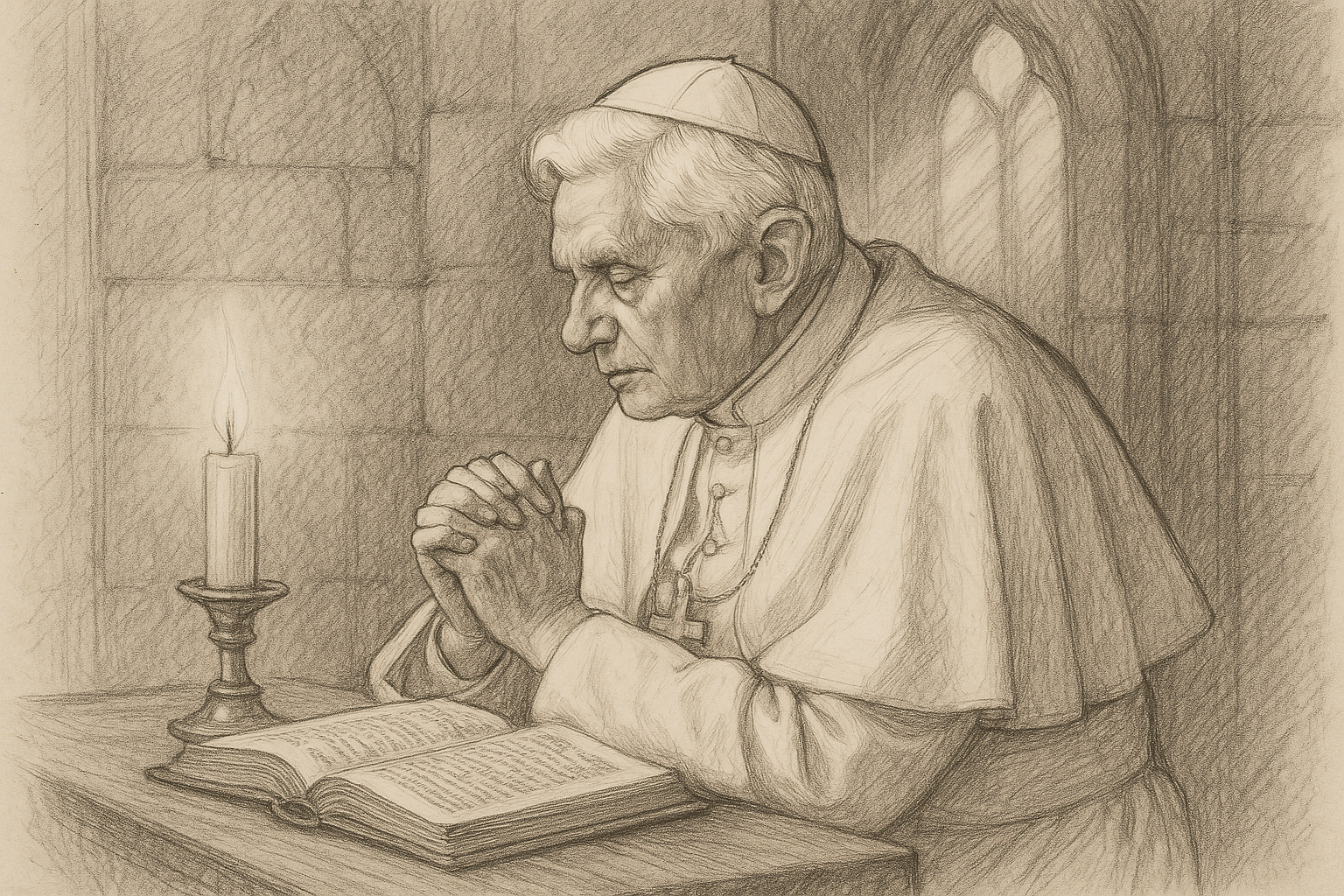
Even after leaving the papacy, he lived quietly in prayer. That final chapter mattered because it gave his public teaching a contemplative seal. The Church saw in him a man who had spent a lifetime thinking publicly about God and then chose to entrust himself more fully to God in silence.
Practical lessons Catholics can still receive
Benedict XVI matters now because his life answers several of the Church's present needs. First, he teaches Catholics not to fear reason. Faith is not fragile when it is true. Second, he teaches that doctrine and devotion belong together. A Catholic who loves the Church should want to understand what she believes. Third, he shows that reverence is not nostalgia. It is a way of making room for God.
He also offers a useful correction to modern impatience. Benedict's style was not fast or flashy. He trusted that the Church is renewed by patient teaching, faithful prayer, and honest repentance. That is still true. Many Catholics today are tempted to think that the answer to confusion is reinvention. Benedict suggests something better: return to Christ, return to the sources, return to worship, return to truth.
His work can also help Catholics read current crises more clearly. When the Church is noisy, Benedict invites silence. When the culture is cynical, he invites hope. When religion is treated as an accessory, he reminds believers that God is the center. These are not small things. They are the foundations of a durable Catholic life.
Three habits Benedict's witness can inspire
- Read the faith seriously. Make room for Scripture, the Catechism, and the writings of the saints, not as homework, but as nourishment.
- Pray with reverence. Let the Mass, the sacraments, and the daily prayers of the Church shape the soul before opinions do.
- Speak truth with charity. Benedict never separated clarity from kindness, and Catholics should not either.
In the end, Benedict XVI still matters because he helped Catholics remember that Christianity is not a mood. It is an encounter with the living God in Jesus Christ, handed on through the Church, celebrated in the liturgy, and lived in truth. In an age that often rewards noise, he left behind the quieter gift of ordered thought, prayerful speech, and a faithful mind turned toward God.
Keep Reading on Lets Read The Bible
Frequently Asked Questions
Why does Pope Benedict XVI still matter to Catholics today?
He still matters because he defended the relationship between truth, worship, and charity. His teaching helps Catholics respond to confusion without abandoning the depth of the faith.
What is Benedict XVI best known for in Catholic history?
He is best known as a theologian pope who emphasized the harmony of faith and reason, the centrality of the liturgy, and the need to proclaim Christian truth clearly and gently.
What is one practical lesson from Benedict XVI's papacy?
A practical lesson is that Catholics should seek reverence, study the faith carefully, and remember that humility and service matter more than image or influence.