Church History
John Paul II in History: A Papacy Shaped by Courage, Prayer, and the New Evangelization
How the long pontificate of Pope St. John Paul II met a fractured age with clarity, mercy, and missionary zeal.
Site Admin | January 14, 2026 | 100 views
Pope St. John Paul II history is inseparable from the world he inherited. When he was elected in 1978, the Church was still working through the aftermath of the Second Vatican Council, many Catholics were unsettled by confusion and division, and much of the world was caught between the ideologies of communism and liberal secularism. Into that setting came a pope formed by suffering, prayer, philosophy, and pastoral experience. He did not enter history as a distant administrator. He entered it as a witness who believed, with all the strength of his soul, that Christ is the answer to the deepest questions of every age.
He would become one of the most visible popes in modern memory, but visibility was never the heart of his mission. His was a pontificate of encounter. He traveled widely, spoke forcefully, prayed publicly, defended human dignity, and insisted that the Church must not fear the modern world when it remains rooted in the Gospel. To understand his legacy, it helps to see the historical pressures of his time and the spiritual instincts that shaped his response.
A Pope Formed by Loss and Resistance
Karol Wojtyla was born in 1920 in Poland, a nation that would be devastated by war and later dominated by communist rule. His early life was marked by grief. He lost his mother, his brother, and then his father before becoming pope. During the Nazi occupation, he studied in secret and worked in a quarry and chemical plant while discerning a priestly vocation. That background mattered. He knew what it meant to live under systems that treated the human person as expendable.
After his ordination, he served as a priest and bishop in a Poland where the Church was both pastor and witness under pressure. He learned how to speak to people whose faith had to endure surveillance, propaganda, and fear. He also learned how to read the human heart. That combination of intellectual depth and lived suffering would become central to his papacy.
Those words from Christ capture something essential about John Paul II history. He was not simply a pope of ideas. He was a pope convinced that truth is personal, that freedom has a moral shape, and that the Church serves humanity best when she proclaims Christ without hesitation.
The World He Inherited in 1978
By the late 1970s, the global situation was tense and unstable. The Cold War divided nations and families. In Eastern Europe, communist governments promised equality while limiting worship, speech, and conscience. In the West, the cultural aftershocks of the 1960s had unsettled moral language and weakened confidence in institutions, including the Church. Many Catholics were trying to understand how to live the faith in a rapidly changing world.
At the same time, the Church herself was in a period of reception after Vatican II. The council had opened important conversations about liturgy, ecumenism, religious liberty, and the Church's relationship to the modern world. Yet in many places the years that followed brought confusion, selective readings of the council, and liturgical experimentation that sometimes obscured reverence and continuity. John Paul II stepped into this moment as a shepherd determined to strengthen Catholic identity without closing the door to genuine renewal.
His pontificate lasted from 1978 to 2005, one of the longest in Church history. Over those decades he faced world-changing events: the Solidarity movement in Poland, the fall of communist regimes in Europe, the Gulf War, the tragedy of terrorism, and a growing culture of relativism in the West. He also lived through the public visibility of his own suffering after the assassination attempt in 1981 and the decline of his health in later years. His papacy unfolded on both a global and a deeply human stage.
Key Events That Defined His Papacy
The first Polish pope
His election itself was historic. The first pope from Poland, and the first non-Italian pope in centuries, he immediately signaled that the universal Church truly spans nations, languages, and cultures. For Catholics in Communist lands, his election was a sign of hope. For the West, it was a reminder that holiness and leadership can arise from places often overlooked by worldly power.
The inauguration of the new evangelization
John Paul II repeatedly called the Church to a new evangelization. He did not mean a new Gospel. He meant a renewed ardor, method, and expression in proclaiming the same Christ to peoples and cultures that had grown distant from active faith. This was one of the defining themes of his history as pope. He recognized that many baptized people had become functionally secular, even while remaining close to the Church in name. He wanted Catholics to recover the joy of discipleship and to speak of Christ with confidence.
The assassination attempt and the meaning of suffering
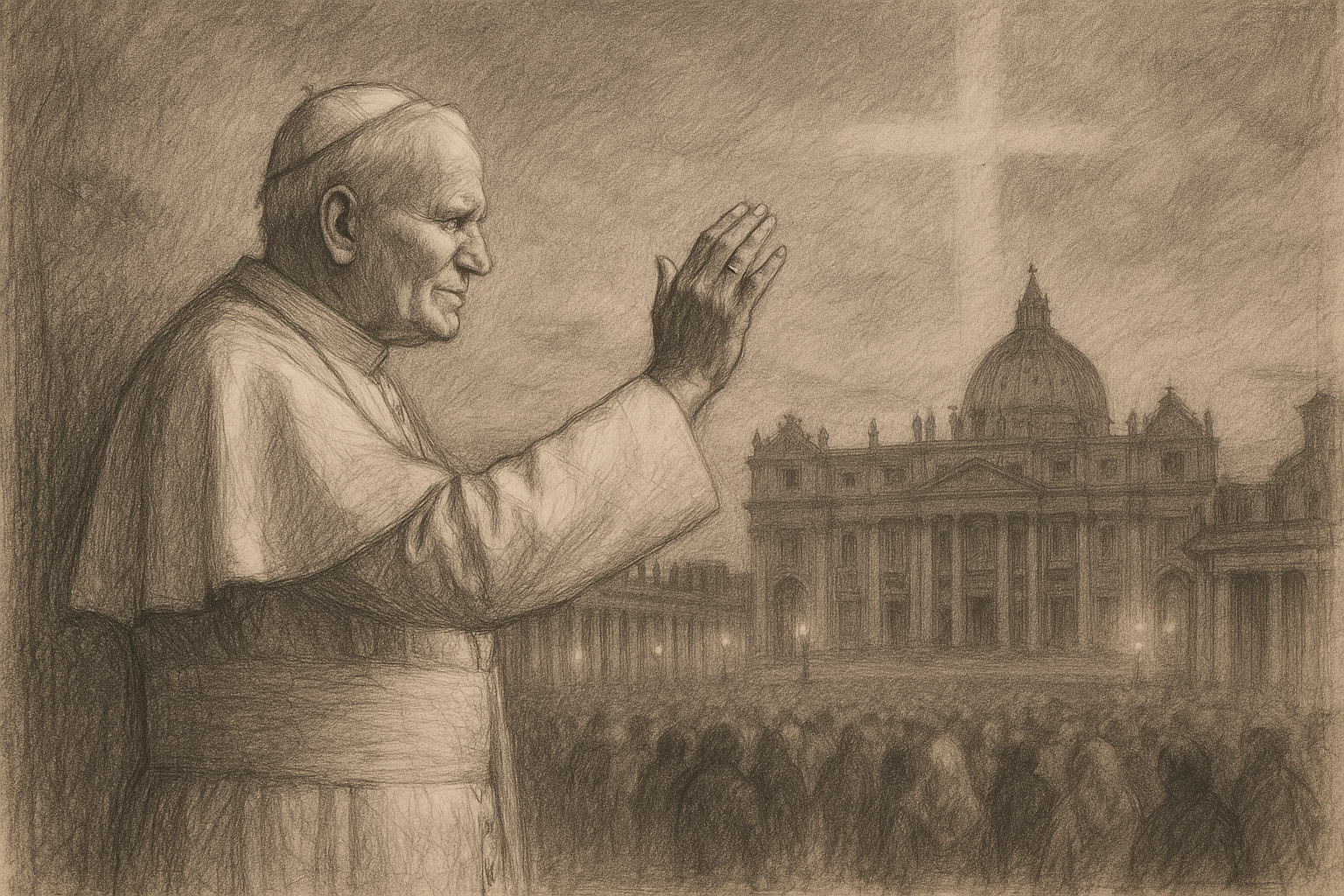
On May 13, 1981, John Paul II was shot in St. Peter's Square. He survived, and the attack became one of the most memorable events of his pontificate. In time, he interpreted his survival in spiritual terms and even forgave the man who shot him. That act of mercy became a powerful witness in a century marked by violence and vengeance. It showed that Christian forgiveness is not weakness but a participation in the mercy of God.
World Youth Day and the gathering of the young
John Paul II had a remarkable ability to speak to young people. World Youth Day began under his pontificate and became one of the most enduring signs of his pastoral vision. He trusted the young enough to challenge them. He did not flatter them with easy slogans. He called them to holiness, vocation, courage, and responsibility. Many Catholics still remember him as a fatherly figure who asked the young to expect more from life than comfort.
The Catechism and the clarity of teaching
One of the most important fruits of his reign was the Catechism of the Catholic Church, published in 1992. It did not invent new doctrine. Rather, it gathered and presented the faith in a coherent and accessible way for the modern age. For a Church facing confusion, it was a gift of clarity. It remains a reference point for catechesis, preaching, and adult formation.
His Response to the Great Questions of the Age
John Paul II history cannot be told only through events. It must also be read through the questions he addressed again and again: What is the human person? What is freedom for? What is love? What is the Church's mission in a culture that often doubts truth itself?
In his major teachings, he defended the dignity of every human life from conception to natural death. He spoke against abortion, euthanasia, consumerism, unjust war, and every ideology that reduces the person to a tool or a problem to be managed. He also insisted that the family is not merely a social convenience but a vital school of love and virtue. His theology of the body offered a profound meditation on human sexuality, marriage, and the meaning of the body itself.
He was equally concerned with the relation between faith and reason. At a time when many people treated religion as a private feeling and science as the only path to truth, he taught that faith and reason are companions. Truth does not fear examination. Properly understood, both reason and revelation point toward the same Creator.
His encyclicals and letters were numerous, but their spirit was consistent. Christ stands at the center of history, and the Church exists to bring people to communion with Him. This conviction shaped his travel, his preaching, and his persistent invitation to the world not to be afraid.
That missionary command is one of the best keys to his pontificate. He believed the Church must never turn inward. She must go out, speak, teach, serve, and baptize.
What Catholics Still Learn From His Witness
The life of John Paul II can be admired on a historical level, but admiration is not the same as discipleship. What makes him enduringly important for Catholics is that he joined doctrine to prayer, authority to tenderness, and intellectual vigor to Eucharistic devotion. He was not perfect in the sense of being beyond criticism in every prudential matter, but his overall witness remains luminous because it was deeply Christ-centered.
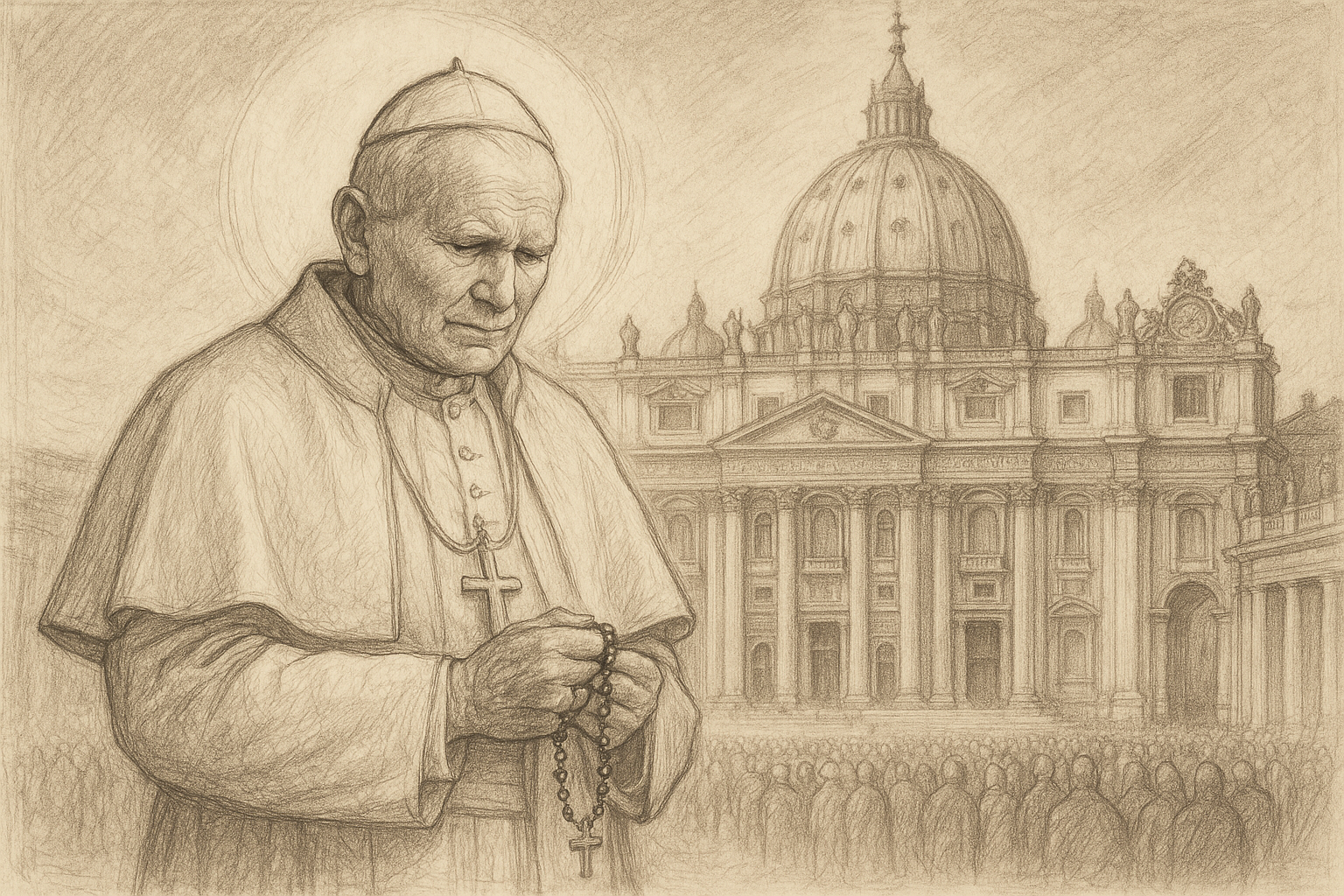
Modern Catholics can learn at least three things from him. First, truth must be spoken with charity, not diluted for convenience. Second, suffering offered to God can bear fruit beyond what we can see. Third, evangelization begins with a living relationship with Jesus, not with marketing or slogans. He spent hours in prayer, celebrated the liturgy with reverence, and drew strength from Marian devotion, especially under the title of Our Lady of Fatima.
There is also a practical lesson for ordinary parish life. He understood that the faith is transmitted most effectively when believers are convinced that it is beautiful and true. Families, teachers, clergy, and laity all have a role in that transmission. A Catholic who knows Christ, loves the Church, and lives with integrity becomes part of the answer to secular fatigue.
For many people, his most lasting image is simple: a pope who stood before the world and kept pointing beyond himself. He did not ask to be the center. He asked the world to look to Christ. That is why John Paul II history continues to matter. In an age that still struggles with fragmentation, despair, and forgetfulness, his life reminds Catholics that holiness is possible, truth is worth defending, and the Gospel can still renew a civilization.
Keep Reading on Lets Read The Bible
Frequently Asked Questions
Why is Pope St. John Paul II so important in Church history?
He helped guide the Church through the late Cold War period, defended human dignity, promoted the new evangelization, and gave the modern Church major teaching gifts such as the Catechism of the Catholic Church.
What was the new evangelization that John Paul II promoted?
It was his call for Catholics to proclaim the same Gospel with renewed zeal, fresh methods, and clear language to baptized people and cultures that had grown distant from active faith.
How did John Paul II respond to suffering in his later years?
He accepted illness and physical decline publicly, showing that suffering united to Christ can become a witness of faith, patience, and hope rather than a defeat.