Church History
Paul VI and the Quiet Strength of a Difficult Papacy
A look at the pope who guided the Church through upheaval, defended human dignity, and asked Catholics to trust Christ in a time of confusion.
Site Admin | January 11, 2026 | 91 views
Pope St. Paul VI is one of the most important figures in modern Catholic history, and also one of the easiest to misunderstand. He lived and served as pope during a time of rapid cultural change, intense disagreement, and deep uncertainty inside and outside the Church. Many Catholics remember him first for Humanae Vitae, his 1968 encyclical on the transmission of human life. Yet his legacy is broader than one document. He guided the Church through the final sessions of the Second Vatican Council, implemented major liturgical and pastoral reforms, strengthened the Church's missionary outlook, and repeatedly called Catholics back to Christ, the Gospel, and the dignity of the human person.
To read Pope St. Paul VI Catholic history well is to see a shepherd who did not enjoy easy victories. He often had to speak and act in a climate of suspicion. Some wanted the Church to change faster than doctrine allows. Others feared that any change at all meant betrayal. Paul VI stood in that tension and tried to keep the Church anchored in continuity. That is one reason he still matters. His papacy shows that fidelity is not the same as popularity, and prudence is not the same as weakness.
A pope formed by a world in crisis
Giovanni Battista Montini was elected pope in 1963, after the death of Pope St. John XXIII. The world he inherited was marked by the Cold War, the spread of secularism, technological optimism, and growing distrust of institutions. The Church was not spared these tensions. The Second Vatican Council was underway, and Catholics everywhere were asking what renewal should look like.
Paul VI did not begin as a pope of spectacle. He was thoughtful, reserved, and often underestimated. But his quiet manner concealed a deep seriousness about the Church's mission. He believed that the Council had to be completed faithfully, not merely celebrated as an event. He also understood that true renewal would require patience. Change in the Church must never come at the expense of truth.
That conviction mattered because the 1960s tempted many people to think that everything solid was dissolving. In that moment, the Church needed a pope who would neither panic nor flatter the age. Paul VI tried to do neither. He gave the Church a measured hand during a period when measured judgment was in short supply.
He completed the Council and kept its meaning alive
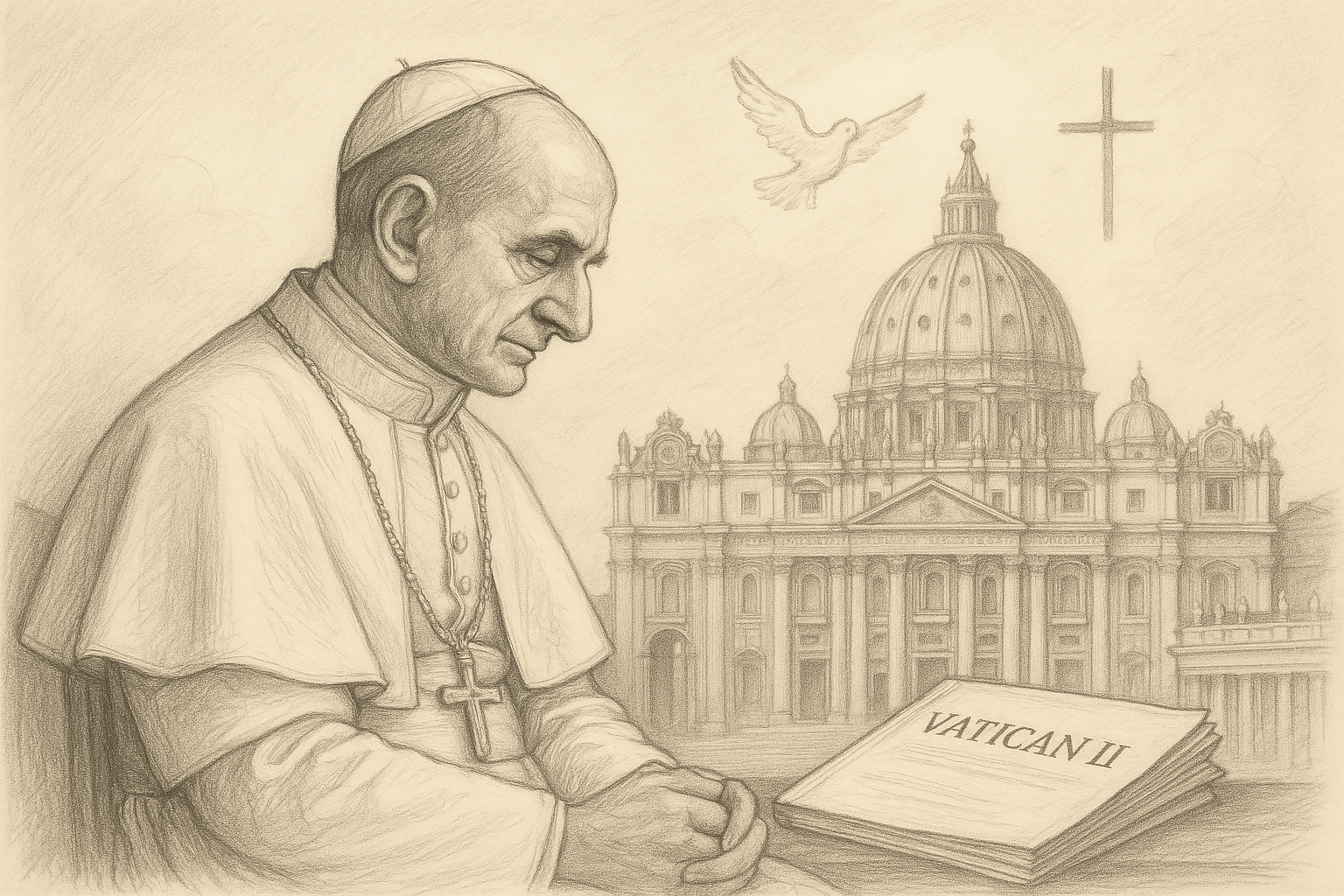
Paul VI presided over the final sessions of Vatican II and made sure its work was brought to completion. He did not treat the Council as a break from the past. Instead, he sought a faithful renewal that could preserve doctrine while opening new paths for evangelization and pastoral care.
One of the most memorable acts of his papacy came in 1965, when he and Patriarch Athenagoras I of Constantinople lifted the mutual excommunications of 1054, a gesture of reconciliation with Eastern Christians. This did not end division, but it signaled a sincere desire for healing and a renewed commitment to Christian unity.
Paul VI also gave the Church important documents on the liturgy, the Church's missionary nature, priestly formation, and evangelization. His apostolic exhortation Evangelii Nuntiandi remains one of the clearest modern statements on evangelization. It teaches that the Church exists to proclaim Jesus Christ, not herself. That point still speaks to Catholics today, because every age is tempted to replace mission with management or identity with performance.
We know that Paul VI did not always receive immediate praise for these efforts. But the value of his work can be measured by how often the Church still turns to his teaching when it needs clarity, discipline, and spiritual realism.
Humanae Vitae and the defense of human dignity
No discussion of Paul VI can avoid Humanae Vitae. Issued in 1968, it reaffirmed the Church's constant teaching that every marital act must remain open to the transmission of life and that artificial contraception is morally wrong. The encyclical was controversial from the moment it appeared, and the controversy has never entirely faded.
To understand why the document matters, Catholics should remember the context. The sexual revolution was advancing rapidly. Many people were beginning to treat human sexuality as a private domain detached from moral law, fertility, and self-gift. Paul VI saw that this would not only affect marriage. It would also shape how society thought about the human body, responsibility, and the meaning of love itself.
His concern was not narrow legalism. He was defending an integrated vision of the person. In Catholic teaching, marital love is meant to be total, faithful, fruitful, and ordered toward communion and life. When pleasure is separated from responsibility, the human person can become easier to use and harder to cherish. Humanae Vitae warned that the loss of reverence for procreation could weaken spouses, families, and even the moral conscience of society.
That warning has proved difficult, but not irrelevant. Catholics today continue to live with the effects of a culture that often separates sex from marriage, children from commitment, and freedom from self-mastery. Paul VI did not invent that crisis. He saw it clearly and spoke before it became even more obvious.
He insisted that conscience must be formed, not invented
Another reason Pope St. Paul VI Catholic history remains instructive is his understanding of conscience. In a confused age, he knew that people often use conscience to mean private preference. But Catholic conscience is not self-will. It is the place where a person hears and responds to the truth.
Paul VI repeatedly called Catholics to fidelity, prayer, and obedience to the Church's teaching office. He understood that a Catholic cannot simply select doctrines like items from a menu. At the same time, he was not indifferent to pastoral suffering. He knew that real people struggle. He knew that marriage can be hard, that cultural pressures are strong, and that holiness often requires sacrifice. His task was not to deny that difficulty, but to illuminate the path through it.
For present-day Catholics, this is an important lesson. If conscience is not formed by Scripture, Tradition, prayer, and the moral teaching of the Church, it can slowly drift into self-justification. Paul VI reminds us that sincerity alone is not enough. Love for the truth must shape the conscience before the conscience can safely guide the heart.
The burden of leadership in a divided Church
Paul VI suffered deeply from the turmoil that marked his papacy. He saw priests and religious leave their vocations. He witnessed confusion over liturgy, doctrine, and moral teaching. He knew that some Catholics felt abandoned, while others felt finally liberated. Few popes have had to govern amid such widely scattered expectations.
His response was not to surrender the Church to ideology. Nor did he retreat into nostalgia. He kept insisting on Christ, prayer, penance, and the unity of the Church. He also modeled a kind of papal humility that is easy to miss. He did not pretend that every problem could be solved quickly. He did not confuse authority with domination. He governed with the awareness that the pope is a servant of the servants of God.
This matters because Catholics today still live in a time of argument and mistrust. The temptation is to define the Church by faction: progressive against traditional, pastoral against doctrinal, local concern against universal discipline. Paul VI's example suggests another way. He shows that the Church remains herself when she keeps her eyes on Christ and refuses to trade truth for convenience.
What Catholics can take from his witness now
Paul VI's papacy offers several concrete lessons for Catholics today.
- Truth and charity belong together. He taught difficult doctrine without abandoning pastoral concern.
- The Church must evangelize, not merely adapt. His call in Evangelii Nuntiandi still challenges a tired Church to speak of Christ with fresh conviction.
- Marriage and family life are moral front lines. Humanae Vitae remains a summons to see human love with Christian seriousness.
- Discipline can serve peace. Catholic obedience is not slavery but a school of freedom ordered to God.
- Unity is a gift to be guarded. Paul VI knew the pain of division and worked, however imperfectly, to preserve communion.
These lessons are not abstract. They matter in parish life, in marriage preparation, in confession, in catechesis, and in the daily struggle to remain faithful when the surrounding culture rewards compromise. Catholics who learn from Paul VI are not being asked to imitate his personality. They are being asked to imitate his seriousness about Christ.
A saint for uncertain times
Paul VI was canonized because the Church recognized the holiness of his life, not because every decision he made was universally admired. That distinction is important. Saints are not flawless leaders. They are faithful servants. In Paul VI's case, fidelity often meant carrying burdens that were misunderstood in his own lifetime.
He died in 1978, leaving behind a Church still wrestling with many of the questions he faced. Yet history has increasingly shown the depth of his judgment. He understood that the Church cannot remain herself if she follows the spirit of the age wherever it goes. She must instead offer the world Christ, who is the same yesterday, today, and forever Hebrews 13:8.
That is why Pope St. Paul VI Catholic history still matters. He reminds Catholics that courage may look quiet, that truth can be costly, and that the Church serves the world best when she refuses to abandon the Gospel. In an age that still prizes speed over wisdom and noise over discernment, his papacy remains a call to steady faithfulness.
If Catholics want a model for how to stand firm without losing hope, Paul VI is worth returning to. He does not offer easy answers. He offers something better: a witness to patience, reverence, and trust in the Lord who guides His Church through every age.
Keep Reading on Lets Read The Bible
Frequently Asked Questions
Why is Pope St. Paul VI important in Catholic history?
He led the Church through the final sessions and implementation of Vatican II, defended the Church's teaching on marriage and human life, and helped shape modern Catholic evangelization.
What is Humanae Vitae and why does it still matter?
Humanae Vitae is Paul VI's 1968 encyclical reaffirming that marital love must remain open to life. It still matters because it defends the dignity of marriage, the meaning of the human body, and the moral truth about fertility.
How did Paul VI help the Church after Vatican II?
He worked to complete the Council faithfully, promoted liturgical and missionary renewal, and insisted that change in the Church must stay rooted in doctrine and communion.