Church History
A Pope for the Threshold: John Paul II and the Church's Courage in a Changing Age
How John Paul II helped Catholics face modern life with clearer faith, firmer hope, and a renewed call to evangelize.
Site Admin | January 15, 2026 | 114 views
Pope St. John Paul II holds a singular place in modern Catholic memory. He was not only a long serving pope and a world traveler. He was also a man who helped the Church speak with confidence in an age marked by political upheaval, moral confusion, and deep questions about human dignity. For many Catholics, his name is linked with courage, mercy, and a renewed sense that faith must not be hidden away.
To speak of Pope St. John Paul II Catholic history is to speak of a pontificate shaped by the events of the twentieth century. He came to the papacy in 1978 after a life formed by war, occupation, suffering, and prayer. That background mattered. He knew from experience what it meant for human beings to live under regimes that denied truth about God and truth about the human person. His teaching and his witness were never abstract. They were forged in the fire of history.
A pope formed by the wounds of the century
Karol Wojtyla grew up in Poland during a time of great suffering. He witnessed the devastation of Nazi occupation and later lived under communism. These were not merely political systems to him. They were competing claims about the meaning of life, freedom, and human dignity. In both cases, the dignity of the person was threatened by powers that tried to reduce human beings to instruments of the state or of ideology.
That history helps explain why John Paul II spoke so often about the human person. He did not treat the moral life as a list of disconnected rules. He saw that once truth about the person is obscured, everything else begins to unravel. The Church's defense of life, marriage, conscience, and religious freedom was not for him a collection of private opinions. It was a defense of what is true about man in the sight of God.
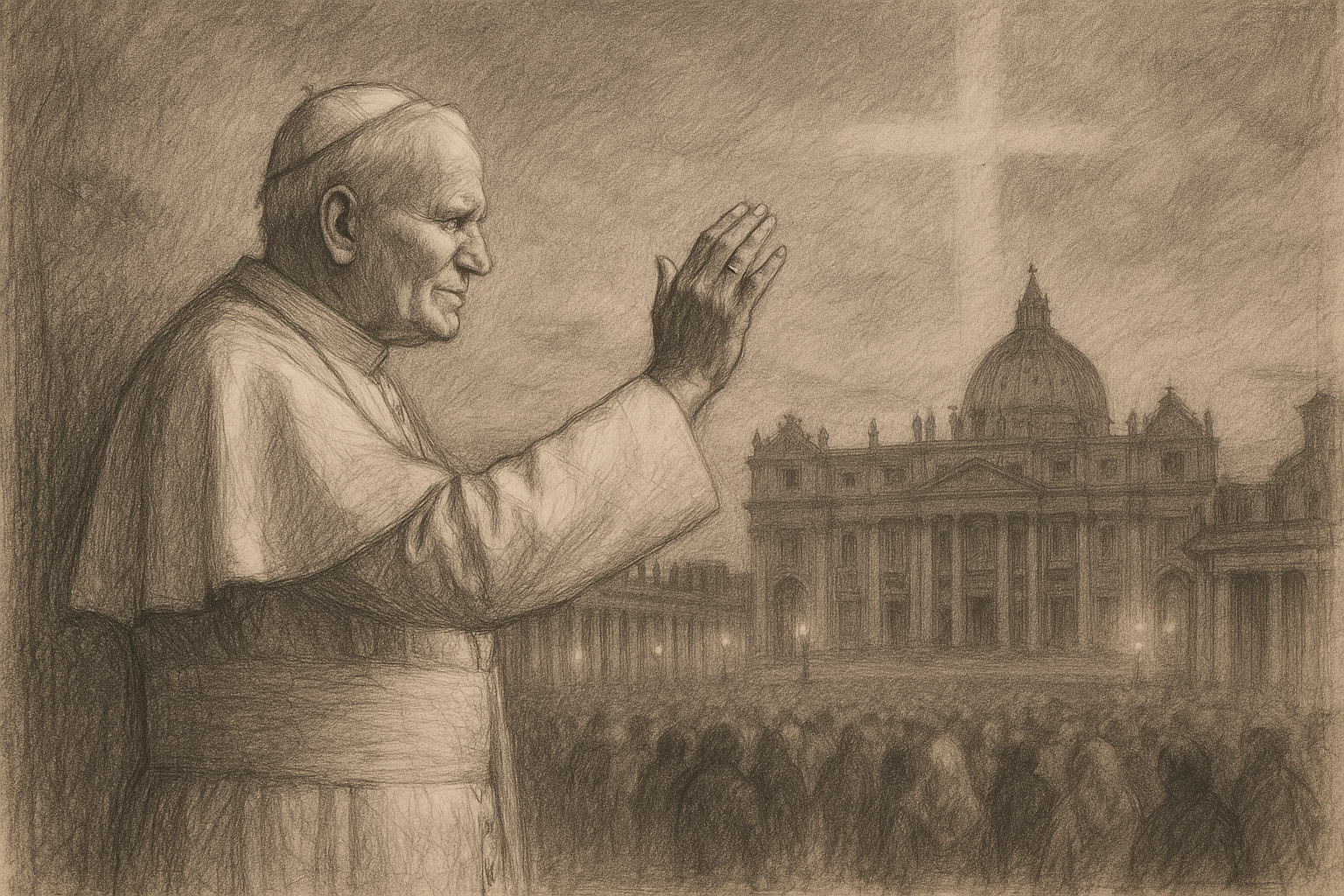
When he appeared on the balcony of St. Peter's Basilica and asked the Church not to be afraid, he was speaking from more than rhetorical instinct. He was speaking as someone who had lived through fear and had seen how Christian faith can outlast empires. His words became memorable because they sounded both simple and urgent: Do not be afraid.
He is not the Savior, but he bore witness to the one Savior with uncommon steadiness.
The historical moment of his pontificate
John Paul II became pope at a critical moment in Church history. The Second Vatican Council had ended just over a decade earlier, and the Church was still living through the challenge of interpreting and receiving its reforms faithfully. Many Catholics were hungry for renewal, but confusion was also widespread. Questions about liturgy, catechesis, authority, morality, and mission were pressing everywhere.
At the same time, the wider world was moving through late Cold War tensions, new consumer prosperity in some regions, and growing secularization in others. The cultural atmosphere was changing quickly. Faith was increasingly treated as a private preference rather than a public truth. John Paul II saw that the Church could not respond by retreating into nostalgia or by diluting her claims to fit the age. She needed to proclaim Christ anew.
His long pontificate gave him time to address these challenges in both word and action. He traveled widely, met with young people, bishops, workers, intellectuals, and the poor, and used the global stage to remind the world that Christianity is not a relic. It is a living encounter with Jesus Christ, who continues to call every generation.
Evangelization as the Church's mission
One of John Paul II's most enduring contributions was his insistence on evangelization. He repeatedly called the Church to a new evangelization, meaning not a new gospel, but a renewed fervor, method, and expression in proclaiming the same Christ to people who had grown distant from Him or had never heard Him clearly.
This emphasis has remained central to Catholic life because it touches the Church's identity itself. The Church exists to make Christ known. She does this through the sacraments, through preaching, through charity, and through the witness of holy lives. John Paul II never treated evangelization as the job of clergy alone. He addressed it to families, lay people, religious, teachers, and young people. Everyone has a role in bringing the faith into the world.
His message was especially powerful because it combined conviction with invitation. He did not present the gospel as a burden to be managed. He presented it as good news worthy of surrender. In a world that often tells people to build themselves from scratch, he reminded Catholics that true freedom is found not in self invention but in receiving life from God.
This is one reason his writings continue to be read. They are not merely historical documents. They still speak to the spiritual hunger of people who want meaning, clarity, and a faith that can withstand modern pressures.
Teaching the dignity of the human person
At the center of John Paul II's thought was the conviction that every human person is made in the image of God and therefore possesses an inviolable dignity. This conviction shaped his teaching on life, sexuality, work, suffering, and social justice. He consistently resisted any attempt to reduce the human person to economics, politics, or appetite.
His defense of life was especially clear. He spoke forcefully against abortion and euthanasia because he saw them as attacks on the weakest and most vulnerable. He also insisted that the dignity of each person must be protected in every stage of life. This was not a narrow issue for him. It was part of a larger vision in which human beings are never disposable.
He also deepened Catholic reflection on the body and love. His catecheses on human love, often called the Theology of the Body, offered a rich meditation on creation, marriage, chastity, and the meaning of the body. These teachings showed that Catholic morality is not a rejection of human flourishing. It is a path toward authentic communion and self gift.
In a culture where sexuality is often detached from commitment and the body is treated as an object, John Paul II's vision remains strikingly countercultural. Yet its appeal endures because it answers a deep human longing: to be loved wholly and to love truthfully.
His witness of suffering and trust
John Paul II's final years gave the Church another kind of teaching. After the assassination attempt in 1981 and the slow decline of his health, he became a public witness to suffering borne with faith. His frailty was visible to the whole world. Yet he continued to pray, bless, forgive, and persevere.
This visible suffering mattered because it gave credibility to his preaching. He had spent years speaking about the cross, and in his later life he carried it in his own flesh. Catholics saw that Christian hope is not based on the denial of pain but on union with Christ in it. A papacy marked by stamina and travel also became a papacy marked by the dignity of weakness.
That witness still encourages Catholics who face illness, aging, discouragement, or hidden burdens. John Paul II showed that fruitful Christian life does not end when strength diminishes. Sometimes it becomes even more luminous. The world may value productivity above all else, but the Church knows that a suffering person united to Christ still bears great spiritual fruit.
What Catholics can still learn from him
John Paul II remains relevant because the needs he addressed have not disappeared. If anything, they have become more visible. Many Catholics today live among competing voices that tell them to doubt the faith, privatize the faith, or reduce the faith to sentiment. His example offers several concrete lessons.
- Be unafraid to belong to Christ. John Paul II reminded Catholics that faith is not something to hide. It should shape daily choices, speech, and relationships.
- Think with the Church. He encouraged deep loyalty to Catholic teaching without reducing the faith to slogans or politics.
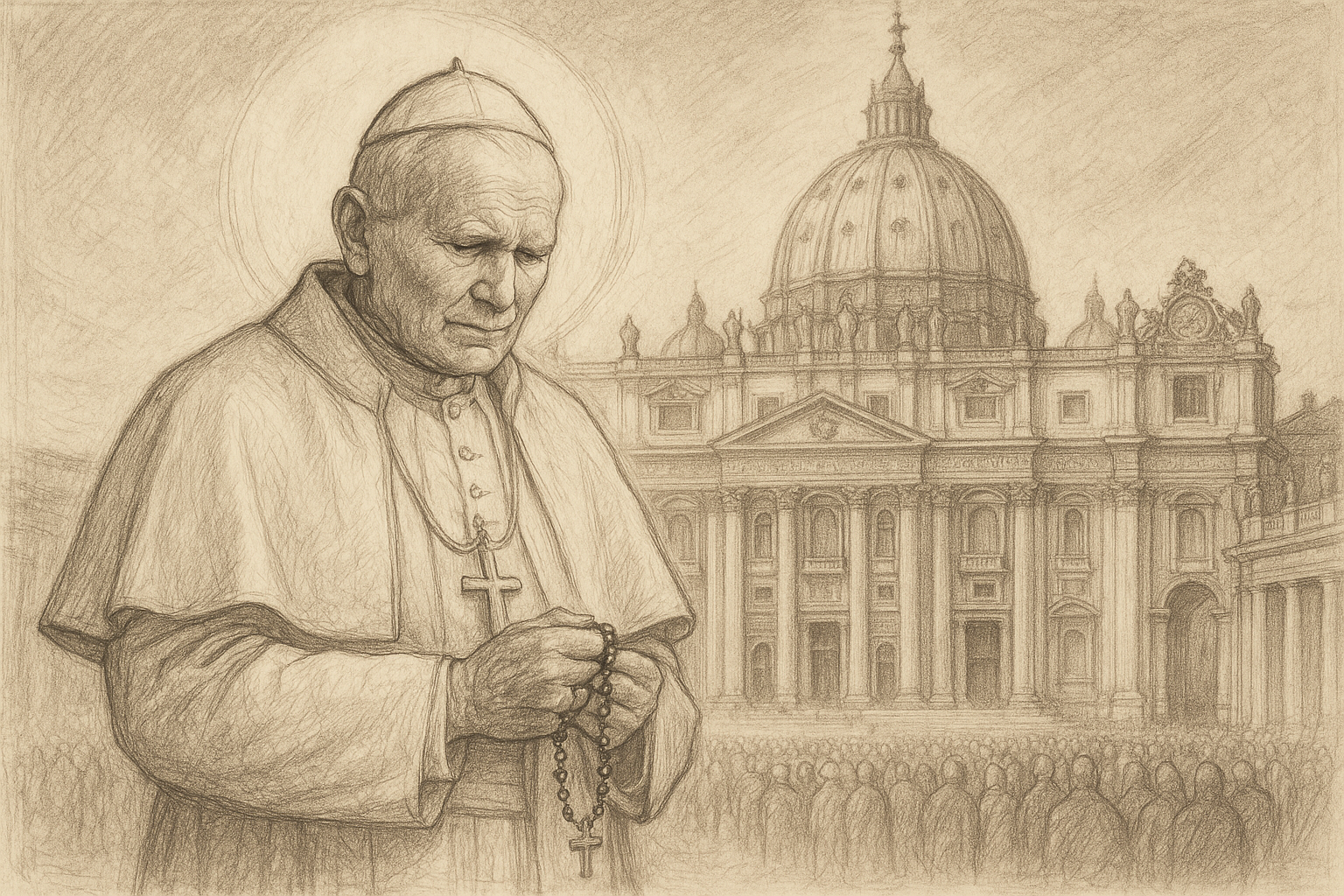
- Pray before acting. His public energy flowed from a hidden life of prayer, especially devotion to the Blessed Virgin Mary.
- Respect the human person. His teaching calls Catholics to defend life, dignity, and conscience in a world that often forgets them.
- Evangelize with confidence and charity. He showed that proclamation works best when truth is joined to tenderness.
His Marian devotion is also worth noting. He entrusted himself to Mary with the words Totus Tuus, meaning totally yours. This devotion was not sentimental decoration. It was a disciplined way of belonging more fully to Christ. Mary leads the Church to her Son, and John Paul II understood that Marian love can deepen missionary zeal rather than distract from it.
For modern Catholics, this balance is important. The Church does not need believers who are loud but shallow, or careful but timid. She needs disciples who know the truth, love the truth, and live it with humility. John Paul II remains a compelling model of that combination.
A saint whose memory still presses for a response
It is easy to remember John Paul II as a famous pope with a long reign and a global presence. It is harder, but more important, to remember why he still matters. He mattered because he insisted that Christ is the answer to the deepest human questions. He mattered because he defended the dignity of the person when many ideologies tried to blur it. He mattered because he called the Church outward, toward mission, rather than inward toward comfort.
In this sense, he is not only a figure of the past. He is a reminder that Catholic history is never merely about what once happened. It is about the living continuity of faith handed on from one generation to the next. His life asks Catholics today whether we will receive that inheritance with gratitude and use it with courage.
The questions he raised remain before us: Will we trust Christ enough to speak His name in public? Will we defend life when it is costly? Will we evangelize with patience, conviction, and joy? John Paul II's legacy does not let the Church settle for passive memory. It points us toward witness.
For Catholics reading his life now, the invitation is simple and demanding. Learn from his clarity. Pray with his confidence. Follow his Marian trust. And like him, walk into the future with the quiet courage that comes from knowing Christ is risen and the Church is never abandoned.
Keep Reading on Lets Read The Bible
Frequently Asked Questions
Why is Pope St. John Paul II so important in Catholic history?
He shaped the Church's response to modern secular culture, defended the dignity of the human person, helped promote the new evangelization, and gave a global witness of courage rooted in prayer and suffering.
What is John Paul II's main teaching on evangelization?
He taught that the Church must proclaim the same gospel with renewed zeal, using fresh methods and language when needed, but never changing the truth of Christ.
How can Catholics apply John Paul II's example today?
They can live with greater courage, deepen prayer, defend life and human dignity, stay faithful to Catholic teaching, and share the faith with charity in everyday life.