Church History
Pope Pius XII and the Burden of a Troubled Century
A Catholic look at the pontificate of Pius XII, shaped by war, diplomacy, and the care of souls in one of history's darkest eras.
Site Admin | January 6, 2026 | 80 views
Pope Pius XII history is inseparable from the upheavals of the twentieth century. When Eugenio Pacelli was elected pope in 1939, Europe was already standing on the edge of catastrophe. Within months, the world was plunged into World War II, and the man who would become Pope Pius XII found himself carrying the weight of a universal pastor in an age when nations were collapsing, ideologies were hardening, and millions of ordinary people were trapped in conditions beyond their control.
To understand his pontificate fairly, it helps to begin with the world he inherited. The Church entered the middle of the twentieth century after the trauma of the First World War, the rise of totalitarian regimes, and the spread of atheistic and militant political movements. Communism, fascism, and Nazi racial ideology all threatened the human person, the family, and the freedom of the Church in different ways. Catholics in many countries were facing censorship, persecution, and pressure to place the state above conscience. A pope in that setting could not afford to be simplistic. He needed doctrine, discipline, patience, and a clear sense of what could be said publicly and what had to be done quietly.
The making of Eugenio Pacelli
Eugenio Pacelli was no stranger to diplomacy or the realities of modern politics. Before becoming pope, he served the Holy See as a diplomat and later as Cardinal Secretary of State. His experience gave him a wide view of international affairs and of the dangers facing the Church in Europe. He was known as a careful, intelligent, and reserved man, formed by prayer and accustomed to weighing words carefully. That matters, because his style as pope was deeply shaped by the burdens of his earlier service.
Pacelli was elected at a time when Catholics needed steady leadership more than dramatic gestures. His pontificate would be marked by repeated efforts to protect the Church's freedom, defend human dignity, and maintain contact with Catholics and non-Catholics alike in a world increasingly divided by war and suspicion. He was not a pope of slogans. He was a pope of measured statements, diplomatic labor, and pastoral restraint.
War, persecution, and the question of prudence
World War II became the defining event of Pope Pius XII history. His wartime conduct has been debated for decades, and any honest account has to recognize both the moral urgency of the period and the severe limits under which he worked. He spoke against war, condemned the loss of innocent life, and repeatedly called for peace. He also faced the painful reality that public denunciations could trigger retaliation against Catholics, Jews, clergy, religious, and occupied populations. In such circumstances, prudence was not a luxury. It was part of the moral burden of office.
One of the most difficult aspects of his wartime leadership was the need to balance public witness with discreet action. The Church was trying to survive in places where words alone could endanger lives. Many local Church institutions, convents, monasteries, and Catholic homes became places of refuge. The Holy See also used diplomatic channels to protest abuses, seek relief, and assist victims. This did not make the age easy to judge, but it does show that the pope's concern was not abstract. He was trying to act in a world where every choice carried consequences for living people.
In a time of violence, the Church does not cease to be a mother. She teaches, warns, shelters, and prays, often while the world demands impossible answers at once.
The Holocaust remains one of the most painful and morally serious contexts for evaluating his pontificate. Catholics continue to ask what was known, when it was known, and what could have been done differently. Those questions deserve seriousness, not defensiveness. At the same time, historical judgment must account for the limited options available under Nazi domination, the role of local bishops and religious communities, and the reality that many acts of rescue were intentionally hidden from public view. The full historical record is large and complex, and it resists easy verdicts.
The pope of doctrine and devotion
Pius XII was not only a wartime pope. He was also a teacher of doctrine and a guardian of Catholic life. He issued important encyclicals on the Church, liturgy, Scripture, morals, and the renewal of Christian life. Among the most notable was Munificentissimus Deus, which defined the Assumption of the Blessed Virgin Mary as dogma in 1950. This was a major moment in modern Catholic history because it showed the Church's confidence in Marian doctrine as something living, not merely inherited. The definition came after consultation with the bishops of the world, reflecting the pope's sense of the Church as a visible communion in which the successor of Peter discerns and confirms the faith.
His teaching also reached into liturgical renewal. He encouraged greater participation in the sacred liturgy and approved changes to the Holy Week rites. These developments would later influence wider liturgical reform. Yet even here, Pius XII moved carefully. He wanted renewal that served devotion and orthodoxy, not novelty for its own sake. His instinct was to strengthen the Church by purifying and deepening what had already been received.
He also addressed questions of Sacred Scripture and theology, insisting that Catholic study of the Bible should be both serious and faithful. In an era of intellectual confusion, he sought to make clear that Catholic truth is not threatened by honest scholarship when scholarship remains obedient to the Church. That balance remains important for Catholics today, especially in times when faith and reason are often presented as enemies.
A global pope in a changing world
After the war, the world did not simply return to normal. New tensions emerged, especially with the spread of Soviet communism and the division of Europe. Pius XII repeatedly warned against ideologies that denied God and reduced human beings to material forces or political instruments. He understood that the postwar world would not be healed merely by the absence of bombs. It would need conversion, moral order, and respect for the dignity of the person.
His pontificate also unfolded during the expansion of radio, mass communication, and modern travel. The pope was becoming more visible to the world, yet the office still depended heavily on paper, diplomacy, and episcopal correspondence. Pius XII adapted to this changing environment while preserving the solemnity of the papacy. He addressed Catholics across continents, strengthening the sense that the Church was not a European club but a worldwide body bound together by faith, sacrament, and obedience to Christ.
Another important feature of his reign was the growing emphasis on the role of the laity. Though later developments would go farther, Pius XII already encouraged Catholics to recognize their responsibility in family life, professional life, and public witness. The Church's mission was not confined to clergy and religious. Every baptized person had a share in the work of evangelization, prayer, and charity.
Questions modern Catholics still ask
Many modern Catholics approach Pius XII through one of two extremes. Some remember him chiefly as a wartime pope and focus entirely on the controversies. Others defend him so strongly that they overlook the real moral discomfort his era leaves behind. Neither approach is very Catholic. The Catholic habit of mind should be both reverent and truthful. We can honor the office of Peter without pretending that history is simple.
What, then, should Catholics learn from his witness? First, that the Church often has to govern through darkness, not clarity. A pope may not be able to remove every evil, but he can still defend principle, preserve unity, and act for the vulnerable. Second, that prudence is not cowardice. In a violent age, measured speech can be a form of responsibility. Third, that doctrine and pastoral care belong together. Pius XII did not think the Church could survive by strategy alone. It needed truth, worship, and holiness.
There is also a lesson in how he faced modernity. He did not romanticize the age. He saw the threats posed by mass politics, propaganda, ideological totality, and secular arrogance. But he also believed the Church could respond without panic. That calm confidence remains valuable today, when Catholics once again live amid confusion, polarization, and pressure to conform to the spirit of the age.
Three enduring images of his pontificate
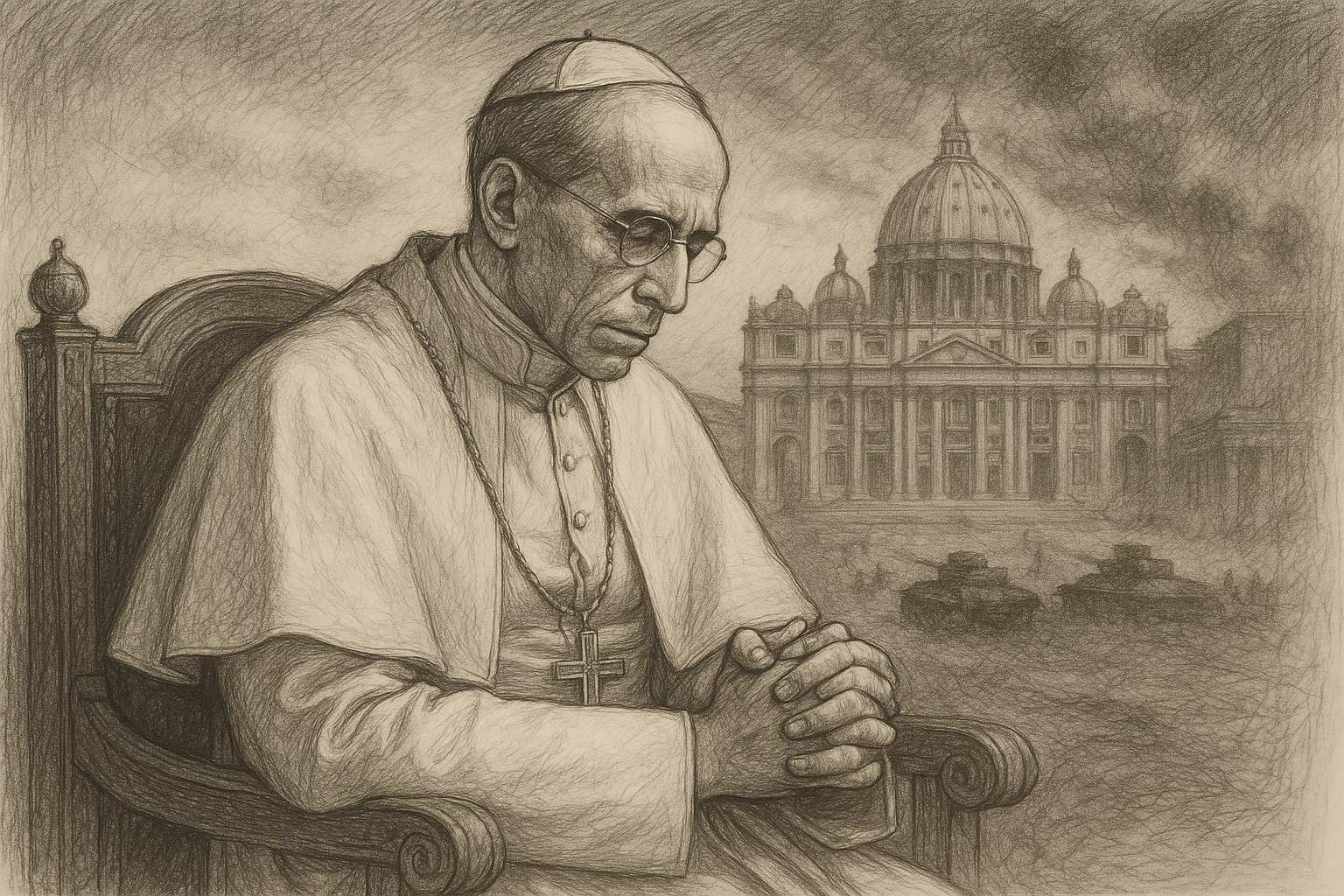
- The pope praying while Europe was at war and human suffering was widespread.
- The teacher of doctrine confirming Marian faith through the definition of the Assumption.
- The shepherd trying to preserve Church freedom while regimes on all sides demanded compromise.
Pope Pius XII history invites careful reading, not slogans. His pontificate was shaped by war, but it was not defined by war alone. It was also marked by doctrine, liturgical care, Marian devotion, global concern, and a steady conviction that the Church must remain herself even when the world is collapsing around her. For Catholics, his life is a reminder that the papacy is often most visible in crisis, and that fidelity sometimes looks like patience, clarity, and the quiet refusal to surrender the faith to the age.
Keep Reading on Lets Read The Bible
Frequently Asked Questions
Who was Pope Pius XII before becoming pope?
Pope Pius XII was born Eugenio Pacelli. Before his election in 1939, he served the Holy See as a diplomat and as Cardinal Secretary of State, which gave him deep experience in international affairs and Church governance.
Why is Pope Pius XII history so closely tied to World War II?
Because his pontificate began just before the war and unfolded during its most devastating years. His leadership during Nazi occupation, the Holocaust, and the broader crisis of total war remains central to how historians evaluate him.
What is one major teaching associated with Pope Pius XII?
One of the most important is his definition of the Assumption of the Blessed Virgin Mary as dogma in 1950 through the apostolic constitution Munificentissimus Deus.