Doctrine and Questions
The Rosary as a School of Prayer and Peace
A biblical, Catholic look at why this prayer has shaped the lives of believers for centuries
Site Admin | June 27, 2025 | 86 views
For many Catholics, the Rosary is one of the most familiar prayers in the Church. It is prayed at home, in churches, in hospitals, on pilgrimage, and in quiet moments when words are hard to find. Yet the reason Catholics pray the Rosary is sometimes misunderstood. Some think it is a repetition detached from Scripture. Others assume it is mainly a devotion to Mary apart from Christ. In reality, the Rosary is a deeply biblical prayer that helps believers contemplate the life of Jesus with the help of His Mother.
So why Catholics pray the Rosary explained simply? Because it is a form of prayer that joins vocal prayer, meditation, and Christian contemplation. It gives structure to prayer when the mind is scattered. It leads the heart through the mysteries of Christ's life, death, and resurrection. And it does all of this in a way that is faithful to the Church's long memory and to the pattern of prayer found in Scripture.
A prayer built around Christ
The first thing to understand is that the Rosary is Christ centered. Every decade of the Rosary invites the believer to meditate on an event from the life of Jesus. These are called the mysteries: the Joyful, Sorrowful, Glorious, and Luminous mysteries. In each one, the prayer is not meant to stop at the words themselves. The words serve the meditation, and the meditation leads to Christ.
This matters because Catholic prayer is not only about speaking to God, but also about listening, remembering, and pondering. The Rosary trains the soul to do exactly that. When the same prayers are repeated, the repetition is not empty. It creates a steady rhythm that quiets distraction and opens the mind to the Gospel.
But Mary kept all these things, pondering them in her heart. (Luke 2:19)
That verse from Luke shows a pattern that lies close to the spirit of the Rosary. Mary does not merely receive the events of Christ's life as passing moments. She keeps them and ponders them. Catholics pray the Rosary in a similar spirit, asking for the grace to remember Christ as Mary did, with reverence and attention.
Scripture, memory, and sacred repetition
Some Christians worry about repeating prayers, but repetition is not foreign to the Bible. In heaven, the angels cry out unceasing praise to God. The Psalms repeat key lines for emphasis and worship. Even Jesus prays in the Garden with repeated words. In Matthew's Gospel, He says,
And in praying do not heap up empty phrases as the Gentiles do; for they think that they will be heard for their many words. (Matthew 6:7)
That warning is often misunderstood. Jesus is not condemning every repeated prayer. He is warning against pagan-style babbling that treats prayer as a technique to force a response from God. The Rosary is nothing like that. It is not an attempt to manipulate heaven. It is a humble and thoughtful act of meditation, repeated because the heart benefits from steady prayer.
Jesus Himself offers another important pattern when He teaches the Our Father. The Rosary begins with that prayer, placing every mystery in the context of the Lord's own words. It also includes the Hail Mary, which is rooted in Scripture. The first part comes from Gabriel's greeting to Mary and Elizabeth's praise of her:
- Hail, full of grace, the Lord is with you (Luke 1:28)
- Blessed are you among women, and blessed is the fruit of your womb (Luke 1:42)
These are not inventions detached from the Bible. They are words drawn from Scripture and arranged into prayer. The Church later adds a petition asking Mary to pray for us now and at the hour of our death, which reflects the Catholic conviction that the communion of saints is real and living in Christ.
Why Catholics turn to Mary at all
At the center of the Rosary is not Mary as an end in herself, but Mary in relation to Christ. Catholics honor her because God honored her first. She is the Mother of the Lord, the woman who said yes to the Incarnation, and the disciple who remained faithful when others fled. To pray with Mary is not to replace Jesus. It is to enter more deeply into His mystery with the one who knew Him most closely on earth.
Catholics also ask Mary to pray for them because asking for prayer is biblical. Christians ask one another to pray in the body of Christ. If believers on earth can intercede for one another, it is fitting to believe that those who are alive in Christ can do the same in heaven. Mary's intercession does not compete with Christ's unique mediatorship. Rather, it depends on it.
Scripture points to Mary's ongoing place in the life of the Church. At Cana, she brings the need of the couple to Jesus and tells the servants, Do whatever he tells you (John 2:5). That line captures the heart of authentic Marian devotion. Mary always leads the believer to obedience to her Son.
The Rosary as a tool for ordinary Catholic life
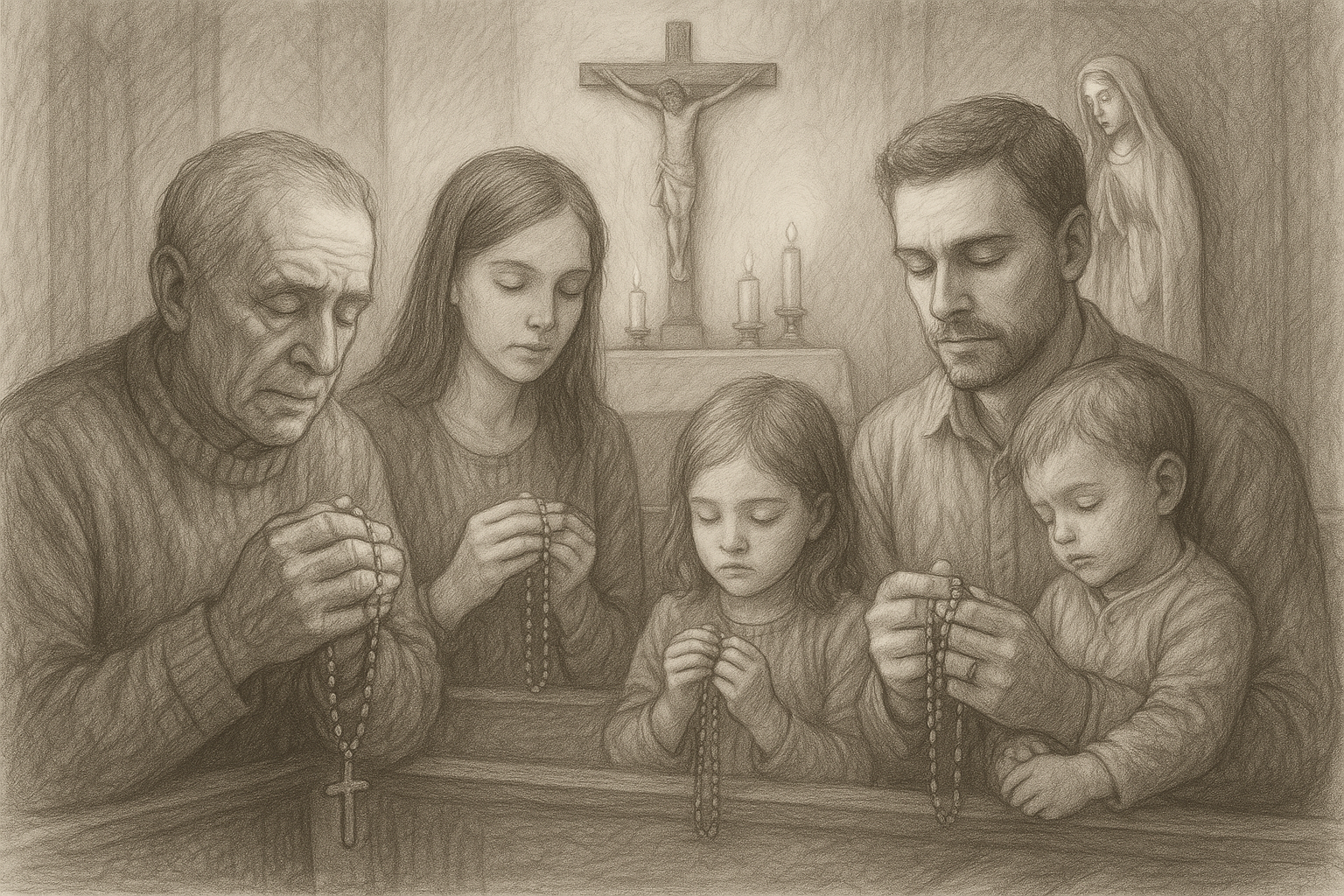
One reason the Rosary has remained beloved is that it fits real life. Not every Catholic can spend long hours in formal meditation. Parents, workers, students, and the sick often need a prayer they can carry with them. The Rosary gives that gift. It can be prayed in a carpool line, during a walk, in a hospital room, or quietly before bed.
Its simplicity is part of its strength. The prayers are few and known by heart. That frees the mind to contemplate. The mysteries provide a structure for meditation without demanding advanced training. Over time, the Rosary forms habits of patience, memory, and trust.
It is also a prayer for suffering. The Sorrowful Mysteries in particular help believers unite their pain to Christ's Passion. When a Catholic prays the scourging, the crowning with thorns, or the carrying of the cross, the prayer becomes a school of perseverance. It teaches that suffering is not meaningless when joined to the Lord who suffered for us.
Let us then with confidence draw near to the throne of grace, that we may receive mercy and find grace to help in time of need. (Hebrews 4:16)
The Rosary is one way Catholics draw near with confidence. It is not confidence in our own words, but confidence in God's mercy, made visible in Christ and reflected in the tenderness of His Mother.
The Rosary and contemplation
The Church teaches that prayer involves more than asking for things. It also includes praise, thanksgiving, and contemplation. The Rosary helps ordinary Catholics enter contemplation by giving them repeated access to the same Gospel events. Repetition allows the mysteries to sink in slowly. A person may pray the same decade many times over a lifetime, and each time hear something new.
That is one reason the Rosary remains fruitful even for seasoned Catholics. It does not grow stale when prayed with faith. Instead, it becomes more spacious. A child can pray it simply. A parent can pray it while carrying many concerns. An elderly person can pray it with deep serenity. And a saint can pray it as an aid to union with God. The form remains the same, but the interior life of the prayer deepens.
The Rosary also guards against a common temptation: to separate doctrine from devotion. In the Rosary, doctrine is prayed. The Incarnation, the Passion, the Resurrection, the Ascension, and the glory of Mary are not abstract ideas. They become moments for praise and reflection. The mind returns again and again to what God has done in Christ.
Peace, endurance, and the habit of returning to God
Many Catholics say the Rosary brings peace, and that is not surprising. Prayer ordered around the mysteries of Christ helps the soul slow down. It teaches a person to return to God in the middle of worry. Even when the heart feels dry, the Rosary can hold a person steady by keeping the lips and mind in prayer.
This is one of the Rosary's quiet strengths. It is not dramatic. It does not depend on emotional intensity. Instead, it forms fidelity. Over time, fidelity becomes peace. The soul learns that prayer is not always about feeling something powerful in the moment. Often it is about staying with the Lord, one decade at a time.
That steady return to Christ is one of the most practical reasons Catholics love the Rosary. It is a prayer for children learning the faith, for adults trying to remain faithful, for the dying preparing to meet the Lord, and for anyone who wants to keep the Gospel near at hand. Its beauty lies in this: it is simple enough to pray anywhere, yet deep enough to last a lifetime.
In the end, why Catholics pray the Rosary explained in the most honest way is this: because it brings them to Jesus. It does so through Scripture, through meditation, through the example of Mary, and through a rhythm of prayer that the Church has treasured for centuries. For the Catholic heart, the Rosary is not a distraction from the Gospel. It is one of the ways the Gospel is held, repeated, and loved.
Keep Reading on Lets Read The Bible
Frequently Asked Questions
Is the Rosary mainly a prayer to Mary?
No. The Rosary is a Christ centered prayer. Catholics ask Mary to pray with them and for them, but the mysteries of the Rosary focus on the life of Jesus from the Incarnation to the Resurrection and glory.
Where is the Rosary found in the Bible?
The Rosary as a complete devotion is not given as a single biblical command, but its prayers and themes are deeply scriptural. The Our Father comes from Jesus, the Hail Mary draws from Luke 1:28 and 1:42, and the mysteries contemplate events from the Gospels.
Why do Catholics repeat the same prayers in the Rosary?
The repetition is meant to support meditation, not replace it. Like repeated lines in the Psalms, the steady rhythm helps the mind rest on Christ and remain attentive in prayer.