Saints and Witnesses
A Small Way That Changed the Church: St. Therese of Lisieux in Daily Life
A brief life, hidden sacrifices, and a saint who still teaches Catholics how to love God in ordinary things.
Site Admin | May 23, 2025 | 79 views
A saint whose life was short but radiant
When Catholics speak of St. Therese of Lisieux, they are often speaking of a saint who seems close at hand. She did not build a public ministry, found a large order, or leave behind a lifetime of travel and preaching. Instead, the story of St. Therese of Lisieux life is the story of a young Carmelite nun who learned to love God in hidden places and to offer Him the smallest duties with great faith.
Born in 1873 in Alencon, France, Therese Martin grew up in a deeply Catholic family. Her parents, Louis and Zelie Martin, were themselves later canonized, and their home formed Therese in prayer, tenderness, and seriousness about the things of God. After her mother died, Therese experienced grief that marked her childhood, and she later wrote with candor about her sensitivities and struggles. Yet those early wounds did not harden her. They became part of the path by which God led her toward a deep and confident trust.
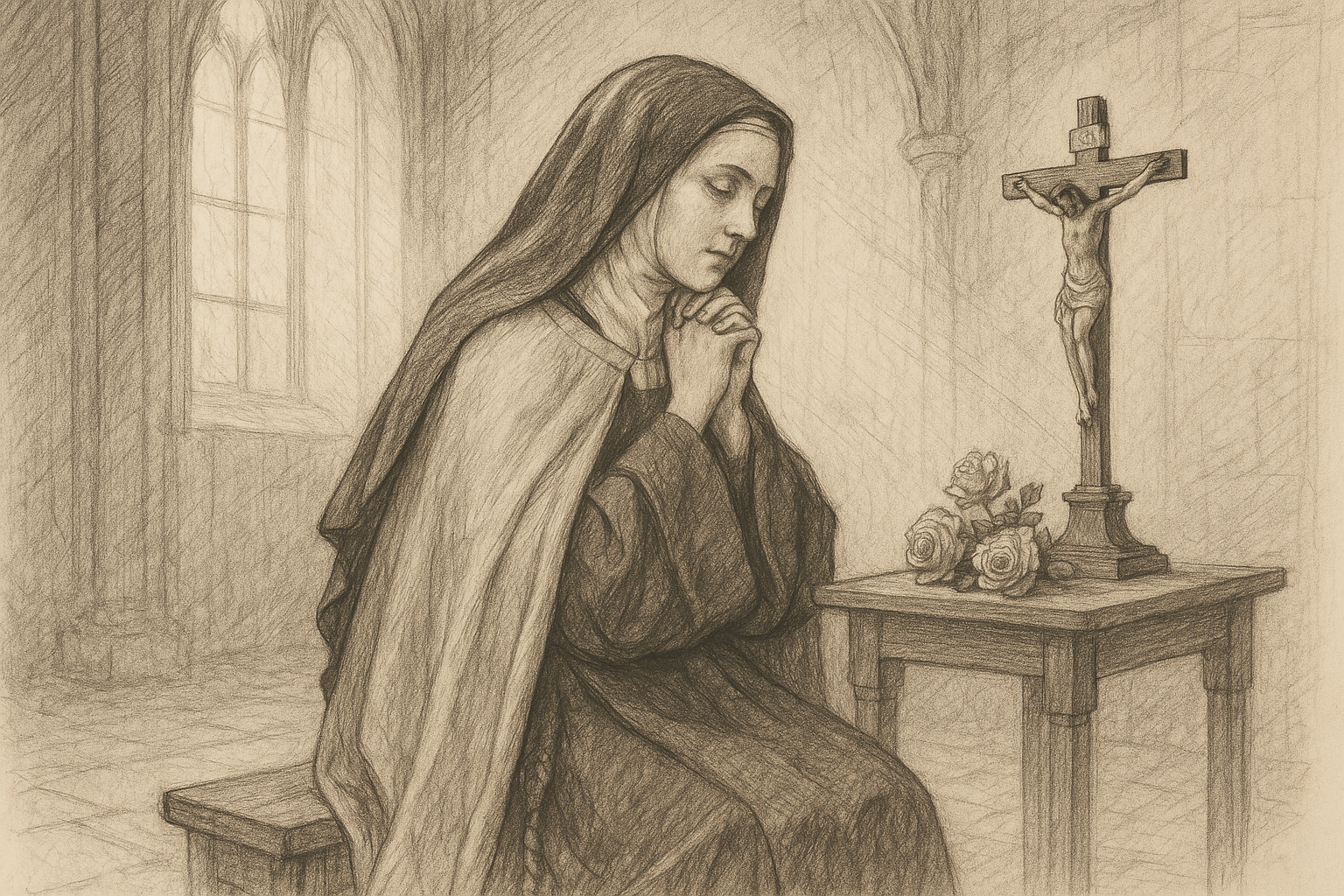
Therese entered the Carmelite monastery at Lisieux at a young age, seeking a life hidden with Christ. She did not enter because she felt strong, but because she believed that God was asking for her complete surrender. The monastery was not a stage for achievement. It was a place of prayer, silence, ordinary labor, and self-denial. For Therese, that hidden life became the setting in which holiness took shape.
The road from childhood devotion to Carmelite simplicity
Therese's childhood was marked by strong affection and strong feeling. She was intelligent, quick to observe, and deeply attached to her family. After her mother died, she became unusually vulnerable to anxiety and fear. A healing grace came in a decisive moment at Christmas when, according to her own memoir, she received the strength not to weep as she had before over childish hurts. That grace became a turning point in her interior life. She understood it as a gift from God, not as a personal triumph.
Her desire for Carmel matured early. She wanted a life entirely devoted to Jesus, and she saw in the Carmelite vocation a way to belong to Him without reserve. Because she was still very young, she had to ask permission to enter. Her persistence was not a display of self-will. Rather, it showed the seriousness of a vocation she believed came from God. She eventually entered the Lisieux Carmel in 1888.
There she took the name Therese of the Child Jesus and of the Holy Face. Both titles reveal the heart of her spirituality. She wanted to live in childlike confidence before God, and she wanted to contemplate the suffering face of Christ. In her own life, tenderness and sacrifice were never far apart.
The little way and the beauty of hidden fidelity
Therese is best known for the Little Way, a simple phrase that can be misunderstood if it is reduced to sentiment. Her teaching was not that holiness is easy, but that holiness is possible in the smallest acts when they are done with love. She believed that human weakness need not become despair. Instead, a soul can place itself like a child in the merciful hands of the Father.
Her Little Way grew from a very Catholic insight: sanctity is not self-made. It is received. We do not climb to God by spiritual pride or dramatic success. We allow ourselves to be loved, corrected, purified, and lifted by Him. Therese trusted that divine mercy could do in a soul what effort alone could never accomplish.
This made her attentive to ordinary duties. In the convent, she lived a hidden life of prayer, work, and fraternity. She did not escape human difficulty. Community life brought misunderstandings, inconveniences, and the need to serve people with different temperaments. Therese practiced patience in those daily frustrations. She treated small annoyances as a place where love could be proven.
Therese understood that there are many moments when no one is watching, no one applauds, and nothing seems remarkable. Yet it is often there that the soul learns to love God most purely.
Her approach is deeply consistent with the Gospel. Jesus praises the hidden works of mercy and the secret generosity of the Father who sees in secret Matthew 6:4. He blesses the poor in spirit Matthew 5:3 and calls His disciples to become like children Matthew 18:3. Therese did not invent these truths. She made them visible in a modern Catholic life.
Suffering, darkness, and trust
It would be sentimental to speak only of Therese's charm and simplicity. Her life included suffering that was both physical and spiritual. She contracted tuberculosis, which gradually weakened her body. In her final months, she endured pain that was severe and prolonged. She also experienced interior darkness, a trial often described as a kind of spiritual dryness or obscurity. Even so, she continued to cling to God.
Her trust was not naive. It was forged under pressure. She did not always feel comfort, but she continued to believe. That makes her particularly helpful for Catholics who pray faithfully yet struggle with dryness, unanswered questions, or hidden suffering. Therese teaches that holiness is not measured by emotional intensity. It is measured by fidelity.
As her illness advanced, she remained anchored in the sacramental life of the Church and in the hope of heaven. Her words from the end of her life are remembered because they reveal not a triumphal spirit but a burning confidence in divine mercy. She died in 1897 at the age of 24. The Church later recognized what many already knew: a brief life can bear immense spiritual fruit when it is united to Christ.
How her witness spread through the Church
Therese did not become famous through public action in her own lifetime. Her influence spread through the manuscript she left behind, later published as Story of a Soul. In it, she recounts her childhood, vocation, and interior life with uncommon frankness. The work is not a polished autobiography in the modern sense. It is more like a testimony, written with the conviction that God had led her through weakness to trust.
Readers found in her words a path that felt both demanding and accessible. She did not lower the call to holiness. She brought it close to the daily life of ordinary Catholics. Her witness spread widely because it spoke to people who knew they were not extraordinary. Parents, workers, priests, religious, and the sick could recognize themselves in her belief that love sanctifies the smallest actions.
The Church eventually proclaimed her a saint and later named her a Doctor of the Church, a remarkable recognition for someone whose spiritual message was rooted in humility and simplicity. That title does not mean she was academic in the modern sense, but that her teaching has enduring value for the universal Church.
What Catholics can learn from Therese today
Therese remains beloved because her message is not trapped in the past. It is immediately relevant to family life, parish life, work, and prayer. Catholics today still face distraction, impatience, discouragement, and the temptation to measure worth by visible success. Therese offers another way.
First, she teaches that sanctity begins where we are. A mother caring for children, a father working long hours, a student struggling with anxiety, a priest serving a difficult parish, or a retired Catholic living quietly at home can all choose love in small things. The little way is not small because it is shallow. It is small because it begins with the humble realities that fill a day.
Second, she teaches that hidden sacrifice matters. A patient response, a silent offering, a dutiful task done without resentment, and a word withheld for the sake of peace can all be acts of love before God. In a culture that prizes visibility, Therese reminds us that the Father sees what is hidden.
Third, she teaches trust. Many Catholics want a spiritual life that feels strong and certain all the time. Therese knew that such feelings do not always come. Yet she believed that confidence in God's mercy is stronger than self-confidence. Her path encourages believers to stop measuring their worth by spiritual consolation and to rely instead on the fidelity of God.
Finally, Therese invites us to love the Church's sacramental life with greater simplicity. Her holiness was not separate from the Church. It was nourished by the Eucharist, prayer, obedience, and the life of a Carmelite community. Her witness reminds Catholics that holiness is not built on private spirituality alone. It grows in communion with Christ and His Church.
Practical ways to live her witness
- Begin the day by offering God one small act of love before the rush starts.
- Choose one ordinary annoyance and refuse to complain about it.
- Pray for the grace to trust God in a concrete fear or uncertainty.
- Read a short passage from Story of a Soul and let it shape your prayer.
- Offer hidden sacrifices for someone who may never know you prayed for them.
St. Therese of Lisieux life remains compelling because it does not promise an easy road. It promises a sure one. Her witness says that the path to holiness is open to the weak, the ordinary, and the weary who are willing to love in faith. That is why so many Catholics keep returning to her little way, and why her quiet voice still speaks with uncommon force today.
Keep Reading on Lets Read The Bible
Frequently Asked Questions
What is St. Therese of Lisieux best known for?
She is best known for the Little Way, her teaching that holiness is found in trusting God and doing small things with great love.
What was difficult about St. Therese's life?
She experienced the loss of her mother, struggles in community life, tuberculosis, and a period of spiritual darkness near the end of her life.
Why is St. Therese important for Catholics today?
Her life shows that sanctity is possible in ordinary duties, hidden sacrifices, and childlike trust in God's mercy.