Doctrine and Questions
Speaking Sins Aloud: The Quiet Mercy of Confession
Catholic teaching sees confession not as a humiliating ritual, but as a meeting with Christ who heals, forgives, and restores the sinner to grace.
Site Admin | June 18, 2025 | 77 views
Christ does not leave forgiveness vague
Many Christians believe, quite sincerely, that repentance should be personal and direct, between the sinner and God. Catholics agree that every sin is ultimately against God and that contrition must begin in the heart. Yet Catholic teaching on Confession to a priest rests on a deeper claim: Christ chose to make his forgiveness visible, spoken, and sacramental. He did not leave mercy as an inner feeling or a private hope. He gave the Church a real ministry of reconciliation.
This is why confession is not a Catholic invention meant to burden consciences. It is a gift meant to strengthen them. In the Gospel, Jesus gives the apostles authority to forgive sins in his name: 23|John 20:22-23. After breathing on them and saying, "Receive the Holy Spirit," he adds, "If you forgive the sins of any, they are forgiven." Catholics see in these words the foundation of the sacrament. The risen Lord uses human ministers to carry divine mercy to wounded souls.
That pattern is not strange to the Bible. God often works through chosen servants and visible signs. He used prophets, priests, water, oil, bread, and laying on of hands. In Confession, the priest is not the source of forgiveness. Christ is. The priest is the servant authorized to speak Christ's mercy to the penitent.
Why speaking sins aloud matters
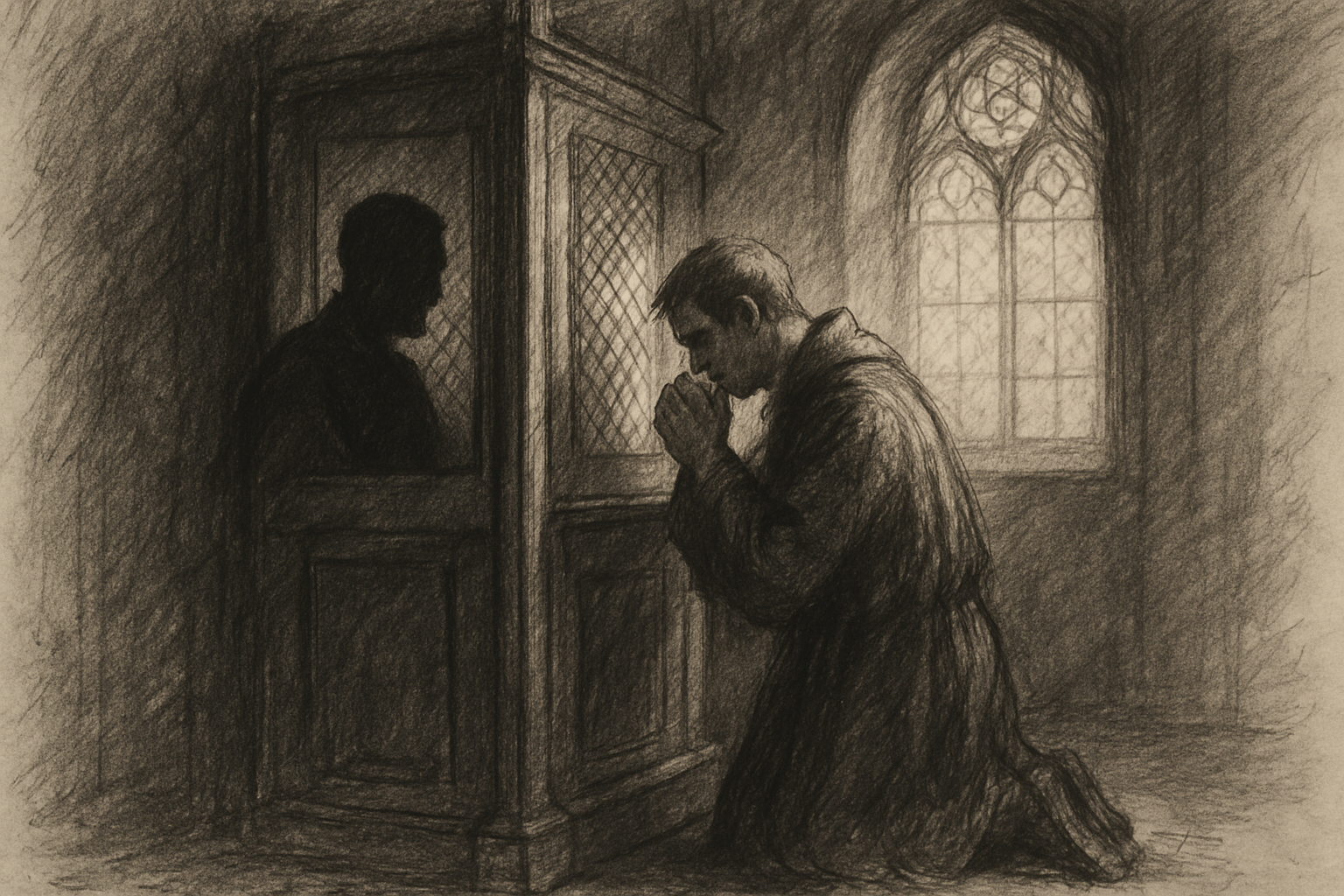
There is a spiritual wisdom in naming sin aloud. Hidden sin grows in secrecy. It can become vague, excused, or minimized. When a person kneels in Confession and speaks honestly, something begins to change. The soul steps out of self-deception and into truth. That truth is not meant to shame but to heal.
Scripture often links conversion with confession. In the Old Testament, the people of God do not merely feel sorry in private. They acknowledge sin before the Lord and return to him. The Psalms repeatedly join repentance to mercy, as in the cry, 2|Psalm 51:1-2. David does not hide his failure. He lays it bare before God, and in doing so he opens himself to mercy.
Confession to a priest Catholic teaching also recognizes that sin damages more than private feelings. It harms communion. Sin wounds the relationship between the sinner and God, but also the bond with the Church. That is one reason the sacrament belongs to the Church, not just to private devotion. Reconciliation is ecclesial, because grace restores us not only inwardly but also to communion with the Body of Christ.
What the priest actually does
It is easy to misunderstand the priest's role. Some imagine that the priest is there as a spiritual witness only, or as a counselor who offers advice. Others assume confession is merely a psychological release. Catholic teaching is more precise. The priest acts in the person of Christ and as a minister of the Church. He listens, advises when needed, assigns a penance, and pronounces absolution by Christ's authority.
That absolution is not a polite blessing. It is a sacramental act. The Church teaches that, through the ordained ministry, Christ truly forgives sins confessed with repentance. This does not mean the priest knows everything about the soul or can see into the heart. He does not need to. The sacrament is not based on the priest's insight but on Christ's promise and the penitent's sincere contrition.
The beauty of this arrangement is that God's mercy remains personal. He does not forgive us in the abstract. He forgives a concrete person, here and now, through a concrete encounter. The penitent speaks. The priest listens. Christ heals. For many Catholics, this is one of the most merciful aspects of the sacramental life: forgiveness is not left to uncertainty when God has given a sure sign.
Scripture and the ministry of reconciliation
Jesus did not simply announce that forgiveness exists. He instituted a ministry to apply it. The apostles were sent as envoys of reconciliation, and Saint Paul later describes this work in rich language: 20|2 Corinthians 5:18-20. God has given us the ministry of reconciliation, and the apostle speaks as though God were making his appeal through them.
This apostolic ministry is not a rival to Christ. It is Christ's own work continuing in his Body. That is why Catholics understand Confession as both intensely personal and deeply communal. The sinner comes before God, yet does so through the Church Christ founded. The minister is not a replacement for the Lord, but a sign that the Lord is still at work among his people.
James also exhorts believers to confess their sins and pray for one another: 16|James 5:16. While this verse does not by itself describe the sacrament in full, it clearly shows that confession is part of the Christian life, not an alien Catholic addition. The Church's sacramental practice develops from the apostolic conviction that sin must be named and grace must be received in truth.
Common misunderstandings about confession
One common misunderstanding is that confessing to a priest means bypassing God. In reality, the opposite is true. The priest does not stand between the sinner and God as a barrier. He stands as a servant through whom God chooses to work. No Catholic believes the priest has power apart from Christ. All sacramental authority comes from Christ.
Another misunderstanding is that confession is only for terrible sins. In fact, Catholics are encouraged to confess grave sins, but many also bring venial sins because the sacrament helps form conscience, increase humility, and weaken the habits that lead to deeper sin. The sacrament is medicinal as well as judicial. It forgives, but it also strengthens.
Some also worry that confession is too human to be sacred. They ask why God would want sins spoken to another person. But this objection overlooks how often God uses human mediation in salvation history. He speaks through prophets, feeds through sacraments, teaches through the Church, and comforts through the Communion of Saints. Christianity is not a religion of isolated souls. It is a religion of incarnation, and the Incarnation means God works through visible, human means.
A final misunderstanding is the fear that confession is merely repetitive, as though the same sins return and therefore the sacrament must be ineffective. Yet the regular need for mercy does not prove the sacrament weak. It proves that human beings are weak and that God's patience is great. A person who returns faithfully to Confession is not failing the sacrament. He is receiving the medicine more than once, as the sick often must.
What preparation looks like
For Catholics, good confession begins with examination of conscience, sorrow for sin, and a firm purpose of amendment. This means a real desire to avoid sin and the occasions that lead to it. It does not mean a promise of sinless perfection. It means honest repentance. The penitent comes because he wants to be reconciled, not because he wishes to make peace with sin.
Preparation is sometimes simple and sometimes difficult. Some examine the commandments, the beatitudes, or the duties of their vocation. Others look carefully at patterns of pride, anger, dishonesty, impurity, neglect of prayer, or failure in charity. The point is not to become scrupulous. The point is to become truthful.
Confession itself is usually brief, but brevity does not make it small. A person may carry hidden shame for years, then speak it in a few humble sentences. The absolution that follows is not dramatic in the worldly sense, yet for the soul it can be as profound as sunrise after a long night. The Church asks that the faithful approach the sacrament regularly because grace is given for the whole life of conversion, not just for rare emergencies.
The peace that follows honesty
Many Catholics can testify that one of the greatest gifts of Confession is peace. Not the false peace of avoiding hard truths, but the deeper peace that comes when truth and mercy meet. The sacrament places a sinner before the God who already knows everything and still offers mercy. That knowledge can be humbling, but it can also be profoundly consoling.
In a culture that often treats guilt as either meaningless or overwhelming, Confession offers another way. It tells the sinner that guilt is not the final word, but it does matter. Sin is real, but so is mercy. Repentance is not self-hatred; it is a return to the Father. The confessional becomes, in a very ordinary parish setting, a place where the Gospel is spoken aloud.
Catholic teaching on Confession to a priest is ultimately about trust. Trust that Christ meant what he said to the apostles. Trust that the Church's sacramental life is not a human obstacle course but a channel of grace. Trust that mercy can be received, not merely imagined. For anyone who has hesitated at the door of the confessional, that trust may begin with a small but decisive act: tell the truth, and let Christ answer with forgiveness.
Keep Reading on Lets Read The Bible
Frequently Asked Questions
Why does Catholic teaching require confession to a priest instead of only praying privately to God?
Catholic teaching holds that Christ gave the apostles authority to forgive sins and that this ministry continues in the Church. Private prayer and contrition are essential, but sacramental confession adds the visible, ecclesial act by which Christ grants absolution through his ordained minister.
Do Catholics believe the priest forgives sins by his own power?
No. Catholics believe Christ alone forgives sins. The priest is a minister who acts in Christ's name and by Christ's authority. The forgiveness comes from the Lord, not from the priest's personal holiness or ability.
Must every sin be confessed in detail?
Catholics are required to confess grave sins as clearly and honestly as possible, including their kind and number when known. Venial sins may also be confessed and are spiritually helpful to bring into the light, though they are not strictly required for validity.