Social Teaching
When the Home Teaches the Heart
The family is not only where children live. It is where they first learn that love is real, demanding, and worth giving back.
Site Admin | October 15, 2025 | 80 views
The family is not merely one institution among many. In Catholic thought, it is a living human community ordered toward the good of persons, and in that community children first come to know what love looks like in ordinary life. Before a child can explain virtue, the child can experience it in a patient parent, a steady grandparent, a sibling who shares, or a household that forgives after conflict. This is why Catholics speak of the family as the first school of love and Catholic life. The phrase is simple, but its meaning reaches deep into the Church's understanding of the human person.
In the home, love is not an abstraction. It is learned through repeated acts: feeding the hungry child, comforting the frightened child, correcting with fairness, praying together, and beginning again after failure. These moments may seem ordinary, but they form the moral imagination. They teach that people are not objects to use, but persons to cherish. They teach that freedom is not the same as doing whatever one wants, and that happiness is not built on self-assertion alone.
The family reveals the dignity of the person
Catholic social teaching begins with the conviction that every human being is made in the image and likeness of God. That truth is not only a doctrine to defend in public. It is a reality to be lived at home. A child who is listened to learns that his or her voice matters. An elderly relative who is welcomed learns that weakness does not erase dignity. A spouse who is respected learns that love does not depend on usefulness. In this way, the family becomes the first place where the dignity of the person is either honored or neglected.
Because the family is so close to daily life, it can form habits that later shape society. A home that treats people with courtesy prepares children to treat strangers with respect. A home that keeps promises prepares young people to trust faithfully. A home that apologizes honestly prepares adults to seek reconciliation rather than pride. The world often speaks about dignity in broad terms, but families make it concrete.
Love in the family begins not with grand speeches but with patient fidelity. The daily choice to see another person as a gift is already a lesson in Catholic life.
Love in the home is learned through sacrifice
The family is the first school of love because it is the first place where love asks something of us. Infants do not survive on sentiment, and children do not thrive on words alone. They need sacrifice. Parents rise at inconvenient hours, manage uncertainty, and give time that might have been spent elsewhere. Children are called to receive this gift with gratitude and gradually to return it in small but real ways. Siblings learn to wait, to yield, to share, and to forgive.
These sacrifices are not failures of freedom. They are the path by which love becomes mature. Catholic faith does not set love against duty. Rather, it teaches that genuine love includes responsibility. Saint Paul describes love in a way that sounds almost domestic in its patience and humility: it is patient, kind, not arrogant, not resentful, and it bears all things [[VERSE|1-corinthians|13|4-7|1 Corinthians 13:4-7]]. That passage is often read at weddings, but it also belongs in the daily life of parents and children. It describes the kind of love a household must practice if it is to become a place of peace.
To sacrifice for one another does not mean erasing the self. It means learning that the self is fulfilled through gift. This is one of the most important lessons the family teaches. A child who experiences love as self-giving begins to understand that life is not about constant possession or attention. It is about communion.
Faith grows best where it is lived, not only explained
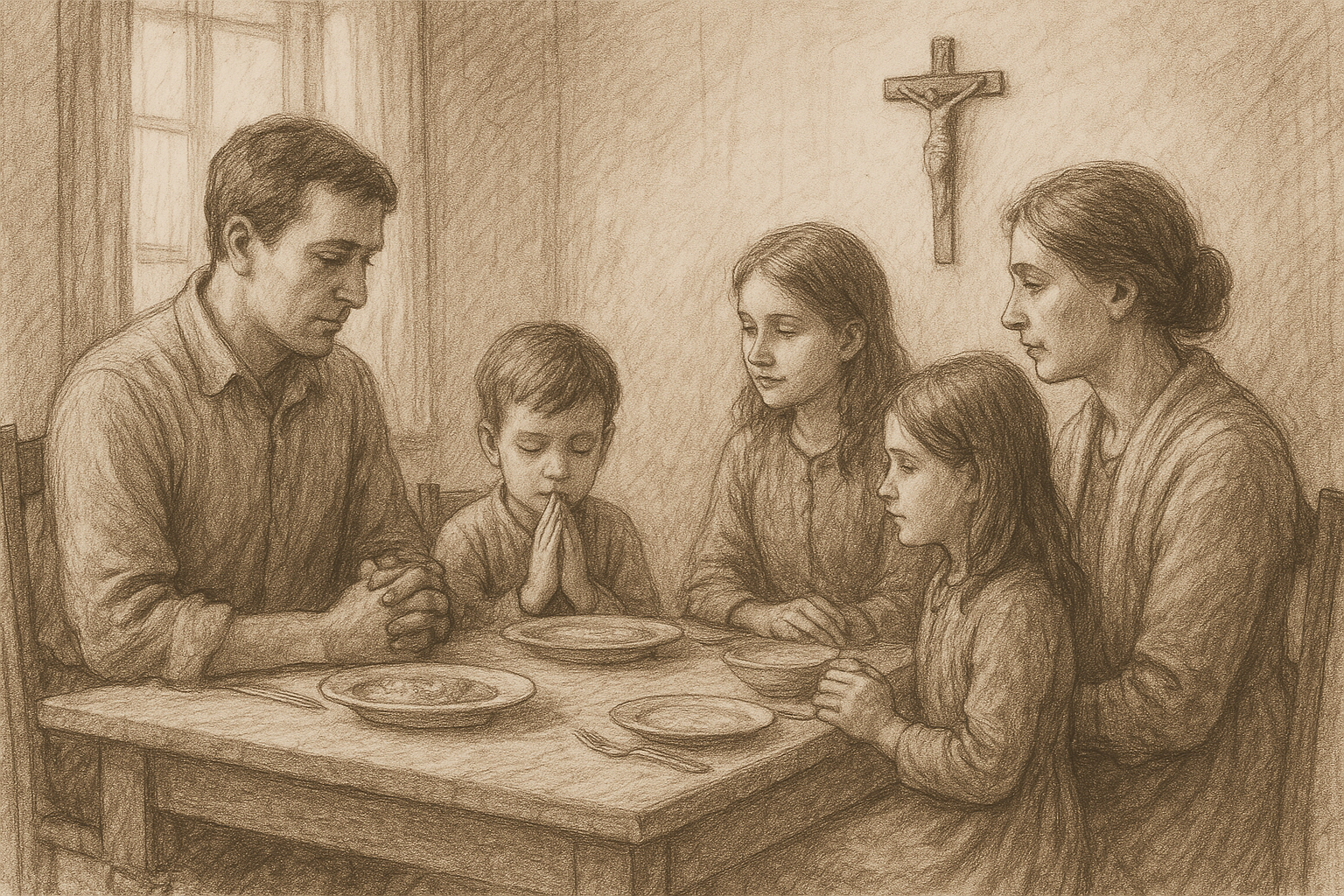
Catholic life is more than private devotion, but it is never less than that. Children learn the faith not only by classes or books, but by watching adults pray, honor Sunday Mass, speak about God naturally, and trust Him in suffering. The family is the first school of love and Catholic life because it is often the first place where the sign of the cross, a bedtime prayer, a blessing before meals, or a reverent silence before the crucifix become part of the rhythm of the day.
Deuteronomy gives a striking image of this kind of formation: God's words are to be on the heart, repeated to children, spoken at home and along the way, when lying down and when rising up [[VERSE|deuteronomy|6|6-7|Deuteronomy 6:6-7]]. This is not a blueprint for religious performance. It is a vision of faith woven into ordinary existence. The household becomes a place where belief is not displayed once in a while, but breathed in daily.
That matters because children usually learn devotion before they can explain doctrine. They absorb tone, habits, and priorities. If the home treats prayer as important, children notice. If the home treats the poor kindly, children notice. If the home makes room for repentance, children notice. In this way, Catholic formation is not only transmitted by instruction. It is transmitted by atmosphere.
The home can shelter truth without becoming harsh
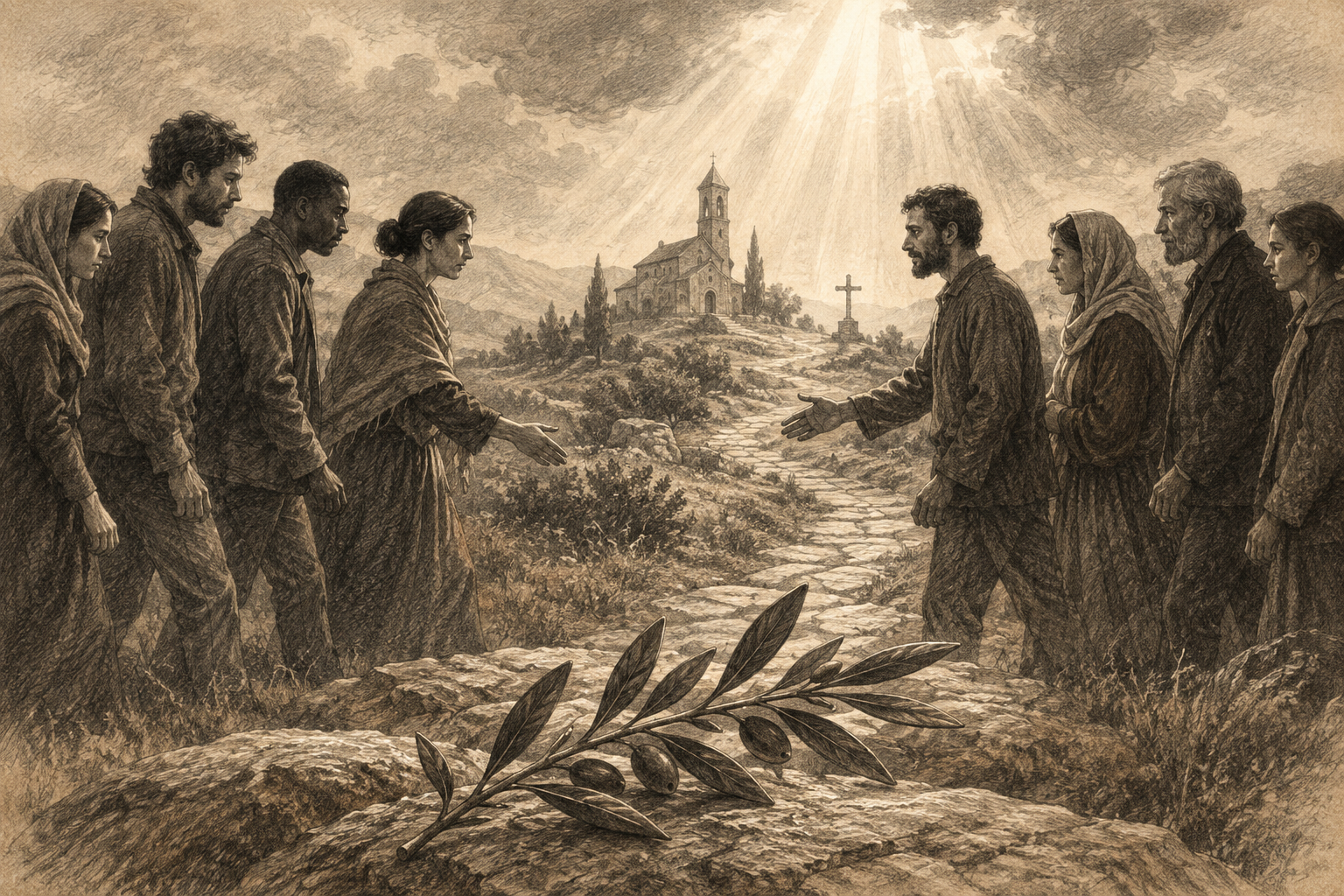
Many families today feel pressure from both sides. Some voices say love means having no boundaries at all. Others say truth must be enforced without tenderness. Catholic life rejects both errors. In the home, truth and mercy belong together. Children need clear guidance, but they also need gentleness. Adults need honest speech, but they also need patience. A family that cannot tell the truth will become fragile. A family that cannot show mercy will become fearful.
This balance is not easy, yet it is essential. The household is where children first learn that correction is not the opposite of love. A parent who sets limits with calm firmness teaches that freedom has purpose. A parent who apologizes after impatience teaches that authority does not excuse sin. A family that practices forgiveness teaches that no one is reduced to a single failure. These lessons are moral, but they are also deeply spiritual.
Christ's own words point to the seriousness of this calling. He identifies Himself with humble service and teaches that greatness is found in serving others Mark 10:45. Families live this truth in hidden ways every day. Washing dishes, making room at the table, listening after a long day, caring for a sick child, or visiting an aging parent are not small things in God's eyes. They are acts of love that form the soul.
The family teaches belonging in an isolated age
One of the wounds of modern life is loneliness. Many people are surrounded by messages, screens, and noise, yet remain unseen. The family offers an answer not because it is perfect, but because it provides a real and stable belonging. A child needs to know that he or she is not loved only when impressive. A spouse needs to know that love does not disappear when life becomes difficult. An older adult needs to know that usefulness is not the measure of worth. The family says, in effect, you belong because you are yours, not because you perform.
This belonging has social consequences. A person who has known stable love is better prepared to love neighbors, coworkers, the poor, and strangers. A person who has learned to receive care at home is more likely to offer care outside it. The family therefore serves the common good. It is not a private refuge detached from society. It is a school that prepares people to live humanely in society.
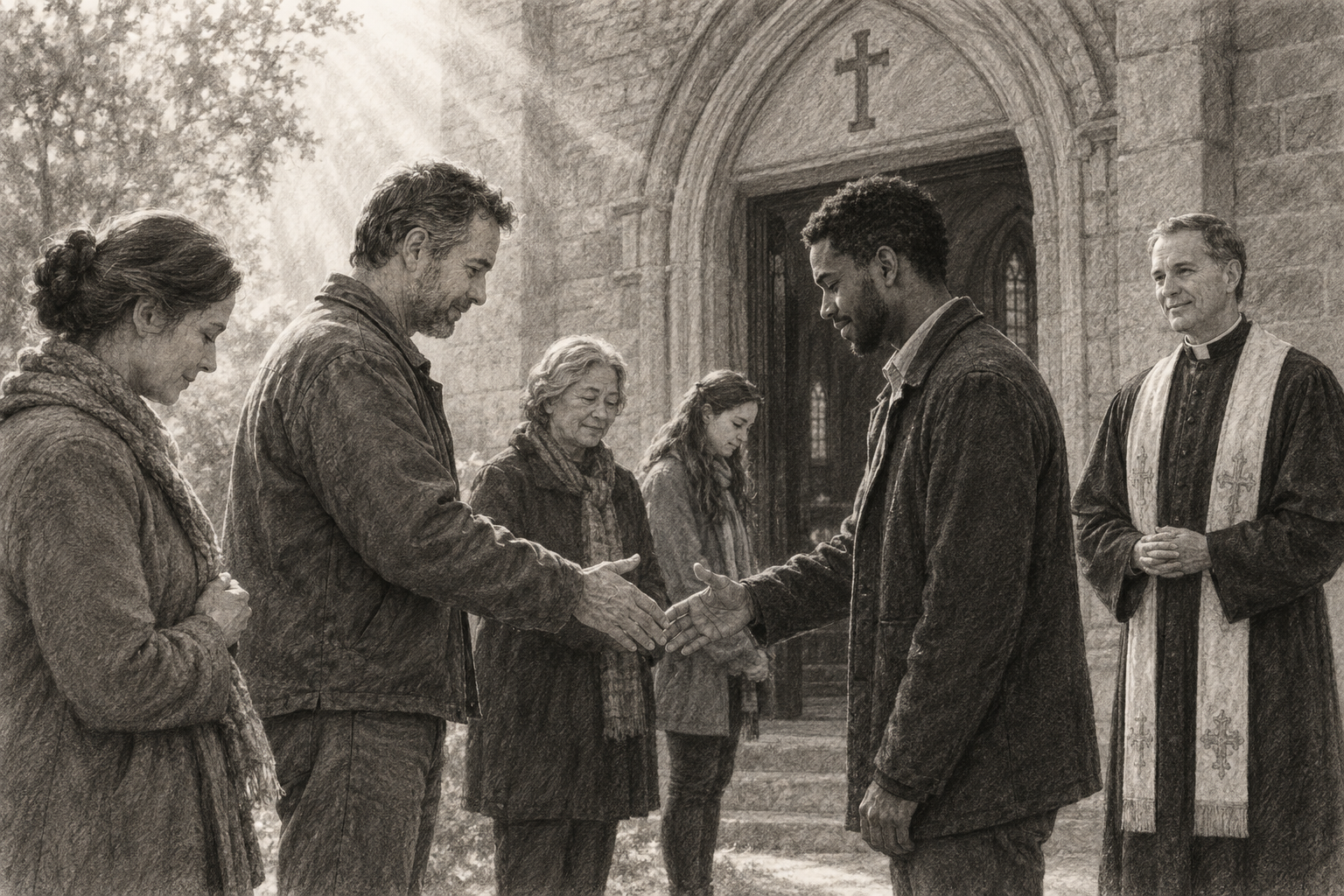
That is one reason the Church protects the family so carefully. Catholic teaching does not idealize households as if every home were easy or every family situation were simple. It knows that some families are marked by grief, conflict, separation, poverty, or the burden of serious sin. Yet even amid weakness, the family remains a central place where grace can work. God often begins His healing in very ordinary rooms.
Practical ways families can become schools of love
It is one thing to admire the family in principle. It is another to live its calling with consistency. The following practices are simple, but they can shape a household over time:
- Pray together in small ways. A short prayer before meals, at bedtime, or when leaving the house can remind everyone that life is received from God.
- Practice attentive listening. Let children speak without interruption when possible, and let adults model calm, respectful conversation.
- Keep apologies honest. A sincere apology teaches that love is not threatened by humility.
- Serve one another in concrete ways. Shared chores, care for the sick, and small acts of help make charity visible.
- Honor the vulnerable. Make room for the very young, the elderly, the disabled, and anyone who is easily overlooked.
- Speak well of absent family members. This protects trust and teaches charity of speech.
These habits do not require wealth or perfect order. They require intention. A family does not become a school of love by accident. It becomes one through repeated choices made in faith.
Parents are not alone in this work
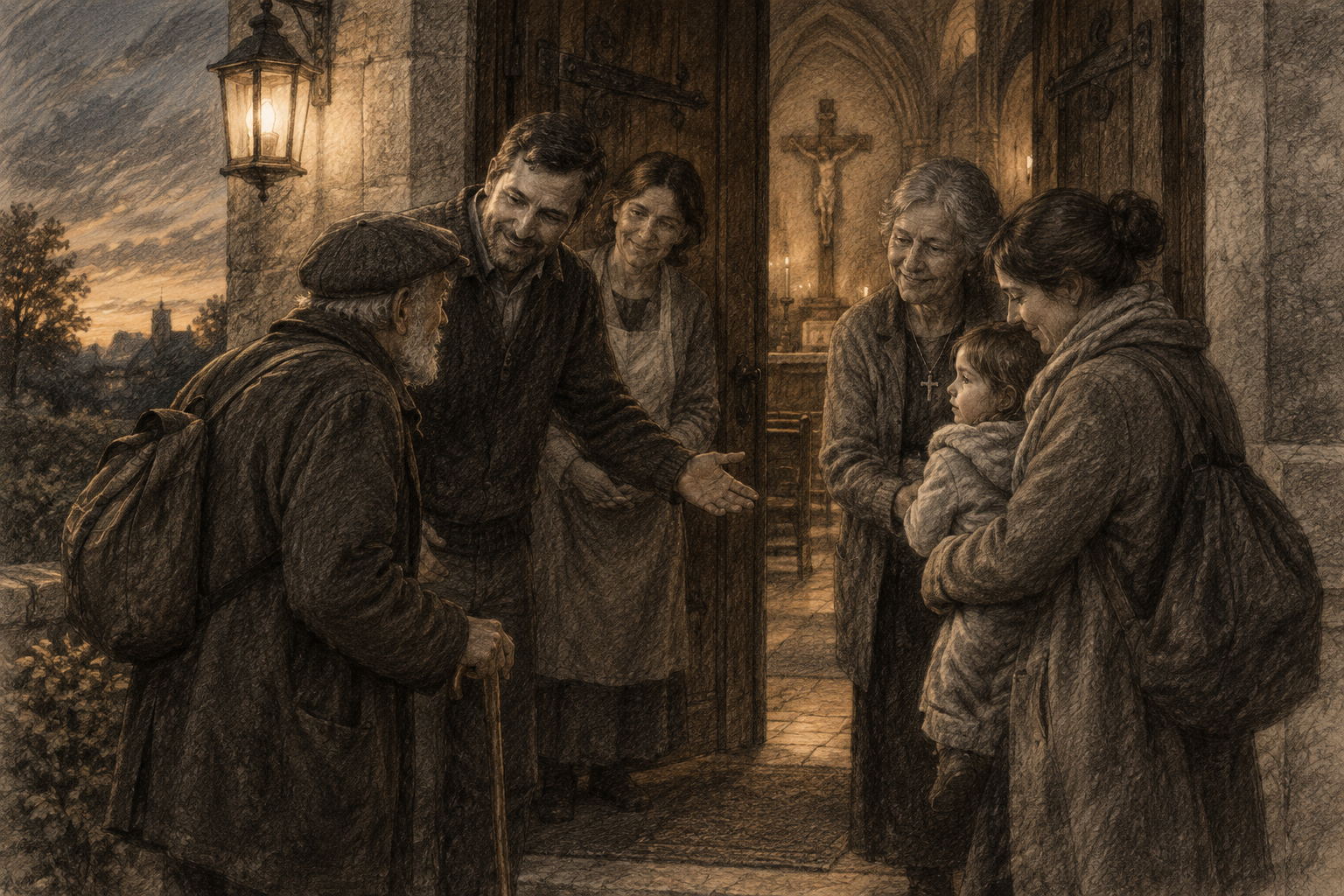
Catholics should never imagine that the family stands by itself, cut off from the Church. Parents are the first teachers of the faith, but they are not the only ones. The parish, the sacraments, good grandparents, godparents, and faithful friends all support the work of formation. The family flourishes when it is nourished by the larger body of Christ.
This wider communion matters especially when families are strained. Not every home is peaceful every day. Not every parent knows exactly what to do. Not every child responds well to instruction. Yet grace does not wait for ideal conditions. The Church accompanies families as they are, while still holding before them the beauty of their vocation. Even when a household feels fragile, the call remains the same: love one another in truth, serve one another in humility, and let Christ be welcomed at the center.
When that happens, the home becomes more than a place of residence. It becomes a sign of God's own way of living with His people. In its best moments, the household shows that love is patient, truth is possible, forgiveness is real, and dignity belongs to every person who crosses the threshold.
That is why Catholics should continue to defend the family not only as a social necessity, but as a sacred beginning. In the ordinary life of the home, hearts are taught to love, and that lesson can shape a lifetime.
Keep Reading on Lets Read The Bible
Frequently Asked Questions
Why does Catholic social teaching call the family the first school of love and Catholic life?
Because the family is usually where a person first learns dignity, sacrifice, forgiveness, prayer, and belonging through daily relationships, not just ideas.
How can a busy family actually live this teaching?
By keeping small and steady habits such as praying together, speaking respectfully, sharing responsibilities, apologizing honestly, and serving one another in practical ways.
What if a family is hurting or imperfect?
Catholic teaching does not deny family suffering or brokenness. Even imperfect homes can still become places where grace works through truth, mercy, and patient care.