Family and Vocation
The Sacrament Hidden in Ordinary Years
Marriage is not only a private promise, but a grace-filled vocation that teaches spouses how Christ loves the Church.
Site Admin | October 27, 2025 | 85 views
Marriage in the light of grace
Many people think of marriage first as a legal bond, a shared household, or a promise of lifelong companionship. All of that is true, but for Catholics marriage is more than any of these. When two baptized persons enter marriage with the right intention and freely consent before God and the Church, they enter a sacrament. That means marriage is not only a human covenant. It is also a living sign through which Christ gives grace.
This marriage as a sacrament reflection begins with a simple truth: the sacrament does not remove the ordinary burdens of married life. It gives them meaning and, when welcomed in faith, a steadier source of strength. The same God who joined man and woman from the beginning still works in marriage, not as a distant idea but as a real help in daily fidelity.
Scripture presents marriage as part of creation, not an afterthought. In Genesis, man and woman are made for communion, and the two become one flesh Genesis 2:24. Later, Jesus refers back to this original design and insists that what God has joined together, no one may separate Matthew 19:6. In those words, Christ does not merely defend an old custom. He lifts marriage into the order of redemption.
Christ and the dignity of the marriage bond
The New Testament gives Catholics a deeply sacramental view of marriage. Saint Paul speaks of the union of husband and wife in language that reaches beyond the visible relationship itself. He calls it a great mystery, and he connects it to Christ and the Church Ephesians 5:31Ephesians 5:32. That passage is often read at weddings, but it deserves to be read slowly long after the wedding day has passed.
Paul does not present marriage as a competition between spouses, but as a call to mutual self-gift. He asks husbands to love their wives as Christ loved the Church and gave Himself up for her Ephesians 5:25. He also calls wives and husbands to the reverence, love, and ordered charity proper to Christian life. The point is not domination or sentimentality, but sanctifying love.
This is where the sacrament becomes practical. Christ does not ask spouses to manufacture holiness by sheer willpower. He asks them to receive His life and let it shape the way they speak, forgive, work, pray, and endure. Grace is not decoration. It is divine help for real love in real conditions.
The Church's teaching on marriage as sacrament
The Catholic Church teaches that marriage between the baptized is one of the seven sacraments. It is a covenant by which a man and a woman establish a partnership for the whole of life, ordered toward the good of the spouses and the generation and education of children. That teaching is not a mere rule. It grows from Scripture, apostolic tradition, and centuries of prayerful reflection on human love in God's plan.
Because marriage is sacramental, it is also ecclesial. A husband and wife are not isolated individuals trying to stay together by private resolve. They belong to the Church, and the Church prays with them, blesses them, and supports them. The grace of marriage is ordered toward fidelity, fruitfulness, and sanctification.
This helps explain why Catholic marriage cannot be reduced to romance alone. Romantic love can be beautiful, but it is not enough to sustain a covenant. Feelings change. Life brings illness, fatigue, financial stress, disappointment, and the ordinary unevenness of two sinners trying to love each other well. The sacrament does not deny these realities. It enters them.
Marriage is a place where grace takes the shape of patience, chastity, forgiveness, and perseverance. These virtues are rarely dramatic, but they are the quiet architecture of a holy home.
Ordinary days become the place of sanctification
It is tempting to imagine sacramental marriage in only ceremonial terms, as if grace is strongest on the wedding day and then gradually fades into routine. Catholic faith points in the opposite direction. The sacrament is not confined to the altar. It unfolds in kitchens, hallways, hospital rooms, school runs, bills, misunderstandings, shared calendars, and late-night conversations.
For many couples, holiness looks less like visible heroism and more like repeated acts of charity. A spouse listens when tired. A spouse restrains a cutting remark. A spouse keeps a promise. A spouse prays when hope feels thin. A spouse begins again after an argument. These things may look small, but they are not small to God.
In this sense, marriage trains the heart in a distinctly Christian way. It teaches that love is not merely the satisfaction of desire. It is the willing good of the other for God's sake. That is one reason sacramental marriage has such moral and spiritual seriousness. It forms people in self-donation, which is always costly and always fruitful when joined to Christ.
There is comfort in knowing that the sacrament is for ordinary days, not only for ideal ones. A couple does not need to wait for a perfect season to live the grace of their vocation. The grace is present in the ordinary discipline of being faithful when life feels repetitive or heavy. The hiddenness of that work does not make it less sacred.
Marriage, the cross, and the hope of resurrection
No honest reflection on marriage can avoid the cross. Every vocation includes sacrifice, and marriage includes a particularly intimate form of it. Spouses learn that love is tested by weakness, time, and the difference between one person's expectations and another person's limits. At its hardest, marriage can feel like a daily crucifixion of selfishness.
Yet Christians do not stop at the cross. Christ's self-gift leads to resurrection, and sacramental marriage participates in that pattern. Forgiveness can restore what resentment would have destroyed. Fidelity can heal what loneliness might have deepened. A home marked by prayer can become a place where children learn, quietly and naturally, that God is real.
This is one reason the Church speaks of children as a blessing and marriage as ordered toward life. The openness of spouses to life is not an abstract principle. It is part of the logic of love itself. Marriage says that love is generous enough to receive what God gives, even when it requires sacrifice, adaptation, or humility.
Not every married couple is granted children, and that suffering can be heavy. Yet even then the sacrament remains fruitful. Marriage can bear spiritual fruit through hospitality, service, adoption, mentorship, and the many forms of love that widen the heart. The fruitful life of marriage is not measured only by biology, but by charity.
Practical wisdom for married life
Reflection becomes fruitful when it touches daily practice. For spouses who want to live marriage as a sacrament, a few habits matter more than grand resolutions.
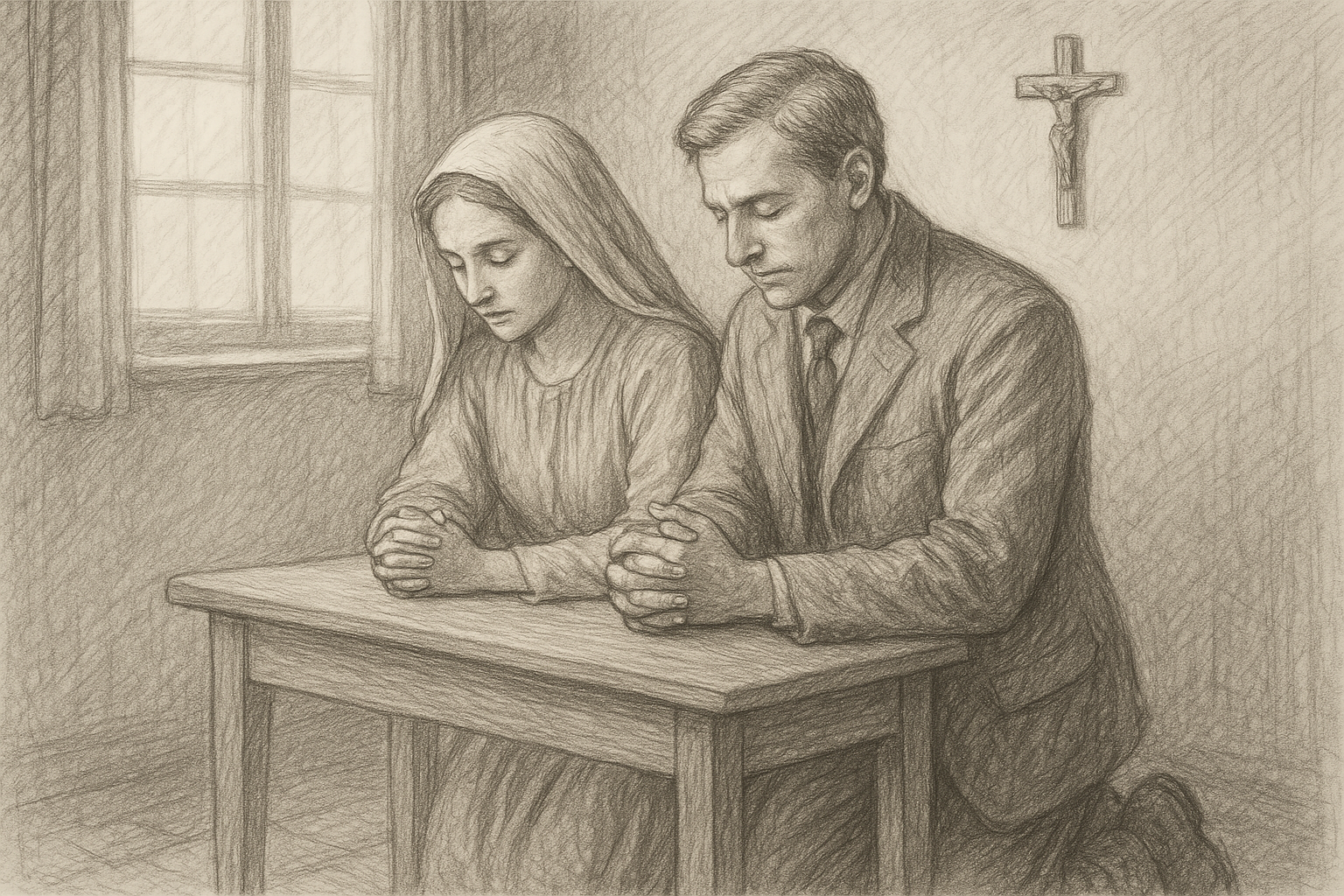
- Pray together in some simple form. A shared Our Father, a brief blessing before leaving the house, or a nightly prayer of thanks can anchor the day in God.
- Ask forgiveness quickly. Pride can turn a small disagreement into a long wound. Humble words restore peace more often than arguments do.
- Speak with reverence. The way spouses speak to each other shapes the atmosphere of the whole home.
- Keep Sunday sacred. The Lord's Day offers rest, worship, and a reminder that marriage belongs inside a larger life with God at the center.
- Receive the sacrament of Reconciliation. Confession helps spouses remain honest before God and less defensive with each other.
These habits may seem simple, but they protect what is most precious. Marriage is not sustained by emotion alone. It is sustained by grace, discipline, and a willingness to begin again.
Single people, engaged couples, and the whole Church
It is also worth remembering that reflection on marriage is not only for the married. Single Catholics, engaged couples, widows, widowers, and priests all have reason to contemplate the sacrament. Marriage reveals something true about Christ, the Church, and human love. It teaches the whole Church how covenant works.
For those preparing for marriage, the sacrament is a call to sober joy. It is beautiful, but it is not casual. Engagement should be a time of prayer, honest conversation, and moral clarity. For those already married, the sacrament is a daily invitation to rediscover one's spouse not as a burden or an assumption, but as a gift entrusted by God.
And for those whose marriages are wounded, perhaps by distance, betrayal, neglect, or grief, the Church does not answer with easy words. She offers prayer, truth, counsel, and mercy. Grace does not always erase suffering quickly, but it does keep hope alive. Even in pain, the sacramental imagination refuses to believe that love is finished simply because it is wounded.
To look at marriage sacramentally is to see more than compatibility or endurance. It is to see a path by which Christ sanctifies two lives joined together, and through them blesses the wider household of the Church. The world often notices only the visible shape of a marriage. Faith looks deeper, and finds a hidden work of grace that continues year after year, often unnoticed, in the quiet fidelity of ordinary love.
Keep Reading on Lets Read The Bible
Frequently Asked Questions
What makes marriage a sacrament in the Catholic Church?
Marriage is a sacrament when two baptized persons freely enter a lifelong covenant of faithful love before God and the Church. In that covenant, Christ gives grace to help them live their vocation and grow in holiness.
Does sacramental grace make marriage easy?
No. Sacramental grace does not remove sacrifice, conflict, or suffering. It gives spouses the help they need to forgive, persevere, and love with greater charity in the midst of ordinary difficulties.
How can Catholic spouses live their sacrament more fully each day?
They can pray together, practice quick forgiveness, speak kindly, keep Sunday centered on worship and rest, and remain close to the sacraments, especially the Eucharist and Reconciliation.