Saints and Witnesses
St. Benedict and the Quiet Power of a Life Ordered to God
A closer look at the father of Western monasticism, his Rule, and the lasting Catholic witness of stability, prayer, and work.
Site Admin | June 3, 2025 | 63 views
When Catholics speak about saints who shaped Christian civilization, St. Benedict often stands near the center of the conversation. He was not known for dramatic public action or for writing lengthy theological works. Instead, he offered something quieter and in many ways more enduring: a way of life ordered to God. That is part of the lasting St. Benedict Catholic inspiration. His witness shows that holiness can be built into the rhythm of ordinary days, through prayer, labor, obedience, and perseverance.
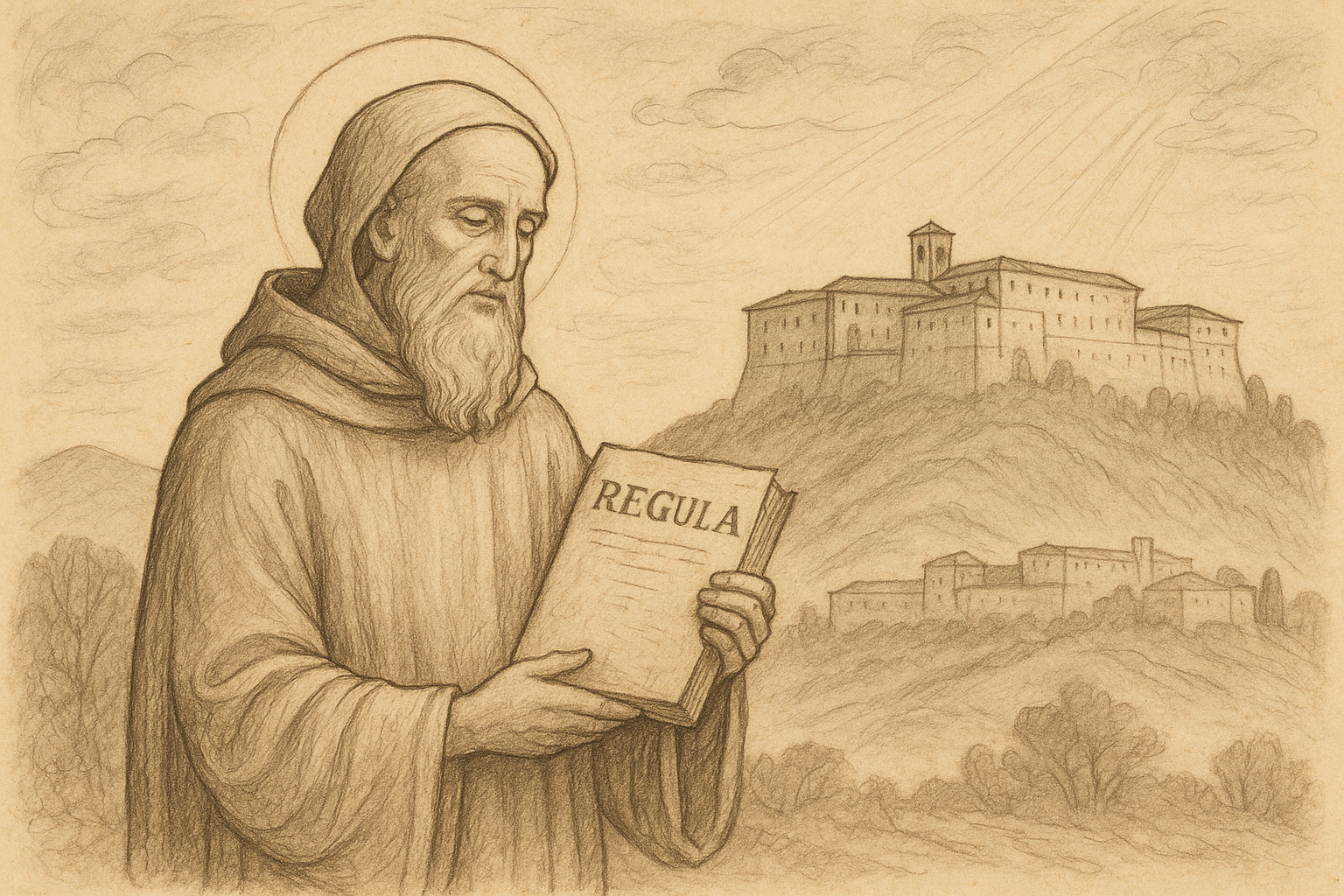
St. Benedict lived during a time of uncertainty in the early sixth century, when the Roman world in the West had changed greatly and many people were searching for stability. He is traditionally associated with Norcia in central Italy and later with Monte Cassino, where he founded a monastery that became one of the most influential centers of Christian life in the West. His chief legacy is the Rule of St. Benedict, a practical guide for monastic communities that balances prayer, work, study, humility, and charity.
For modern Catholics, Benedict's witness still matters because it answers a deep spiritual need. Many people long for peace, but they look for it in noisy and scattered places. Benedict teaches that peace begins with conversion of life. The heart must be reordered toward God before the rest of life can find its proper shape.
A saint formed by solitude and discernment
Little is known with complete certainty about Benedict's early life, and the Church has long recognized that the historical record is limited. The main ancient source for his life is the Dialogues of St. Gregory the Great, who presents Benedict as a man drawn away from worldly ambition and into a life of prayer. According to this tradition, Benedict withdrew for a time to seek God in solitude before gathering disciples and founding communities centered on the praise of God.
That pattern itself is spiritually important. Benedict did not begin by trying to reform the world from the outside. He began by letting God reform his own heart. Catholic life often follows the same path. Grace does not usually come as a sudden spectacle. It comes through fidelity, discernment, and daily cooperation with God.
In Benedict's case, solitude was not escape for its own sake. It was purification. The silence of the desert, or of a hidden place apart from distraction, can reveal what truly governs the soul. Benedict learned to listen. He learned that the first task of a disciple is to receive the Lord's voice with humility.
Listen, O my son, to the precepts of the master, and incline the ear of your heart.
That famous opening line of the Rule captures the spirit of Benedictine life. Before action, there is listening. Before discipline, there is receptivity. Before fruitfulness, there is obedience to God.
The Rule as a school of the Lord's service
The Rule of St. Benedict has endured because it is humane, balanced, and deeply Christian. Benedict did not aim to create a spiritual program for a small elite. He wrote a path of communal life that could actually be lived over time. His Rule has been called a school for the Lord's service, and that phrase is fitting. It forms the person gradually, through habits that shape the whole soul.
Three elements stand out in particular. First is prayer, especially the liturgy of the hours, which sanctifies the day with regular psalms and scripture. Second is work, not as mere productivity but as honorable cooperation with God's providence. Third is stability, the commitment to remain in one community and allow oneself to be formed there. Together these practices teach patience, humility, and perseverance.
These themes resonate strongly with Catholic faith. The Church does not treat holiness as a private mood. Holiness involves an entire way of life. A saintly person learns to pray when prayer is consoling and when it is dry. A saintly person works faithfully even when the work is hidden. A saintly person stays put long enough to grow in charity.
Benedict's Rule also respects human weakness. It is not harsh for the sake of harshness. It understands that people grow by degrees. This is one reason it remains so accessible to readers today. It presents asceticism not as self-punishment but as ordered freedom. By training the desires, the person becomes more available to God and more useful to others.
Pray and work: a Christian rhythm for real life
The phrase ora et labora, pray and work, has long been associated with the Benedictine tradition. While it is a concise summary rather than a slogan found in the Rule itself, it expresses well the spirit of Benedictine spirituality. Prayer and work are not rivals. They are partners in a life consecrated to God.
This balance is one reason St. Benedict Catholic inspiration remains so practical for lay Catholics. Most people do not live in monasteries. They live in homes, offices, hospitals, schools, farms, and places filled with interruption. Yet Benedict's wisdom still speaks. Work can become prayer when offered in charity. Prayer can become steadier when it is woven into the day. Even a busy family life can be marked by simple rhythms of morning offering, grace before meals, Sunday worship, and evening examen.
Benedict teaches Catholics that ordinary duty can be sacred. Washing dishes, answering emails, caring for children, studying, or tending to a sick relative may seem small. But when done in union with Christ, these acts become part of a life given to God. The saint does not divide the sacred from the ordinary. He helps us see that the ordinary can become sacred.
That insight also protects Catholics from a restless spirituality. Many people seek dramatic experiences while neglecting the disciplines that actually sustain faith. Benedict points in the opposite direction. He asks us to be faithful in little things. The soul becomes strong through consistency.
Humility, obedience, and the healing of pride
One of the most striking sections of the Rule is Benedict's long treatment of humility. He describes a ladder of humility that leads the monk away from self-assertion and toward reverence before God. The movement is not sentimental. It is demanding. Pride is one of the deepest wounds of fallen humanity, and Benedict knew that no community can flourish where pride is left unchecked.
His teaching here is especially relevant for Catholics today, when self-display is often rewarded and silence can seem unnatural. Benedict offers another path. Humility does not mean denying gifts or shrinking from responsibility. It means living in the truth. The humble person knows that every good thing comes from God and that every task must be carried out in charity.
Obedience also plays a central role in Benedictine life. In Catholic tradition, obedience is not blind servility. It is a free and loving response to legitimate authority, rooted ultimately in obedience to Christ. Benedict asks for a spirit that can receive correction, submit to shared life, and prefer the good of the community over personal preference. That is difficult, but it is deeply liberating.
Modern culture often treats independence as the highest good. Benedict reminds us that we were made for communion. Growth in holiness usually requires learning how to listen, how to wait, and how to yield.
Why Benedict still speaks to the Church
St. Benedict's witness continues to inspire Catholics for several concrete reasons.
- He gives a realistic path to holiness. The Rule assumes weakness, distraction, and the need for mercy.
- He unites prayer and labor. Benedict shows that the Christian life is not split between sacred moments and ordinary tasks.
- He values stability. In a restless age, staying rooted can become an act of faith.
- He teaches humility. His wisdom cuts through vanity and calls the soul back to truth.
- He forms communities. Benedict knows that sanctity is not only personal but communal.
These are not abstract ideals. They are habits that shape a life over time. That is why Benedictine spirituality has remained fruitful for centuries in monasteries, schools, parishes, and homes. It keeps pointing Catholics back to what lasts.
The saint's influence also extends through the wider history of the Church. Benedictine monasteries preserved learning, cultivated liturgical prayer, copied manuscripts, and offered hospitality to travelers and the poor. But the deepest meaning of that work is spiritual rather than cultural. All of it flowed from men and women trying to seek God together with steady hearts.
Reading Benedict in a noisy age
It can be tempting to imagine that saints belong only to heroic ages or dramatic circumstances. Benedict challenges that idea. He shows that a faithful life, patiently ordered around God, can quietly shape centuries. His example is especially useful in times of overload, when attention is divided and interior silence is rare.
Catholics who want to learn from Benedict do not need to become monks to benefit from his wisdom. They can begin with modest steps. Set aside fixed times for prayer. Limit distractions. Keep Sunday holy. Work diligently. Ask for humility. Stay faithful to the duties already given. These are small things, but Benedict knew that great sanctity often grows from small obediences.
His life also invites a deeper trust in providence. A person does not need to control everything in order to belong to God. Benedict's spirituality rests on the conviction that the Lord is already at work, and that human beings flourish when they align themselves with His will.
In the end, St. Benedict remains compelling because he offers something the modern world still lacks: a way to live with peace, order, and spiritual seriousness without losing charity. His Rule does not promise ease. It promises formation. And formation, when surrendered to grace, leads the soul toward God.
That is why St. Benedict Catholic inspiration continues to endure. He is not merely a figure from the past. He is a witness who still teaches the Church how to listen, how to labor, and how to seek the Lord with a steady heart.
Keep Reading on Lets Read The Bible
Frequently Asked Questions
Who was St. Benedict in Catholic history?
St. Benedict was a sixth century monk and abbot traditionally associated with Monte Cassino in Italy. He is best known for the Rule that shaped Western monastic life and influenced Catholic spirituality for centuries.
What is the main message of the Rule of St. Benedict?
The Rule calls Christians to a balanced life of prayer, work, humility, obedience, and community. Its opening call to listen to the Master is at the heart of its spiritual wisdom.
How can lay Catholics apply St. Benedict's example today?
Lay Catholics can borrow Benedictine habits by keeping regular prayer, honoring Sunday, working faithfully, practicing humility, and creating a stable rhythm of life that leaves room for God.