Saints and Witnesses
St. Benedict and the Quiet Strength of Ordered Holiness
A closer look at the monk whose life, wisdom, and Rule helped shape Christian civilization
Site Admin | June 2, 2025 | 62 views
Few saints have left a mark as lasting as St. Benedict. He did not build an empire, preach in public squares, or write volumes of theology. Yet the shape of his life, and the wisdom gathered into his Rule, helped form generations of monks, and through them shaped the Church far beyond monastery walls. In an age often marked by instability, his witness still speaks with calm authority. The story of St. Benedict life is not a tale of spectacle. It is the story of a man who learned to seek God with seriousness, and who taught others to do the same.
What makes Benedict so compelling is the balance in his witness. He was not soft on the demands of holiness, but neither was he harsh for its own sake. He understood human weakness, the need for patience, and the value of steady habits. His life suggests that sanctity is not always dramatic. More often, it grows in hidden places, through fidelity in prayer, work, humility, and community.
From Roman beginnings to a different kind of greatness
Benedict was born around the late fifth century, likely in Nursia, in central Italy. He came from a Roman family and was sent to Rome for study. But the world he found there did not draw him closer to God. According to the traditional account preserved by St. Gregory the Great, Benedict was troubled by the moral laxity around him and withdrew from that environment in search of a more disciplined life.
This decision was not a rejection of the world in a shallow sense. It was an act of discernment. Benedict recognized that the soul can be pulled in many directions, and that not every place helps a person listen to God. He sought silence, prayer, and a life that would allow grace to take root.
His early years of withdrawal included a period of solitude in Subiaco, where he lived as a hermit. There, he learned the severe and simple lessons that would later shape his monastic wisdom. Solitude tested him. It also purified him. The Christian tradition often shows that before a person can guide others, he must first be formed by God in hiddenness.
The hidden years that prepared a public legacy
Benedict's life in solitude eventually drew the attention of others. Men began to gather around him, seeking his guidance. From that small beginning came communities. Benedict did not simply collect disciples. He taught them how to live as Christians in common, under a rule of life ordered toward God.
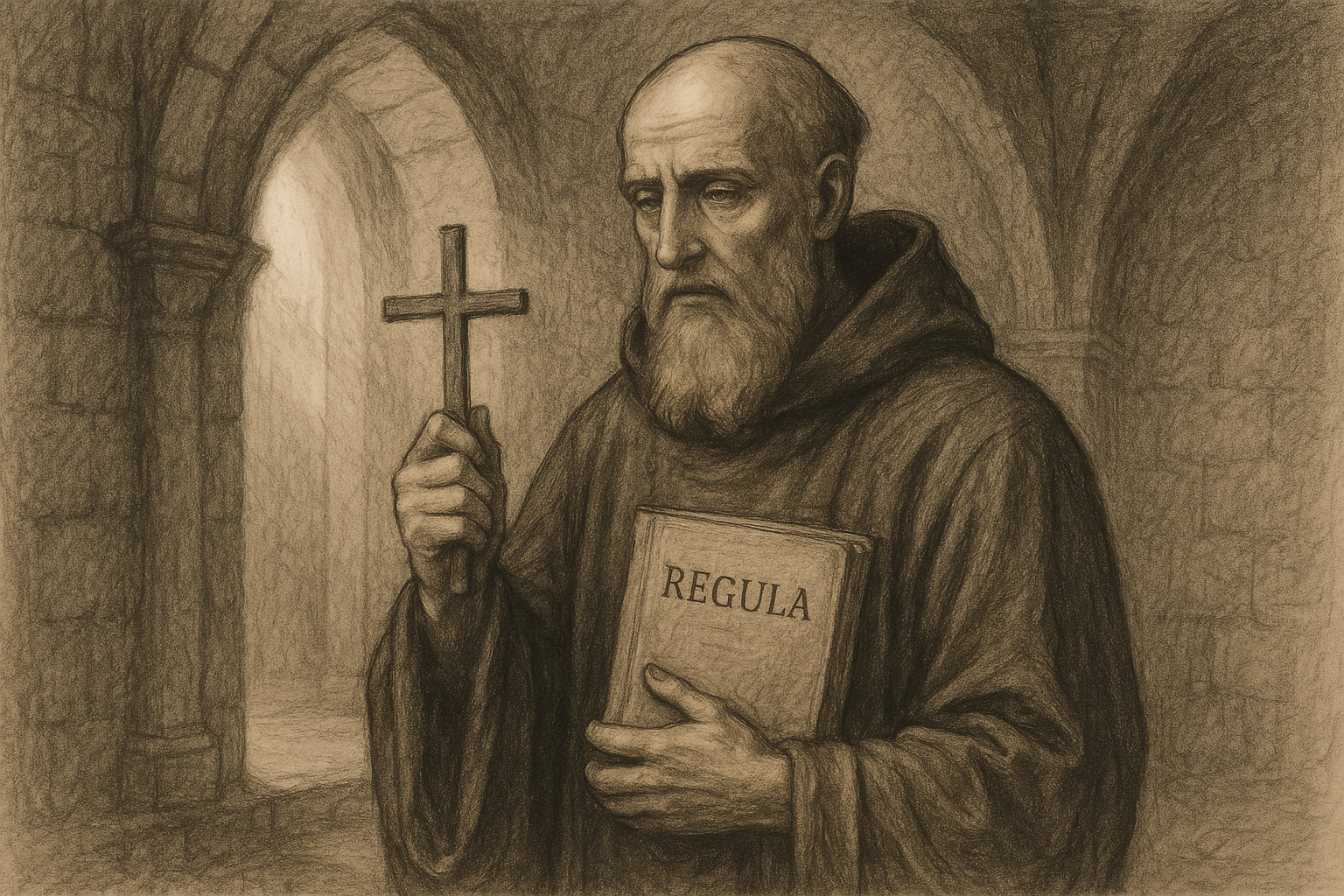
In time, he founded the monastery at Monte Cassino, which became the most famous center associated with his name. There he wrote the Rule of St. Benedict, a practical and spiritual guide for monastic life. Its enduring strength lies in its realism. Benedict knew that people are not pure spirits. We grow through structure. We need prayer, but we also need sleep, labor, mutual correction, and measured discipline.
The Rule is often described as balanced, and that word is fitting. It does not romanticize asceticism. It does not pretend that community is easy. It seeks a path of stability where the monk can be converted little by little. Benedict believed that holiness is learned in ordinary acts repeated faithfully.
What the Rule teaches about Christian life
The Rule of St. Benedict is written for monks, but its wisdom reaches much farther. Catholics who have never lived in a monastery can still recognize its lessons. Benedict places prayer at the center, but he also insists on humility, obedience, moderation, and perseverance. These are not abstract ideals. They are habits that shape a person from the inside out.
One of the most famous principles associated with Benedict is ora et labora, prayer and work. The exact phrase does not appear as a slogan in the Rule, but it captures Benedict's spirit well. Human life needs both contemplation and labor. Prayer without discipline can become vague. Work without prayer can become restless or empty. Benedict's vision joins them in service to God.
He also understood the importance of community. Christians are not saved as isolated individuals. We are brought into the Church, formed in households of faith, corrected by others, and sustained by common worship. Benedict knew that living with other people can be difficult, and he did not hide that difficulty. Instead, he built a way of life that assumes imperfection and seeks charity anyway.
Three Benedictine lessons for Catholics today
- Stability matters. Benedict teaches that spiritual growth usually comes from remaining faithful where God has placed us, rather than chasing constant novelty.
- Order serves freedom. A disciplined rhythm of prayer, work, and rest can make the soul more available to grace.
- Humility is strength. Benedict's path shows that true greatness is found in obedience to God, not self-assertion.
A saint formed by prayer, tested by leadership
It would be easy to imagine Benedict as only a serene teacher, but sanctity rarely unfolds without trial. Leadership brought its own burdens. Communities are fragile. People resist discipline. Not everyone who seeks holiness is ready for the sacrifices it requires. Benedict had to guide souls with patience, firmness, and prudence.
That balance is one reason his example remains useful. Some Christians are tempted to think holiness means intensity without tenderness. Others think charity means avoiding any demand. Benedict held together truth and mercy. His Rule gives correction, but it also gives rest. It asks much, but not more than a person can reasonably bear under grace.
His life also reflects a deep biblical wisdom. Scripture repeatedly shows that God forms His people through covenant, discipline, and perseverance. Israel is taught through wilderness, law, worship, and communal memory. The New Testament speaks of running the race, keeping vigil, and growing in maturity. Benedict lived this pattern in a particularly ordered way, making visible what the Scriptures already teach: the soul needs formation.
"Seek first the kingdom of God and his righteousness, and all these things will be added to you." Matthew 6:33
That verse could stand as a motto over Benedict's life. He sought the kingdom first. Everything else, including his influence on centuries of Christian life, followed from that priority.
The Benedictine legacy in the wider Church
St. Benedict did not set out to become the father of Western monasticism, yet that is how history remembers him. Benedictine monasteries preserved prayer, learning, agriculture, manuscript copying, and hospitality through ages of upheaval. The Church benefited enormously from the steady work of monks who lived according to his Rule.
But the deeper legacy is spiritual. Benedict showed that Christian civilization begins in converted hearts. A society becomes more humane not merely through laws, but through men and women shaped by virtue. The monastery was not an escape from the world in the sense of indifference. It was a place where order, charity, and worship could flourish, and from which the light of faith could radiate outward.
For Catholics today, this matters because modern life often fragments attention. We move quickly, speak quickly, decide quickly, and rarely remain long enough in silence to hear what God may be saying. Benedict offers another pace. His witness invites us to slow down, examine our habits, and build life around prayer rather than distraction.
Practical ways to live with Benedictine wisdom
A Catholic reading of Benedict should never remain theoretical. His life asks for response. Not everyone can join a monastery, but every Catholic can learn from Benedict's discipline of heart.
- Make prayer regular. A fixed time for morning and evening prayer can begin to reorder the day around God.
- Choose fidelity over impulse. Benedictine stability reminds us that growth often comes from staying faithful to present responsibilities.
- Accept hidden labor. Work done without applause can still be offered to God with great value.
- Practice silence. Interior quiet makes room for discernment and helps the soul resist needless noise.
- Live humbly with others. Family life, parish life, and community life all require patience, forgiveness, and a willingness to be corrected.
These are not impressive practices in the eyes of the world. But the saints rarely begin by impressing the world. They begin by surrendering themselves to God, one ordinary act at a time.
Why Benedict still feels close to the present hour
St. Benedict's life remains compelling because it answers a modern hunger. Many people long for peace, but they search for it in constant motion. Benedict points in the opposite direction. He teaches that peace is not found by escaping duty, but by ordering life toward God.
His witness is especially valuable for Catholics who feel overwhelmed by noise, confusion, or spiritual inconsistency. Benedict does not ask us to become heroic overnight. He asks us to begin. Pray. Work. Listen. Stay. Obey. Return again to God. In that quiet rhythm, the soul becomes available to grace.
There is something consoling about a saint whose greatness grew from hidden beginnings and disciplined habits. Benedict reminds the Church that the most fruitful lives are often the most ordered ones, and that the kingdom of God can take root in places where people simply decide to seek Him with perseverance.
In the end, the lasting power of St. Benedict life lies not only in the monasteries that bear his name, but in the invitation he leaves behind: to build a life where prayer is not occasional, virtue is not accidental, and God is not placed at the margins. That is a demanding path, but it is a deeply human one, and it is still open to every Catholic willing to begin.
Keep Reading on Lets Read The Bible
Frequently Asked Questions
Who was St. Benedict in the Catholic Church?
St. Benedict was a monk and abbot from the early sixth century who founded communities at Subiaco and Monte Cassino and gave the Church the Rule of St. Benedict. He is remembered as a major father of Western monasticism.
What is the Rule of St. Benedict used for?
The Rule of St. Benedict is a guide for monastic life. It gives practical direction on prayer, obedience, humility, work, community life, and the rhythm of daily life centered on God.
Can lay Catholics benefit from St. Benedict's life and teachings?
Yes. While the Rule was written for monks, lay Catholics can learn from Benedict's emphasis on prayer, stability, discipline, silence, and faithful daily duties offered to God.