Saints and Witnesses
St. Catherine of Siena and the Courage of a Soul Given Fully to Christ
A clear look at the life, prayer, and public witness of one of the Church's great women doctors
Site Admin | May 17, 2025 | 69 views
St. Catherine of Siena is one of those saints whose life feels at once distant and urgently close. She lived in 14th century Italy, in a world marked by plague, division, and political turmoil. Yet her witness still speaks with unusual clarity. Her story is not only about extraordinary mystical experiences or her influence on Church affairs. It is also about a soul gradually surrendered to Christ, a life shaped by prayer, sacrifice, and a deep love for the Church.
When Catholics reflect on the St. Catherine of Siena life, they do not find a personality built on self-assertion. They find a woman who listened, repented, prayed, served, and finally spoke with a courage that came from communion with God. That pattern matters. It is not only for canonized saints. It is for any Christian who wants to belong more fully to Christ.
From Siena to a Life Set Apart
Catherine was born in Siena in 1347, one of a very large family. Even in childhood, she showed an unusual seriousness about God. According to the broad tradition of her life, she desired prayer and solitude from a young age and resisted the ordinary expectations around her. Her family hoped for a more conventional future, but Catherine's heart was already turning toward God.
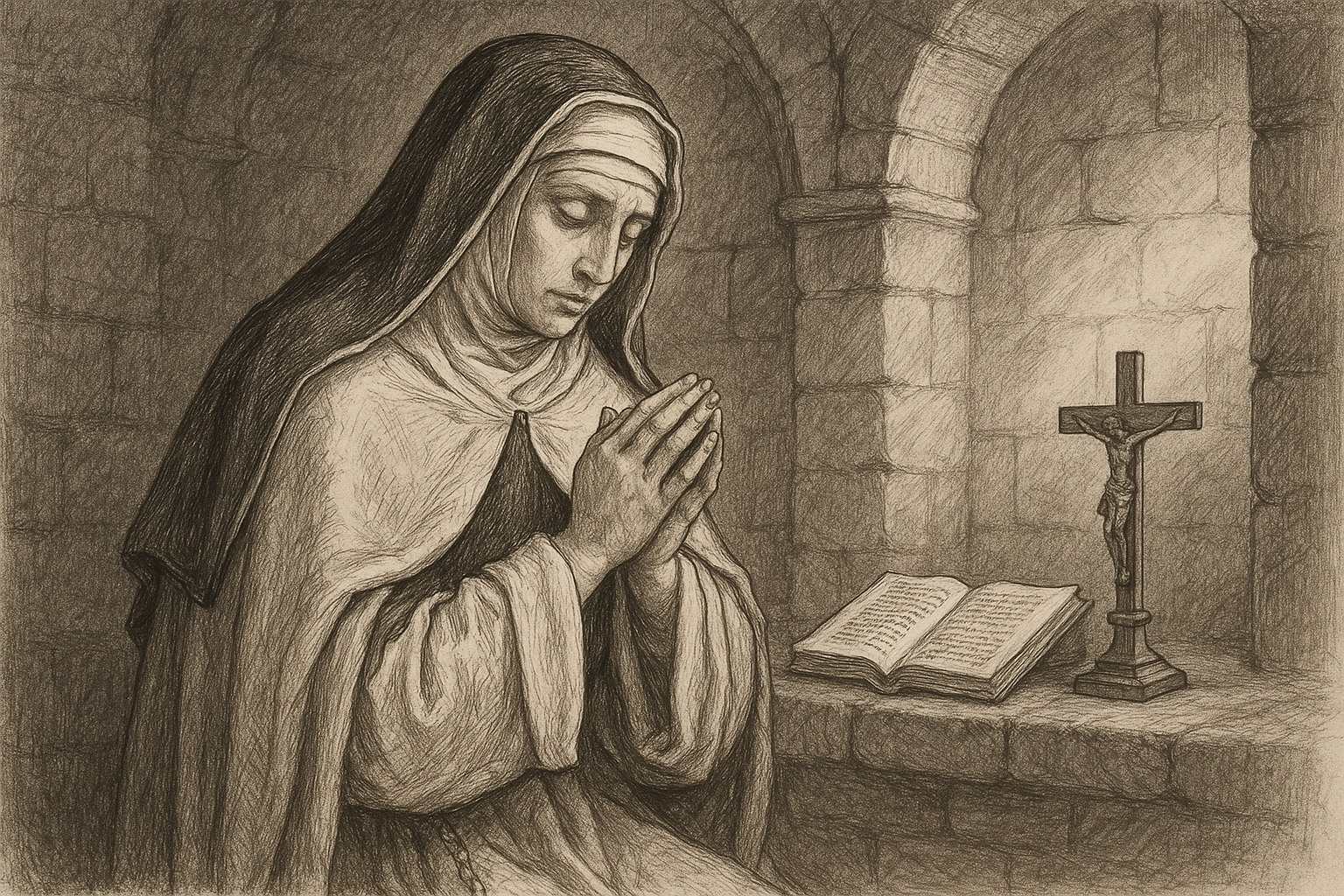
As a young woman, she joined the Lay Dominicans, known as the Third Order of St. Dominic. This allowed her to live a life of prayer and penance while remaining in the world. She did not enter a cloistered convent, but her devotion was no less radical. Her days were marked by fasting, prayer, and service, and her interior life deepened through silence and contemplation.
The Catholic memory of Catherine's early years is important because it reminds us that holiness often begins in hidden places. Before her public words carried weight, she spent long hours in prayer. Before she influenced bishops and rulers, she learned to belong to God in the ordinary demands of daily life.
Conversion, Mercy, and Interior Clarity
Catherine is sometimes described as having experienced a turning point in youth when she abandoned the distractions of vanity and gave herself more fully to Christ. In her writings, she speaks often of the soul's need for purification, humility, and obedience to God. Her spirituality is not sentimental. It is uncompromising about sin, yet always ordered toward mercy.
One of the most striking features of her life is the way she united ascetic discipline with compassion. She cared for the sick, the poor, and those whom others avoided. During outbreaks of plague, she and those around her served people in need. This combination of sacrifice and tenderness is not accidental. In Catholic life, real conversion does not make a person cold. It enlarges the heart.
Her Dialogues and letters reveal a woman who believed that the soul grows by knowing both its own weakness and God's overwhelming goodness. She did not speak as someone who thought holiness was achieved by mere effort. Rather, she saw virtue as a gift received through grace and cooperation.
"You are she who is not, and I am he who is." This famous line, associated with Catherine's spiritual teaching, captures her sense of God's greatness and the soul's dependence on Him.
A Woman Who Spoke for the Church
Catherine's public role is one reason her life continues to attract Catholic readers. She lived during the Western Schism, a painful period when rival claimants to the papacy divided the Church. In that troubled context, Catherine became a strong voice urging fidelity to the successor of Peter. She wrote letters to bishops, cardinals, political leaders, and even to the pope himself, calling them to reform, peace, and courage.
Her words were direct, but they were not mere criticism. She loved the Church as a mother loves a wounded family. Because of that love, she could speak truth without becoming cynical. She wanted reform, but not rebellion. She wanted purification, but not the tearing apart of Christ's Body.
This is one of the clearest lessons from the St. Catherine of Siena life: reverence for the Church does not mean silence in the face of disorder. Yet Catholic confidence in truth also requires humility, prayer, and obedience. Catherine did not speak from the spirit of complaint. She spoke from belonging.
Her counsel to Church leaders was often severe, but it was grounded in love for souls. She saw that shepherds carry a grave responsibility before God. At the same time, she asked the faithful to pray, repent, and offer sacrifice for the Church's renewal. Her witness joins reform and fidelity in a way Catholics still need to remember.
The Suffering Body and the Life of Prayer
Catherine's spirituality cannot be separated from her willingness to suffer. She practiced severe penance and fasted intensely. Her health deteriorated, and her body became increasingly weak. Modern readers may struggle with this aspect of her life, and it should be approached carefully. The Church does not canonize self-harm or unhealthy excess. Yet within the context of her age and her own interior gifts, Catherine understood suffering as something that could be united to Christ for the good of souls.
That union with the Cross is central to Christian holiness. St. Catherine did not seek suffering for its own sake. She sought to love Christ so deeply that even pain could become an offering. Her life recalls the Gospel truth that discipleship includes self-denial and endurance. As Jesus says, take up his cross.
At the same time, her life shows that prayer is not an escape from the world. It forms the soul so that the world can be loved rightly. Catherine's contemplation led her outward. She served the sick, counseled the troubled, wrote with urgency, and encouraged peace. Her interior life made her more present, not less.
Her Writings and Lasting Influence
Catherine was not formally educated in the way many clerical writers were, yet her teaching has endured because it is spiritually direct and deeply orthodox. In her Dialogues, she presents a rich vision of God's providence, the dignity of the human person, the nature of virtue, and the need for conversion. Her letters show practical intelligence and fearless charity. She wrote to real people in real crises.
In 1970, the Church proclaimed her a Doctor of the Church, recognizing the enduring value of her teaching. That title does not mean she was flawless, nor does it turn her life into an abstraction. It means the Church has judged her wisdom to be especially worthy of attention for the faithful.
For Catholics today, her influence is especially powerful because she bridges contemplation and action. She was not a theorist detached from life. She was a woman who prayed, repented, served, and then acted in history. Her witness suggests that the deepest renewal of the Church begins in sanctity, not in strategy alone.
What Catholics Can Learn from Her Life
St. Catherine's life is not meant to be copied in every detail. Few people are called to her particular form of penance or her public role in Church politics. But several lessons from her life are available to every Catholic.
- Prayer comes before influence. Catherine's authority flowed from her intimacy with God, not from ambition.
- Loving the Church means wanting her holiness. She did not flatter problems, and she did not abandon the Church when she saw them.
- Charity and truth belong together. She spoke forcefully because she cared deeply.
- Service to the suffering is part of holiness. Her prayer moved her toward the sick and the poor.
- Conversion is ongoing. Catherine's life invites continual repentance, not one-time enthusiasm.
Her example is especially helpful in an age when people often separate conviction from humility. Catherine shows that a Christian can be bold without becoming harsh and faithful without becoming passive. She also reminds us that holiness is not a private mood. It has consequences for the Church and for the world.
Her witness in ordinary Catholic life
Most Catholics will not write letters to popes or mediate public crises. But they can imitate Catherine's interior path. That may mean a steadier prayer life, more honesty in confession, better care for the suffering, or deeper trust in the Church even when she is wounded by human weakness.
It may also mean learning to love truth without spectacle. Catherine did not need to be noticed in order to be faithful. She needed to belong to Christ. That is still the heart of discipleship. The saints do not first ask us to admire them. They ask us to follow Christ with them.
Read in that light, the St. Catherine of Siena life is not a distant medieval story. It is a living call to surrender, prayer, courage, and trust. In a Church that still needs holiness, her voice remains clear: return to God, love the Church, and let grace make your life fruitful.
Keep Reading on Lets Read The Bible
Frequently Asked Questions
Why is St. Catherine of Siena so important in Catholic history?
She is important because she combined deep prayer, charitable service, and fearless public witness during a time of great turmoil in the Church. Her letters and spiritual writings also remain influential, and the Church later named her a Doctor of the Church.
Did St. Catherine of Siena live in a convent?
No. She was a Lay Dominican, so she lived a consecrated spiritual life in the world rather than as a cloistered nun. She devoted herself to prayer, penance, and service while remaining outside a convent.
What can Catholics learn from St. Catherine of Siena today?
Catholics can learn that holiness begins in prayer, grows through repentance, and bears fruit in love for the Church and service to others. Her life also shows that truth and charity should never be separated.