Saints and Witnesses
St. Dominic and the Stillness Behind His Fire
A Dominican saint whose love of truth, prayer, and preaching still gives Catholics a clear and hopeful model of holiness.
Site Admin | May 14, 2025 | 62 views
St. Dominic's enduring appeal
Among the saints of the Church, St. Dominic stands out for a reason that is both simple and demanding. He did not build a spiritual legacy on spectacle, political power, or dramatic self-display. He became known for a steady life of prayer, disciplined study, and preaching that sought the salvation of souls. That combination has given Catholics generations of St. Dominic Catholic inspiration, because it shows that holiness can be both contemplative and active, both gentle and unflinching.
Dominic de Guzman was born in Spain around 1170 and later became the founder of the Order of Preachers, known as the Dominicans. The Church remembers him as a man who loved truth enough to live for it. He saw that error could not be answered by noise alone. People needed catechesis, compassion, and a preacher whose own life gave credibility to his words. That insight still feels fresh because the same need remains in every age.
His life also reminds Catholics that saints are not spiritual decorations. They are witnesses. Their lives make the Gospel visible in a particular time and place. St. Dominic's witness is especially appealing because it joins the intensity of mission with the hidden labor of prayer. He was not only a preacher in public. He was, first of all, a man who belonged to God.
The man behind the preaching
St. Dominic lived in a troubled period for the Church in southern France, where the Albigensian heresy was spreading. The details of that conflict can be complex, but the basic pastoral need is easy to understand. Many people were confused about Christian faith, the goodness of creation, and the reality of the sacraments. Dominic recognized that the answer could not be reduced to force. The Church needed teachers who could speak clearly, live simply, and trust grace to do what argument alone could not.
Before founding his order, Dominic served as a canon at Osma in Spain. His life there formed him in prayer and regular observance. Later, when he traveled through difficult regions, he came to see more clearly that ministers of the Gospel had to be both learned and humble. A preacher who does not know the faith may mislead. A preacher who knows the faith but does not love souls may become cold. Dominic sought a different path, one in which study was ordered to charity and preaching flowed from contemplation.
This is one reason Catholics continue to return to him. His life refuses the false choice between head and heart. He knew doctrine mattered. He also knew doctrine was not merely information. Truth was meant to convert, console, correct, and strengthen. The saint's example makes clear that Catholic witness works best when intellect and devotion are joined.
Prayer first, then speech
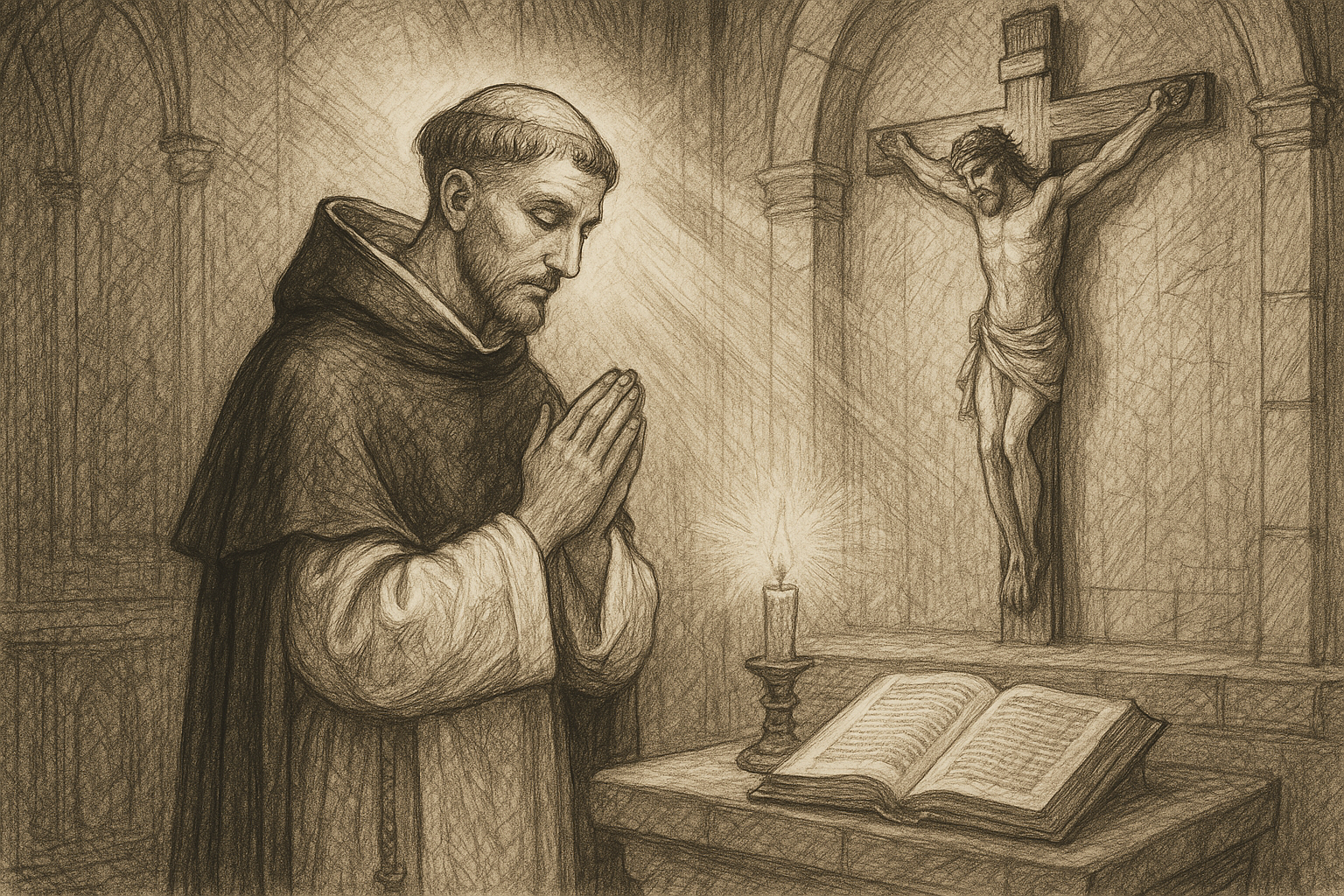
It is easy to think of St. Dominic primarily as a great preacher, but the order of his life matters. He preached because he prayed. He spoke because he listened. He taught because he had first placed himself before God in humility. That pattern is not a detail. It is the key to understanding his holiness.
The Dominican tradition has long emphasized contemplation in service of preaching. In Dominican spirituality, truth is not a possession to boast about but a gift to receive and share. Dominic himself seems to have lived from this same conviction. Tradition remembers him as a man of profound prayer, often spending long hours before God. He was known for fasting, charity, and compassion for those who suffered. His missionary urgency was never detached from reverence.
For Catholics today, that is a needed correction. We often want action without silence, efficiency without adoration, and certainty without conversion. St. Dominic's life suggests a better order. Before one can preach Christ well, one must belong to Christ deeply. Before one can speak of truth with integrity, one must let truth search the heart.
Preaching is not only a matter of eloquence. In the Catholic tradition, it is a work of mercy when it leads souls toward Christ.
That principle explains why Dominic's memory has remained so strong in the Church. His legacy is not simply a style of speaking. It is a way of being. He reminds us that words carry weight when they rise from prayerful obedience.
Why his witness still feels practical
St. Dominic inspires Catholics because his holiness meets ordinary struggles. Many believers know the frustration of trying to speak about faith in a culture that is distracted, suspicious, or tired of religious language. Dominic faced a world with its own confusions and competing claims. He did not answer them by retreating into private piety. He founded a community devoted to study, preaching, poverty, and common life so that the truth of the Gospel could be proclaimed with clarity and credibility.
That approach still offers practical wisdom.
- He shows that learning is holy. Catholics do not need to fear serious study. When ordered to God, learning becomes an act of love.
- He shows that simplicity strengthens witness. A preacher who is not burdened by luxury is freer to speak plainly and live honestly.
- He shows that mercy and truth belong together. People are not converted by argument alone, but neither are they served by vague comfort without truth.
- He shows that mission begins in communion with God. The fruit of preaching depends on grace, not personality.
These lessons matter in parish life, in family life, and in personal prayer. Parents who want to hand on the faith can learn from Dominic's balance of patience and clarity. Teachers and catechists can learn from his respect for doctrine. Priests and deacons can learn from his emphasis on preparation and holiness. Lay Catholics can learn that apologetics, when done well, is not a performance but an act of charity.
Dominican spirituality and the Catholic imagination
The influence of St. Dominic did not end with his own lifetime. The Dominican family of religious, priests, nuns, and lay associates has continued to shape Catholic life through teaching, preaching, scholarship, and contemplative prayer. Think of St. Thomas Aquinas, whose theological work would eventually become one of the great gifts of the Church. The Dominican tradition helped form a Christian imagination in which truth can be sought with confidence because all truth comes from God.
That wider Dominican heritage matters because it shows that Dominic's charism was never narrow. He was not only concerned with winning arguments. He wanted souls to encounter Christ. He knew that beauty, order, doctrinal clarity, and prayer all serve that encounter. For Catholics who sometimes feel overwhelmed by confusion in the modern world, his witness offers a steadying point. Truth is not fragile when it rests in God.
His devotion to the Rosary is also part of the story, though the development of the Rosary tradition unfolded over time within Dominican life and devotion. Even so, the association remains meaningful. The Rosary itself is a contemplative way of looking at Christ with Mary, and that fits Dominic's spiritual instinct. He wanted the mysteries of salvation to be pondered, prayed, and proclaimed. In that sense, the Rosary continues his mission in the hands of ordinary Catholics.
What St. Dominic asks of us
St. Dominic is not merely admired from a distance. He asks something of the faithful. His life quietly presses Catholics toward a more coherent discipleship. If we honor him sincerely, we will not reduce faith to sentiment. We will not separate prayer from truth. We will not assume that public witness is enough if our private life is empty.
He also invites us to examine the way we speak about the faith. Do we speak with charity? Do we speak with accuracy? Do we listen before we answer? Do we believe that God can work through our weak but honest efforts? Dominic's example suggests that preaching begins long before a person opens his mouth. It begins in surrender, study, repentance, and love.
Scripture offers several touchstones that fit his charism well. The Lord sends disciples to proclaim the kingdom and instructs them to rely on God's providence Proclaim the Kingdom. St. Paul tells Timothy to preach the word, be persistent, and teach with patience Preach the Word. The apostolic mission is never merely self-expression. It is service of the truth received from Christ. Dominic lived that mission with uncommon steadiness.
He also reflects the biblical pattern of contemplative fruitfulness. Like Mary at the feet of the Lord and Martha in active service, the Church needs both listening and labor Mary at Jesus' Feet. Dominic's genius was to see that preaching flourishes when it emerges from contemplation. That is why his witness still feels so needed. He does not flatter our restlessness. He teaches us to become still enough to hear God and brave enough to speak for Him.
In the end, St. Dominic remains compelling because his life was not built around himself. It was built around Christ, the truth he preached, and the souls he longed to bring home. That is why Catholics still find in him a living invitation: let prayer deepen your words, let truth purify your motives, and let charity shape the way you witness to the Gospel.
Keep Reading on Lets Read The Bible
Frequently Asked Questions
Who was St. Dominic in the Catholic Church?
St. Dominic was a Spanish priest and founder of the Order of Preachers, also called the Dominicans. He is remembered for his prayer, study, poverty, and preaching in service of the Church's mission.
Why is St. Dominic important to Catholics today?
St. Dominic matters because he shows how Catholic faith can unite deep prayer, serious learning, and clear preaching. His example helps Catholics see that truth should be shared with humility and charity.
Is the Rosary connected to St. Dominic?
The Rosary is strongly associated with Dominican spirituality, and tradition links its spread to St. Dominic, though its historical development took shape over time. Catholics still see the Rosary as part of the Dominican call to contemplation of Christ with Mary.