Saints and Witnesses
St. Gianna Molla and the Courage to Love Without Reserve
A physician, wife, and mother whose quiet fidelity still speaks to Catholic hearts
Site Admin | May 30, 2025 | 79 views
St. Gianna Molla stands among the modern saints as a reminder that holiness is not reserved for cloisters, cathedrals, or dramatic public moments. She was a physician, a wife, and a mother who lived the Christian life in the press of ordinary responsibilities. Her witness still reaches Catholics because it joins together two truths that are often separated in practice: the call to personal holiness and the call to defend human life with love.
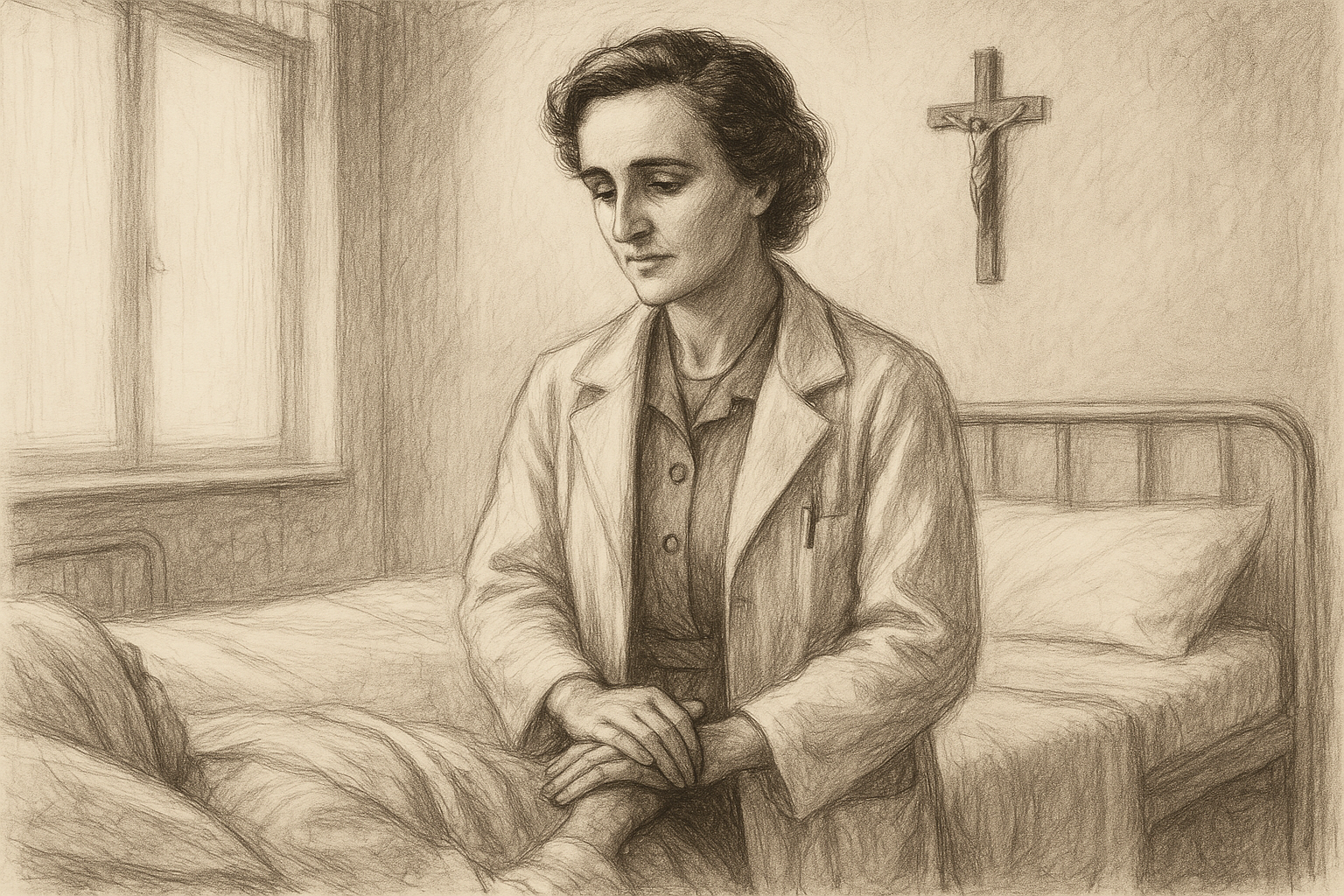
Gianna was born in 1922 in Magenta, Italy, and grew up in a deeply Catholic family. She pursued medicine, became a pediatrician, and later married Pietro Molla. Their marriage was rooted in faith, mutual affection, and a willingness to place God at the center of family life. In her professional work, she cared for mothers, children, and the vulnerable with competence and compassion. In her home, she lived the duties of wife and mother with the same spirit of generosity.
What makes her especially compelling is not that she lived an easy life, but that she lived an integrated one. Her faith was not an accessory to her work or family life. It shaped how she saw every person. The Christian conviction that each human being is made in the image of God was not an abstract idea for her. It became concrete in the way she treated patients, spouse, and children, and in the way she faced suffering at the end of her life.
A saint formed by ordinary fidelity
Many Catholics find St. Gianna Molla Catholic inspiration in the fact that she did not seem to live in a world far removed from our own. She knew the demands of scheduling, illness, childcare, professional responsibility, and family love. Yet these ordinary concerns became the very place where grace bore fruit. That is one reason her witness is so lasting. She shows that sanctity can grow in the midst of a normal calendar, a family table, and the hidden sacrifices no one else notices.
Gianna had a deep devotion to prayer and the sacraments. She trusted Providence, and she wanted her life to belong fully to Christ. Her letters reveal a woman who loved her family intensely while also understanding that every earthly good must be ordered toward God. That balance is important for Catholics today. We can love our work, our children, our plans, and our dreams, but we cannot make them ultimate. Gianna reminds us that everything human becomes clearer when it is received as a gift.
Her life also reflects a distinctly Catholic sense of vocation. Marriage was not for her a second best path, nor was professional life a distraction from holiness. She lived both as a vocation. In the Christian view, marriage is a sacrament, a real path to sanctity, and professional competence can become an act of service when offered in charity. Gianna's life quietly confirms this truth.
Medicine, mercy, and the dignity of the person
As a doctor, Gianna worked among mothers and children, and this shaped the way she understood care. Medical skill, for her, was never merely technical. It served the good of the whole person. This is one reason she continues to matter in a culture that can be tempted to separate efficiency from mercy. The Catholic moral imagination insists that persons are never problems to be managed. They are neighbors to be loved.
That conviction becomes especially clear when we think about the child in the womb. Scripture speaks with striking tenderness about God's knowledge of the human person before birth: Before I formed you in the womb I knew you and You formed my inward parts. The Church has always drawn from this biblical vision to defend the dignity of unborn life. Gianna's witness belongs to that same moral world, where the smallest and most vulnerable are not invisible to God.
It is important, however, not to flatten her story into a slogan. She is not inspiring simply because she can be invoked in a pro-life context. She is inspiring because her pro-life witness flowed from a whole Catholic life. She did not love life in the abstract. She loved persons concretely. She loved them as a doctor, as a wife, as a mother, and as a believer who knew that Christ entered the world through a human body and redeemed us by taking flesh.
The final trial and a mother's surrender
The most widely known moment of St. Gianna Molla's life came during her fourth pregnancy. Doctors discovered a medical complication that put her life in grave danger. In such a situation, she had to confront a heartbreaking choice in which the life of her child and her own life were both at risk. She chose to continue the pregnancy and to do everything possible to save her child. Her daughter, Gianna Emanuela, was born. Gianna Molla later died after the birth from complications related to the pregnancy.
This moment has remained central in Catholic memory because it reveals sacrificial love in its most demanding form. Yet even here, the Church does not celebrate suffering for its own sake. What is honored is love that refuses to abandon either mother or child. Gianna did not choose death as an abstract ideal. She chose fidelity to maternal love, trusting herself and her unborn child to God. Her decision speaks with special force because it was made in the presence of real fear, real pain, and real uncertainty.
For Catholics, this witness is closely joined to the moral teaching that every human life has dignity from conception until natural death. We are not asked to romanticize tragedy. We are asked to see every life, including the life of the unborn child and the life of the mother, as sacred. Gianna's story helps many believers grasp that this teaching is not cold or theoretical. It is protective, humane, and rooted in love.
Holiness often looks like steadfastness when no one can see the cost. In Gianna's case, that steadfastness became a sign of hope for the whole Church.
Marriage as a path to sanctity
St. Gianna Molla also speaks powerfully to married Catholics. Her marriage was not a background detail but a real arena of holiness. She and Pietro lived a love marked by faith, trust, and mutual self-gift. She wanted her home to be a place where Christ was welcome, where love was practical, and where family life itself was offered to God.
That vision corresponds closely to Catholic teaching on marriage. The sacrament is not merely a social arrangement or emotional companionship, but a covenant ordered toward the good of the spouses and the generation and education of children. In that setting, daily duties can become acts of love: preparing meals, caring for children, enduring fatigue, making sacrifices, speaking with patience, and forgiving quickly. Gianna's life makes these hidden acts look beautiful, not because they are dramatic, but because they are faithful.
Many Catholic spouses find in her example an encouragement to keep going when ordinary life feels repetitive or exhausting. Saintly marriage is rarely spectacular. It is usually built in the small decisions that repeat every day. Gianna gives dignity to that hidden labor. She shows that domestic fidelity is not lesser holiness. It is holiness in a form most people can recognize.
A witness for Catholics in a divided age
There is another reason St. Gianna Molla Catholic inspiration remains strong today. Her life cuts through the tendency to divide faith from public life, compassion from principle, and mercy from truth. She was not an ideological figure. She was a Catholic woman whose love for God shaped her intelligence, her work, her marriage, and her conscience. That integration is urgently needed now.
Catholics today often live under pressure to privatize faith or reduce morality to personal preference. Gianna offers a better way. She invites believers to form their consciences, to honor the weak, to value the sacramental dignity of marriage, and to carry suffering with trust. She also reminds us that Christian witness is persuasive when it is visibly humane. People may not be moved by arguments alone, but they are often moved by lives that embody what the Church teaches.
Her example can help parents, doctors, students, and parishioners alike. Parents see in her a model of sacrificial love. Medical professionals see in her a reminder that skill must serve conscience. Young adults see that holiness is possible before life becomes fully settled. Those who suffer losses or fear the future can see that a saint is not someone untouched by pain, but someone who allows pain to be joined to Christ.
What her witness asks of us
St. Gianna Molla does not ask Catholics to imitate the exact circumstances of her life. She asks something more universal and more demanding: to love God first, to honor every human person, and to be faithful in the responsibilities actually entrusted to us. That may mean perseverance in marriage, reverence for unborn life, honesty in work, or patience in illness. It may mean simply refusing to let fear decide everything.
Her life also encourages a deeper Marian spirit, a willingness to say yes to God without controlling every outcome. This is not passivity. It is trust. It is the courage to believe that obedience can be fruitful even when the future is uncertain. In that sense, Gianna's witness feels very close to the Gospel itself, where love is proved not by sentiment, but by self-gift.
For Catholics who want a saint for modern life, Gianna Molla is a quiet but powerful companion. She does not shout. She does not simplify suffering. She does not separate life from love. Instead, she shows that when a Christian woman lives her vocation with faith, intelligence, and tenderness, the world receives a glimpse of what grace can do in an ordinary home and an ordinary heart.
That is why her memory remains so fresh. It is not only that she defended life. It is that her whole life became a defense of love, and love, in the end, is what the saints make visible.
Keep Reading on Lets Read The Bible
Frequently Asked Questions
Why is St. Gianna Molla so important to Catholics today?
St. Gianna Molla is important because she shows how holiness can shine in marriage, motherhood, and professional life. Her witness also strengthens Catholic respect for human life, especially the unborn, by showing that pro-life conviction should be rooted in charity, sacrifice, and faith.
Was St. Gianna Molla a doctor?
Yes. Gianna Molla was a physician, and she worked especially with mothers and children. Her medical vocation became part of her Christian witness because she understood care for the body as service to the person created by God.
What can married Catholics learn from St. Gianna Molla?
Married Catholics can learn that ordinary family life is a real path to sanctity. Gianna and her husband Pietro lived faith within daily responsibilities, showing that patience, sacrifice, and trust in God can make married love holy.