Saints and Witnesses
St. Ignatius of Loyola and the Grace That Reordered a Life
From wounded soldier to founder of the Jesuits, Ignatius shows how God can turn ambition into discernment and surrender.
Site Admin | June 6, 2025 | 73 views
The St. Ignatius of Loyola life is one of the great Catholic stories of conversion, but it is not a simple tale of a sinner who suddenly became holy. It is the story of a man shaped by honor, military discipline, ambition, and suffering, who slowly learned to give his imagination, his plans, and his future to God. That movement from self-direction to obedience did not happen in a moment. It unfolded through prayer, testing, patience, and a growing willingness to let Christ lead.
Ignatius was born in 1491 in the Basque region of Spain, at Loyola, into a minor noble family. He was drawn early to the life of the court and the world of knightly honor. He served in military circles and desired distinction. Like many young men of his class, he prized reputation, courage, and the admiration of others. Yet the Lord was preparing a different path, one that would pass through weakness before bearing fruit.
A wound that changed the direction of his life
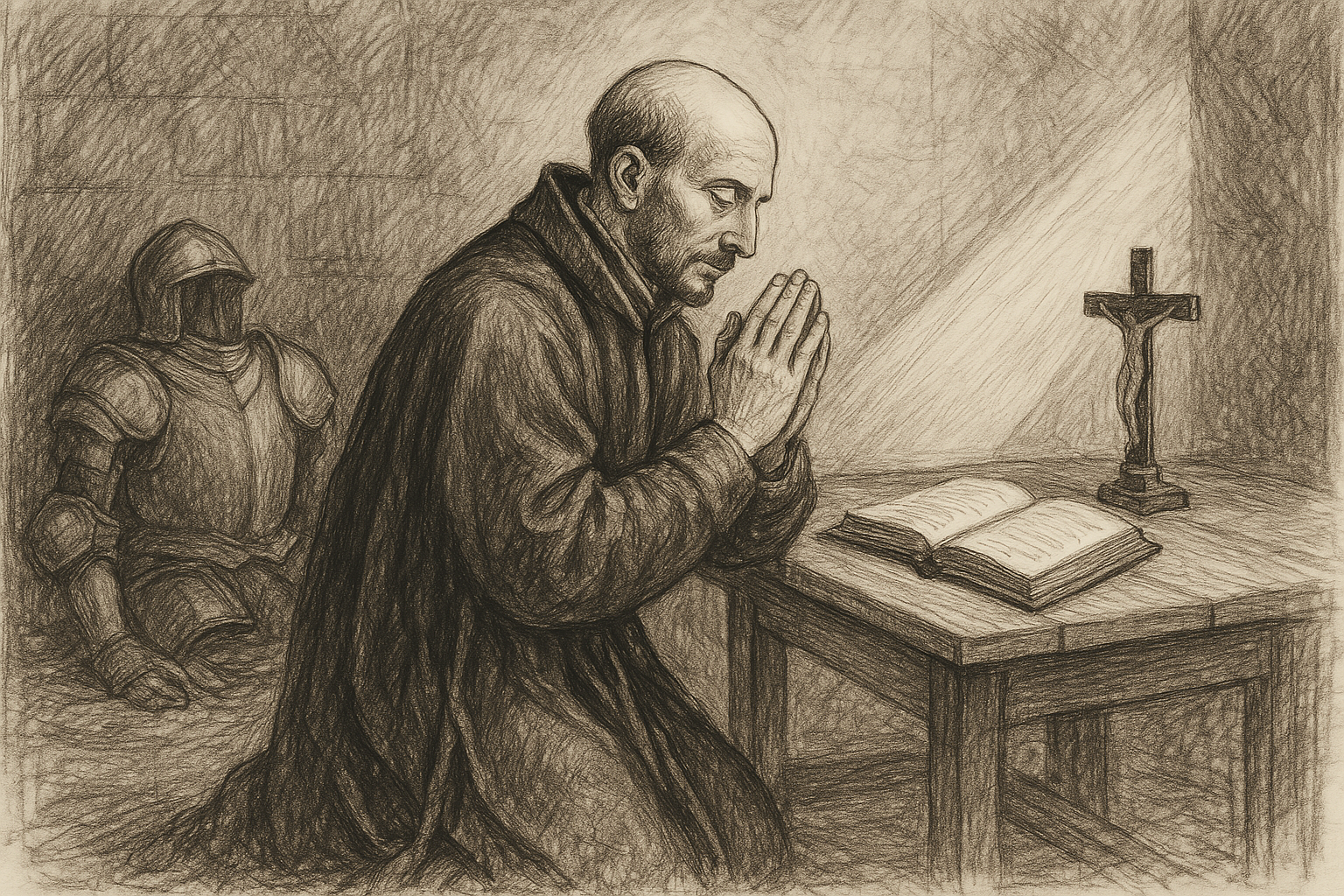
The decisive turning point came in 1521, when Ignatius was injured at the Battle of Pamplona. A cannonball shattered his leg and left him gravely wounded. For a man who had built his identity around action and status, the injury was a humiliation as much as a physical trial. During the long recovery that followed, he asked for books of chivalry, but none were available. Instead, he was given lives of Christ and the saints.
That simple accident of reading became a moment of grace. As he reflected, Ignatius noticed a difference between the satisfaction that came from worldly fantasies and the peace that came from imagining a life given to God. He saw that one kind of desire faded quickly, while another left a deeper and more lasting joy. This experience would become the beginning of the discernment for which he is now so well known.
Ignatius did not emerge from his convalescence instantly transformed into a saintly model. He still struggled, still refined his motives, and still had to learn the meaning of humility. But the direction of his heart had changed. The man who once sought earthly acclaim began to ask what would truly serve Christ. That question, repeated honestly, became the center of his vocation.
Scripture gives language for Ignatius' conversion. Jesus says, I am the vine, you are the branches. A branch cannot bear fruit apart from the vine, and Ignatius came to understand that a life apart from Christ, however impressive, remains spiritually barren.
From pilgrimage to purpose
After his recovery, Ignatius embarked on a pilgrimage of sorts, first to Montserrat and then to Manresa. There he lived in simplicity, prayed intensely, and underwent a deep interior purification. He spent long hours in prayer and penance, wrestling with scruples and learning to distinguish between consolations that came from God and impulses that led away from peace. His time at Manresa was not merely a retreat from the world. It was a forge in which his soul was being formed.
During these years, Ignatius began to compose the spiritual insights that would later shape the Spiritual Exercises. The Exercises are not a sentimental devotional manual. They are a disciplined way of examining the movements of the heart, considering sin and mercy, and choosing one's life in light of the Gospel. At their center is the conviction that God can speak within the conscience and that a Christian must learn to listen carefully.
Ignatius eventually made his way to the Holy Land, hoping to remain there in service to Christ's places and people, but the Franciscans there judged the conditions too dangerous and sent him back. He then realized that he needed a stronger theological foundation if he was to help souls effectively. So, in an act that might have seemed improbable to those who knew his earlier life, he entered the path of study, beginning in Barcelona and later continuing at Alcala, Salamanca, and Paris. He was no longer chasing fame, but seeking formation.
This is one of the most remarkable parts of the St. Ignatius of Loyola life: he did not merely feel a new spiritual enthusiasm. He accepted the long labor of becoming useful. For Ignatius, holiness was never only about private devotion. It was about being available to God for whatever service the Church required.
The birth of a missionary mind
In Paris, Ignatius gathered companions who shared his desire to serve Christ without reserve. Among them were Francis Xavier and Peter Faber, men who would help shape the future of the Church in the sixteenth century. Together they formed a brotherhood that would eventually become the Society of Jesus, approved by Pope Paul III in 1540.
The Jesuits were not founded as a monastery in the ordinary sense. Their charism was marked by mobility, education, preaching, missionary zeal, and direct service under the Pope. In a period of upheaval and reform, they answered a real need in the Church: the need for well-formed men who could go wherever the Church required, teach clearly, and defend the faith with intelligence and charity.
Ignatius became the first superior general of the Society of Jesus and spent the rest of his life guiding the order. He remained a man of practical governance, careful correspondence, and patient attention to souls. The founder who had once sought glory learned to labor quietly for Christ through administration, discernment, and friendship in the Lord.
It is easy to think of saints as people untouched by ordinary responsibilities, but Ignatius was deeply involved in ordinary burdens. He dealt with misunderstandings, financial strain, delicate human personalities, and the constant demand of making decisions for others. His holiness was tested not in isolation but in the daily demands of leadership.
Discernment as a way of life
If there is one gift Ignatius gave the Church that still resonates, it is his teaching on discernment. He understood that the Christian life is not simply about choosing between obviously good and evil acts. Much of our life is lived in the realm of mixed motives, competing desires, and subtle temptations. A person may want to do good and still be driven by pride, fear, or vanity.
Ignatius taught that the soul must learn to notice what leads toward God and what leads away from Him. This is why his method looks at consolation and desolation. Consolation is not merely emotional happiness. It is the movement of the soul toward faith, hope, and love, a deepening peace in God. Desolation is the opposite, a darkening, a turning inward, a loss of spiritual strength. These are not abstract categories. They are practical signs that help a person pray with greater honesty.
The wisdom here is profoundly biblical. St. Paul tells the Romans, Do not be conformed to this world, but be transformed by the renewal of your mind, and Ignatius would surely agree that renewal requires attention. A Christian does not drift into holiness. He or she learns, through grace, to recognize which thoughts and desires are drawing the heart toward Christ.
Ignatius also insisted that freedom is essential. To be free is not to have no commitments. It is to be detached enough from possessions, reputation, and preference that one can truly say yes to God's will. His famous prayer, often called the Suscipe, expresses this surrender in concise form: to receive, to love, to yield, and to trust that God alone suffices. This is not passive resignation. It is active, deliberate abandonment to divine providence.
What Catholics can learn from Ignatius today
Modern Catholics often live amid noise, urgency, and distraction. We are pulled by constant information, pressured by performance, and tempted to measure our lives by visible results. Ignatius speaks directly to this condition. He reminds us that the deepest questions are not answered by impulse. They are answered by prayerful discernment rooted in truth.
His life suggests several practical lessons:
- God often uses interruption. A sudden wound, an illness, a disappointment, or a closed door may become the place where grace begins to work in a new way.
- Interior movements matter. Not every good feeling is from God, and not every difficulty means failure. The soul needs patient examination.
- Formation takes time. Ignatius embraced study because zeal alone was not enough. Catholics today likewise need sound doctrine, sacramental life, and disciplined prayer.
- Service must be available. Holiness does not always mean choosing what seems impressive. It often means letting God decide where and how we are needed.
- Freedom is a spiritual achievement. Detachment from ego and outcomes makes room for obedience and peace.
Ignatius also helps correct a common misunderstanding about discernment. Discernment is not the same as endlessly postponing decisions. It is a way of seeking God's will so that one may act with clarity. In this sense, discernment is meant to lead to obedience. Prayer reveals the path, but the Christian must still walk it.
For many Catholics, the life of St. Ignatius can feel especially close because it joins ambition and surrender. He did not begin as a cloistered contemplative. He began as a man of the world. Yet grace met him where he was and redirected everything. That should give hope to anyone who wonders whether a restless heart can become a holy one.
A saint for those who want to begin again
Ignatius died in Rome in 1556. By then, the Society of Jesus had already begun to shape Catholic education, missionary work, and spiritual renewal in powerful ways. His influence would continue to spread far beyond what he could have imagined in his wounded youth. But the measure of his life is not only in institutions founded or works accomplished. It is in the quiet surrender by which he allowed Christ to reorder his desires.
At the heart of the Catholic life is the conviction that God does not merely forgive the past. He can also redirect the future. St. Ignatius of Loyola learned that truth in his body, in his imagination, in his studies, and in his prayer. His witness still speaks to those who are trying to make sense of their own interior struggles. He invites the Church to ask, again and again, not what is easiest or most admired, but what leads more surely to God.
That question remains as urgent now as it was in the years after Pamplona. And for the believer willing to answer it honestly, Ignatius still stands as a steady companion on the road toward freedom in Christ.
Keep Reading on Lets Read The Bible
Frequently Asked Questions
What changed St. Ignatius of Loyola's life most dramatically?
His wound at the Battle of Pamplona in 1521 changed everything. During recovery, he read about Christ and the saints, which awakened a new desire for God and began his conversion.
What is the Spiritual Exercises of St. Ignatius about?
The Spiritual Exercises are a method of prayer and discernment that helps a person examine the movements of the heart, grow in freedom, and choose God's will more faithfully.
Why is St. Ignatius important for Catholics today?
He offers a practical model of discernment, detachment, and disciplined prayer. His life shows that God can transform ambition into service and restless energy into fruitful holiness.