Saints and Witnesses
St. Scholastica and the Grace of Holy Friendship
A quiet saint, a steadfast prayer, and a witness that still speaks to Catholic life
Site Admin | June 5, 2025 | 68 views
St. Scholastica is one of those saints who seems to live at the edge of the page, mentioned briefly in history, yet remembered steadily in the life of the Church. She is known chiefly as the sister of St. Benedict and as a woman of prayer whose holiness was marked by humility, perseverance, and love for God. Her witness is not loud, but it is lasting. For Catholics looking for St. Scholastica Catholic inspiration, her life offers a clear reminder that sanctity does not depend on visibility. It depends on fidelity.
What makes St. Scholastica especially moving is that so little is known with certainty about her life. The Church does not hand us a detailed biography filled with dramatic speeches or public achievements. Instead, she is remembered through the tradition of the Church, especially through the account in St. Gregory the Great's Dialogues, which presents her as a woman of intense prayer and deep trust in God. That simplicity matters. It invites the faithful to look not for spectacle, but for the hidden work of grace.
A life remembered through prayer and tradition
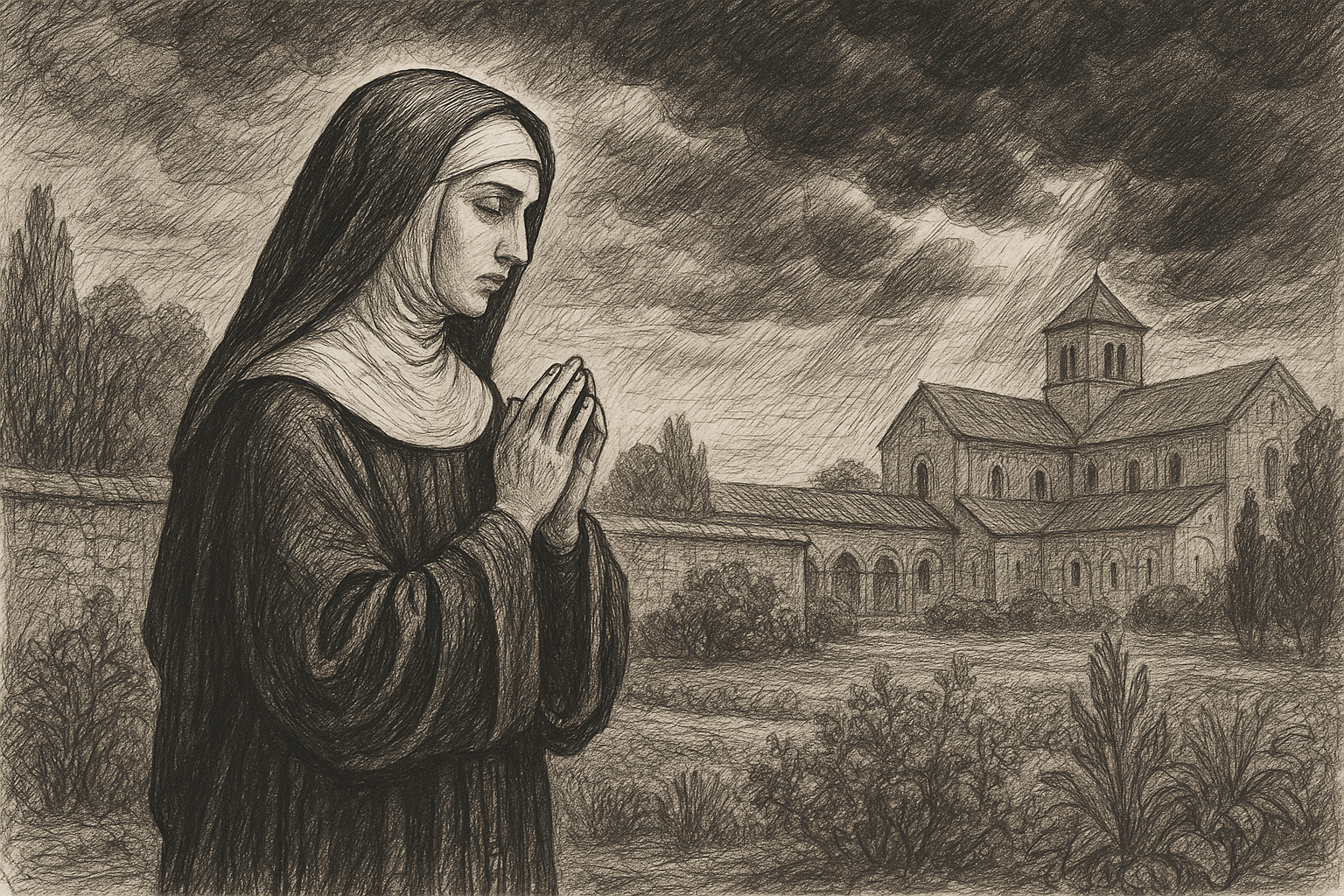
Scholastica is traditionally honored as the sister of St. Benedict, the father of Western monasticism. According to the long-standing tradition preserved in the Church, she lived a consecrated life near her brother's monastery and visited him once a year. Their final meeting is the most famous scene associated with her. After a day of holy conversation, Scholastica asked Benedict to remain with her a little longer so they could continue speaking about God. When he hesitated, she prayed, and a storm arose that kept him from leaving. Benedict later recognized that her prayer had prevailed through love and humility before God.
This account is not merely a charming story from the saints' lives. It reveals something central to Christian prayer. Scholastica does not manipulate God, and she does not seek her own advantage. She asks from a heart wholly turned toward God, and her request is granted in a way that serves divine providence. The episode echoes the confidence of Scripture, where persistent prayer is never treated as a technique but as an act of trust. Jesus Himself says, Ask, and it will be given to you, and St. James urges the faithful to ask in faith, not doubting (James 1:6).
Scholastica's prayer is not grandstanding. It is intimacy with God. That is why her witness continues to matter. Many Catholics know the temptation to think prayer must sound impressive or feel dramatic to be real. Scholastica suggests something different. Her holiness appears in steady desire, in love that persists, and in confidence that God listens even when others do not understand.
What the Church sees in her quiet holiness
The Church honors saints not simply because they were religious people from the past, but because their lives reveal the work of grace. In Scholastica, Catholics see several important features of holiness.
- She lived with spiritual seriousness. Her life was not casual about God. She desired communion with Him and pursued it with discipline and reverence.
- She valued holy conversation. The tradition of her final meeting with Benedict suggests a soul eager to speak of God, not merely to exchange worldly news.
- She trusted prayer more than human calculation. When the moment mattered, she did not rely on persuasion alone. She prayed.
- She loved without rivalry. Her relationship with Benedict is remembered not as competition between siblings, but as mutual reverence ordered to God.
These are not small virtues. In fact, they are the kind that shape a life quietly over time. The saints often remind us that holiness is not mostly about being noticed. It is about becoming available to grace.
That theme runs deep in the Gospel. Mary of Bethany sits at the Lord's feet and listens (Luke 10:39), while Jesus defends her choice to attend first to what is necessary (Luke 10:42). Scholastica belongs to that same spiritual family of discipleship. She is a woman who knows that communion with God is the better part. She shows that devotion is not wasteful. It is fruitful.
Holy friendship is part of the Christian life
One reason St. Scholastica continues to inspire Catholics is that her story highlights the sanctity of friendship. Christian friendship is not merely companionship or shared interests. It is a relationship ordered toward the good of the soul. Scholastica and Benedict, as tradition remembers them, are not admired because they were emotionally close in a modern sense. They are remembered because their bond was centered on God.
That is a beautiful correction to many modern assumptions. Today, friendship is often measured by convenience, common hobbies, or frequent communication. Christian friendship goes deeper. It asks whether we help one another seek the Lord. The book of Proverbs says, Iron sharpens iron, and one man sharpens another. Scholastica and Benedict embody that truth in a contemplative key.
For Catholics, this offers a practical exam of conscience. Do our closest relationships lead us more deeply into prayer, patience, and charity? Or do they simply fill time? Scholastica reminds us that friendship can be a path to sanctity when it becomes a shared desire for God. Such friendships do not need to be many. They need to be truthful.
There is also a particular tenderness in the fact that Scholastica is remembered as a sister. Family life is often not described with enough spiritual seriousness, yet the Christian home can be a place where holiness is first learned. Parents, siblings, and relatives can become one another's first witnesses to faith. Not every family will have a Benedict or a Scholastica, but every Catholic family is called to become a place where God is spoken of naturally, prayed to sincerely, and loved above all.
Her witness to prayer for Catholics today
St. Scholastica Catholic inspiration becomes especially strong when Catholics consider prayer as a living habit rather than a rare emergency measure. Scholastica prayed at the decisive moment, but her confidence came from a life already rooted in God. This matters for anyone who has ever prayed only when under pressure and wondered why prayer feels difficult.
Her example points to three ordinary truths about prayer:
- Prayer is relationship before it is request. Scholastica did not treat God as a distant authority to be managed, but as the Lord she loved.
- Prayer can be humble and bold at the same time. She asked directly, yet without presumption.
- Prayer shapes the soul even when it changes circumstances. The storm in the tradition is memorable, but the deeper miracle is the sanctifying trust that prayer expresses.
Catholics today face many forms of noise: constant screens, quick opinions, hurried schedules, and the pressure to be always available. Scholastica stands in contrast to that pattern. She teaches the value of silence, waiting, and attentive desire. She reminds us that prayer is not an interruption of life. It is the atmosphere in which Christian life becomes clear.
The Psalms frequently portray this kind of steady surrender: Be still, and know that I am God. Scholastica's witness gives that verse a human face. She is not famous for activism, debate, or achievement. She is known for stillness turned toward God.
Why her memory belongs in the Church's life
St. Scholastica is especially important because she helps balance our understanding of holiness. Some saints preach through public mission, some through martyrdom, some through scholarship, and some through hidden prayer. Scholastica belongs to the last of these, but her hiddenness should not be mistaken for insignificance. The Church needs saints who show that prayer itself is apostolic, because prayer supports the whole Body of Christ.
Her memory also strengthens Catholics who may feel unnoticed in their own vocations. Many faithful people serve God in quiet ways that will never make headlines: a grandmother praying the Rosary, a brother caring for his siblings, a religious sister living fidelity in obscurity, a parishioner persevering through illness. Scholastica says that such lives are not second-rate holiness. They are often the very place where holiness matures.
And because her feast is linked to St. Benedict, her witness naturally invites Catholics to think about order, listening, and perseverance. Benedictine spirituality is not built on spiritual spectacle but on stability and conversion of life. Scholastica complements that pattern beautifully. She shows that the contemplative heart is not passive. It is alert to God, firm in desire, and willing to receive grace in God's time.
In that way, she remains a saint for ordinary Catholics as much as for religious communities. Anyone learning to pray more faithfully, love more purely, or accept God's timing more peacefully can find encouragement in her.
Learning from Scholastica without romanticizing her
It is tempting to turn saints into gentle symbols and leave them at that. But the real saints are more challenging than symbols. Scholastica was not simply serene. She was a woman whose prayer altered the course of an encounter and whose love for God was strong enough to insist on one more hour in His presence. That kind of longing is demanding. It asks us to place divine things first.
For Catholics, that may mean reassessing how we use time. Do we reserve our best attention for God, or do we give Him what is left after everything else? Do our conversations with friends and family turn toward the things of faith? Do we make space for silence, or are we always filling it?
Scholastica does not shame us. She invites us. Her life suggests that a soul becomes fruitful not by being constantly busy, but by being deeply rooted. That is a lesson worth keeping close in a distracted age.
When Catholics ask for St. Scholastica Catholic inspiration, they are really asking how to live prayerfully, faithfully, and without pretension. Her answer is simple and exacting at once: love God sincerely, seek Him persistently, and let every worthy friendship become a path toward Him. That is a quiet grace, but it is enough to change a life.
Keep Reading on Lets Read The Bible
Frequently Asked Questions
Who was St. Scholastica in Catholic tradition?
St. Scholastica is traditionally honored as the sister of St. Benedict and as a holy woman known for prayer, humility, and love of God. The Church remembers her especially through the tradition of her final meeting with Benedict, preserved in St. Gregory the Great's account.
Why is St. Scholastica associated with prayer?
She is associated with prayer because the Church's tradition presents her as a woman whose prayer was marked by deep trust in God. In the well-known account of her last meeting with St. Benedict, she prayed that they might remain together longer in holy conversation, and her prayer was answered.
What can Catholics learn from St. Scholastica today?
Catholics can learn that holiness often grows in quiet places, that friendship can be ordered toward God, and that prayer is not a last resort but a way of life. Her witness encourages steady trust, contemplative habits, and love that seeks the Lord above all.