Saints and Witnesses
St. Scholastica and the Quiet Strength of a Life Turned Toward God
A brief life sketch of the sister of St. Benedict, whose prayer and trust still speak to Catholics today.
Site Admin | June 4, 2025 | 61 views
One of the Church's most quietly luminous saints
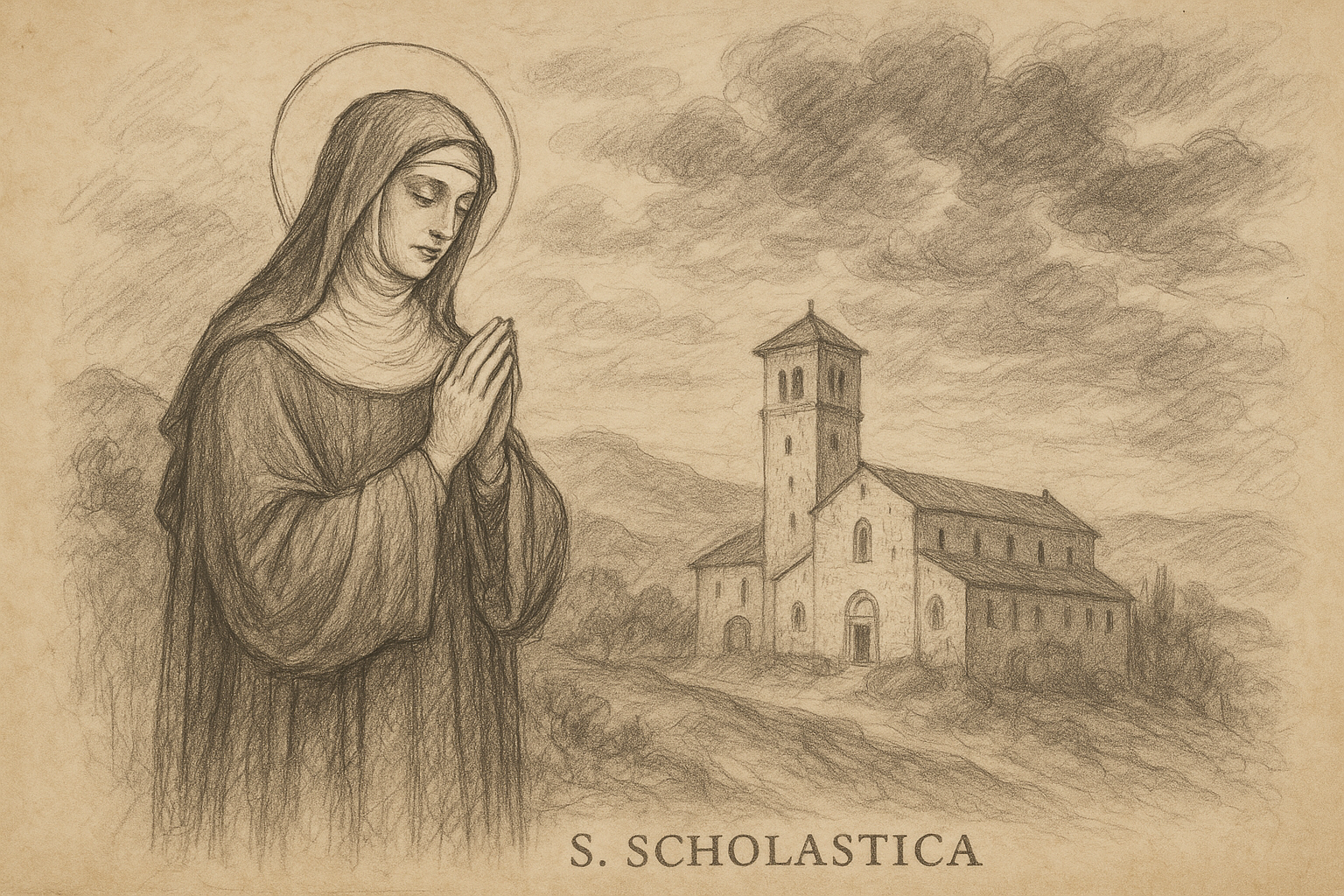
Among the saints of the early Church, St. Scholastica stands in gentle contrast to more public figures. We know her chiefly as the sister of St. Benedict and as a woman of prayer whose faith was rooted in hidden fidelity rather than public action. The St. Scholastica life is brief in the historical record, yet what the Church remembers about her is enough to suggest a soul formed by patience, trust, and intimacy with God.
Scholastica is honored as a virgin and abbess, and tradition places her among the earliest women in the Benedictine family of holiness. Her life is not filled with long biographical detail, but even the small amount we do have points to a steady Catholic truth: sanctity does not depend on visibility. It grows wherever a person learns to love God completely.
What we know of her life
St. Scholastica was the twin sister of St. Benedict, founder of the Benedictine order. Tradition places her early life in Italy, likely in the region of Nursia, during a time when the Roman world was giving way to instability and upheaval. Like her brother, she devoted herself to God in consecrated life. Many accounts present her as the foundress or mother figure of a community of women living according to a life of prayer and discipline, though the historical details are sparse.
Most of what the Church preserves about her comes through St. Gregory the Great, who wrote of her in the Dialogues. There he describes a sister who loved God deeply and who visited Benedict once a year near Monte Cassino. Those meetings were marked by spiritual conversation rather than ordinary family exchange. Their bond was not merely natural affection, but a shared life ordered toward heaven.
That alone is revealing. Scholastica's holiness did not come from doing more than others in a worldly sense. It came from belonging to God, persevering in prayer, and living with a heart trained for eternity.
The meeting that became part of Catholic memory
The best-known event in the St. Scholastica life is the final visit she made to her brother. According to the traditional account, Benedict and Scholastica met near his monastery and spent the day in holy conversation. As evening approached, Scholastica asked Benedict to remain with her through the night so they could continue speaking of God. Benedict refused, saying he could not stay outside the monastery.
Scholastica then bowed her head in prayer, and a storm broke out so suddenly that Benedict and his companions could not leave. Benedict asked what she had done. She answered with words that the Church has long treasured: I asked you, and you would not listen. I asked my God, and He did listen.
The story is not only memorable because of the storm. It reveals something essential about Christian prayer. Scholastica was not trying to overpower her brother by force. She was turning to God with the confidence of a child who knows her Father hears. Her request was simple, but her trust was complete.
The episode is often read as a beautiful sign of prayer's power, yet it also shows the deeper logic of holiness. Scholastica was not seeking her own will in a selfish way. She was asking for more time in the presence of spiritual conversation, and her request was granted in a way that pointed both siblings beyond themselves. Benedict, the great lawgiver of monastic life, learned from his sister that love and prayer can open what human resolve cannot.
Her prayer did not replace obedience; it revealed a deeper obedience to God. Scholastica asked in faith, and her prayer became a witness to the Father's merciful attention.
Prayer, trust, and the heart of feminine holiness
It is tempting to think of holiness as dramatic action, but St. Scholastica reminds the Church that prayer is itself a great work. Her sanctity did not depend on public preaching or visible leadership in the ordinary sense. It grew in the secret place where the soul meets God. That makes her especially dear to Catholics who live quiet lives of faith, whether in family homes, monasteries, convents, or ordinary daily labor.
Her witness also fits well within the Catholic understanding of contemplation. To pray well is not to escape reality, but to enter it more deeply through God. Scholastica's prayer in the storm account is not magical thinking. It is a sign of filial confidence, the confidence praised throughout Scripture. The Lord hears the cry of the humble. Scholastica believed that truth enough to ask boldly.
For Catholics today, this matters because prayer is often reduced either to routine or to emotion. Scholastica offers another way. She teaches a prayer that is steady, trusting, and intimate. It is prayer that can remain faithful even when visible results are not immediate, and that can ask without presumption because it knows the goodness of God.
A saint formed by the Benedictine spirit
Though St. Scholastica lived in her brother's shadow in the historical record, she belongs fully to the Benedictine world of prayer and stability. The Rule of St. Benedict would later shape countless monasteries with its call to balance, obedience, humility, and reverence for the liturgy. Scholastica's life helps us see that the fruit of that spirit was not limited to men.
In the Benedictine tradition, the search for God is lived in ordered common life. The daily rhythm of prayer, work, silence, and hospitality forms the soul over time. Scholastica stands as a witness that women, too, have always been central to that tradition. Whether or not she founded a formal community in the way later abbesses did, the Church remembers her as a consecrated woman whose life gave shape to the holiness admired in Benedictine spirituality.
There is also something striking about the balance in her story. Benedict is remembered for structure and discipline. Scholastica is remembered for prayer and surrender. Together, they show that Christian life needs both form and fire, both rule and grace. Discipline without love becomes cold. Love without discipline drifts. In Scholastica, the two meet in a beautiful and natural harmony.
Lessons Catholics can carry into daily life
The Church does not canonize saints only so we may admire them from a distance. The saints are given to us as companions and teachers. St. Scholastica offers several lessons that remain practical and attainable.
- Pray with trust. Scholastica prayed with the confidence that God hears. Catholics can learn to bring ordinary needs to the Lord without embarrassment.
- Value holy conversation. Her final meeting with Benedict centered on spiritual things. Many souls are strengthened when family and friends speak honestly about faith, not only daily concerns.
- Do not underestimate quiet holiness. The Church often remembers those whose lives are hidden because hidden fidelity is often where sanctity matures.
- Live with spiritual seriousness and tenderness. Scholastica and Benedict show that discipline and affection are not enemies in the life of grace.
These lessons are simple, but simplicity is not weakness. In fact, the saints often show that the Christian life becomes most powerful when it is least self-conscious. Scholastica did not need a large public platform to bear witness. She needed only faith, prayer, and the courage to ask God for what was good.
What her feast day invites the Church to remember
St. Scholastica's feast day invites Catholics to recover the dignity of hidden prayer. In a world that rewards noise, she reminds us that stillness before God is never wasted. Her memory also strengthens the bond between contemplation and charity. To pray deeply is to love more truly, because prayer orders the heart toward God's will.
Her story is also a mercy to those who feel unseen. Not every vocation is public. Not every holy life is documented. Yet the Church knows that many souls serve Christ in ways that will only be fully known in heaven. Scholastica belongs to this great company of hidden servants. She was remembered by the Church because God remembered her first.
For Catholics seeking a pattern of faithful living, her witness is both demanding and comforting. It asks for real trust. It asks for perseverance in prayer. But it also assures us that God listens. The quiet sister of St. Benedict still speaks across the centuries, not with loudness, but with the calm authority of a soul that knew where to turn in her hour of need.
To remember St. Scholastica is to remember that the life of grace often grows in silence, and that a heart fixed on God can move history in ways no one sees at the time.
Keep Reading on Lets Read The Bible
Frequently Asked Questions
Who was St. Scholastica in relation to St. Benedict?
St. Scholastica is traditionally remembered as the twin sister of St. Benedict. The Church honors her as a virgin and a woman of prayer within the early Benedictine tradition.
What is St. Scholastica best known for?
She is best known for the traditional account of her final meeting with St. Benedict, when she prayed for more time together and a storm prevented Benedict from leaving. The story has long been read as a sign of the power of prayer.
What can Catholics learn from the life of St. Scholastica?
Catholics can learn to pray with trust, to value holy conversation, and to recognize that quiet fidelity can be a powerful form of witness. Her life shows that hidden holiness matters deeply in the Church.