Saints and Witnesses
St. Scholastica and the Strength Hidden in Prayer
A quiet saint whose life shows how prayer can shape love, perseverance, and holiness in hidden ways.
Site Admin | May 22, 2026 | 126 views
St. Scholastica is one of those saints whose life seems small at first glance and yet opens into something unexpectedly wide. The historical record about her is brief, but the Church has long treasured her as the twin sister of St. Benedict and as a woman whose holiness was marked by prayer, humility, and a deep longing for God. The St. Scholastica life is not a story of public preaching, heroic travel, or dramatic conversion from scandal. It is a story of fidelity. That may sound quiet, but in Catholic life, quiet fidelity often carries the deepest fruit.
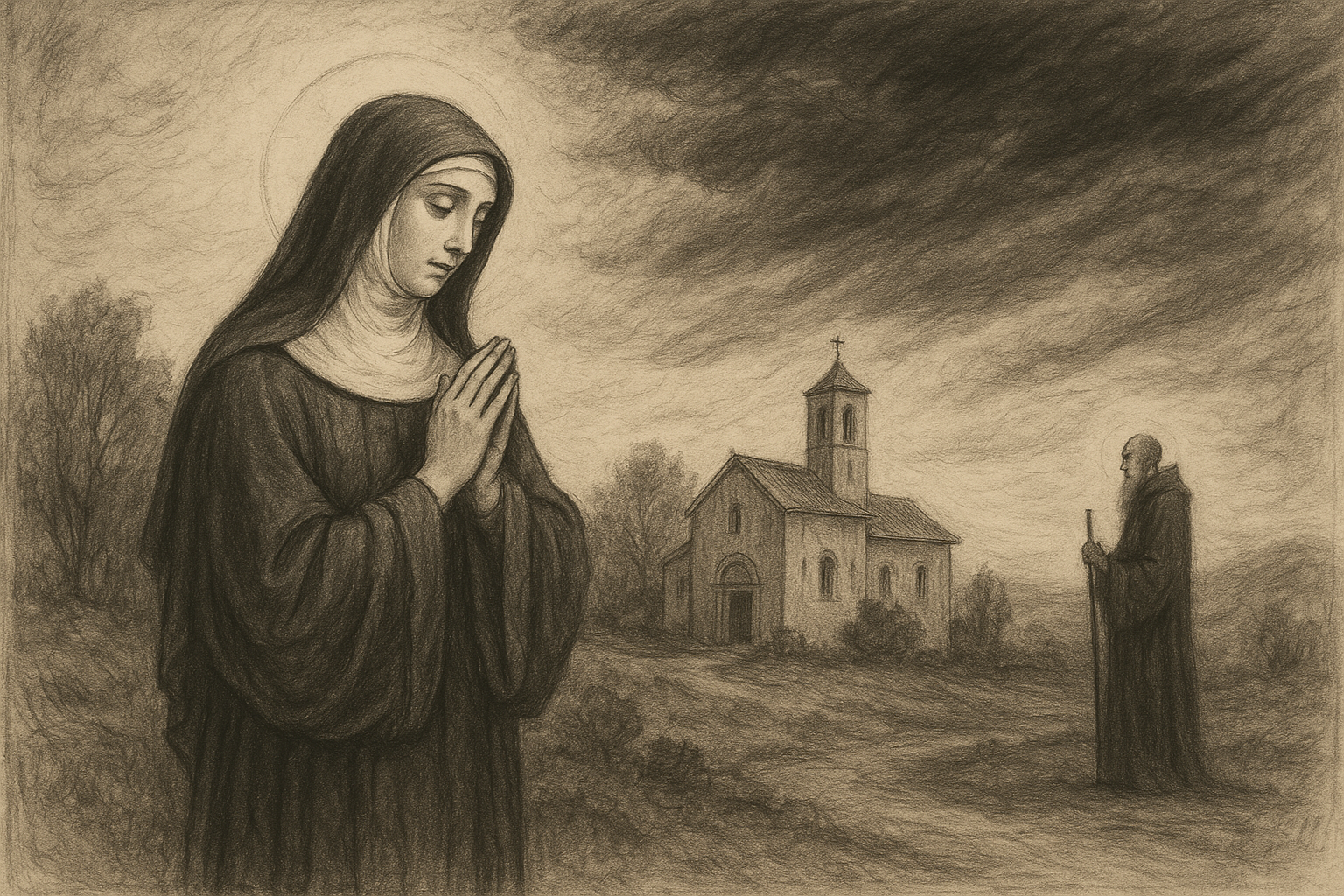
Most Catholics know St. Scholastica through the well known account found in St. Gregory the Great's Dialogues. Once a year, Scholastica and Benedict met near Monte Cassino and spoke about the things of God. On one of those visits, she asked her brother to remain longer so they could continue their holy conversation. When he hesitated, she prayed, and a sudden storm made travel impossible. The moment is famous not because it shows manipulation, but because it reveals the intimacy of prayer. Scholastica asked not from fear or convenience, but from love, and God answered her prayer in a striking way. The scene suggests a lesson that still reaches Catholics today: prayer is not passive. It can shape reality in ways that only heaven fully understands.
A brief life with lasting light
The details of Scholastica's early life are limited, but tradition places her in Italy in the sixth century and identifies her as Benedict's sister. Like her brother, she likely dedicated her life to God in a consecrated manner. She is often remembered as the foundress or spiritual mother of women religious in the Benedictine tradition, though the surviving sources do not give us a full biography in the modern sense. What we do have is enough to see the outline of a holy life centered on prayer and communion with God.
It can be tempting to think that saints become important only when they do something outwardly visible. Scholastica challenges that assumption. She appears in the historical memory of the Church not because she built an empire or wrote a major theological work, but because she loved God faithfully and prayed with confidence. In that sense, her life is a reminder that holiness is not measured by noise. It is measured by surrender.
The meeting that became a parable
The story of Scholastica's final meeting with Benedict has endured because it speaks so clearly to the spiritual life. According to St. Gregory, the siblings spent the day in sacred conversation. When the time came for Benedict to return, Scholastica asked him to stay. He replied that he could not remain outside the monastery. Then she bowed her head in prayer, and a storm broke out with such force that neither he nor his companions could leave.
Benedict later said that Scholastica had won by asking what she desired through prayer rather than through argument. The line is memorable because it honors the power of humble intercession. Scholastica did not win a debate. She did not demand. She prayed. The Church has always understood that this is one of the deepest forms of strength. In Scripture, prayer is often described not as escape from the world, but as the place where the human heart is aligned with God's will. Jesus teaches, Ask, and it will be given to you, and Scholastica's story gives that promise a human face.
Her prayer was not a trick. It was an act of love. She wanted more time with her brother, but the deeper meaning may be even richer: she wanted more time in the presence of the one thing they both loved most, namely God. Catholic tradition often sees in this scene the beauty of holy friendship and holy family life. Scholastica and Benedict were not separated by rivalry. They were united by grace, and that grace made their final conversation fruitful for the whole Church.
Prayer, love, and holy persistence
One reason Scholastica continues to speak to Catholics is that her witness corrects a shallow view of prayer. Many people think of prayer as words spoken into silence when there is nothing else to do. Scholastica shows something stronger. Prayer is a communion that can change the shape of an hour, a day, and even a life. It is not magic, and it is not a substitute for obedience. But it is a real meeting with God, who is free to answer in merciful and surprising ways.
Her example also reminds us that persistence in prayer is not a lack of trust. It can be a form of trust. Jesus Himself praises those who persevere in asking, as in the parable of the persistent widow. Scholastica's prayer was not lengthy, at least as the tradition records it, but it was determined. She asked with confidence, and she accepted the result that followed. In that balance of boldness and surrender, many Catholics recognize a healthy model for petitionary prayer.
Scholastica's story suggests that the most fruitful prayers are not always the most polished ones. They are the prayers that rise from love, are offered in faith, and remain open to God's answer.
What her witness says about consecrated life
Because so little is known about Scholastica's daily life, it is easy to overlook the significance of her vocation. Yet the tradition that remembers her as a consecrated woman tells us much about the Church's esteem for hidden holiness. She represents a life given over to God through prayer, simplicity, and fidelity. In a world that often prizes visibility, the consecrated life quietly insists that God alone is enough.
For Catholics, Scholastica's witness can be especially helpful when thinking about vocation. Not every calling is public, and not every fruitful life is dramatic. Some of the most important forms of service happen in prayer, in silence, in faithful endurance, and in the unseen offering of ordinary days. This does not make such a life less real. It makes it more deeply rooted in God.
The Benedictine tradition in particular values stability, liturgy, prayer, and the ordering of life toward God. Scholastica's memory belongs naturally within that spiritual world. Her holiness was not separate from the rhythm of prayer; it was formed by it. That is still true for Catholics who seek a more ordered life of faith. Regular prayer, the sacraments, fidelity to one's duties, and patience in trial all make room for grace to work.
Lessons for Catholics today
St. Scholastica's life offers several practical lessons that are as timely now as they were in the sixth century. First, she teaches that prayer should be real and personal. Catholics are not called to recite words without heart. We are called to speak to God as to the living Lord who hears us. Scholastica's prayer was simple, direct, and full of confidence.
Second, she reminds us that love belongs at the center of holiness. Scholastica and Benedict were bound by more than family ties. Their meeting was holy because it was ordered to God. In the Christian life, love is never merely sentiment. It becomes charity when it seeks the good of another in God. That is why holy relationships can be such powerful means of grace.
Third, her life challenges Catholics to value hidden sacrifice. Not every act of faith will be noticed by others. Many of the most faithful things we do are seen by God alone. A mother praying for her children, an elderly man attending daily Mass, a religious sister spending long hours in silent adoration, a layperson resisting resentment and choosing forgiveness: these are all forms of Scholastica's witness.
Finally, her story gently teaches receptivity. Benedict had a plan. Scholastica had a prayer. The storm that followed was not an argument for chaos, but a sign that God can interrupt our preferred schedules for the sake of something better. Catholics often need this reminder. We plan, labor, and serve responsibly, but we also remain open to God's unexpected mercy.
Her feast and her place in the Church
St. Scholastica is commemorated on February 10 in the Roman Catholic calendar. Her feast day comes near that of St. Benedict, whose memory is celebrated on July 11 in the current Roman calendar. The closeness of their remembrance invites reflection on the unity of prayerful witness in the Church. Brother and sister, monk and consecrated woman, teacher and intercessor: each points to the same Lord.
Devotion to Scholastica has remained strong especially among Benedictines, but her significance extends beyond any single religious family. She belongs to the whole Church as a witness to prayerful perseverance. Her life can encourage parents, single Catholics, religious, and clergy alike. Anyone who has ever prayed for one more hour, one more chance, or one more grace may find something of themselves in her.
In a culture that often values control, Scholastica shows the beauty of trust. In a culture that prizes self-expression, she shows the power of surrender. In a culture that rushes, she teaches patience. And in a culture that forgets the hidden life, she reminds us that God often works most deeply where few people are looking.
To remember St. Scholastica is to remember that prayer is not a retreat from the world. It is one of the ways the world is quietly held before God. Her life remains a gentle but firm invitation to ask, to trust, and to remain near the Lord with a heart that is both humble and fearless.
Keep Reading on Lets Read The Bible
Frequently Asked Questions
Who was St. Scholastica in the Catholic tradition?
St. Scholastica is traditionally identified as the twin sister of St. Benedict and a sixth century consecrated woman known for her life of prayer and holiness. The Church remembers her especially for her deep spiritual friendship with Benedict and her powerful example of intercessory prayer.
What is the most famous story about St. Scholastica?
The most famous story tells of Scholastica asking Benedict to stay longer during one of their yearly meetings. When he refused, she prayed, and a storm prevented him from leaving. The Church has long viewed this as a sign of the power of humble, loving prayer.
What can Catholics learn from St. Scholastica today?
Catholics can learn that prayer is a real encounter with God, that hidden fidelity matters, and that holiness often grows quietly in ordinary life. Scholastica also teaches perseverance, trust, and the value of loving relationships ordered to God.