Saints and Witnesses
When Prayer Interrupts the Ordinary: St. Scholastica and the Quiet Power of Holy Persistence
A Benedictine saint whose brief but striking witness shows how prayer can shape love, reverence, and trust in God.
Site Admin | May 23, 2026 | 93 views
St. Scholastica and the grace hidden in a simple life
St. Scholastica is one of those saints whose story is brief, but not small. She is closely associated with her brother, St. Benedict, and with the beginnings of Western monastic life, yet the Church remembers her not because she sought public notice, but because her holiness was so clear in its quietness. Her witness still speaks to Catholics today because it shows that prayer is not a retreat from reality. Prayer is one of the deepest ways of entering it.
What we know of Scholastica comes mainly through St. Gregory the Great, who preserved the famous account of her final meeting with Benedict. Tradition says she was consecrated to God from an early age and lived a life shaped by prayer, devotion, and discipline. If Benedict helped form the Benedictine tradition through order and stability, Scholastica revealed its tenderness and strength through love, trust, and persevering prayer.
Her feast is celebrated on February 10, and the Church honors her as a virgin and religious. Yet even without a long biography, her life is spiritually rich. The saints do not need many surviving details to witness to Christ. Sometimes a single act, done in faith, is enough to reveal a soul.
The night she would not let prayer end too soon
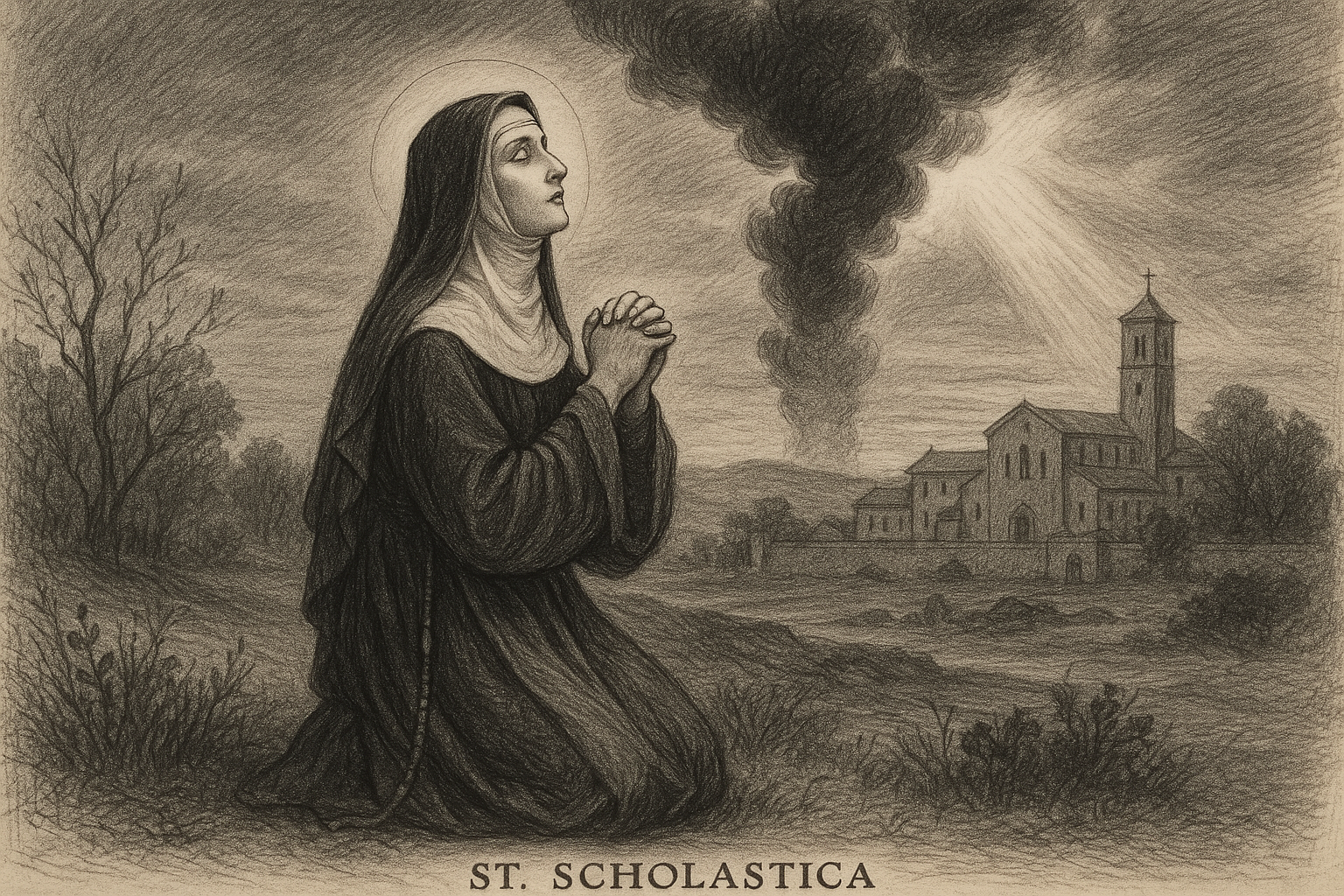
The most famous story about St. Scholastica comes from a final visit with her brother near the monastery at Monte Cassino. They spent the day speaking of God, and when the hour of parting came, Scholastica asked Benedict to remain with her and continue their conversation. Benedict, keeping to the monastery rule, refused. Scholastica then bowed her head in prayer, and a storm rose suddenly, making travel impossible.
Gregory tells us that Benedict protested, but Scholastica answered with holy simplicity that she had asked him and he had refused, so now she had asked God, and God had granted her request. The point of the story is not that she manipulated events. It is that prayer, made in love and trust, has real power. Scholastica did not dominate her brother by force. She entrusted her desire to God.
In that moment we see a beautiful Catholic truth: the saints teach us that love and prayer are not opposed to obedience. Scholastica was not selfish in wishing to remain with Benedict. She wanted one more night of sacred conversation, one more time to dwell in the things of God. Her request was rooted in spiritual hunger, and her prayer arose from that hunger without embarrassment. She did not hide her desire from the Lord.
This is one reason the St. Scholastica Catholic inspiration remains so enduring. Her witness reminds Catholics that holy desire matters. The Church does not ask us to become cold or indifferent. She teaches us to direct our desires toward God, who purifies them and often fulfills them in ways we do not expect.
What her life says about prayer
St. Scholastica is often remembered for prayer because her story places prayer at the center of ordinary relationship. She does not appear as a preacher, an abbess with many recorded sayings, or a martyr facing public trial. She appears as a woman whose prayer flowed naturally from love of God and love of a brother who shared her vocation. That is important. Prayer was not an escape from her life. It was the meaning of her life.
Catholics can learn from her that prayer is not measured only by length or visible success. Sometimes prayer is persistent. Sometimes it is simple. Sometimes it is bold enough to ask for what seems impossible. Scholastica shows us that prayer is an act of trust in the Father who hears His children. Jesus Himself teaches this confidence in the Gospel: Ask and You Shall Receive.
Her story also echoes the humble boldness of the widow who keeps asking for justice until the judge yields. The Lord praises perseverance not because He is difficult to persuade, but because persistent prayer forms our hearts. It teaches us dependence, humility, and freedom from self-reliance. Scholastica's prayer, in that sense, was not only effective. It was transforming.
For many Catholics, prayer can feel practical only when it is organized, scheduled, and controlled. Scholastica gently corrects that idea. The best prayer is not always the most efficient. Sometimes the holiest thing we can do is remain before God a little longer, not because we can force His hand, but because love does not want to be hurried.
A sister, a brother, and the friendship of the saints
There is also something deeply moving about the bond between Scholastica and Benedict. The saints are not isolated spiritual heroes. They are members of Christ's Body, and their holiness often ripens in relationship. Benedict and Scholastica lived consecrated lives in different places, but their last meeting suggests a shared world of prayer, wisdom, and mutual respect.
That matters for Catholics today because holiness is often imagined as solitary. Yet the Christian life is full of brothers and sisters, spiritual friendships, family ties, and communities shaped by grace. Scholastica reminds us that the love of God deepens rather than destroys holy human affection. The saints do not become less human as they become more holy. They become more fully human.
Her bond with Benedict also shows that contemplation is not opposed to love. If Benedict represents the ordered stability of monastic discipline, Scholastica represents the warmth of love that refuses to let sacred time end too quickly. Together they suggest a balanced spiritual life: discipline joined to affection, silence joined to prayer, rule joined to trust.
In an age that often prizes efficiency over devotion, Scholastica's witness is a needed correction. She teaches that there are moments when spiritual love should not be rushed. The soul sometimes needs time to linger with God and with those who seek God alongside us.
Faith that is strong without being loud
One of the most compelling aspects of St. Scholastica is the quiet authority of her faith. She did not preach in public squares, compose theological treatises, or build institutions that bear her name. Yet the Church has preserved her memory because her sanctity was unmistakable. There is a lesson here for Catholics who feel unnoticed in their daily duties.
Holiness is not reserved for those who are visible. Many saints live hidden lives. Their fidelity shapes families, parishes, monasteries, and workplaces in ways no one records. Scholastica belongs to this company of hidden witnesses. Her sanctity was expressed in perseverance, humility, and prayer. That is enough for God.
The Letter to the Hebrews speaks of the great cloud of witnesses surrounding us Cloud of Witnesses. Scholastica is part of that cloud. Her life invites us to believe that quiet fidelity matters. The grace of God is not made greater by noise. It is made visible when a soul yields itself entirely to Him.
Her example is especially useful for those who wonder whether their prayer life matters if it never seems dramatic. Scholastica answers that concern with her very existence. The Church remembers her because she prayed, and because her prayer came from a heart wholly given to God. Not every saint story is filled with miracles that appear often. But every saint reveals that grace is real.
How Catholics can follow her witness today
St. Scholastica's example is not meant to stay in the past. It can shape ordinary Catholic life in practical ways. Her witness suggests several habits worth reclaiming.
- Make room for unhurried prayer. Not every prayer should be treated like a task to finish. Some prayer should simply be prolonged love before God.
- Bring holy desires to the Lord. Scholastica asked for the gift she longed for. Catholics can do the same, trusting that God purifies desire rather than dismissing it.
- Honor spiritual friendship. Faith grows through relationships formed in Christ. A brother, sister, or friend in the faith can become a real support in the journey to holiness.
- Value hidden faithfulness. Much of Christian life is unseen. Scholastica teaches that hidden prayer has lasting fruit.
- Let discipline serve love. Benedict's rule and Scholastica's prayer are not enemies. Together they show that order in the spiritual life should serve deeper communion with God.
These are simple lessons, but they are not small. The saints often lead us by returning us to what we already know and helping us live it with greater depth. Scholastica teaches Catholics to stay close to prayer, especially when it feels ordinary, and to trust that God works even in quiet moments.
Her witness in the life of the Church
St. Scholastica is also a reminder that the Church's memory is larger than the famous and the public. The sanctity of women religious has shaped Christian life for centuries through prayer, hospitality, teaching, penance, and steadfast witness. Scholastica stands within that tradition as a woman whose life was concealed, but whose influence continues because holiness leaves a mark that history cannot erase.
For Catholics who are drawn to the saints, her life can be especially comforting. She was not remembered because she was extraordinary in the worldly sense. She was remembered because she belonged to God. That is the deepest vocation of every Christian. Her story points us toward the quiet truth that the most fruitful lives are often those most rooted in prayer.
At a time when many people feel pressure to be constantly productive, Scholastica offers a gentler measure. The greatest work may be the work of opening the heart to God. The greatest victory may be the perseverance to pray once more. The greatest witness may be to love so faithfully that even a final prayer becomes part of the Church's memory.
When Catholics turn to St. Scholastica, they are not only remembering a saint from long ago. They are learning how to pray with hope, how to love without haste, and how to trust that God hears the soul that remains with Him a little longer.
Her life still whispers that holy persistence is never wasted, and that when prayer takes root in love, even a brief story can become a lasting light.
Keep Reading on Lets Read The Bible
Frequently Asked Questions
Who was St. Scholastica in Catholic tradition?
St. Scholastica is traditionally honored as the sister of St. Benedict and as a Benedictine saint whose life was centered on prayer, consecration to God, and spiritual friendship. The Church remembers her especially for her holy perseverance in prayer.
Why is St. Scholastica associated with prayer?
She is associated with prayer because of the famous account of her final meeting with St. Benedict, where she prayed to remain with him longer and God answered by sending a storm. The story highlights the power of prayer offered in trust and love.
What can Catholics learn from St. Scholastica today?
Catholics can learn to value unhurried prayer, to trust God with sincere desires, and to remember that hidden holiness matters. Her witness encourages faithful persistence and a deeper love for God that does not rush away from His presence.