Saints and Witnesses
St. Therese of Lisieux and the Quiet Strength of Small Acts
How the Little Flower still points Catholics toward holiness in ordinary life
Site Admin | May 24, 2025 | 80 views
A saint whose life still feels close to home
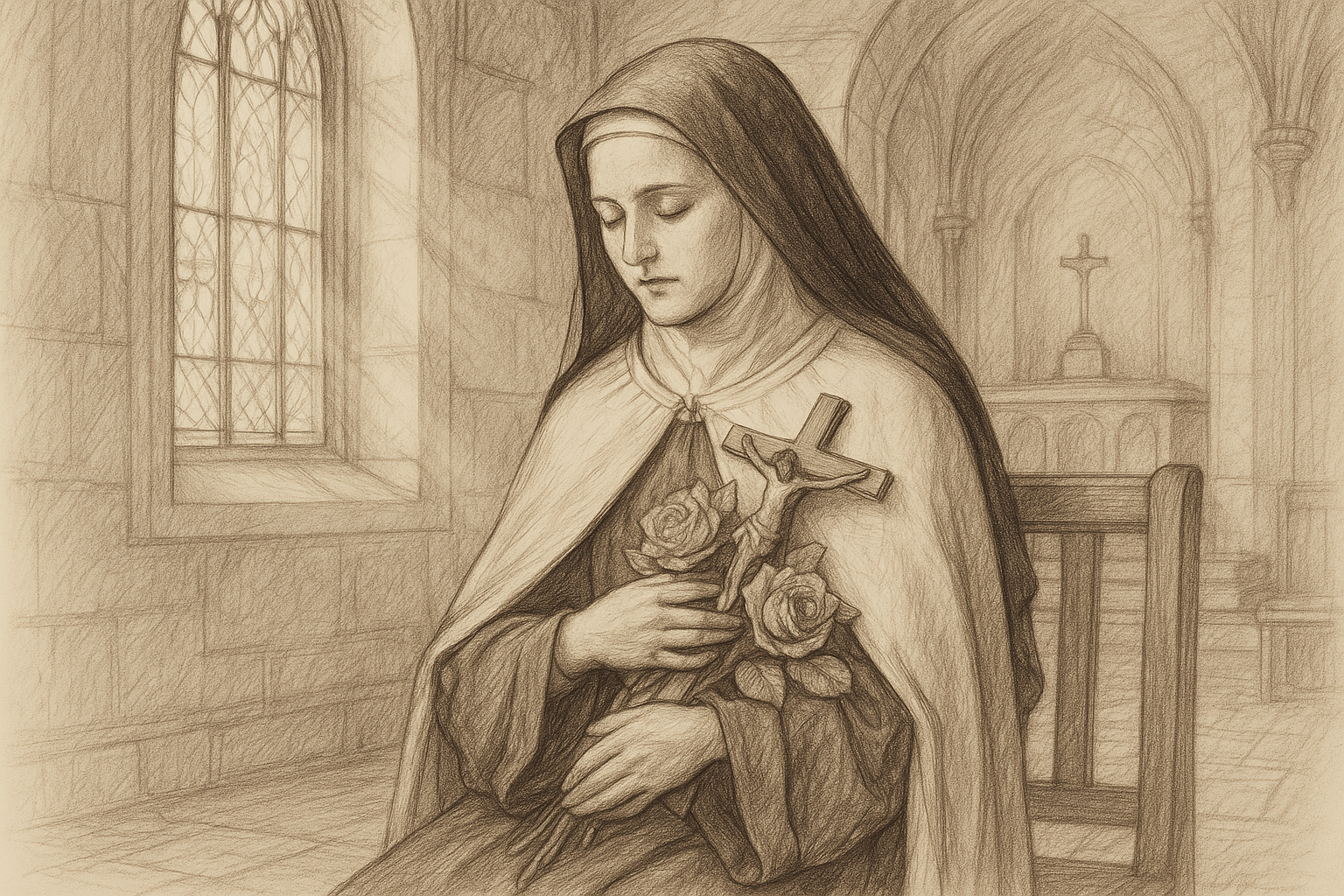
St. Therese of Lisieux has a way of speaking to people who do not feel heroic. She was not a founder of a great religious order, a public preacher, or a traveler across the world. She was a Carmelite nun who lived a hidden life in Normandy and died at 24. Yet her witness has reached far beyond the cloister. For many Catholics, she remains a steady companion because she makes holiness look not distant, but possible.
Therese Martin was born in 1873 in Alencon, France, the youngest child of Louis and Zelie Martin, both now canonized saints. Her childhood was marked by tenderness, grief, and an intense desire for God. After her mother died, Therese grew especially attached to her older sisters and to her father, and her path toward Carmel was shaped by a deep interior calling. She entered the Carmelite monastery at Lisieux in 1888, when she was only 15, and remained there until her death from tuberculosis in 1897.
What makes St. Therese of Lisieux Catholic inspiration so enduring is not simply the facts of her life, but the spiritual vision that emerged from them. She came to understand that sanctity does not depend on dramatic achievements. It depends on fidelity, humility, and confidence in God's mercy. That insight, often called the Little Way, has helped generations of Catholics approach prayer and duty with renewed peace.
The Little Way is not little because it is easy
The phrase Little Way can sound gentle enough to be simple. In fact, it asks a great deal. Therese did not mean that Christians should aim low or settle for mediocrity. She meant that in the ordinary circumstances of life, one can offer each action to God with love. A hidden sacrifice, a patient response, a sincere prayer, or an act of cheerful obedience can become a path to holiness when united to Christ.
Therese had a strong sense of her own weakness, but she did not treat weakness as a reason for despair. Instead, she saw it as a place where grace could work freely. She often described herself as a little child before God, trusting not in her own merits but in the Father's goodness. That childlike trust is rooted in the Gospel. Jesus says, Unless you turn and become like children, and Therese heard that word not as poetry alone, but as a practical rule for Christian life.
Her Little Way also reflects the Pauline conviction that God chooses what is small so that his power may be known. Therese read St. Paul with love, and his letters shaped her understanding of vocation, charity, and spiritual confidence. And the greatest of these is love became central to her own self-understanding. She did not seek to be admired for greatness. She wanted to love Jesus more faithfully in the place where he had put her.
Hidden holiness and the beauty of ordinary duties
One reason the Little Flower continues to inspire Catholics is that her spirituality respects the actual texture of daily life. Most people do not spend their days in extraordinary settings. They work, care for family, struggle with fatigue, manage disappointment, and repeat tasks that seem to leave no visible mark. Therese saw that these hidden moments are not empty. They are where love can become real.
Her own convent life was not free from difficulty. She lived with illness, interior trial, and the ordinary demands of community life. She struggled with sisters who irritated her, with dryness in prayer, and with the limitations of a small, enclosed world. Yet she learned to offer these inconveniences to God. That is part of her witness: sanctity is not reserved for people whose circumstances are ideal. It is forged in patience when circumstances are not.
In this, her life harmonizes with the Christian call to do all things for the glory of God. Whatever you do, in word or deed, do everything in the name of the Lord Jesus captures the spirit of her spirituality well. Therese believed that a humble act done with love has immense worth in the eyes of God. A smile given when one would rather withhold it, a duty completed without complaint, a prayer whispered in weakness, these can become acts of worship.
Therese and the mercy of God
At the heart of St. Therese of Lisieux Catholic inspiration is her confidence in divine mercy. She did not approach God as a self-made spiritual achiever. She approached him as a daughter who knew she was loved. This is one reason so many Catholics turn to her in seasons of fear, guilt, or discouragement. She does not invite us to perform our way into holiness. She invites us to trust the One who saves.
Therese wrote with striking honesty about her own limitations. She knew she could not ascend to God by her own strength. Instead, she rested in the Lord's condescension, his willingness to lift the small and weak. This is profoundly Catholic. Grace is not a reward for natural excellence. It is God's free gift, given through Christ and received in faith, repentance, and love. Therese's trust does not weaken the demands of conversion. It strengthens them by making them hopeful.
Therese did not teach Christians to ignore sin or pretend weakness does not matter. She taught them to bring weakness into the light of God's mercy and to keep moving toward him with confidence.
Her trust also helps explain why she remains so beloved in suffering. She experienced illness and a long final decline before her death. She was not spared pain, but she faced it with a faith shaped by love rather than fear. Catholics who pray with her often find that she gives language to what they already feel: that holiness is still possible when life is fragile, and that God is near even when consolation is scarce.
A young saint with a mature vision of the Church
Therese is sometimes remembered only for sweetness, but she was more than tender feeling. She had a serious and beautiful sense of the Church's mission. In her autobiographical writings, later published as Story of a Soul, she speaks of her longing to love Christ in every vocation at once. She desired to be apostle, missionary, doctor, martyr, and priest in spirit, until she discovered that charity is the heart of the Church. That realization gave shape to her vocation within the Church's body.
This matters because it shows how deeply her little path is joined to the larger life of the Church. She did not retreat into private devotion detached from the Church's mission. Rather, she understood that love is the power that animates all Christian service. Her hidden prayers, offered in the monastery, were part of the Church's life for the world. Her life reminds Catholics that contemplation and mission are not rivals. They belong together when charity is at the center.
Therese was named a Doctor of the Church by St. John Paul II in 1997, the centenary year of her death. That recognition did not create her spiritual authority. It confirmed what the faithful had already long known: her doctrine on the love of God, humility, and trust is rich enough to teach the whole Church. A saint can be young and still profound. A hidden life can still illuminate the world.
Why her witness keeps reaching Catholics today
There are many reasons Catholics still return to St. Therese. She speaks to young people because she was young herself and because she did not wait for perfect conditions before seeking holiness. She speaks to parents and workers because she sanctified the small duties of common life. She speaks to the discouraged because she understood weakness from within. She speaks to those who fear they are spiritually ordinary because she shows that ordinary is not a barrier to sanctity.
Her life also challenges a modern habit of measuring worth by visibility. Today, much attention goes to what is loud, efficient, and impressive. Therese points in another direction. She tells us that God sees what others overlook. The unseen sacrifice, the faithful prayer, the act of gentleness that no one notices, these are not wasted. In God's hands, they are fruitful.
Her witness is especially powerful because it unites simplicity and depth. The Little Way is easy to describe, but hard to live. It requires surrender of pride, patience with weakness, and real trust in God. It is not sentimental. It is cruciform. It keeps returning the soul to Christ, who made himself small for our sake. In that sense, Therese's little path is deeply evangelical. It leads not to self-importance but to dependence on grace.
Living with Therese in the ordinary rhythm of Catholic life
For Catholics today, following St. Therese does not mean trying to imitate every detail of her Carmelite life. It means letting her spiritual logic shape the day that God has actually given us. The office, the kitchen, the classroom, the commute, the family table, the bedside of someone who is ill, all of these can become places of offering.
Her witness invites a few simple practices:
- Begin the day with a small offering to God, asking to love him in whatever comes.
- Accept a minor inconvenience without immediate complaint, and offer it for someone in need.
- Pray briefly and honestly when full prayer feels difficult.
- Choose one hidden act of kindness and keep it private.
- Return often to trust, especially after failure.
These are not techniques for self-improvement. They are ways of living as children of the Father. Therese understood that holiness grows where love is repeated. She did not need a grand stage because she believed God is present in the smallest place where a soul says yes.
That is why her witness remains so alive. St. Therese of Lisieux Catholic inspiration endures because it does not flatter human strength. It dignifies human littleness under God's gaze. In a world that often prizes scale, influence, and display, she reminds the Church that love hidden in faith can change souls, and that a life offered simply to Jesus is never small in the only sense that finally matters.
Keep Reading on Lets Read The Bible
Frequently Asked Questions
What is St. Therese of Lisieux's Little Way?
It is her teaching that holiness is found in doing small things with great love, trusting God's mercy rather than relying on personal spiritual achievement.
Why is St. Therese so popular among Catholics?
Catholics are drawn to her honesty, humility, and confidence in God. Her life shows that holiness is possible in ordinary circumstances, not only in dramatic ones.
Did St. Therese of Lisieux write any important spiritual works?
Yes. Her best-known work is Story of a Soul, a collection of her writings that reveals her interior life, her love for Christ, and her understanding of the Little Way.