Doctrine and Questions
Sunday Morning Is Not Ordinary: The Catholic Meaning of Mass and Obligation
The Church's Sunday obligation is not a burden placed on the faithful, but a gift ordered toward worship, communion, and the shape of Christian life.
Site Admin | June 18, 2026 | 29 views
For many Catholics, Sunday Mass can begin to feel like one more item on a crowded schedule. Work, family demands, fatigue, travel, and distraction all press in, and the question can quietly arise: why does the Church insist so strongly on Sunday worship? The answer is not that God needs our attendance, but that we do. Sunday Mass matters because it places our lives back in order. It gathers scattered hearts, renews faith, and gives us the grace to live as disciples in the ordinary world.
The Church does not treat Sunday Mass as a bare rule detached from spiritual life. She sees it as the weekly center of Christian existence. In the Mass, Christ gives Himself to the Father for us, and He gives Himself to us in the Eucharist. This is why the Sunday obligation is not best understood as a mere external command. It is a sign that worship is not optional in the life of the baptized. The Christian week begins by receiving what we cannot give ourselves: the living presence of the Lord.
Sunday and the first day of new creation
From the beginning, Sunday carried meaning for Christians. Jesus rose from the dead on the first day of the week, and the Gospels repeatedly emphasize that the Resurrection happened at the dawn of a new creation. The Lord's Day is not simply the end of a work cycle. It is the day on which the Church remembers that death has been defeated and that history has been opened by grace.
Scripture shows the importance of gathering for the Lord. The early Church did not treat worship as an isolated private devotion. Believers assembled to break bread, pray, and hear the apostolic teaching. The pattern of Sunday worship is rooted in the Resurrection itself, and the Church has preserved that pattern because it comes from the apostolic heart of Christianity.
Saint John speaks of being in the Spirit on the Lord's Day the Lord's Day, and the Acts of the Apostles describes the community at Troas gathered on the first day of the week to break bread the first day of the week. Saint Paul also speaks of setting aside the first day in connection with Christian life and worship the first day of every week. These are not random details. They show that from the earliest days, Christians recognized a day set apart for the Lord.
What the Church means by obligation
When Catholics hear the word obligation, it can sound heavy. Yet in the life of faith, obligation often marks something important enough to protect. We speak of obligations to truth, justice, family, and conscience because some things shape the soul and cannot be left to mood or convenience. The Church's Sunday obligation belongs to that same moral logic.
The Catechism teaches that the Sunday Eucharist is the foundation and confirmation of all Christian practice. Catholics are bound to attend Mass on Sundays and holy days of obligation unless a serious reason excuses them, such as illness, the care of infants, or other grave circumstances. That teaching does not reduce Mass to a legal minimum. Rather, it safeguards a habit of worship that human beings easily neglect when left to impulse alone.
In this sense, the obligation is pastoral. The Church knows the human heart. Left to ourselves, we drift toward busyness, comfort, and self-direction. A clear command helps us remember that God comes first. The obligation protects a freedom deeper than preference, the freedom to belong to God.
The Mass is participation in Christ's sacrifice
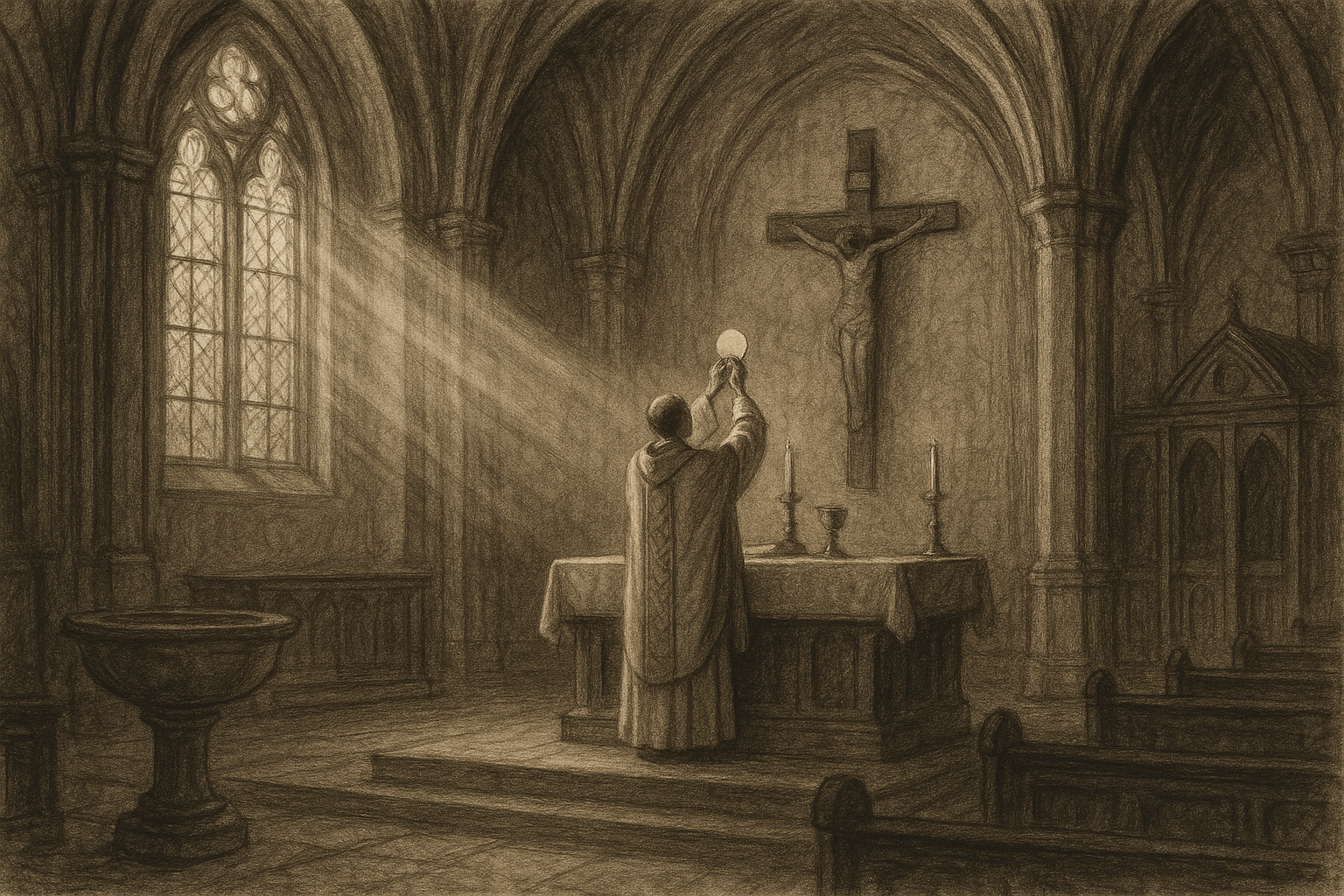
The greatest reason Sunday Mass matters is that the Mass is not only a gathering. It is the sacramental making present of Christ's one sacrifice. At the altar, the Church does not repeat Calvary, but she is joined to the once-for-all offering of Christ to the Father. This is why the Mass is central to Catholic life. It is worship in the fullest sense, where the faithful unite themselves to Jesus Christ, the High Priest.
The Letter to the Hebrews speaks with grandeur about the priesthood of Christ and the offering He made for sin once for all, and not neglecting to meet together exhorts believers not to neglect meeting together. These words remain deeply relevant. Christians are not called merely to believe in the sacrifice of Christ at a distance. We are called to enter into it through the liturgy, where the Church is gathered, sanctified, and fed.
At Mass, the faithful hear the Word of God proclaimed and receive the Body and Blood of the Lord. These are not symbolic additions to a sermon. They are the heart of Catholic worship. Sunday Mass matters because it is where heaven touches earth in an especially direct way, and where the believer learns again that salvation is gift before it is task.
When Catholics speak of Sunday as sacred, they are not saying the day is magical in itself. They are saying it is set apart for the One who made time, redeemed time, and fills time with grace.
Why ordinary Catholic life depends on Sunday worship
It is easy to think of Mass as one part of the Christian life among many parts. Scripture, prayer, charity, fasting, family life, and moral effort all matter. But Sunday Mass gathers and strengthens them all. Without the Eucharist, Christian practice can slowly lose its center. Devotion can become individualistic. Morality can become willpower. Charity can become mere activism. Sunday worship keeps these things anchored in God.
Mass also shapes the way Catholics see ordinary life. A Christian who worships on Sunday learns that work is not ultimate, money is not ultimate, and human achievement is not ultimate. The week is no longer a closed circle of pressure and performance. It has an opening toward eternity. The Lord's Day teaches the body as well as the mind. We stand, kneel, listen, respond, and receive. Over time, these acts form humility, attentiveness, and gratitude.
This is one reason the Church has always defended Sunday rest and Sunday worship together. A day of worship without rest can become rushed and distracted. A day of rest without worship can become empty leisure. Together, they remind us that human beings are not made for endless productivity. We are made for communion with God.
What Sunday Mass gives that private prayer cannot replace
Private prayer is essential, but it is not a substitute for the Eucharist. A Catholic may pray the Rosary, read Scripture, or make a spiritual communion during the week, and all of that is good. Yet Sunday Mass gives something irreplaceable: the Church acting as the Body of Christ in public worship, with Christ Himself as the chief actor.
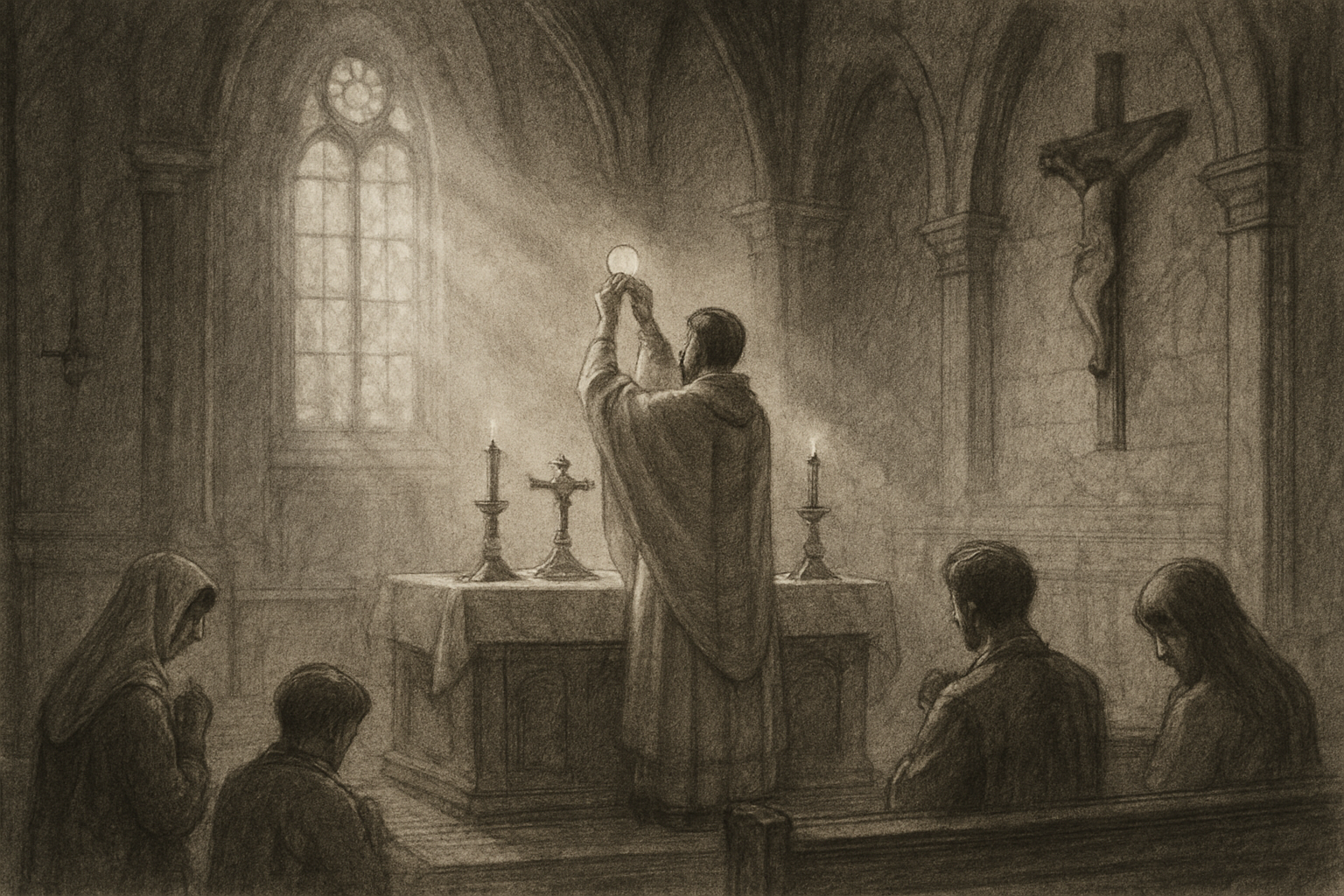
At Mass, Catholics are not isolated believers performing a religious task in private. They are members of one Body gathered around one altar. The liturgy forms a communion that is larger than personality, mood, or preference. We receive a faith that preceded us and will remain after us. This is a consolation in an age that often treats religion as self-expression.
For families, Sunday Mass can become one of the most stable gifts parents offer children. Children learn by repetition what adults often struggle to believe: that God is worthy of our time, that the Eucharist is holy, and that worship belongs at the center of life. When a child grows up with Sunday Mass, the rhythm itself teaches reverence.
Common reasons people miss Mass and how the Church understands them
The Church is not blind to human difficulty. Illness, caring for a sick family member, serious travel problems, dangerous weather, and other grave reasons can excuse one from the Sunday obligation. The Church judges such matters with mercy because the obligation exists for our good, not our harm.
At the same time, Catholics should be careful not to excuse themselves too quickly. Fatigue alone is often not the same as necessity. A busy weekend is not usually the same as a grave reason. The question is not whether Mass fits perfectly into our preferred schedule, but whether we are willing to order our lives around the Lord. That question is spiritually revealing.
Sometimes the deepest obstacle is not inconvenience but forgetfulness. People can grow used to missing Mass and then become numb to what is lost. Yet every neglected Sunday weakens the habit of worship. The heart begins to accept that God may be first in theory but second in practice. Sunday Mass matters because the soul is shaped by what it repeatedly honors.
The joy hidden inside the command
It may sound strange, but many Catholic duties are also gifts in disguise. The command to attend Mass on Sunday is one of them. The Church is not trying to burden the faithful with a rule for its own sake. She is trying to preserve a source of joy that believers might otherwise set aside.
There is a particular peace that comes from keeping Sunday holy. The week is interrupted by grace. The body is gathered. The conscience is calmed. The Word is heard. The Eucharist is received. Even when a person arrives distracted or tired, Mass can become the place where burdens are placed on the altar and received back in hope.
That is why Sunday Mass matters explained in the simplest Catholic terms: it is where the baptized remember who they are, whose they are, and what kind of world they inhabit. It is where the Church learns again that the risen Christ is alive, near, and worthy of worship. And when Sunday is kept with faith, the rest of the week begins to look different, because it has been placed under the mercy of God.
For Catholics trying to live faithfully in an anxious age, Sunday is not a leftover piece of the calendar. It is the Lord's gift to His people, a weekly return to the altar where time is redeemed and the heart is re-centered on what lasts.
Keep Reading on Lets Read The Bible
Frequently Asked Questions
Is missing Sunday Mass always a mortal sin?
Deliberately missing Sunday Mass without a serious reason is grave matter in Catholic teaching, but personal responsibility also depends on knowledge and freedom. If there is a serious excuse, such as illness or another grave cause, the obligation does not bind.
If I pray at home, why is Sunday Mass still necessary?
Private prayer is important, but it does not replace the Eucharist or the public worship of the Church. Sunday Mass unites the faithful to Christ's sacrifice and to one another as one Body.
What should I do if I regularly struggle to get to Sunday Mass?
Begin by identifying the practical obstacle, whether it is schedule, transportation, family logistics, or discouragement. Then make a concrete plan, ask for help if needed, and speak with a priest if there are serious pastoral concerns.