Social Teaching
The Door the Church Keeps Opening
Hospitality toward the vulnerable is not a polite extra in Catholic life, but a concrete way of seeing Christ in those most easily overlooked.
Site Admin | October 7, 2025 | 74 views
Hospitality is often spoken of as a warm trait, the kind of thing that makes people feel comfortable in a home, parish hall, or fellowship meal. In Catholic life, however, hospitality toward the vulnerable and Catholic life are bound together more deeply than simple welcome. The Church does not treat hospitality as a social grace reserved for the socially polished. She sees it as a work of mercy rooted in the dignity of every human person, especially those who are poor, lonely, displaced, disabled, elderly, frightened, or otherwise easy to ignore.
This is not sentimental language. Scripture speaks with directness about how God judges the nations by their treatment of the hungry, the stranger, and the least among us. Jesus identifies himself with them: I was a stranger and you welcomed me. That line is not poetic exaggeration. It reveals a mystery at the heart of Christian discipleship. When Catholics open their homes, parishes, and habits of heart to the vulnerable, they are not simply being kind. They are responding to Christ present in those who arrive with little social power and often very little safety.
Hospitality begins with Catholic anthropology
To understand why hospitality matters, we have to begin where Catholic teaching begins: with the human person. Every person is made in the image and likeness of God, endowed with dignity that does not depend on usefulness, health, productivity, legal status, age, or emotional appeal. That dignity remains intact whether someone is a well-spoken neighbor or a person whose life has been marked by poverty, addiction, mental illness, trauma, or migration.
This is one reason the Church resists any culture that sorts people by convenience. The vulnerable are often treated as interruptions, but Catholic faith teaches that they are not interruptions to be managed. They are persons to be received. If we lose that truth, hospitality becomes a performance. It may look generous on the surface while still keeping the needy at a safe distance. True hospitality asks something sharper. It asks us to let another person matter on their own terms.
That does not mean ignoring prudence. Catholic charity is not naive, and it is not the same as lowering every boundary without discernment. But prudence should protect charity, not replace it. A parish, family, or Catholic community can have wise limits and still remain open in spirit, attentive in speech, and ready to help in real ways.
Christ does not ask for a clean guest list
The Gospels repeatedly show Jesus drawing near to people others avoid. He eats with tax collectors, speaks with Samaritans, touches lepers, and receives children. He also notices what many overlook: the widow who gives her last coins, the beggar at the gate, the guest without proper clothing at the wedding feast, the neighbor who knocks at midnight. Again and again, he reveals that God is not impressed by social ranking.
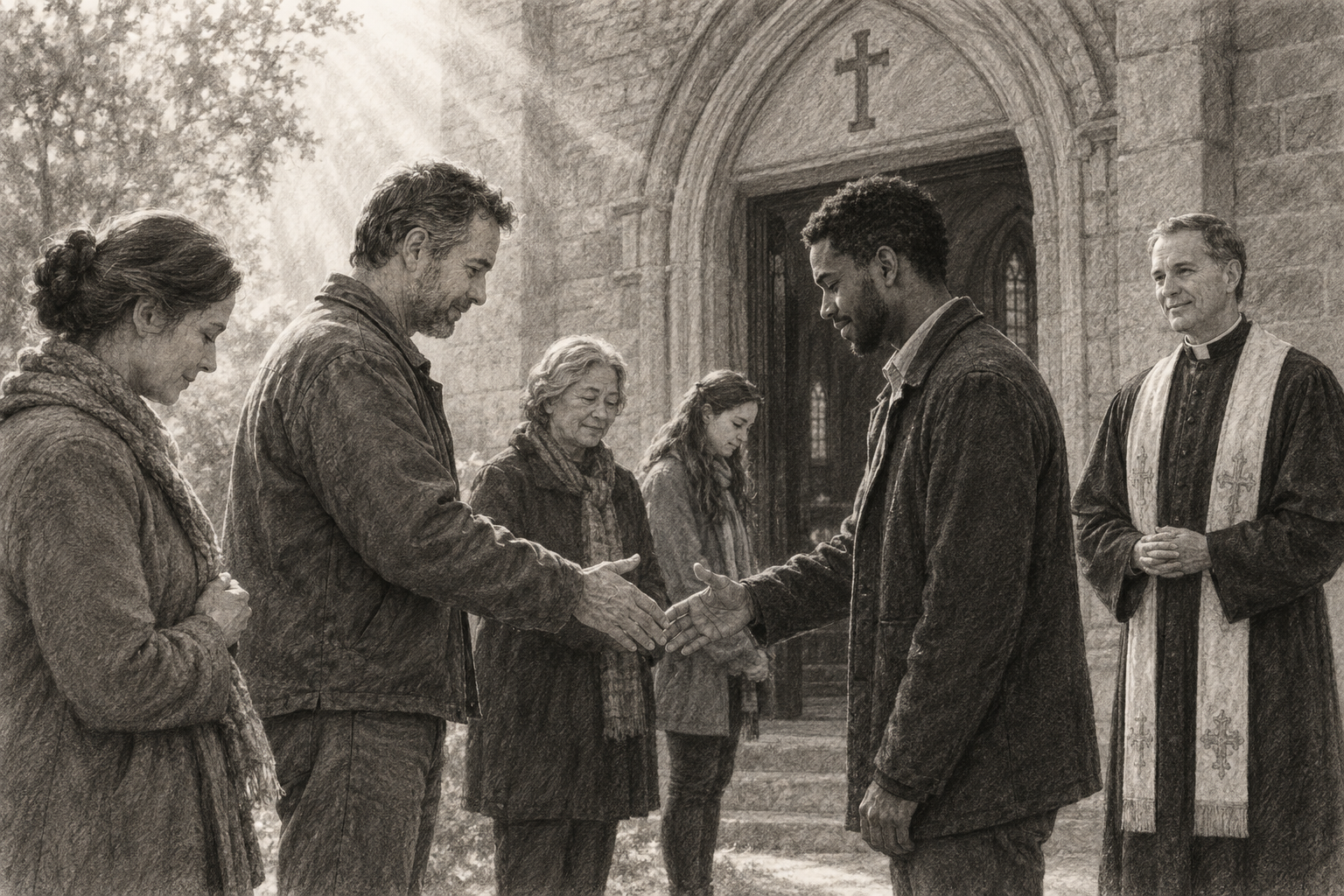
That pattern should shape Catholic life at every level. In the home, it may mean making room for someone who is awkward, burdened, or unlike us. In the parish, it may mean noticing the person who stands alone after Mass, or the mother who seems overwhelmed, or the refugee family struggling with language and logistics. In public life, it means defending policies and structures that protect human dignity instead of rewarding indifference.
The Church's social teaching never treats hospitality as a private feeling detached from justice. If a community says it welcomes the vulnerable but leaves them isolated, unprotected, or unheard, the welcome remains incomplete. Mercy must become concrete. Otherwise it risks becoming little more than a pleasant mood.
The vulnerable are not one group, but many faces
When Catholics speak about the vulnerable, it helps not to flatten everyone into a single category. Vulnerability takes many forms, and hospitality must be attentive to real conditions rather than abstract labels.
- The elderly person who no longer drives and is slowly disappearing from ordinary conversation.
- The child who is neglected, anxious, or carrying the weight of family instability.
- The pregnant woman who feels pressure, fear, or abandonment.
- The immigrant or refugee who is trying to navigate language barriers and an unfamiliar system.
- The person living with disability who is too often excluded by architecture, scheduling, or assumptions.
- The poor family for whom one broken appliance or medical bill becomes a crisis.
- The person struggling with addiction, mental illness, or shame, and who needs compassion without denial of the truth.
Hospitality toward the vulnerable and Catholic life together require the moral imagination to see beyond appearance. A person may not look needy in the way we expect. Some burdens are hidden. Some people have learned to be invisible. Others have been spoken to so often as cases that they no longer expect to be greeted as persons. Catholic hospitality restores personhood by naming, noticing, listening, and making room.
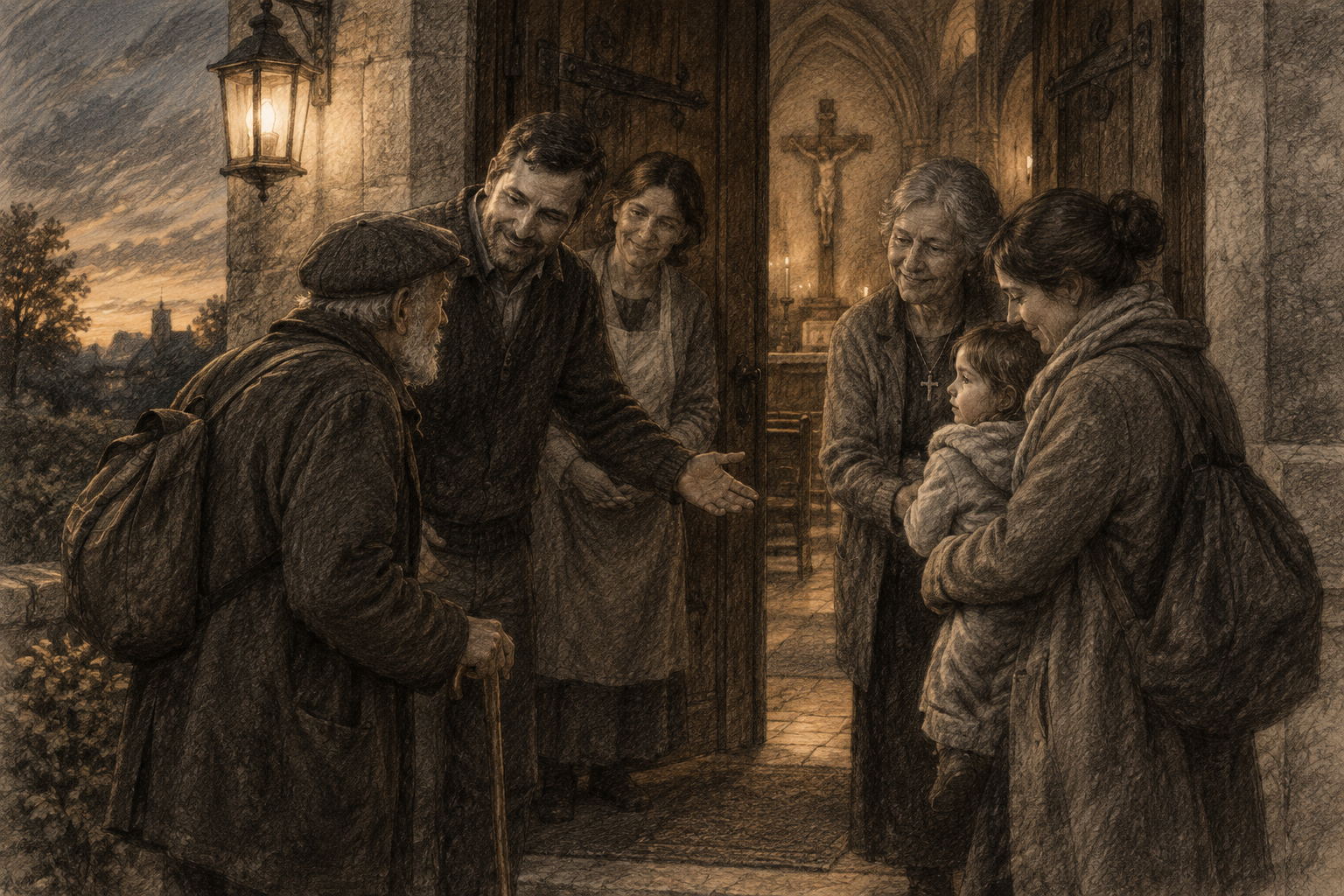
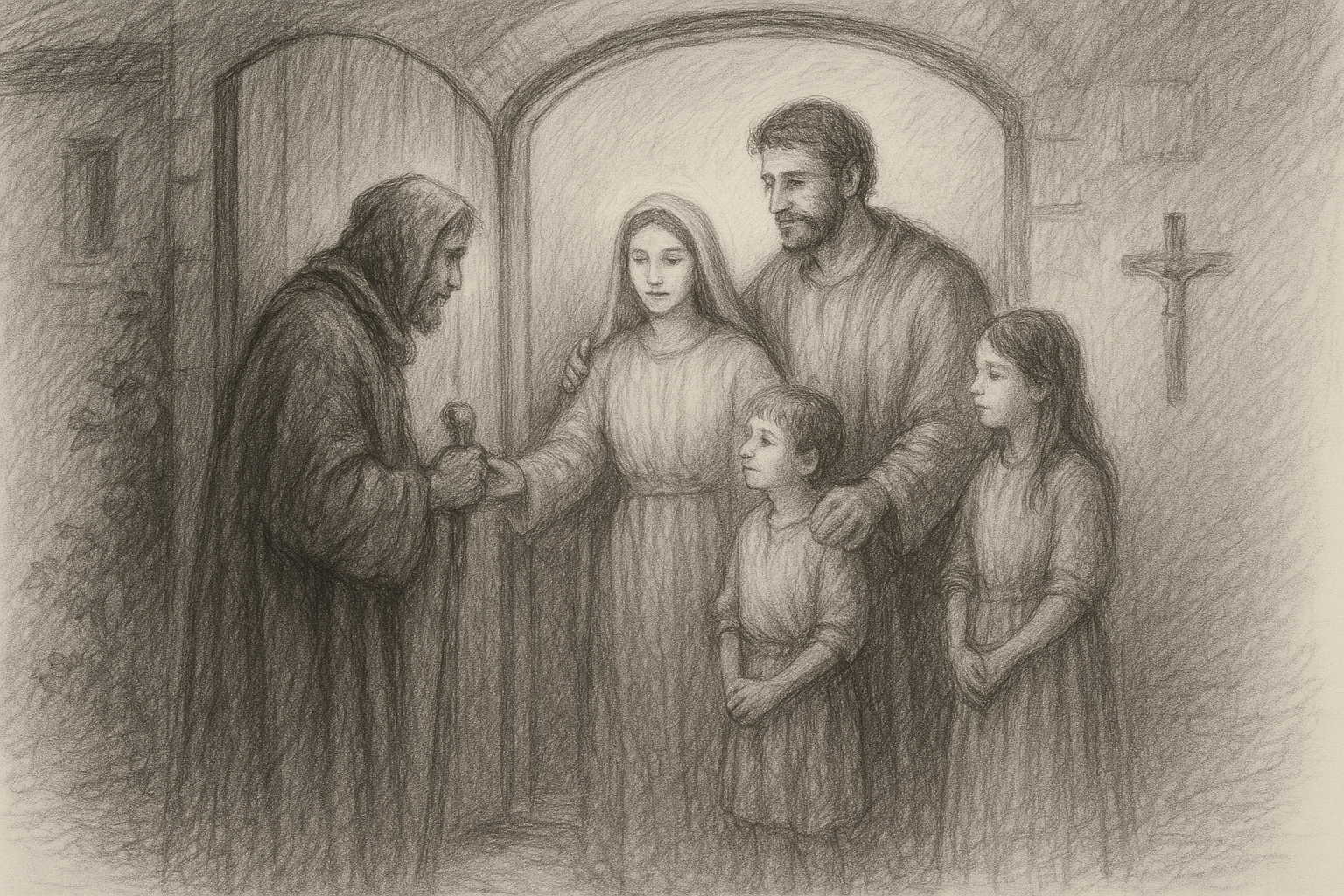
Do not neglect to show hospitality to strangers, for thereby some have entertained angels unawares. Do not neglect to show hospitality to strangers
Hospitality is mercy with a face
Mercy is not abstraction. It always has a shape. It feeds, visits, accompanies, and protects. Hospitality gives mercy a domestic, embodied form. It means the chair at the table, the cup of water, the patient conversation, the clear directions, the ride to an appointment, the extra portion, the quiet place to sit, the respectful introduction to others, the willingness to learn a name and remember it.
This is one reason hospitality can feel humble. It often looks ordinary. Yet ordinary acts can become holy when they are offered with reverence. A Catholic household can be an extension of the Church's mission when it becomes a place where people are not treated as burdens for being in need. A parish can become a true sign of communion when the vulnerable are not merely served from a distance but included in prayer, fellowship, and leadership as appropriate.
At the same time, hospitality should never be reduced to social warmth alone. Someone can be greeted kindly and still remain structurally excluded. So Catholic hospitality also asks whether our routines help or hinder access. Are our parish spaces accessible to wheelchairs and walkers? Are our announcements understandable to newcomers? Do we make room for children, for the poor, for those with limited schedules, for those who need patience rather than speed? Small choices reveal whether welcome is real.
Truth and charity belong together
Some people fear that hospitality toward the vulnerable requires softening moral truth. It does not. Catholic charity never abandons truth, and truth without charity becomes harsh. The Church is called to both. Jesus welcomed sinners, but he also said, Go, and do not sin again. He did not welcome people in order to leave them as they were in every respect. He welcomed them so that healing could begin.
This balance matters today because vulnerability can be complicated. A person may be vulnerable and also behaving destructively. A family may be in crisis and still need honest boundaries. A neighbor may need help and also require correction. Catholic hospitality refuses to confuse compassion with approval, and it refuses to confuse prudence with contempt.
In practice, that means we can offer food without enabling harm, companionship without pretending away danger, and assistance without surrendering moral clarity. The vulnerable deserve more than pity. They deserve the truth told gently and the help needed to receive it.
Parish life should make room for the least visible
Many Catholics learn the language of hospitality most concretely in parish life. A parish is not simply a place where individuals attend Mass. It is meant to be a living body, a community where the baptized bear one another's burdens. That can be difficult in large or busy parishes, where people are easy to miss. Yet the very size of a community makes intentional hospitality more necessary.
What does that look like? It may mean a greeter who notices the new family, not just the regulars. It may mean catechists who understand that a child from a chaotic home may need more patience than a tidy curriculum allows. It may mean parish leaders who listen carefully to people with disabilities, to single parents, to the grieving, and to those who carry shame into the church pew. It may mean liturgical and practical accessibility, but it also means something less measurable: a culture where vulnerable people are not treated as problems to solve but as members to cherish.
The parish is a place where hospitality should be visible in habits, not just announcements. If the Church's language about mercy is to be credible, the vulnerable should find that they can ask for help without humiliation.
Practicing hospitality at home and in ordinary life
Not every Catholic family has large means, extra time, or a spacious house. But hospitality does not depend on luxury. It depends on intentional love. A small apartment can be hospitable. A crowded schedule can still leave room for mercy. A modest budget can still make a guest feel honored.
Here are a few ordinary practices that can make hospitality more real:
- Keep a space in your schedule for interruption, at least occasionally, so that someone in need is not always turned away because life is too full.
- Teach children to greet guests respectfully and to notice people who are left out.
- Share meals when possible, especially with those who are isolated or grieving.
- Learn the names of people who serve you, and speak to them as persons, not functions.
- Support ministries that serve the poor, migrants, mothers in crisis, the elderly, and people with disabilities.
- When someone reveals need, respond with practical help before offering a lecture.
These practices do not solve every problem. They do, however, shape the heart. Repeated acts of hospitality train Catholics to see the vulnerable not as occasional projects but as neighbors. Over time, that changes how we speak, vote, spend, and organize our lives.
Hospitality is a spiritual discipline
Because hospitality is costly, it cannot survive on good intentions alone. It needs grace. Catholics should not be surprised when welcome becomes difficult. Vulnerable people are, by definition, people whose needs may unsettle our routines. They may arrive tired, confused, anxious, grieving, or mistrustful. They may not express gratitude in the way we hoped. They may require patience we did not plan to give.
That is where prayer matters. Prayer reminds us that hospitality is not self-congratulation. It is participation in God's own mercy. We receive because we have been received. We forgive because we have been forgiven. We make room because Christ has made room for us. The Eucharist itself teaches this pattern: God gives himself first, and then forms a people capable of self-gift.
When Catholics live this way, hospitality becomes more than a social virtue. It becomes a witness to the Kingdom of God, where the poor are not forgotten, the stranger is not turned away, and the vulnerable are not treated as disposable. The Church is most herself when the door is open and the heart is ready to see Christ approaching in unexpected company.
Keep Reading on Lets Read The Bible
Frequently Asked Questions
Is Catholic hospitality only about inviting people into my home?
No. Home hospitality is important, but Catholic hospitality also includes parish life, public witness, practical service, and the everyday habit of receiving people with dignity. It is a way of living charity, not only hosting meals.
How can Catholics practice hospitality toward the vulnerable without ignoring safety or boundaries?
Catholic charity and prudence belong together. Good hospitality includes wise boundaries, honest communication, and appropriate safeguards. It does not require ignoring danger or enabling harmful behavior.
What is one simple way to begin living this more intentionally?
Start by noticing the person who is easiest to overlook, then offer a concrete act of welcome, such as a meal, a ride, a conversation, or a practical connection to help. Small acts repeated faithfully can reshape a community.