Doctrine and Questions
When Sin Becomes Serious, and When It Wounds Instead
A clear Catholic look at mortal and venial sin, conscience, grace, and the difference that changes everything
Site Admin | July 13, 2025 | 73 views
Few Catholic teachings are as practical, or as easily misunderstood, as the distinction between mortal and venial sin. Some people hear the terms and think the Church is splitting hairs. Others assume every serious fault must be mortal, or that venial sin is harmless. Neither is true. The Church speaks carefully here because human freedom, divine mercy, and the life of grace are all at stake.
To speak of mortal and venial sin explained is not to build a spiritual ranking chart. It is to name the difference between sin that kills charity in the soul and sin that wounds it. That distinction appears in Scripture, is reflected in the Church's moral tradition, and helps Catholics examine conscience honestly without falling into either presumption or despair.
What sin is, at the root
Sin is not merely a mistake, a weakness, or a social inconvenience. It is a free turning away from God, from His law, and from the good for which we were made. Every sin damages our relationship with the Lord, because every sin says in some way that my will matters more than His.
Yet not every sin has the same effect. Some sins are light enough to wound charity without destroying it. Other sins are grave enough to sever the soul from sanctifying grace. That is the basic Catholic distinction between venial and mortal sin.
St. John writes, There is sin which is mortal and also speaks of sin that is not mortal [[VERSE|1-john|5|16-17|1 John 5:16-17]]. St. Paul warns that those who persist in grave immorality, idolatry, greed, or other serious sins will not inherit the kingdom of God [[VERSE|1-corinthians|6|9-10|1 Corinthians 6:9-10]]. At the same time, Scripture also recognizes the reality of daily faults, failures, and offenses that call for mercy and conversion without being the same as total rebellion.
What makes a sin mortal
The Church teaches that a mortal sin must meet three conditions: grave matter, full knowledge, and deliberate consent. If any one of these is lacking, the sin is not mortal, though it may still be serious.
1. Grave matter
Some acts are objectively grave because they directly oppose God's law in a serious way. Examples include murder, adultery, grave theft, perjury, blasphemy, and deliberate sexual acts outside marriage. The category is objective, not merely emotional. A sin is grave because of what it is, not because of how dramatic it feels.
In the Gospel, Jesus speaks plainly about inner and outer sins, including adultery of the heart and the deadly seriousness of scandal, contempt, and hard-heartedness [[VERSE|matthew|5|27-28|Matthew 5:27-28]]. He does not reduce moral life to externals. He shows that grave matter reaches to the heart.
2. Full knowledge
A person must know that the act is seriously wrong. This does not mean one needs perfect theology or a long explanation from a moral manual. It means the person understands enough to recognize the act as gravely contrary to God's law.
Ignorance can lessen culpability, though not always erase it. A person can be mistaken, confused, poorly formed, or under strong emotional pressure. That is one reason the Church takes conscience formation seriously. A conscience must be taught, not merely consulted.
3. Deliberate consent
The act must be chosen freely. Fear, force, coercion, addiction, habit, psychological pressure, and grave immaturity can lessen responsibility. But when a person freely chooses evil, knowing it is grave, the act is mortal sin.
This is why moral theology is pastoral as well as doctrinal. The Church is not interested in reducing everyone to a case file. She is trying to tell the truth about the soul. She knows that freedom can be damaged, but she also knows that freedom remains real.
What venial sin is
Venial sin is sin that wounds charity but does not destroy it. It may involve something objectively light, or it may involve grave matter without full knowledge or full consent. Venial sin weakens our love of God, disposes us toward worse sin, and makes the spiritual life less receptive to grace, but it does not cut us off from sanctifying grace in the way mortal sin does.
This is why venial sin should never be dismissed as trivial. Small compromises shape the heart. Repeated impatience, dishonesty, vanity, gossip, careless prayer, needless indulgence, and unkindness can harden the soul over time. A person rarely falls into major ruin all at once. More often, the fall begins with tolerated lesser faults.
Jesus' warning about faithfulness in little things applies here as well Luke 16:10. The ordinary patterns of the heart matter. Grace works in ordinary life, and so does sin.
Why the distinction matters in ordinary Catholic life
This teaching is not meant to frighten Catholics into obsessiveness. It is meant to help us live in the truth. The distinction between mortal and venial sin helps in at least four practical ways.
- It protects the dignity of the Eucharist. The Church asks Catholics who are conscious of mortal sin to go to confession before receiving Holy Communion. This is not punishment. It is reverence for the Lord's Body and Blood and concern for the communicant's soul.
- It gives clarity in conscience. Not every failure requires panic. Some sins call for repentance, prayer, and amendment without the added concern of sacramental confession before Communion.
- It encourages hope. A person struggling with repeated weakness is not necessarily cut off from God. Venial sin can be healed by prayer, acts of charity, the Eucharist, and sacramental confession.
- It keeps us honest about grave sin. When a sin is mortal, we should not rename it as a mere imperfection. Truth serves mercy better than denial does.
St. James writes that desire gives birth to sin, and sin, when fully grown, brings forth death [[VERSE|james|1|14-15|James 1:14-15]]. The Church's language reflects that sobering biblical realism. Some sins merely trouble the soul. Others threaten spiritual death.
Confession, grace, and the healing of the soul
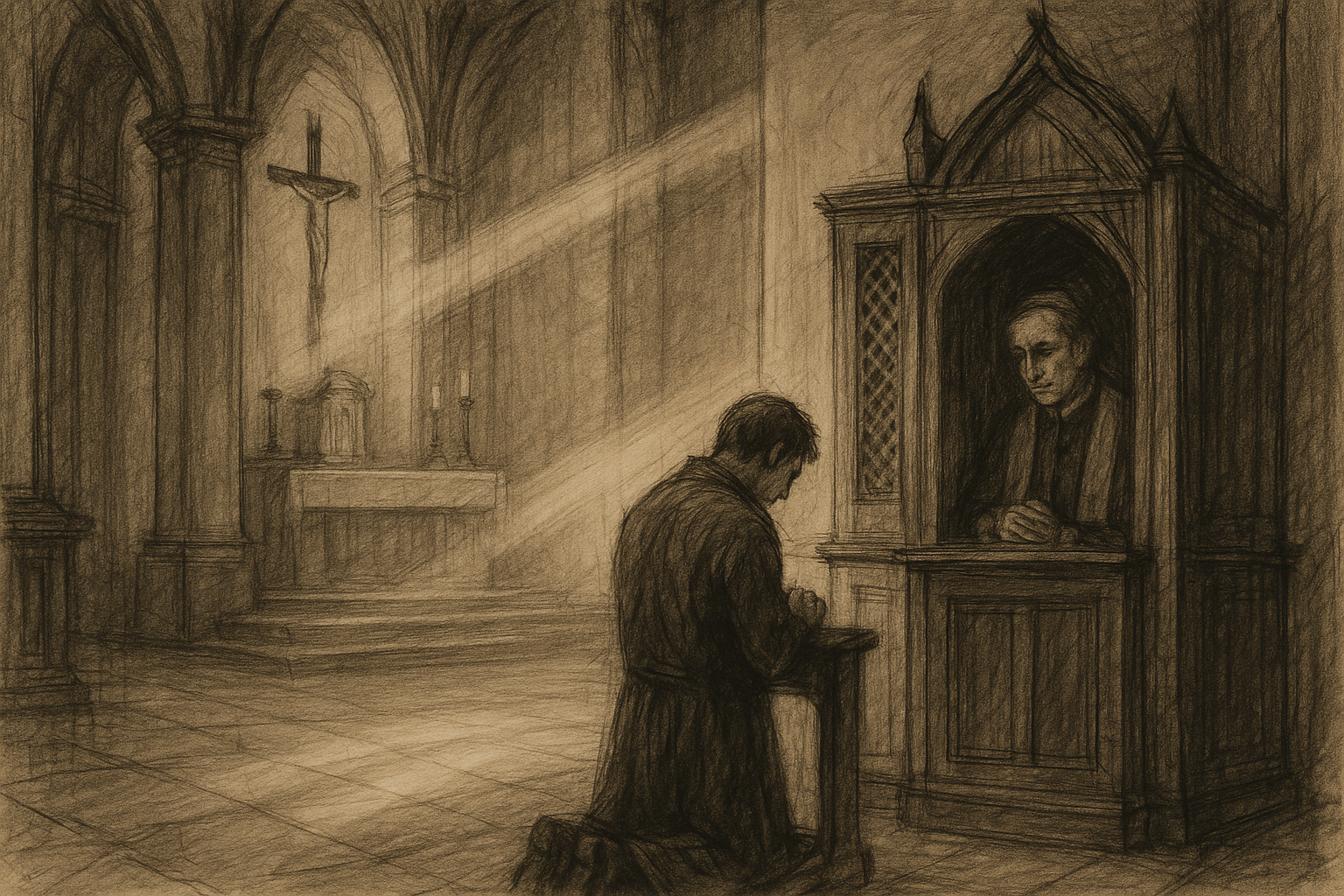
One of the great gifts of Catholic life is that sin is never the last word. Christ gave the Church the sacrament of Penance so that sinners could be restored. For mortal sin, confession is ordinarily necessary before receiving Holy Communion again, unless there is a grave reason and a sincere act of perfect contrition accompanied by the intention to confess as soon as possible.
Venial sins can also be brought to confession, and they should be. Regular confession is not only for dramatic sins. It trains humility, sharpens conscience, and opens the soul to grace. Many saints recommended frequent confession precisely because they knew that holiness is not achieved by pretending to be fine. It is cultivated by repentance, honesty, and surrender to mercy.
The words of the First Letter of John are encouraging here: If we confess our sins, he is faithful and just, and will forgive our sins and cleanse us from all unrighteousness 1 John 1:9. The promise is not that sin does not matter. The promise is that mercy is real.
Common mistakes Catholics make
It is easy to misunderstand this teaching in either direction.
Some people treat mortal sin as rare in a way that makes it almost theoretical. But grave sin is not rare in the world, and it is not impossible in ordinary life. Dishonesty, sexual sin, deliberate injustice, and contempt for God's law are not abstract problems.
Others fall into scrupulosity and label every fault mortal. That can lead to fear, paralysis, and a distorted image of God. The Lord is not waiting to condemn a sensitive conscience. He is calling it to peace and truth.
A healthy Catholic conscience asks three simple questions:
- Was the matter seriously wrong?
- Did I know it was seriously wrong?
- Did I freely choose it?
If the answer to all three is yes, the sin is mortal. If not, it is venial or lessened in culpability. That clarity is a mercy.
How to examine your conscience well
A good examination of conscience is not a vague feeling of regret at the end of the day. It is a prayerful review before God. Ask where you failed in charity, purity, honesty, justice, reverence, patience, and trust. Consider not only what you did, but what you chose, what you avoided, and what you allowed to grow in your heart.
Pray for honesty without harshness. The goal is not self-condemnation, but conversion. God already knows the truth. The examination of conscience is for us, so that we can stop hiding from the truth and start receiving grace more fully.
Lord, show me where I have wounded love, where I have turned away, and where I need mercy more than excuses.
That kind of prayer is simple, but it is deeply Catholic. It trusts that God wants to heal, not merely to expose.
Living with reverence and confidence
The distinction between mortal and venial sin is one of the clearest signs that Catholic moral life is neither casual nor hopeless. The Church believes sin is real enough to kill grace, but mercy is stronger than sin when the sinner turns back. She believes little faults matter enough to confess, but she also knows that every stumble is not spiritual death.
That is why the teaching remains so important in family life, in parish life, in confessor's counsel, and in the daily work of conscience. It teaches Catholics to take sin seriously without losing sight of the Father who runs to meet the prodigal son [[VERSE|luke|15|11-32|Luke 15:11-32]]. It teaches us to fear sin, but to trust mercy even more.
When Catholics truly understand mortal and venial sin explained in the light of Scripture and the Church's teaching, they are less likely to excuse grave evil and less likely to despair over ordinary weakness. That balance is not easy, but it is one of the marks of mature Christian life.
The goal is not merely to avoid punishment. The goal is to remain in friendship with God, to let grace heal what is wounded, and to keep returning to the One who alone can make the soul whole.
Keep Reading on Lets Read The Bible
Frequently Asked Questions
What is the difference between mortal and venial sin?
Mortal sin destroys charity in the soul and cuts a person off from sanctifying grace if three conditions are present: grave matter, full knowledge, and deliberate consent. Venial sin wounds charity but does not destroy it.
Can a Catholic receive Communion after venial sin?
Yes. Venial sin does not bar a Catholic from receiving Holy Communion, though Catholics should still strive to repent of it and bring repeated or serious venial sins to confession.
Do mortal sins always feel serious?
No. A mortal sin may be chosen calmly, even casually. Its seriousness depends on the object of the act, the person's knowledge, and the freedom of the choice, not on emotional intensity.