Doctrine and Questions
When the Family of God Prays Together: The Saints and Their Quiet Help
The communion of saints is not a poetic idea only. It is a living reality that shapes how Catholics pray, hope, and ask for help.
Site Admin | June 10, 2026 | 50 views
The intercession of the saints can seem mysterious at first, especially if someone has grown up thinking prayer should be addressed to God alone. Catholics agree that God alone is worshiped, adored, and trusted as the source of every grace. Yet the Church also teaches something beautiful and deeply biblical: the members of Christ's body do not stop caring for one another when death comes. In Christ, they remain united. Those who have reached heaven can pray for us, and their prayer is one more gift within the life of the Church.
This is what Catholics mean when they speak of the intercession of the saints explained. It is not a claim that saints replace Christ, nor that they possess divine power on their own. It means that the holy men and women who are alive with God can present our needs before him, just as Christians on earth pray for one another. The difference is not the kind of prayer, but the state of the one who prays. The saints are perfected in charity, closer to the Lord than we are, and entirely alive in him.
Prayer in the family of God
One of the simplest ways to approach this teaching is to think of the Church as a living family. On earth, Catholics ask friends, parents, priests, and fellow parishioners to pray for them. No one sees that as a challenge to God's glory. It is an act of humility and trust. We know that the prayers of the righteous are powerful, as Scripture says: The prayer of a righteous person is powerful.
The saints are not distant religious figures frozen in stained glass. They are members of the same Body of Christ. Scripture teaches that the Church is one body with many members, and that the whole body suffers and rejoices together If one member suffers, all suffer together. If that is true of the Church on earth, it is no less true for the Church in heaven, where charity is made complete.
When Catholics ask a saint to pray for them, they are not bypassing Christ. They are asking a fellow member of his body to join their petition. Every true intercession in the Church rises through Christ, because he is the one mediator between God and man One mediator between God and men, the man Christ Jesus. Catholic teaching does not weaken that truth. It depends on it.
What Scripture shows about heavenly intercession
The Bible gives several glimpses of the saints in heaven presenting prayers before God. In the book of Revelation, John sees the elders in heaven holding golden bowls full of incense, which are the prayers of the holy ones Golden bowls full of incense. He later sees an angel offering incense with the prayers of all the saints on the golden altar before the throne The prayers of all the saints. These images matter because they show that prayer does not vanish into the air. It is received in heaven, and it is part of the worship of God.
Another important biblical witness comes from the Transfiguration. Moses and Elijah appear with Christ in glory Moses and Elijah with Jesus. They are not isolated from the saving work of God. They are alive to him. Jesus himself says that God is not the God of the dead but of the living He is not God of the dead, but of the living. That does not settle every question by itself, but it opens the door to the Church's confidence that the righteous dead are not cut off from us in Christ.
There is also the important passage in Hebrews describing the heavenly worship surrounding the throne of God. The faithful on earth are surrounded by a great cloud of witnesses So great a cloud of witnesses, and the vision of heaven is not of silence but of praise, adoration, and prayer. Catholics read these texts together and see a single truth: the communion of saints is real, and prayer in Christ is not limited by the grave.
Intercession is not worship
Many objections to the practice come from a serious concern: if Catholics ask saints to pray for them, are they worshiping saints? The answer is no. The Church is careful to distinguish between worship due to God alone and the honor given to God's friends. Catholic prayer to a saint is more like asking a trusted friend to pray, though with the recognition that the saint now stands before God in glory.
This distinction matters. Worship belongs to the Holy Trinity alone. The saints are not divine, not self-existent, and not the source of grace. They are witnesses to grace. Their holiness is not their own achievement apart from God. It is the fruit of Christ's redemption and the work of the Holy Spirit. When Catholics honor a saint, they honor what God's mercy has done in that person's life.
That is why the language of intercession is so important. Intercession means praying on behalf of another. It is not competing with Christ's unique role. Rather, it participates in his one priesthood. All Christian prayer is made possible by Jesus, and all Christian charity is gathered into him. A saint's prayer does not stand outside that order. It flows from it.
Why Catholic hearts turn to the saints
For ordinary Catholic life, this teaching is not an abstraction. It affects the way people pray through grief, temptation, illness, work, family strain, and uncertainty about the future. The saints give the faithful concrete friends in heaven, men and women who know what it is to suffer, to wait, to repent, to serve, and to trust God when the road is hard.
Someone trying to grow in patience may turn to Saint Monica and remember the long obedience of prayer. A parent carrying fear for a child may ask Saint Joseph for quiet strength. A person battling fear or discouragement may take comfort in a saint whose life shows that holiness is not the absence of struggle, but fidelity in the middle of it. The saints make the Christian life feel less lonely because they remind us that grace has already borne fruit in real human lives.
This also helps Catholics resist the temptation to imagine holiness as an idea rather than a path. The saints are not heroic exceptions reserved for another age. They are proof that Christ changes people. Their intercession encourages us because it places our struggles inside a much larger story. We are not inventing sanctity from scratch. We are entering a communion already alive in heaven and on earth.
How this teaching shapes prayer at home and in the parish
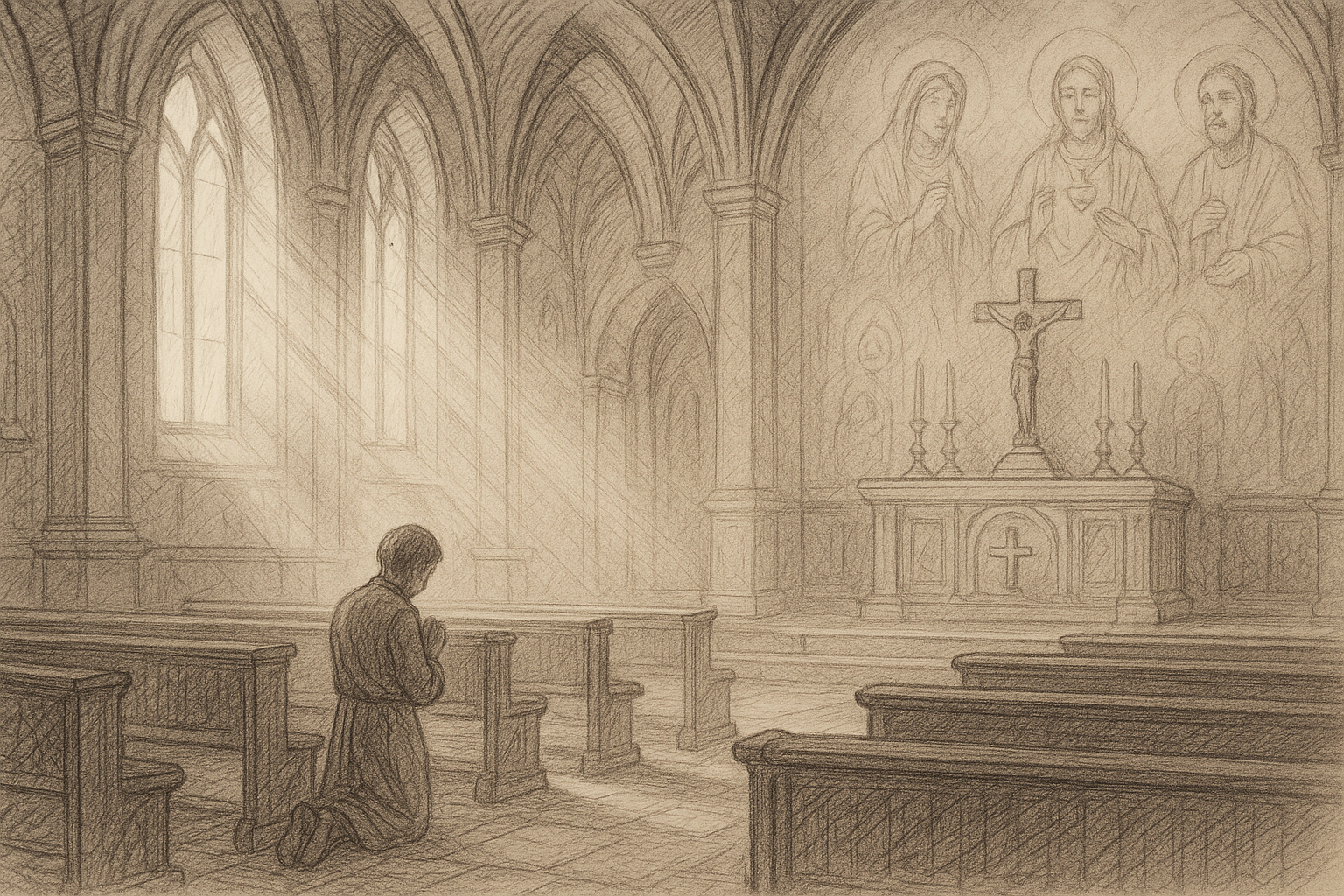
Many Catholics first learn the practice of asking for intercession through family prayer or the liturgy. A child hears a parent say, "Saint Anthony, help us find what is lost." An adult prays before an icon or statue with a simple request for help, not because the image is magical, but because it points the heart toward the saint and, through the saint, toward God. In parish life, feast days, novenas, and devotional prayers all reinforce the same truth: Christians are not alone.
At the same time, healthy Catholic devotion keeps its bearings. The saints are aids to prayer, not replacements for it. Their lives should lead us to deeper faith in Christ, more love for the sacraments, and greater willingness to obey God's will. If a devotion becomes disconnected from the Gospel, it loses its purpose. The best devotion to the saints is the kind that makes prayer more humble, more hopeful, and more attentive to God's providence.
Here the communion of saints also strengthens our sense of responsibility toward one another. If heaven and earth are joined in Christ, then prayer for the living is not an optional extra. It is part of Christian love. Parents pray for children, children for parents, friends for friends, the Church for the suffering, and the saints for all who call on them. The whole communion becomes a school of charity.
Common questions that deserve a calm answer
Some people worry that asking saints for help means Christians should go to saints instead of God. But the Church's answer is simple. Catholics always pray to God directly. When we ask a saint to intercede, we are asking for a prayer, not offering divine honor. If a friend on earth can pray for us, then a friend in heaven can do so as well, and with greater closeness to the Lord.
Others ask whether the dead can hear us. Catholics do not say this because the saints possess omniscience. Rather, they are alive in Christ and share in the light of his presence. The details of how God allows them to know our petitions belong to his mystery. What matters pastorally is that Scripture presents heaven as aware of earthly prayer and involved in God's praise The prayers of the holy ones before God.
Still others wonder whether this practice distracts from Jesus. Properly understood, it does the opposite. The saints make Christ visible. Their holiness is evidence that his grace works. Their intercession is one more sign that he has not abandoned his people. To love the saints rightly is to love the Lord who made them holy.
The saints do not draw the Church away from Christ. They show what Christ can do with a human life surrendered to grace.
A quiet confidence for daily Catholic prayer
In daily life, the doctrine of the saints' intercession can be a source of steady peace. It reminds Catholics that prayer is never solitary in the deepest sense. We pray in a Church that spans earth and heaven. We ask for help within a communion that death cannot break. We trust that those who loved Christ on earth now love him perfectly and continue to care for the members of his body.
This is not sentiment. It is part of the Church's understanding of salvation. The saints are not distant ornaments added to the faith after the fact. They belong to the living structure of Christian hope. Their intercession is one more way the Lord gathers his people together, teaches them to depend on grace, and keeps them from imagining they must carry the burdens of life alone.
So when Catholics ask a saint to pray with them, they are not stepping outside biblical faith. They are entering more deeply into it. They are speaking as members of one family, under one Savior, in one Spirit, toward the same Father who hears every humble prayer.
Keep Reading on Lets Read The Bible
Frequently Asked Questions
Do Catholics believe saints have power of their own?
No. Catholics believe all grace comes from God. Saints do not have divine power in themselves. They intercede because they are alive in Christ and pray for us within his saving work.
Is asking a saint for help the same as worshiping that saint?
No. Worship belongs to God alone. Asking a saint to pray is an act of honor and fellowship, not adoration. The request is for intercession, not divine worship.
Where in Scripture is the intercession of the saints suggested?
Catholics point especially to Revelation 5:8 and 8:3, where heavenly figures present prayers before God, as well as the wider biblical witness to the communion of believers in one body in Christ.