Doctrine and Questions
Sin Is Not All the Same: Reading the Moral Life with Catholic Clarity
The Church's distinction between mortal and venial sin is not meant to frighten believers, but to help them see the seriousness of love, freedom, and grace.
Site Admin | June 29, 2026 | 96 views
Catholic teaching on sin can sound severe at first, especially when the Church speaks of mortal and venial sin Catholic teaching in the same breath. Yet the distinction is not a technicality meant to make faith complicated. It is a way of taking love seriously. If sin is a turning away from God, then not every offense carries the same weight, and not every wound affects the soul in the same manner.
Scripture itself recognizes that sins differ in gravity. Saint John writes, "There is sin which is mortal; I do not say that one is to pray for that" 1 Jn 5:16. Jesus also speaks of inner corruption, warning that what comes from the heart can defile a person Mk 7:20-23. The Church does not invent this seriousness. She names it, so that conscience can be formed honestly and repentance can be sincere.
Two ways of wounding charity
Catholic moral teaching begins with the truth that sin is more than breaking a rule. It is a failure in love. We are made for communion with God, and every sin harms that communion in some measure. But the Church teaches that some sins destroy charity in the heart, while others wound it.
A mortal sin is a grave offense that kills sanctifying grace in the soul if it is committed with full knowledge and deliberate consent. A venial sin does not destroy charity, though it weakens it and disposes the soul to greater harm if left unchecked. This distinction has been taught consistently in the Church's tradition and is summarized clearly in the Catechism.
The word mortal is not meant as a dramatic insult. It is a sober description of a spiritual reality. Mortal sin is called mortal because it is deadly to the life of grace. Venial sin is called venial because it is pardonable and does not sever one's relationship with God in the same way. Both are serious. Both matter. But they are not equal.
What makes a sin mortal
For a sin to be mortal, three conditions must be present together: grave matter, full knowledge, and deliberate consent. If one of these is lacking, the sin is not mortal, though it may still be sinful and harmful.
1. Grave matter
Some actions are objectively grave because they directly contradict God's law in a serious way. Examples include murder, adultery, blasphemy, sacrilege, serious theft, and other acts that deeply violate justice or charity. The gravity is not measured by how emotionally intense the act feels, but by what the act is.
2. Full knowledge
A person must know that the act is seriously wrong. This does not require perfect theological understanding, but it does require real awareness. Someone who acts in ignorance may still sin, but the guilt may be lessened if the ignorance was not freely chosen. Ignorance can never be used casually as an excuse, yet moral responsibility does take knowledge into account.
3. Deliberate consent
The act must be freely chosen. Fear, coercion, habit, emotional disturbance, addiction, or immaturity can reduce responsibility, sometimes substantially. The Church is careful here because she knows the human person is not a machine. Freedom can be weakened without being entirely absent. Still, a freely chosen grave act remains grave.
Saint Paul gives a sharp picture of this seriousness when he warns against living according to the flesh rather than according to the Spirit Gal 5:19-21. He is not merely listing bad behavior. He is naming the kind of life that closes a person off from the inheritance of God's kingdom. That is why the Church treats mortal sin with such care.
Why venial sin still matters
Venial sins are not harmless. They do not cut off sanctifying grace, but they do weaken charity, cloud judgment, and make the soul less responsive to God's movement. Repeated venial sins can dull conscience and make mortal sin easier. A small, repeated betrayal can train the heart to accept larger betrayals.
This is one reason Catholics should never shrug off venial sin as if it were irrelevant. Jesus teaches that fidelity begins in the interior life, in what is small and hidden as well as in what is public and visible Lk 16:10. A soul that grows careless about lesser sins becomes less alert to the dangers of greater ones.
Yet the Church's teaching on venial sin is also hopeful. Not every failure is a catastrophe. Growth in holiness is often gradual, and the Lord patiently works with the weak, the inconsistent, and the unfinished. Venial sin reminds us that holiness is not the absence of every flaw at once. It is the steady purification of the heart through grace, repentance, and perseverance.
Common misunderstandings about mortal sin
One common misunderstanding is the idea that mortal sin means God stops loving the sinner. That is false. God's love does not fail. A person in mortal sin is not outside God's desire to save, and the Church never teaches otherwise. The tragedy of mortal sin is not that God's mercy disappears, but that the sinner has chosen a state that rejects God's life and friendship.
Another misunderstanding is the belief that Catholics live in constant fear of accidentally committing mortal sin. That is not the spirit of the Church. Moral theology is not meant to make Christians anxious. It is meant to help them act in freedom and truth. A well-formed conscience, prayer, and trust in God's mercy do not produce scrupulosity. They produce clarity.
Some also imagine that venial sin can be treated as if it were trivial because it does not lead to hell in the same immediate way. But sin is never merely private. Every sin distorts love, and love is what the Christian life is for. Even venial sin needs healing, because every ordered soul should desire not only to avoid damnation, but to grow in communion with God.
Scripture, repentance, and the life of grace
The Bible shows repeatedly that God distinguishes between sin and sin, while always calling sinners to repentance. King David's grave sin is followed by deep contrition Ps 51:1-4, and the prophet Ezekiel makes clear that the Lord desires conversion, not death, for the sinner Ez 18:21-23. Jesus begins His public preaching with the call, "Repent, and believe in the gospel" Mk 1:15. Repentance is not vague regret. It is a real turning of the heart.
The parable of the prodigal son offers one of the clearest images of this truth Lk 15:11-24. The son does not simply feel bad. He returns. The father does not minimize the son's actions, but he restores him with mercy. Catholic teaching on mortal and venial sin belongs to that same pattern. It names wrongdoing truthfully and then opens the way home.
Grace is not a vague religious mood. It is God's own life dwelling in the soul. Mortal sin rejects that life. Venial sin weakens it. Repentance restores what sin has damaged, and the sacraments are not symbolic gestures but real means by which Christ heals and strengthens His people.
Confession belongs at the center of the Catholic response
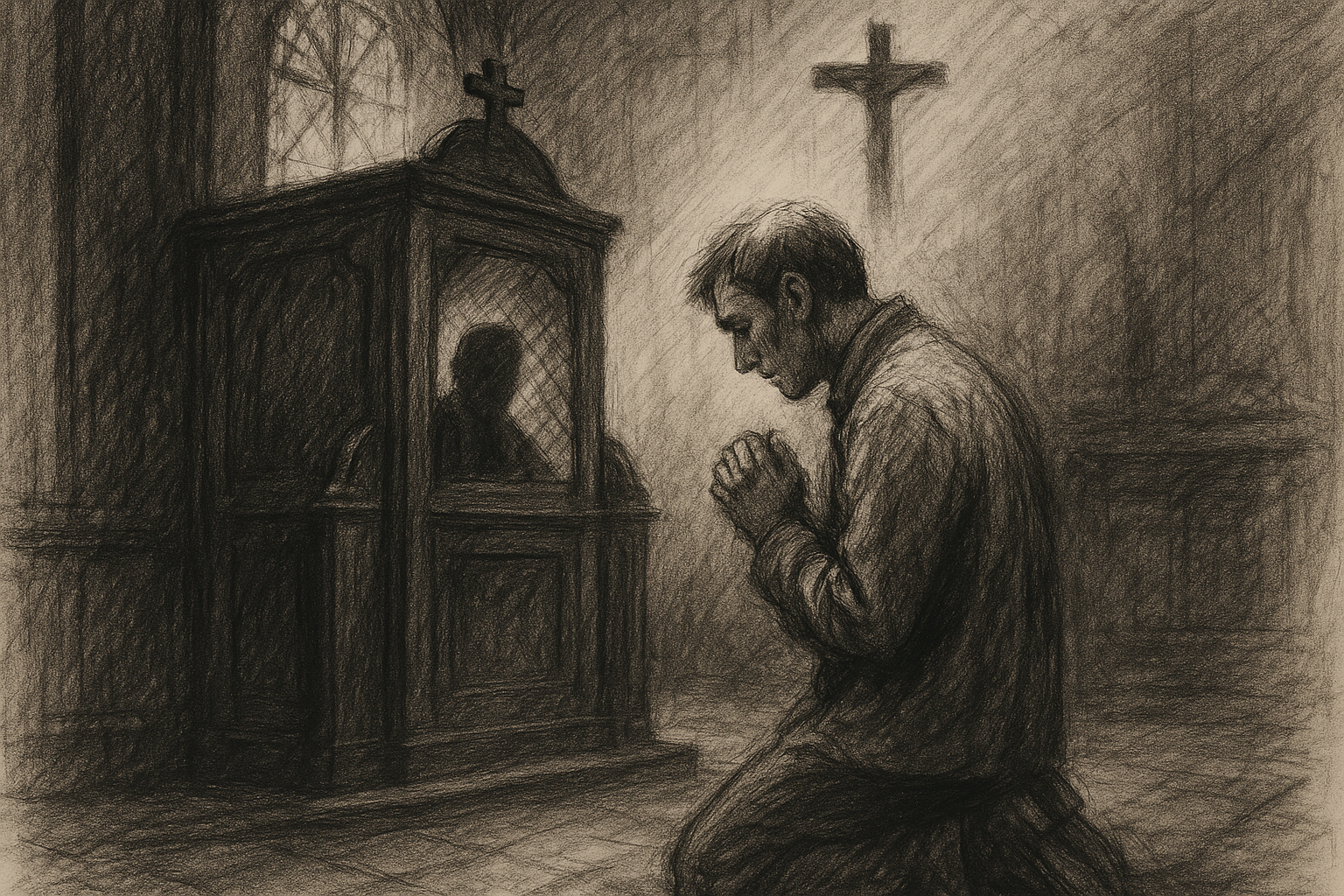
Because mortal sin destroys sanctifying grace, the ordinary sacramental remedy is the Sacrament of Penance and Reconciliation. The Church requires that grave sin be confessed before receiving Holy Communion, because the Eucharist is not simply a personal devotion. It is communion with Christ and His Church, and it must not be approached without repentance when grave sin is present.
At the same time, confession is not only for dramatic failures. Frequent confession of venial sins can be a powerful help in the Christian life. It sharpens conscience, strengthens humility, and opens the heart to grace. The sacrament is medicine, not mere paperwork.
Jesus gave the apostles authority to forgive sins when He breathed on them and said, "Whose sins you forgive are forgiven them" Jn 20:22-23. That gift was not symbolic. It is part of the Church's concrete pastoral care. In confession, the sinner is not met with shame alone, but with truth, mercy, and absolution.
How to think about your own conscience
A Catholic conscience should be informed, calm, and honest. It should not excuse sin, but neither should it exaggerate everything into mortal guilt. The best approach is to ask simple and serious questions: Was the matter grave? Did I know it was grave? Did I freely choose it? These questions are not about self-protection. They are about truth before God.
If a person is unsure, the safer and more humble path is to bring the matter to confession and ask a priest for help in forming conscience. That is especially important for repeated struggles, patterns of habit, or areas where temptation has become confusing. The Church is a mother in this work. She does not shame the wounded. She helps them tell the truth.
Saint James reminds believers that every good gift comes from above and that we should be doers of the word, not hearers only Jas 1:17-22. That is the practical aim of moral theology. It is not to categorize people into the worthy and unworthy, but to lead souls toward real conversion, steady virtue, and deeper friendship with God.
When Catholics speak carefully about mortal and venial sin, they are not splitting hairs. They are honoring the difference between a wound and a death, between weakness and rebellion, between stumbling and turning away. That difference matters because grace matters, freedom matters, and the God who calls us to holiness also gives us the mercy to begin again.
Keep Reading on Lets Read The Bible
Frequently Asked Questions
Can a venial sin become mortal sin?
A venial sin does not simply turn into mortal sin by repetition alone, but repeated venial sin can weaken conscience and make a person more likely to commit grave sin with fuller consent and knowledge.
Do Catholics have to confess venial sins?
Catholics are not required to confess venial sins, though doing so is strongly recommended. Confession of venial sin helps form conscience, strengthens humility, and brings grace for growth in holiness.
What if I am not sure whether a sin was mortal?
If you are uncertain, speak honestly in confession and ask for guidance. A priest can help you judge the matter carefully. When in doubt, humility and a sincere desire to repent are always the right place to begin.