Social Teaching
Work That Honors the Image of God
Catholic social teaching sees labor not as a burden to escape, but as a way human beings cooperate with creation, serve neighbor, and grow in holiness.
Site Admin | October 17, 2025 | 64 views
Work is part of the human vocation
Many people speak about work mainly in terms of stress, wages, and schedules. Those concerns are real, especially when jobs are unstable, poorly paid, or physically demanding. Yet Catholic faith begins from a wider and more hopeful vision. Work is not only something we endure in order to survive. It is part of what it means to be human.
From the beginning, Scripture presents human labor as a gift ordered toward stewardship. In Genesis, God places man in the garden to till it and keep it. Before sin enters the story, work already belongs to the good design of creation. After the fall, labor becomes more difficult and often painful, but it does not lose its dignity. It remains bound to the human person, who is made in the image of God and called to participate in God's care for the world.
This is why the Church speaks so strongly about work and the dignity of labor and Catholic life. Labor is not merely about production. It is about the person who works, the family that depends on that work, and the common good that is shaped by honest service. A Catholic view of work protects us from two errors: treating labor as a curse to be escaped, or treating workers as if they were only tools for profit.
Christ enters ordinary labor
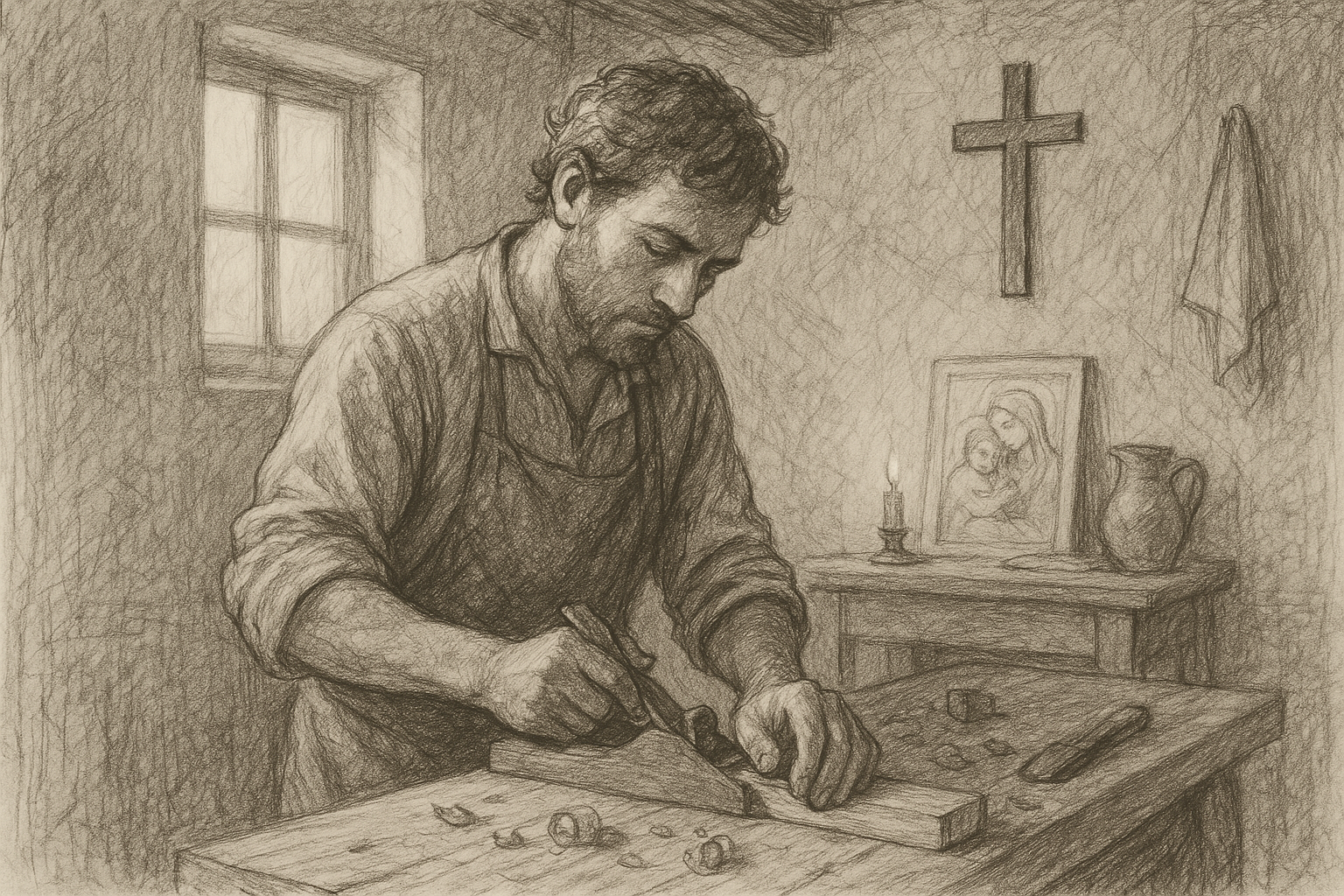
The Incarnation gives labor an even deeper meaning. Jesus did not begin his public ministry with a life removed from ordinary human effort. He lived for many years as the son of a craftsman, known in the simplicity of daily life. In doing so, he sanctified the hidden, faithful work of ordinary people. The Savior of the world spent much of his earthly life in labor that went unnoticed by the crowd.
That fact matters. It means no honest work is beneath the gaze of God. Caring for children, cleaning a room, repairing a machine, balancing accounts, stocking shelves, teaching, farming, cooking, serving the sick, and building homes all belong to a world that Christ entered. In the mystery of the Incarnation, the Son of God shows that human labor can be a path of love, patience, and offering.
Scripture also reminds us that work should be marked by justice and honesty. Let the thief no longer steal, but rather labor, doing honest work with his own hands (Ephesians 4:28). St. Paul does not praise work because effort itself is holy in a vague sense. He praises honest work because it serves others and restores a person to right relationship with neighbor. In Catholic teaching, labor is not only private self-improvement. It is a moral act.
The dignity of the worker comes before the value of output
Modern culture often measures a job by efficiency, market value, or social prestige. Catholic teaching asks a different question first: what does this work mean for the person who does it? Human beings are never to be reduced to costs, units, or functions. A worker is a son or daughter of God, not a disposable asset.
This principle has practical force. Employers should not expect conditions that crush family life, damage health, or ignore basic justice. Workers should not be treated as if they have no right to rest, to a fair wage, or to safe conditions. At the same time, the dignity of work also calls employees to sincerity, responsibility, and respect for the goods of others. Catholic social teaching does not flatter either side. It asks both labor and management to serve truth.
The Church has long insisted that a just wage matters because a person should be able to support life with dignity. Pope Leo XIII, in Rerum Novarum, defended the rights of workers and the moral claims of labor in an age of industrial upheaval. That concern remains relevant whenever people are paid too little to live decently, when families are forced to choose between time and survival, or when work becomes so unstable that the person cannot plan a future. The Church does not bless exploitation simply because it is legal or common.
At the same time, Catholic thinking avoids the temptation to idolize labor. Work is important, but it is not the highest good. Human beings are made for God. That means labor should serve life, not consume it. A healthy Catholic understanding of work leaves room for worship, Sabbath rest, family meals, prayer, and friendship. If labor destroys the soul's capacity for communion, something has gone wrong.
Labor becomes a form of love when it serves the common good
One of the most beautiful truths in Catholic social teaching is that ordinary work can become a real act of charity. A nurse who stays attentive in a long shift, a father who endures an exhausting commute to feed his family, a young worker who learns humility on a first job, a retiree who volunteers skills for parish life, and a mother who keeps a home ordered with patience are all participating in the shared good of society. Their work is not glamorous, but it is fruitful.
The common good is not an abstract slogan. It is the conditions that allow people and families to flourish. Honest labor contributes to those conditions. Roads are built, bread is baked, children are taught, the sick are cared for, records are kept, and communities are held together by countless acts that rarely make headlines. Catholic faith insists that such work matters because persons matter.
St. Paul offers a sober warning against idleness that harms both the person and the community. If anyone will not work, let him not eat (2 Thessalonians 3:10). That line has often been misunderstood, but its meaning is not cruelty. It is a call to responsibility. The Church knows that work can fail, jobs can disappear, illness can limit effort, and hardship can overtake even the faithful. Still, when a person is able to contribute, he or she should not turn away from duty. Human beings are meant to receive and give, to be served and to serve.
Charity also shapes how Catholics speak about the unemployed, the underemployed, and those whose labor is invisible. A person without stable work is not less worthy. A parent who cannot find a job is not a failure in the eyes of God. Catholic life asks us to notice dignity before judgment. Communities should create practical paths of assistance, formation, and accompaniment. Mercy is not sentimental. It is concrete.
Rest is not the enemy of dignity
In a culture that can glorify busyness, the Church offers a liberating truth: rest is holy. God commands the Sabbath not because human work is worthless, but because human beings are not machines. We are creatures who need worship, silence, and renewal. Rest protects labor from becoming an idol.
For Catholics, Sunday has a special place. It is the Lord's Day, the day of the Resurrection, and it calls us to Mass, prayer, and family life. When possible, it should be preserved as a day set apart from ordinary commercial pressure. This is not nostalgia. It is a defense of human dignity. If the rhythm of life leaves no room for worship or repose, then work has begun to rule the person instead of serving the person.
That same principle applies within households. Parents need time with children. Spouses need time for conversation. Children need the presence of adults who are not always exhausted. Rest makes love possible because love requires attention. A Catholic approach to work therefore includes limits, prudence, and the wisdom to know that a full life is larger than a paycheck.
Practical ways Catholics can live this teaching
It is easy to admire the dignity of labor in theory and then live as if work were only a burden. Catholic life asks for habits that make belief visible.
- Begin the workday with prayer. Offer the day to God, asking for honesty, patience, and charity in every task.
- See coworkers as neighbors. A Christian workplace is marked by courtesy, fairness, and a refusal to gossip or humiliate.
- Respect the work of others. Whether the task is public or hidden, acknowledge the labor that sustains daily life.
- Support just treatment of workers. Speak plainly when conditions are unsafe, wages are unjust, or schedules destroy family life.
- Keep Sabbath rest. Guard time for Mass, prayer, and peace when possible, so work does not become an idol.
- Teach children to value effort. Form them to see chores, study, and service as training in responsibility and love.
These are not large gestures, but they shape the soul. A Catholic who prays before work, works honestly, and rests with gratitude begins to see labor differently. The office, the classroom, the workshop, the kitchen, the field, and the hospital corridor can all become places of offering.
When work is hard, faith still speaks
Not all labor feels meaningful. Some jobs are repetitive. Some are lonely. Some expose people to danger or wear them down with chronic stress. Others leave a person feeling unseen or replaceable. Catholic teaching does not deny any of this. It simply insists that even painful work does not erase human worth.
In such moments, the Cross gives the clearest light. Christ's own saving work was not comfortable or efficient by worldly standards. He labored in obedience to the Father and gave himself for our salvation. That does not make suffering good in itself, but it does mean suffering can be united to love. A tired parent, a factory worker in pain, a caregiver who feels forgotten, or a small business owner carrying heavy responsibilities can all bring their hidden burdens to God.
Faith also reminds us that work is not the final measure of a life. A person is not beloved because he is productive. He is beloved because he exists. That truth is deeply healing in a world that often rewards only the visible and the profitable. The Church asks us to resist that lie and to honor the person who labors, whether the labor is praised or overlooked.
When Catholics live this way, work becomes more than survival and more than status. It becomes a daily school of virtue, a service to neighbor, and a quiet participation in God's creative care. In that light, even the most ordinary task can be offered with reverence, and every honest effort can become part of a life ordered toward love.
Keep Reading on Lets Read The Bible
Frequently Asked Questions
What does the Church mean by the dignity of labor?
The Church teaches that work has dignity because the worker has dignity. Human labor should serve the person, the family, and the common good, not treat people as disposable tools for profit.
Does Catholic teaching support a right to rest?
Yes. The Church teaches the importance of Sabbath rest, especially Sunday, because human beings are not made only for production. Rest protects worship, family life, and the health of the soul.
How can Catholics apply this teaching at an ordinary job?
Catholics can pray before work, act honestly, respect coworkers, support fair treatment, and remember that even hidden or repetitive labor can be offered to God in love.