Social Teaching
More Than a Paycheck: The Catholic Vision of Work as Human Dignity
Catholic social teaching sees labor not as a burden to endure, but as a participation in God's care for the world and a path to human flourishing.
Site Admin | October 16, 2025 | 75 views
Work as part of the human calling
Catholic social teaching begins with the conviction that the human person is not a tool. Each man and woman is made in the image of God, with reason, freedom, and the capacity to love. From that truth flows a deeper understanding of work. Labor is not a punishment to be tolerated until leisure arrives. It is part of the human vocation to cooperate with God in caring for creation, serving others, and building a society where people can live with dignity.
Genesis presents this in a way that is both simple and profound. God places the first human beings in the garden to tend and keep it. Before sin enters the story, work already belongs to human life. After the fall, work becomes harder and more painful, but it does not lose its goodness. It remains part of what it means to be human, though now marked by fatigue, frustration, and conflict. This matters because it keeps Catholics from treating labor as a merely economic question. Work touches the whole person.
The Church has long insisted that the value of work is not measured only by output or profit. A person is not valuable because he is productive, but because he is a child of God. That principle changes the way we think about employees, employers, the unemployed, the elderly, the disabled, and those who do work that is hidden, repetitive, or poorly paid. The dignity of labor is really about the dignity of the laborer.
The worker comes before the work
One of the clearest themes in Catholic teaching is that labor exists for the person, not the person for labor. This is a corrective to systems that treat workers as if they were interchangeable parts in a machine. A healthy economy needs efficiency, skill, and initiative, but it cannot sacrifice the person in the name of results. Long hours, unsafe conditions, unstable schedules, and wages that do not allow a person to live decently are not just management issues. They are moral issues.
Saint John Paul II made this point with great force in Laborem Exercens, teaching that work should be understood in light of the human subject who performs it. The worker is not merely producing something external. Through labor, the person develops habits, relationships, responsibility, and even a deeper sense of self. Work can be a school of patience and fidelity. It can also become a place of alienation if it is stripped of meaning and reduced to pressure alone.
This does not mean every job must be emotionally fulfilling or personally ideal. Catholic realism knows that many forms of labor are difficult, monotonous, or hidden from public admiration. The Church does not romanticize work. Rather, she insists that even ordinary labor can be honorable because it serves life. A parent caring for children, a janitor cleaning a school, a mechanic repairing a vehicle, a nurse caring for a patient, and a farmer tending the land all participate in real service to others.
Work is not only what a person does. It is also one of the ways a person gives himself in love.
Wages, justice, and the common good
Catholic teaching on work cannot be separated from justice. A just wage is not a luxury or a reward for the fortunate. It is a moral necessity rooted in the rights of the worker and the responsibilities of society. A wage should be sufficient for a person to live in dignity and, when possible, to support a family. This does not mean every pay scale must be identical, nor does it mean the Church reduces complex economic questions to slogans. It does mean that compensation must be judged by more than market convenience.
The common good is also essential here. Work does not happen in a vacuum. Families, communities, schools, churches, and local businesses all depend on conditions that allow stable, honest labor to flourish. When workers are paid fairly, have reasonable safety protections, and can remain with their families, society benefits. When people are forced into constant insecurity, everyone pays a price. Catholic social teaching therefore asks not only what is profitable, but what is just, sustainable, and humane.
The Church also affirms the legitimacy of private property, enterprise, and entrepreneurship. A Catholic view of work is not hostile to business. On the contrary, businesses can be a noble place of creativity and service when they are ordered toward the common good. Owners, managers, and investors have real responsibilities, not merely technical ones. They are stewards of human lives, not only of assets.
This is why Catholic teaching often resists either extreme: the temptation to idolize the market as though it could solve every problem on its own, or the temptation to flatten all economic life into bureaucracy. Both can ignore the concrete person. The Church asks for something more demanding and more human, a moral economy in which freedom and responsibility are held together.
Labor, family life, and the rhythm of human limits
Work is never only individual. It reaches into the home. Parents need enough stability to be present to their children. Children need to see that effort, responsibility, and sacrifice are honorable. Spouses need time to live their vocation of mutual gift, not merely to coordinate survival around a schedule that consumes them. For this reason, Catholic teaching pays close attention to the relationship between labor and family life.
Rest matters here as much as work. The Sabbath principle reminds us that human beings are made for worship, communion, and repose, not endless production. A society that cannot rest is a society that forgets who it is. Sunday worship in particular teaches that work is not ultimate. We are not saved by our performance. We are creatures dependent on God. Rest helps restore perspective and keeps labor from becoming an idol.
This balance also protects the poor, who are often the first to suffer when work is organized without regard for family life. Unstable hours, excessive commuting, and unrealistic expectations can weigh heavily on those already carrying financial burdens. Catholic social thought does not deny the need for hard work. It honors it. But it also defends the human limits that make work truly human rather than mechanical.
There is a quiet holiness in ordinary fidelity. Many people will never receive public praise for the years they spend working, caregiving, commuting, budgeting, or persevering through fatigue. Yet Catholic faith sees these hidden sacrifices. They are not wasted when offered to God in charity. In that sense, work can become a place of sanctification, not because it is easy, but because love can be practiced there.
The dignity of all kinds of honest labor
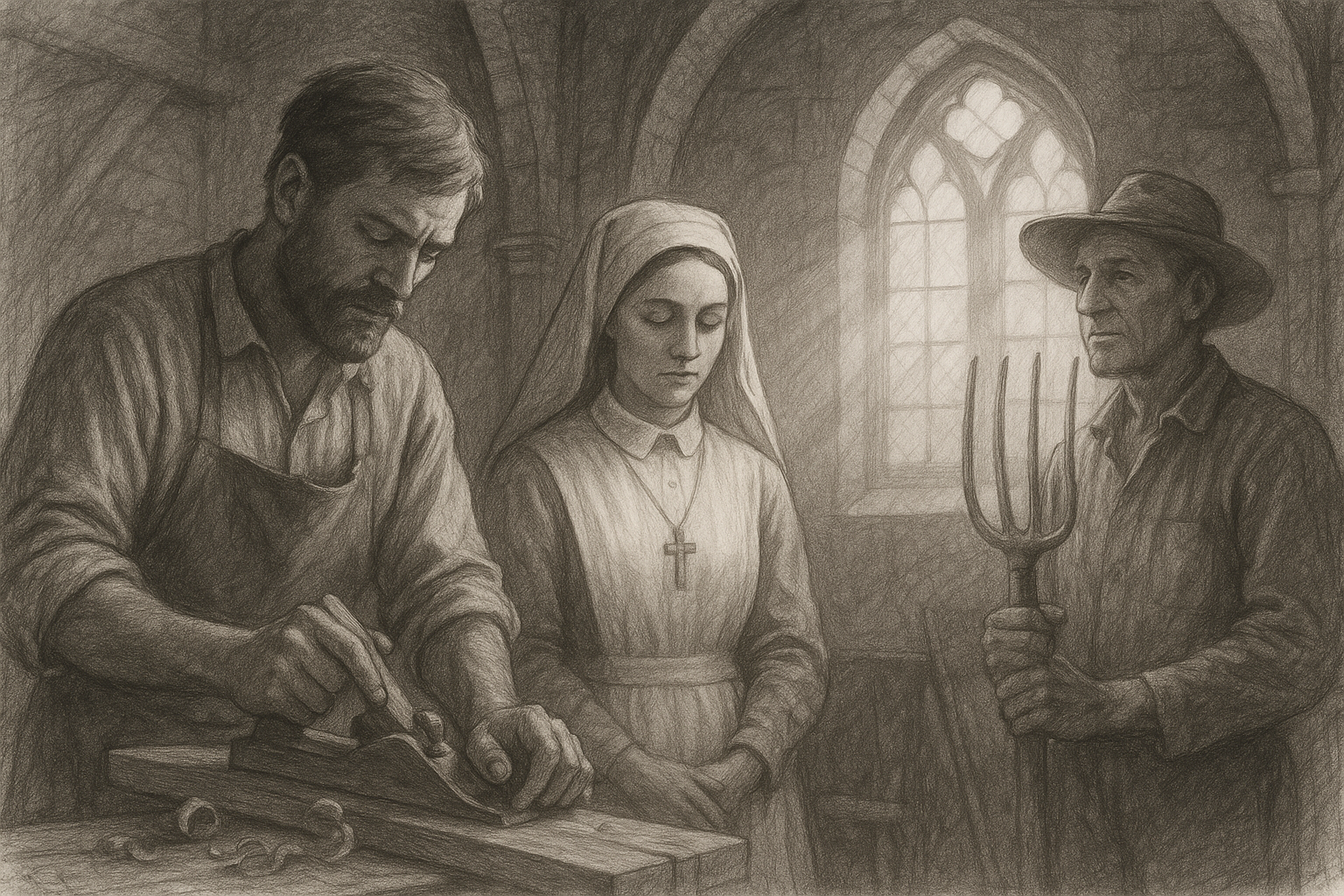
Modern culture often ranks work by prestige. Some jobs are admired because they are visible, creative, or highly paid. Others are overlooked because they are routine, physical, or done in the background. Catholic teaching refuses that hierarchy of human worth. The dignity of work does not depend on social applause. Every honest form of labor that serves human life participates in the good.
This is especially important in a time when many forms of labor are hidden or taken for granted. The person who cleans, cooks, repairs, transports, organizes, or cares for the vulnerable may not appear in headlines, but society depends on such work every day. The Church invites believers to see these tasks with gratitude. Gratitude itself becomes a moral act, because it acknowledges dependence and honors the people whose labor sustains the common life.
At the same time, Catholic teaching recognizes that not everyone is able to work in the same way or at all. Illness, disability, age, family responsibilities, and economic hardship can all shape a person's capacity. Human dignity does not disappear when employment does not appear. The unemployed should never be treated with contempt, nor should the disabled be reduced to what they cannot do. The Church is called to accompany those who seek work, defend those who are exploited, and remember that every person bears an irreducible worth before God.
That is why solidarity is necessary. Solidarity means more than sympathy. It means choosing to see others as neighbors rather than competitors, especially when labor conditions become unstable or unjust. It can show itself in fair hiring, honest supervision, patient mentoring, union organization when appropriate, respect for lawful rights, and practical concern for those under pressure. Solidarity is a habit of moral attention.
Labor as participation in God's creative care
At its deepest level, work is not only about earning a living. It is about participating in God's providence. When a person plants, builds, teaches, heals, designs, listens, fixes, or serves, that person is helping sustain a world that God loves. Human labor is limited and imperfect, but it can still be joined to divine purpose. This is one reason Catholics speak of offering daily work to God. Such an offering does not turn labor into something magical. It simply places ordinary effort within a spiritual horizon.
Scripture presents this beautifully in the life of Jesus himself. He lived most of his earthly years in hidden labor, in the quiet reality of family and trade. In doing so, he sanctified ordinary human work from within. The Son of God did not bypass the ordinary life of labor. He entered it. That fact dignifies every honest worker who rises early, shoulders responsibility, and carries burdens that may never be noticed by the world.
Catholic teaching, then, does not ask whether work is good or bad in some abstract sense. It asks how work can be ordered so that persons flourish, families remain strong, and the common good is served. It asks employers to see workers as persons. It asks workers to bring integrity, diligence, and solidarity to their tasks. It asks all of us to reject contempt for labor in any form, whether that contempt comes from greed, pride, or indifference.
When work is understood rightly, it becomes a place where justice and charity meet. It can support a family, strengthen a community, and train the heart in patience and responsibility. It can also become an offering, a way of living before God with gratitude and trust. That is the Church's steady vision, and it remains as necessary now as ever.
Keep Reading on Lets Read The Bible
Frequently Asked Questions
What does Catholic teaching mean by the dignity of work?
It means that work is important because the person who works has God-given dignity. Labor should serve the person and the common good, not reduce people to productivity or profit.
Does the Church teach that all work is equally valuable?
The Church does not say every job has the same social role, but it does teach that every honest form of labor has dignity. Prestige, pay, or public attention do not determine a person's worth.
How should Catholics think about wages?
Catholics should support just wages that allow workers to live in dignity and, when possible, support family life. Wages are a matter of justice, not only economics.