Doctrine and Questions
From Eden to a Human Family: How Adam and Eve Populated the Earth
A Catholic look at Scripture, tradition, and the question behind humanity's first family
Site Admin | June 20, 2026 | 109 views
One of the most common questions about Genesis is also one of the most ordinary: if Adam and Eve were the first human beings, how did the human family begin to spread? The question is not silly, and it is not new. It comes up whenever Catholics read Genesis closely and notice both the unity of the first couple and the vast number of people who now live on earth.
The Church does not ask believers to imagine Genesis as a modern science report. She asks us to receive it as true revelation, teaching us who God is, who we are, and why the human family needs redemption. Within that faith, the question of how Adam and Eve populated the earth is answered in a straightforward way: through real human marriage, through children, and through generations of descendants who came from the first parents God gave to the human race.
The basic Catholic answer
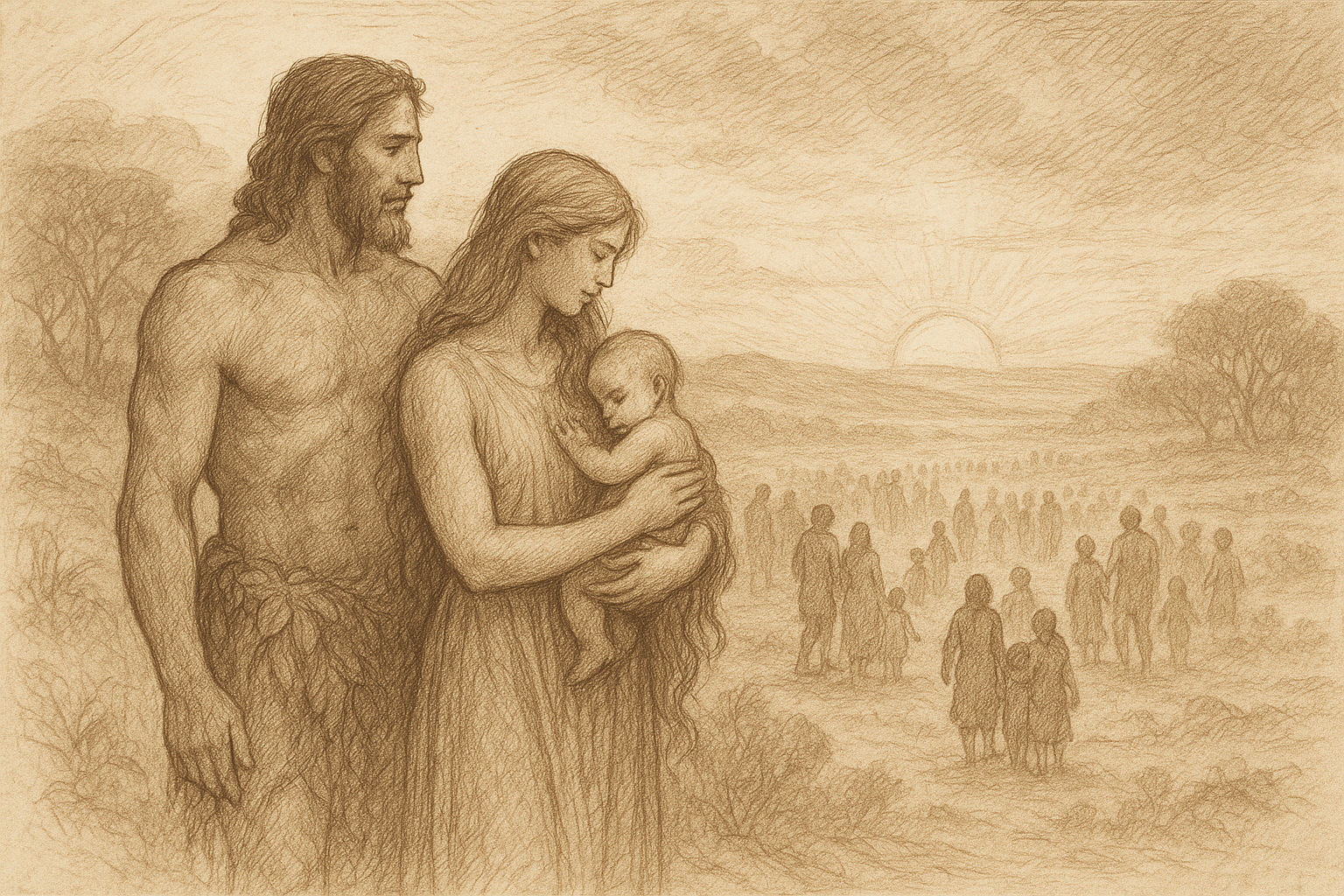
In the simplest terms, Adam and Eve populated the earth by becoming the first parents of the human family. Genesis presents them not as symbolic names for a crowd, but as the first man and woman, united by God and commanded to be fruitful and multiply. The book of Genesis says, "Be fruitful and multiply, and fill the earth" Genesis 1:28.
That command is not decorative. It is part of God's blessing on humanity. The first couple were made for communion with God and with each other, and their union was ordered toward life. In Catholic teaching, marriage is not only for the good of the spouses but also open to the gift of children. The opening chapters of Genesis already point in that direction.
Scripture then shows the unfolding of that blessing. Genesis names sons and daughters in Adam's line and presents human history as beginning from this first household. The point is not to give us a full census. The point is to show that humanity is one family with one origin under God.
What Genesis actually says
Some readers notice that Genesis 4 mentions Cain's wife and the building of a city, then wonder where all these people came from. But the biblical text itself assumes a growing human family over time. After Adam and Eve, Scripture says that Adam "had other sons and daughters" Genesis 5:4. That single line matters a great deal.
It means the inspired text is not limited to the two named children, Cain and Abel. It indicates a larger family, which would naturally include marriages among the descendants of the first couple in the earliest generations. Genesis does not pause to explain every marriage or every household. It moves quickly because its purpose is theological and historical, not genealogical in the modern sense.
We should also remember that the Bible often tells the story of beginnings in a compressed way. A few verses can cover many years. So when we ask how Adam and Eve populated the earth, we are asking for details the text does not try to supply in full. What it does supply is enough for a clear answer: they had children, and those children had children.
Did Adam and Eve's children marry each other?
This is often the next question, and it is reasonable. If Adam and Eve were the first human parents, then in the earliest generations of the human race, marriage would have taken place among close relatives. Catholics do not need to be startled by that fact when speaking about primeval history. It does not imply anything sinful in that original context, because the moral and biological conditions of the human race were not yet what they became after many generations of history.
At the same time, the Church does not define the exact family lines or the practical arrangements of the first generations. She does not hand us a family tree stretching from Eden to every nation on earth. She teaches what is necessary: that the entire human family shares a common origin, and that sin entered history through the real disobedience of the first parents Romans 5:12.
As the human race multiplied, God also guided human life within the order of creation. The Church's moral teaching on marriage developed in a world where close kin marriage is generally forbidden for grave reasons. That later discipline does not cancel the fact that in the beginning, when there was no other human family from which to draw spouses, the first descendants would have come from the one family God had already established.
Why the Church does not reduce Adam and Eve to symbols
Some people try to solve the question by saying Adam and Eve were only symbols for the human race. But Catholic teaching does not allow that reduction. The Church has consistently taught that there was an original human pair from whom all people descend. This matters because the doctrine of original sin depends on it. If there were no real first parents, then the biblical account of a fall would lose its historical foundation.
St. Paul ties Christ's saving work to Adam's real role in the human story. He writes that "sin came into the world through one man" and that grace abounds through Jesus Christ Romans 5:12, Romans 5:15. Later, Paul compares Adam and Christ directly, calling Adam a figure of the one who was to come Romans 5:14. The comparison only makes sense if Adam is more than a literary placeholder.
The same is true in 1 Corinthians, where Paul says, "For as in Adam all die, so also in Christ shall all be made alive" 1 Corinthians 15:22. Catholic theology sees this as more than poetry. It is a way of describing the human condition and the remedy God gives in Christ.
How Catholics can hold faith and reason together
Questions about human origins can become heated because people often assume there are only two options: either a literal reading that ignores all science, or a scientific account that excludes God and Scripture. Catholic faith refuses that false choice. The Church welcomes what is true in reason and science, while insisting that divine revelation speaks with authority about truths science cannot settle on its own, such as the origin of the soul, the image of God in man, and the reality of sin.
So a Catholic may explore questions about population genetics, ancient human history, and the limits of scientific inference without fear. But those studies do not replace the theological truth that humanity is one family rooted in a first human pair. The creation account reminds us that human beings are not accidents of matter. We are creatures made by God, capable of communion, responsibility, and grace.
It is also important not to overstate what science can prove here. Scientific models can describe population patterns in ways that are useful and serious, but they do not reach all the way back to the first moments of human history in a way that settles the theological question. Catholic belief is not built on guessing. It rests on revelation received through Scripture and the living tradition of the Church.
Why this teaching matters in ordinary Catholic life
At first glance, this may seem like a remote question, fit only for classroom debates. But it reaches into daily Catholic life more than we think. If all people come from one first family, then every person is our neighbor in the deepest sense. Human dignity is not an abstract principle. It is rooted in shared origin and shared destiny.
This teaching also deepens our understanding of marriage and parenthood. Adam and Eve are not simply ancient figures standing at the edge of a myth. They are the first parents whose vocation echoes in every Christian home. Their call to multiply, to nurture life, and to live before God still shapes family life today. Parents cooperate with God in the gift of children, and children are not burdens but blessings.
It matters as well for our view of sin and mercy. If the human family has fallen, then the human family needs a Redeemer. The story of Adam and Eve is not mainly about curiosity. It is about why salvation is necessary, why Christ entered history, and why baptism matters. The world is not merely imperfect. It is wounded. Yet that wound is not the final word.
God did not leave the human family in the garden. He entered our history to restore what was broken and to lead us home.
That is why Catholics do well to read Genesis with reverence. The first chapters of Scripture are not a puzzle box to be solved for curiosity alone. They are a revelation of our beginnings, our dignity, and our need for grace.
Reading Genesis with the mind of the Church
The Church encourages careful reading of Scripture that respects both the literary form of the text and the truth God intends to reveal. Genesis uses rich, ancient language to speak about real beginnings. Its message is not weakened when we read it with thought. If anything, it becomes stronger.
When we ask how Adam and Eve populated the earth, the Church leads us to see the answer in three parts. First, God created a real first human couple. Second, he blessed their union with children. Third, through their descendants the human family spread across the earth. That is enough to preserve both the plain sense of Genesis and the Catholic doctrine that all people are one family descended from first parents.
It is worth lingering over the beauty of that truth. No one is self-made. No one begins alone. Every human being enters a history already shared, already marked by need and hope. And because we all come from the same beginning, we also share the same call: to seek God, to live in charity, and to be restored by Christ, the new Adam.
The first garden is behind us, but its lessons remain. We were made for communion, we fell from it, and in God's mercy we are still being drawn back.
Keep Reading on Lets Read The Bible
Frequently Asked Questions
Did Adam and Eve have enough children to populate the earth?
Yes. Genesis indicates that Adam and Eve had sons and daughters, not only Cain and Abel. Catholic teaching holds that the human race descended from the first parents through their children and later generations.
Does the Church require Catholics to read Adam and Eve as purely symbolic figures?
No. Catholic doctrine teaches that Adam and Eve were real first parents of the human race. The Church does not treat them as mere symbols, because original sin and the saving work of Christ are tied to their real place in human history.
Were early marriages between close relatives sinful in the time of Adam and Eve?
In the earliest generations, human beings had only one family line from which to form marriages. Catholics understand that those first unions took place under conditions very different from later history, before the moral and biological concerns that govern marriage among close relatives today.